



Five Things We Will Learn
- What autophagy really is—and why it’s often described as the body “cleaning house.”
- How fasting acts as the trigger that flips on the body’s built-in repair system.
- What happens inside the body during a five-day fast, hour by hour and day by day.
- Why symptoms like fatigue, cold sensitivity, or mental fog can signal deep cellular reset.
- How to break a fast wisely so the benefits of autophagy aren’t lost.
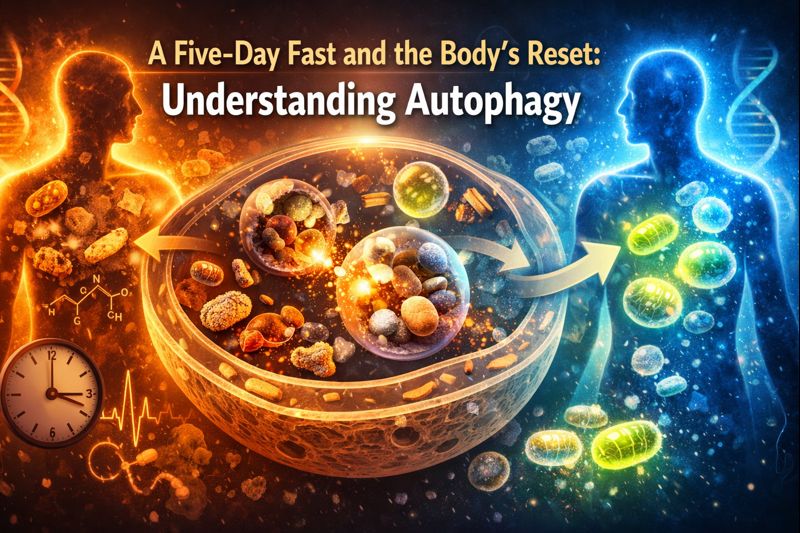
A Five-Day Fast and the Body’s Reset: Understanding Autophagy
Autophagy is when the body cleans house—removing damaged cells and recycling them so healthier cells can function better.
The Trigger — How Hunger Flips the Switch
Picture this: you stop eating. Blood sugar drops. Insulin falls fast. Inside your body, a quiet alarm sounds—no fuel delivery today.
That drop in insulin is the signal. Cells recognize scarcity and shift into survival mode. Special genes activate, releasing microscopic cleanup systems that begin breaking down damaged cellular parts and repurposing them for repair. No supplements. No tracking apps. Just a deeply wired biological response.
This process is called autophagy—and it only turns on when the body is no longer constantly fed.
The Timeline — A Cellular Garbage Run
Hours 0–12:
The body still expects food. Stored carbohydrates are burned first.
Hours 12–24:
Glucose runs low. Autophagy begins quietly in the background.
Day 2:
Ketones rise. The brain shifts into survival mode. Cells begin removing damaged proteins and worn-out components. You enter into Ketosis.
Days 3–5:
Peak cleanup. Old, inefficient cellular parts are broken down and recycled. Energy may feel inconsistent. You might feel cold, lightheaded, or mentally distant—signs the system is working hard.
It’s like cleaning out an attic while the house runs on emergency power.
What Dies, What Lives — A Cellular Reset
Autophagy doesn’t destroy healthy cells. It targets the broken ones first:
- Dysfunctional mitochondria that produce excess cellular waste
- Damaged proteins linked to inflammation and degeneration
- Invading bacteria and cellular debris hiding inside cells
These are dismantled and reused as raw materials for repair. New proteins are built. Immune cells refresh. Efficiency improves.
It’s not destruction—it’s eviction. The squatters go, and healthy systems move back in.
Side Effects — Fog, Cold Hands, or the “Fast Glow”
Early days: headaches, digestive discomfort, irritability, night sweats.
Middle phase: energy dips, cold fingers, slowed movement as blood flow prioritizes vital organs.
Later phase: many report clearer thinking, improved skin tone, looser joints, and a surprising sense of calm.
Sleep can be uneven. Hunger hormones pulse every few hours. But by day four, some experience deeper, more restorative rest as the body stabilizes.
Breaking the Fast — Refeed Like a Pro
This is where many undo the benefits.
Start small. Broth first. Then gentle fats like avocado or eggs. Add slow carbohydrates such as sweet potato. Rushing back to heavy meals can overwhelm digestion, disrupt electrolytes, and shock the system.
Think of landing a plane—smooth and steady, not a hard drop.
Key Takeaway
A five-day fast starves what no longer serves you and feeds what helps you thrive.
Autophagy isn’t a trend—it’s the body’s built-in reset, waiting for space to work.