



Five Things We Will Learn
- Why living alone is a spiritual stewardship, not just a lifestyle choice
Your home is never neutral ground; it carries spiritual weight and responsibility. - How unspoken expectations quietly produce confusion, resentment, and compromise
Clarity protects relationships; silence creates vulnerability. - Why boundaries are wisdom established in advance—not legalism
Godly boundaries protect peace, purity, and calling before pressure ever arrives. - How spiritual vulnerability often enters homes through persuasion, not force
Discernment and pre-decided lines guard against subtle access and influence. - Why decisions made in the light become anchors in seasons of darkness
What God clarifies in peace keeps you steady when emotions, pressure, or temptation rise.
Living alone is not merely a housing decision—it is a spiritual stewardship.
Many people enter new living situations believing freedom comes from having no boundaries or setting no expectations. In reality, the absence of clearly defined boundaries is one of the fastest ways to become a victim of someone else’s choices—or your own.
Most relational breakdowns do not occur because standards are too high, but because expectations exist without boundaries to govern them.
People avoid stating expectations or boundaries for two primary reasons:
- They believe clarity gives up control.
- They fear rejection if others know their standards.
Yet whether expectations are spoken or not, they still exist. When they remain hidden, confusion and resentment grow. The person who unknowingly violates an unspoken expectation becomes the victim of passive frustration, while the one who failed to define the standard quietly grows bitter over a choice they themselves made.
As a follower of Christ, this is not merely a relational issue—it is a spiritual one.
Your Home Is Not Neutral Ground
The Spirit of God dwells with you. Therefore, your home is never spiritually neutral.
When entering a new home or living situation—especially when living alone—it is vital to prayerfully establish God-honoring boundaries from the beginning. These are not legalistic rules. They are pre-decided lines that protect your heart, your peace, and your calling.
An immature or spiritually undiscerning person often seeks independence simply to “do their own thing.” Rarely is that pursuit rooted in a desire to live holy before God. Without intentional boundaries, freedom quickly turns into captivity—not because they are weak, but because they failed to plan.
Scripture Is Clear About the Nature of the Threat
A person without a plan is at the mercy of the demons who do have one.
(Ephesians 6:12)
The enemy’s intentions are not hidden—to steal, kill, and destroy.
(John 10:10)
“They are the kind who worm their way into homes and gain control over gullible [men and] women, who are loaded down with sins and are swayed by all kinds of evil desires.”
(2 Timothy 3:6, NIV)
This is not symbolic language. It is a sober warning about access, influence, and unguarded homes.
Boundaries, Gullibility, and Spiritual Vulnerability
Gullible means easily persuaded or deceived, especially because of a lack of discernment, experience, or established boundaries.
In plain terms, a gullible person is not unintelligent or immoral—they are unguarded.
Biblically and practically, gullibility often shows up as:
- Trusting words without testing motives
- Yielding to persuasion to avoid conflict or rejection
- Lacking pre-decided standards or convictions
- Confusing kindness with wisdom
- Believing sincerity equals safety
A gullible person does not intend harm—but becomes vulnerable because they have not set clear boundaries or lines.
Homes are rarely compromised through force.
They are compromised through persuasion, familiarity, and unchecked access.
Boundaries Are Not Law—They Are Wisdom
Godly boundaries are not the law. The law empowers sin when used improperly. Boundaries, however, are wisdom established in advance.
Expectations explain what we value.
Boundaries determine how we live it out.
When lines are drawn before temptation, pressure, or persuasion appears, clarity replaces confusion. In the moment, you can calmly say:
- “I do not do that here.”
- “I decided this place belongs to the Lord.”
- “I will not invite something into my home that offends God or grieves His Spirit.”
Clarity removes the power of manipulation. Big talkers, emotional persuaders, and boundary-pushers lose influence when you already know where the lines are. Anyone who consistently pressures you to cross those lines is not acting in love—regardless of how convincing they sound.
Wisdom also teaches this: once you draw your lines, step back and draw them again—a little farther out. That way, if you stumble, you fall on the right side of your convictions rather than crossing into compromise.
Boundaries Decided in the Light Protect You in the Dark
When you lay out clear boundaries and expectations while you are walking in the light—when your mind is clear and your spirit is settled—you will not have to question them in the darkness.
All of us walk through valleys of darkness at times, as David acknowledged in Psalm 23. Yet safety is not found in avoiding the valley, but in knowing the Shepherd who leads us through it.
What God makes clear to you in the light becomes an anchor in the dark. Writing those boundaries down—while you have clarity—keeps you from drifting, second-guessing, or negotiating truth when emotions, fear, or pressure rise. Jesus, our Great Shepherd, uses what He revealed in the light to guide us safely through the valley.
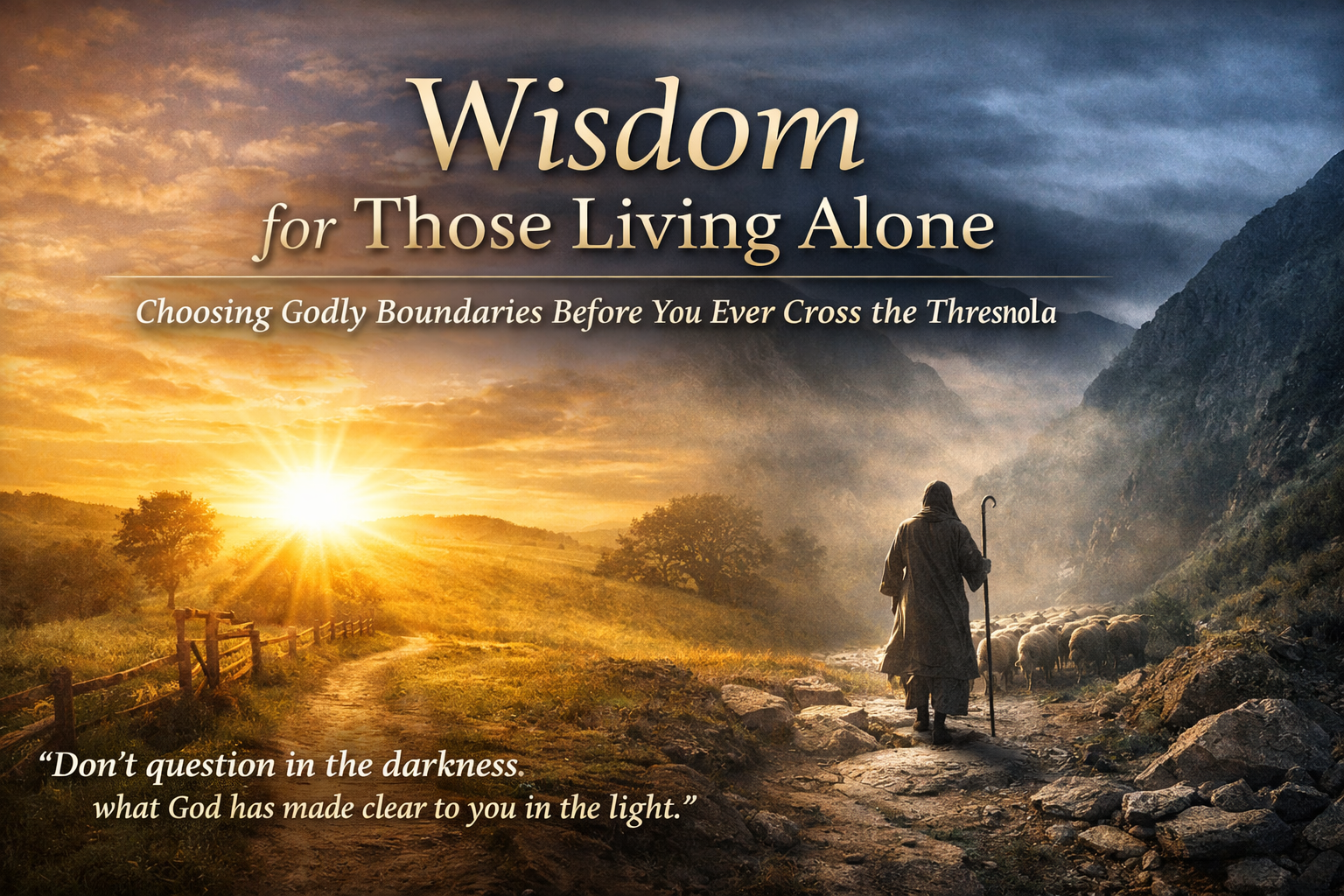
Don’t question in the darkness what God has made clear to you in the light.
A Timeless Measure of Maturity
A reader once asked a columnist to define maturity. The response was simple and enduring:
Maturity is the ability to stick with a job until it is finished;
to do one’s duty without supervision;
to carry money without spending it;
and to bear injustice without seeking revenge.
Living alone reveals maturity quickly.
Who you are when no one is watching is who you truly are.
Questions Every Person Living Alone Should Answer in Prayer
Take time—before God—to write these boundaries down. Revisit them often.
- How will I handle neighbors?
- How will I handle relationships with men or women?
- How will I respond to those currently held captive by darkness?
- How will I relate to family while maintaining peace and boundaries?
- Who will I allow to be alone with me in my home—and under what circumstances?
- What will I permit into my eyes and ears through media, streaming, music, and entertainment?
- Jesus warned that if the eye becomes unhealthy, the whole body—your whole “house”—will be filled with darkness.
- Will I choose to meet certain people outside my home rather than invite them into it?
- How will I handle someone who believes their “best plan” is to become my roommate?
- How will I protect the safety, peace, and spiritual atmosphere of my home?
Final Reflection
Your home is more than a place to sleep.
It is where your convictions are either strengthened—or slowly eroded.
Decide now—before pressure comes—who you are, how you will live, and what you will not allow. These are not restrictions; they are guardrails of freedom.
Who are you when you are alone with God?
That answer will shape everything.
Begin Your Journey Today
Jesus didn’t just call us to believe in Him—He called us to follow Him.
Step into the life He designed for you through Emmaus Road’s The Commands of Jesus . This is more than learning—it’s an invitation to walk with Him, obey Him, and experience Him in a real and powerful way.
You don’t want to miss this exciting adventure Jesus has called you into.
Start now:
https://GregLancaster.org/StartHere