



Five Things We Will Learn
- Why biblical church growth has always come through multiplication, not expansion of buildings.
- How Jesus’ teaching on the Vine reveals God’s design for relational, organic church growth.
- What the early church in Acts teaches us about rapid expansion without institutional containment.
- Why large buildings often create spiritual bottlenecks rather than kingdom momentum.
- How small, Spirit-led gatherings become the seedbed for global, unlimited expansion.
Why the Church Must Rethink “Big”
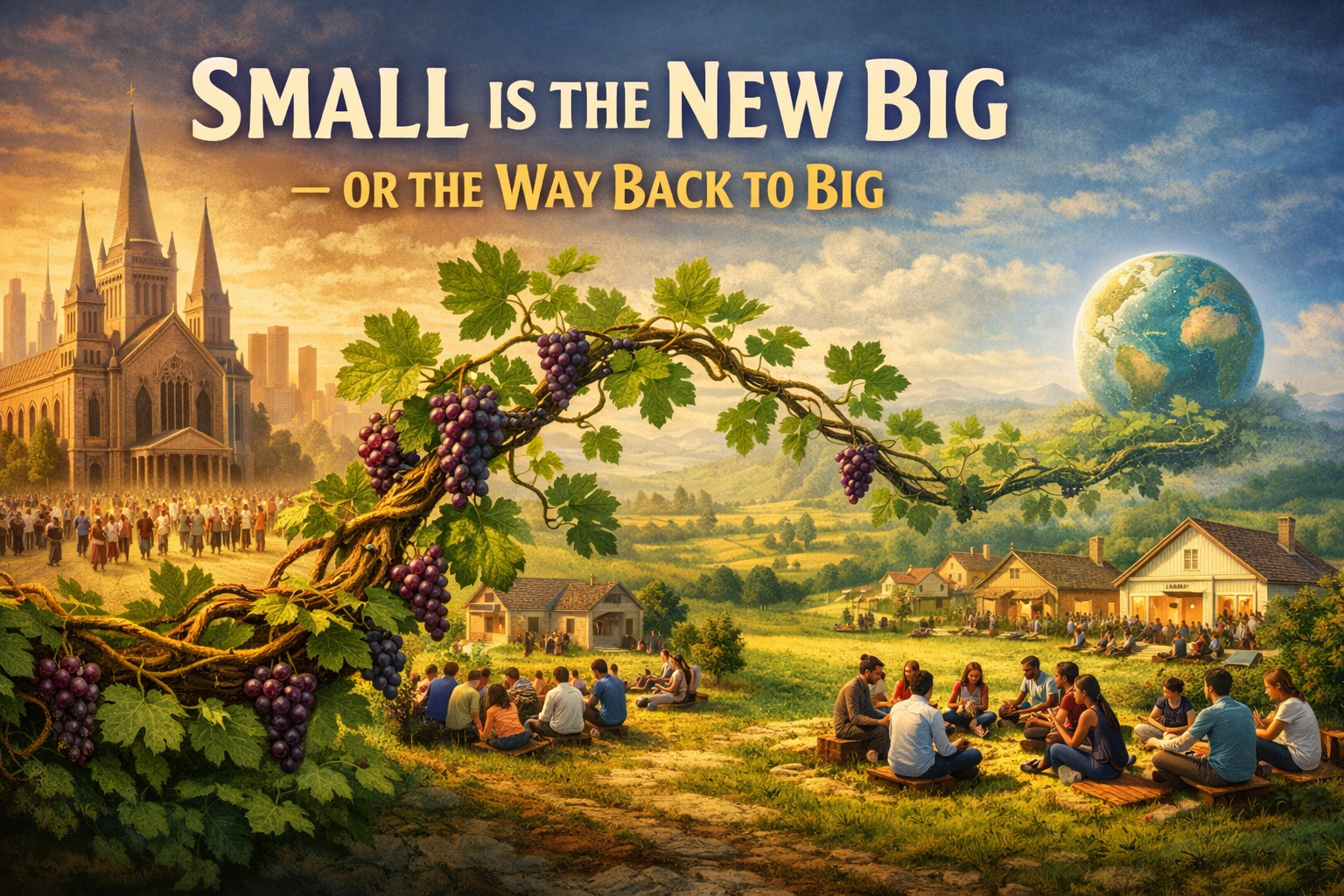
In a world obsessed with scale and spectacle, the church often falls into the trap of equating growth with grander buildings and larger crowds. Yet history and Scripture reveal a different truth: the church thrives and expands most rapidly when it breaks free from containment.
Rather than growing through addition inside auditoriums, the church grows through multiplication in everyday lives—spreading organically like a vine across the earth. This is the “big” the early church knew: a kingdom-wide movement that could not be confined by walls, no matter how impressive.
Jesus captured this reality clearly:
“I am the vine; you are the branches. If you remain in me and I in you, you will bear much fruit; apart from me you can do nothing.” (John 15:5, NIV)
True expansion flows from abiding, not accumulating.
The Vine: A Biblical Blueprint for Growth
Jesus did not describe His kingdom as a structure, a stage, or an institution. He described it as a living organism.
The imagery of the Vine in John 15 is not about isolated growth, but about interconnected life—branches extending, bearing fruit, and reproducing. The church was never designed to function as a static structure, but as a living body that multiplies through relationship.
When believers gather in small, family-like environments, discipleship happens naturally. Gifts flow freely. Accountability is real. New branches form and spread. History consistently shows that when the church returns to this vine-like pattern, influence multiplies rapidly—reaching cities, nations, and cultures without the limitations of physical containment.
Historical Lessons: Rapid Spread Without Walls
The Book of Acts provides a clear example of how “small” gatherings fueled massive growth.
The early believers devoted themselves to teaching, fellowship, breaking of bread, and prayer. They met in homes and shared life daily. Without cathedrals or centralized facilities, the church expanded from Jerusalem to Judea, Samaria, and the ends of the earth.
“They broke bread in their homes and ate together with glad and sincere hearts… And the Lord added to their number daily those who were being saved.” (Acts 2:46–47, NIV)
Throughout history, whenever the church became overly institutionalized, momentum slowed. But when movements returned to relational, Spirit-led gatherings, growth accelerated again. God’s kingdom advances like a vine—resilient, invasive, and unconstrained.
The Containment Trap: Buildings vs. the Body
No matter how large or modern a building becomes, it still limits growth. Buildings naturally create a come-and-see culture, where success is measured by attendance rather than disciple-making.
This shifts the focus:
- From people to programs
- From family to production
- From multiplication to controlled addition
Scripture never commands the church to gather everyone into one place. The mandate is to go.
When the church is released from walls, it spreads naturally—into homes, neighborhoods, workplaces, and communities. Small gatherings of about 5–20 people create space for every believer to participate, minister, evangelize, and multiply.
This is not a downgrade. It is the way back to true “big.”
Small Gatherings: Seeds of Unlimited Expansion
While individual gatherings remain small, the network they form is limitless.
These communities operate relationally rather than bureaucratically—connected voluntarily, not through hierarchy. The focus remains clear: making disciples, operating in the gifts of the Spirit, shepherding people, and reproducing healthy churches.
Disciples make disciples. Churches birth churches. Growth becomes exponential.
Vine Seminars—three-day intensives offered through Greg Lancaster Ministries—exist to equip believers practically for this model, helping them establish Spirit-filled communities that abide in Christ and bear lasting fruit.
“Others, like seed sown on good soil, hear the word, accept it, and produce a crop—thirty, sixty or even a hundred times what was sown.” (Mark 4:20, NIV)
Related:
- Vine Seminar Articles
- The Commands of Jesus
- House of Peace, Person of Peace Temple Courts, Houses of Peace, and Houses of Chaos
- Predator Warning
- MARTYRED FOR SPEAKING THE TRUTH
- Imitate Me – Paul’s Pattern of Boldness, Humility, and Submission
- Imitate Me – Follow Paul’s Example as He Follows Jesus’ Example
- Antioch: The Spirit-Filled, Spirit-Led Church
- Antioch – One Body, Many Parts, Different Gifts
- Antioch – One Body, Many Parts, Different Gifts, Apostles (pt 2)
- Antioch – One Body, Many Parts, Different Gifts (pt 3) Eight Gifts Placed by God
- Different Gifts (Pt 4) 7 Grace Gifts to the Body
- Antioch – Love One Another
- Antioch: River to Rain — Tongues, Prophecy, and the Power of Agapē
- Antioch: The Order of Worship
The Vision in Action: A Global Movement
Vine Fellowship Network embodies this biblical pattern today, supporting a growing, worldwide network of small, Spirit-filled churches rooted in relationship and mission.
These churches are autonomous yet connected through love, shared values, and voluntary partnership. Rather than being confined, the church becomes what it was always meant to be—a living vine overtaking the landscape.
History confirms it again and again: when the church stops trying to build big and allows small to multiply, it returns to its original intent.
“I in them and you in me—so that they may be brought to complete unity. Then the world will know that you sent me.” (John 17:23, NIV)
Embracing the Way Back
To reclaim the “big” of the early church, we must release it from self-imposed containers.
Small gatherings are not a compromise—they are the catalyst for unlimited growth. As believers abide in Christ, multiply relationally, and equip one another, the church once again becomes unstoppable.
Small is the new big.
And it is the way back.
Begin Your Journey Today
Jesus didn’t just call us to believe in Him—He called us to follow Him.
Step into the life He designed for you through Emmaus Road’s The Commands of Jesus . This is more than learning—it’s an invitation to walk with Him, obey Him, and experience Him in a real and powerful way.
You don’t want to miss this exciting adventure Jesus has called you into.
Start now:
https://GregLancaster.org/StartHere