



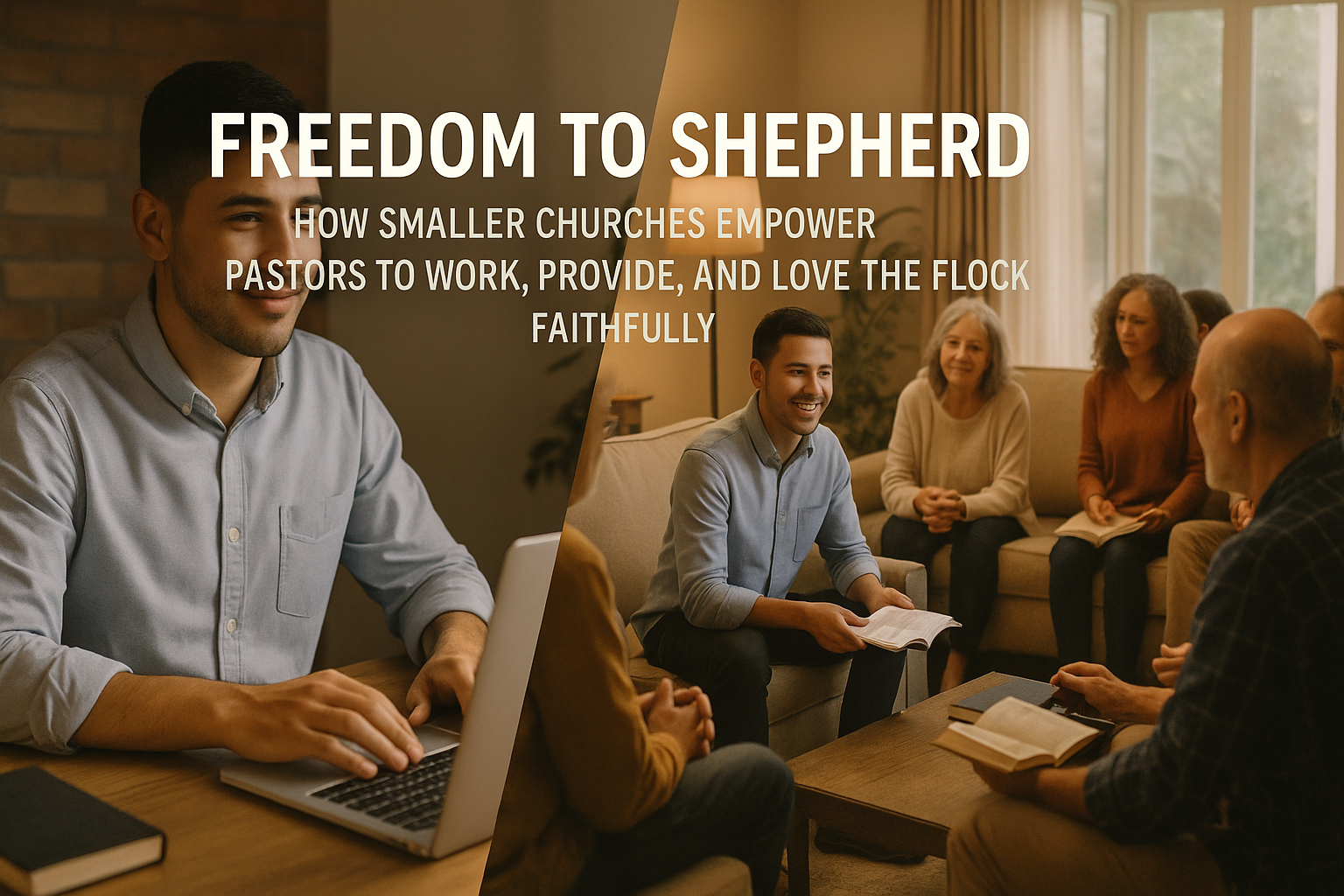
Five Things We Will Learn
- How the 1980s corporate church model reshaped American Christianity—and what was lost.
- Why smaller, family-sized fellowships reflect the biblical design of the early Church.
- How working pastors regain authentic ministry by staying engaged in the marketplace.
- What freedom and sustainability look like when ministry isn’t dependent on offerings.
- Why the future Church in America must return to homes to recover God’s presence and power.
How the Family-Sized Church Restores the Heart of Ministry
Over the past forty years, the landscape of the American church has changed dramatically. In the early 1980s, a wave of corporate thinking swept through Christianity. Pastors were taught to build brands, expand platforms, and scale ministries like businesses. “Church growth” replaced “making disciples.” Attendance became the new measure of success, and pastoral salaries rose accordingly. Not only did we lose the family atmosphere, we lost touch with the day-to-day lives of those we ministered to.
By the mid-2000s, megachurches—those with over 2,000 weekly attendees—had become the face of American Christianity. According to the Hartford Institute for Religion Research, there are now more than 1,800 megachurches in the United States. Many of their lead pastors earn well into six or seven figures annually, with multimillion-dollar homes, private jets, and sprawling campuses that resemble shopping malls more than sanctuaries.
While this model draws crowds, it often drifts far from the relational design Jesus and the apostles established. It’s a system where ministry success is measured by performance, not presence—by budgets, not belonging.
But what if we returned to what the Church always was—and still is in most nations around the world?
Related:
- Vine Fellowship Network
- What is a VFN Related Church?
- Learn “Our Story” the Story of Being Family and how God’s Spirit Moves
- Vine Seminar – Spirit-Filled Vine Seminar
The Power of Meeting “as Family”
In much of the global Church—whether in China, India, Africa, or the Middle East—believers still meet in homes. These gatherings, usually between 5 and 20 people, look much like the first-century Church described in Acts. They devote themselves to the apostles’ teaching, to prayer, to breaking bread, and to caring for one another (Acts 2:42–47).
These believers don’t rely on massive budgets, polished programs, or professional clergy. Their strength lies in devotion, not production. They know each other’s names. They share their struggles and their meals. The Church isn’t an event—it’s a family.
No matter where or how the Church gathers—whether in a home, a building, or under a tree—it’s a wonderful thing when Jesus is the center of it. What we’re describing here isn’t a shift in location, but a return to scale—to the kind of relational, family-sized gatherings where every believer can be known, loved, and discipled.
Meeting “as family” in churches of 5–20 members allows pastors—and as a VFN Related Churches and Groups with Vine Fellowship Network’s voluntary support for these autonomous fellowships—to cultivate genuine community and sustainable ministry. In this model, pastors lead relationally, not organizationally. They are shepherds, not CEOs.
Freedom from Financial Pressure
One of the greatest blessings of this biblical model is freedom. Keeping gatherings within a family-sized range allows pastors to maintain full-time employment or operate their own businesses—just as the Apostle Paul did when he made tents to support his ministry (Acts 18:3).
In this model, pastors can earn a full income through their business or career, receiving all the benefits of stable employment—such as paid vacations, health insurance, and retirement—while faithfully shepherding their church family.
This provides stability and removes financial pressure from the church. No more unrealistic expectations, no more burnout, and no temptation to compromise for offerings or popularity.
It restores ministry to what it was meant to be: an overflow of love, not a means of livelihood.
The Church in the Marketplace
In the first three centuries of Christianity—before the rise of cathedrals or clergy—believers met in homes and carried the Gospel into daily life. Christianity spread through relationships, not marketing.
When pastors and believers are free to serve in their everyday vocations, the Church re-enters the marketplace. The presence of God moves from behind stained glass into schools, businesses, offices, and homes.
“I won more people to Jesus when I was working forty hours a week than I ever did preaching behind this pulpit.”
A pastor once brought me the podium he had preached behind for years—one his father had lovingly built for him. With deep emotion, he told me how, since leaving his job to enter “full-time ministry” (meaning his entire income now came from the church), something vital had been lost. He missed the daily interactions he once had in the marketplace—the ordinary conversations where he could share the goodness of Jesus with people from every walk of life. As he stood beside the pulpit, he said with tears in his eyes, “I won more people to Jesus when I was working forty hours a week than I ever did preaching behind this pulpit.” Note: The pulpit, with his permission, was burned during that time as a form of repentance for the Lord for false teachings spoke from, not his, but pulpits throughout the nation as Steve Hill shared in his prophetic vision Avalanche.
A modern pastor might also be a teacher, an entrepreneur, a mechanic, or a state senator—each carrying the presence of Jesus wherever they go. The light of Christ begins to influence the culture again, not from a pulpit alone, but from within every sector of society.
Reclaiming the True Measure of Success
Since the 1980s, American Christianity has been tempted to measure fruit by metrics. Bigger crowds, larger campuses, and social media followers replaced what Jesus actually commanded: to make disciples who obey His teaching (Matthew 28:19–20).
The family-sized church reclaims the true measure of success—obedience, transformation, and love. Every person matters. Every gift has a place. Every believer is equipped to multiply.
In this environment, spiritual fathers and mothers raise up sons and daughters in the faith. The Church becomes multi-generational, not multi-campus. It begins to look like heaven again—diverse, devoted, and deeply connected.
The average congregation sees about 65 people gather each week.
The Church America Needs Again
While some of the highest-paid pastors in America earn millions, the most effective pastors in God’s eyes may be those quietly discipling ten people around a dinner table as Jesus did.
Across much of the world, this is still how the Church grows—one home, one family, one relationship at a time. The same pattern birthed the early Church, fueled revivals in history, and continues to multiply the Body of Christ across continents today.
As Vine Fellowship Network and GLM help establish these autonomous, family-sized churches across America, the Lord is calling His people back to His original design: simple, relational, Spirit-led, and filled with love.
“Every day they continued to meet together in the temple courts. They broke bread in their homes and ate together with glad and sincere hearts.”
— Acts 2:46 (NIV)
The Church began in homes, spread through homes, and will finish in homes—before the return of Jesus. The question is: will we return to His pattern?

Begin Your Journey Today
Jesus didn’t just call us to believe in Him—He called us to follow Him.
Step into the life He designed for you through Emmaus Road’s The Commands of Jesus . This is more than learning—it’s an invitation to walk with Him, obey Him, and experience Him in a real and powerful way.
You don’t want to miss this exciting adventure Jesus has called you into.
Start now:
https://GregLancaster.org/StartHere