



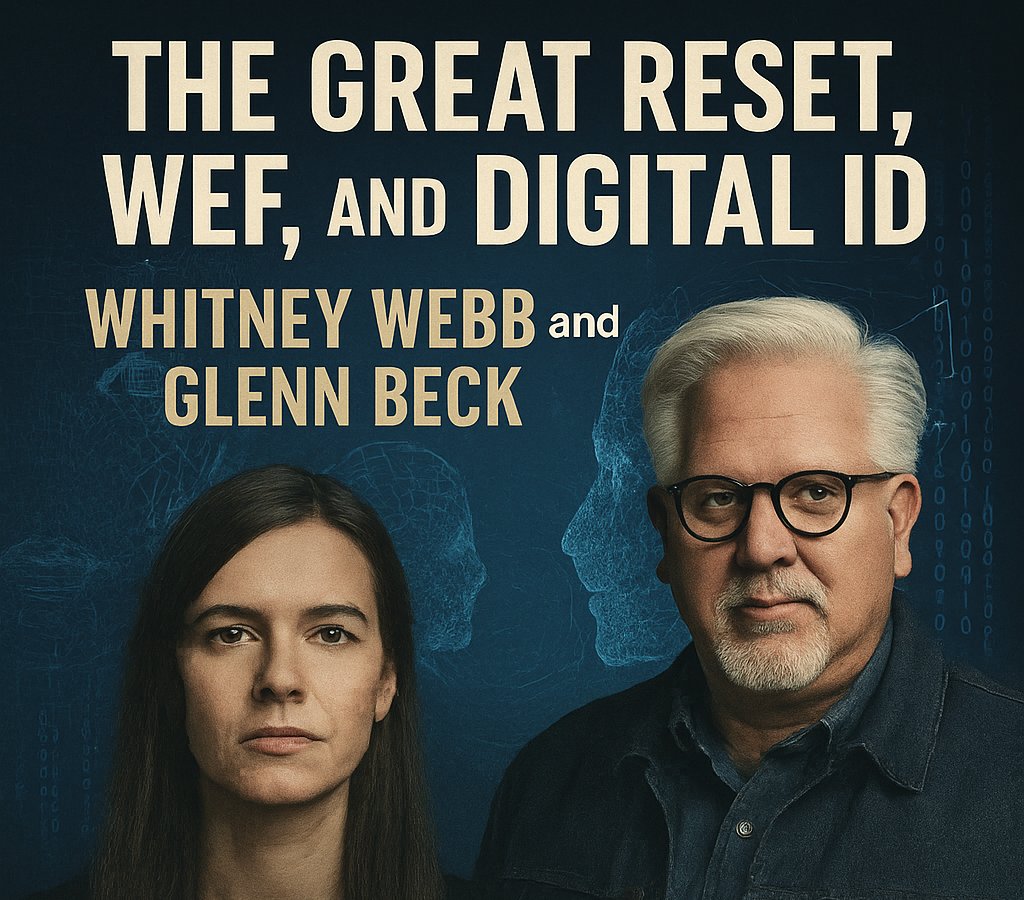
10 Things We Will Learn
- Why the World Economic Forum’s (WEF) public image faded — and how its agenda simply shifted into private industry.
- How Digital ID systems—sold as “security” and “convenience”—are actually gateways to global surveillance and control.
- The connection between Digital ID and digital currency, and how both form the backbone of a universal technocratic economy.
- How AI and behavioral science are being weaponized to reshape human perception and diminish critical thought.
- Why predictive policing and pre-crime programs pose grave threats to constitutional freedoms and due process.
- The role of Palantir, intelligence agencies, and private contractors in building the infrastructure for mass data collection and control.
- How global think tanks and “public-private partnerships” synchronize policy across nations, eroding national sovereignty.
- The hidden financial and technological networks that connect Jeffrey Epstein, big tech elites, and intelligence operations.
- Why propaganda, information warfare, and infiltration of truth movements are used to blur the line between fact and fiction.
- How individuals and families can resist digital enslavement—by building local resilience, analog alternatives, and critical-thinking culture.
Introduction & The Great Reset, WEF, and Digital ID
The last time I spoke with this week’s guest, the Great Reset was in full swing. Klaus Schwab and the World Economic Forum ruled the world. My guest predicted that the global elites were going to use AI and transhumanism to create a new class of slaves.
Now, fast forward three years, and it seems like Donald Trump has destroyed the WEF and ESG in America. The rest of the world is spiraling toward total government control, and AI is becoming a part of our daily lives. So, what’s happening now? Where does she see us? Is the Great Reset really dead? Or have the global elites just pivoted? And what’s happening with Digital ID, which has just been released? Is that part of everything—the kind of spooky stuff we’ve talked about in the past? Please welcome back to the podcast one of the world’s leading researchers on these issues, Whitney Webb.
You know Whitney, last time we spoke…
You know Whitney, last time we spoke, I think it was right after COVID. You had just released your book on Epstein, which is fabulous. I’d just released a book on the World Economic Forum and the Great Reset, and we were talking about the Great Reset and the World Economic Forum. You said that’s only really one part of this big global octopus. I was so hyper focused on the World Economic Forum and what they were doing. I have to ask you: Has the World Economic Forum been sacrificed? Did we win? Because it kind of went to the wayside, but I know they’re not gone. Klaus Schwab was exposed. Of course, they’re not gone, right? They’re not gone. So, have they just mutated? Is somebody else taking their place? Did they pass the torch? What is happening?
Yeah. So, I would argue—let’s look at what the WEF is by its own description. It’s the premier promoter of the public-private partnership. A lot of the policies they attempt to sell people through the public sector—i.e., governments—was exposed. I think they’ve gone to the other side of the public-private partnership and are trying to market some of their unpopular policies—particularly in the West—via the private sector.
Can you give me examples? I think that’s what’s happening.
Yeah. One example would be what’s happening in Britain with the so-called Brit Card and Digital ID. There’s been a lot of political pushback to that from Keir Starmer’s intention to frame this as a way to solve illegal immigration—which is absolutely a ludicrous idea. Madness. Completely insane. And then, of course, they come out and say that soon it wouldn’t just be limited to its use as an alleged work permit. It would expand to all facets of life. But actually, if you look at how the UN has labeled—or has laid out—its plan to have Digital ID implemented at a global scale, it’s not to have a centralized Digital ID like the Brit Card has been proposed. Instead, it’s meant to be a vendor-agnostic system, whereby you would have different vendors sell a Digital ID-type platform. To the public, the public would see it as decentralized—all these different private-sector partners in Digital ID—and have the illusion of choice between them. But really, all that data is meant to be interoperable, so it can all be harvested from any of these different Digital ID platforms and collated in a single database. Because ultimately, if you were to have something like the Brit Card happen, you would have all the data harvested into a single library—what Tony Blair’s Institute, for example, calls the “national data library.” Something like that. So, you could have that happen with Keir Starmer’s Brit Card or something else that comes from five or six different companies offering different forms of Digital ID. But all of that data could still be harvested from all those different vendors because they all agreed to specific standards. And if you look at some of these alliances about Digital ID that were a focus during COVID—like the ID2020 Alliance, for example—they were all about getting all these different vendors of Digital ID to agree to the same set of international standards, so they could harvest the data from any Digital ID, no matter who makes it, and have it held in the same global centralized database. So, there are different ways to get what they ultimately want, but it all comes down to public perception. A colleague of mine who I’ve worked with closely on Digital ID for a few years now—Ian Davis, who’s based in the UK—recently wrote about what’s going on there. He posited that maybe what Keir Starmer is doing is…
Actually a bait-and-switch: to create all this unpopularity about this style of Digital ID…
actually a bait-and-switch: to create all this unpopularity about this style of Digital ID, but then someone later could come in riding the wave of the discontent this is creating and offer a new solution—which would be more along the lines of what I just described, which is actually how the UN itself and SDG 16 (which is the SDG that includes Digital ID) laid out the roadmap. It’s not the same as the one laid out by Keir Starmer. So, in that, you still have a public-private partnership, right? But it would be the private leading as opposed to the public leading. What we’re seeing come out of the UK right now is being sold as a public-leading thing, and it’s grossly unpopular. I think they’re a lot smarter than people give them credit for. They’re fundamentally very manipulative, and they want us to get stuck with the same policy, but they’re very apt at selling it different ways. They know that they’ve become very unpopular with large segments of the population. So, like a chameleon, they have to take a different form, but ultimately the goal is to lead people to the same type of technocratic, Orwellian system.
Related:
- The A.I. Dilemma and The Church, Artificial Intelligence (Part 1: Section 1 & 2) How advanced is AI? Could it be the image of the beast?
- The A.I. Dilemma and The Church, Artificial Intelligence (Part 2) AI and 40% of Jobs Lost, Cyborgs, and Making Sense of the Chaos
- The A.I. Dilemma and The Church, Artificial Intelligence (Part 3) AI robots in our image: Can they really be harmless? Why did the AI creator panic and warn world leaders?
- The A.I. Dilemma and The Church, Artificial Intelligence (Part 4) Exchanging the Glory of God for the Image and Last Days Prophecy
- The A.I. Dilemma and the Church (Part 5) | “A-Eye” is Watching! Is Big Tech, Big Brother?
- The A.I. Dilemma and the Church (Part 6) Deconstruction of Capitalisms, the Rise of a new Economy, and the Beast Economy
What is Digital ID? Surveillance, Predictive Policing, and Civil Liberties
A couple of things. First of all, for years now, I’ve looked at what is being done to us with both horror and, in a way, strange admiration. They are so thorough.
They are so well thought out. The structure of this, the fallbacks, the use of behavioral scientists and everything else—at some point, a book is going to be written that says, “Look at how all of this was designed.” I mean, it is probably many books.
Yeah. It’s really incredible to me how many great minds have spent so much time trying to enslave their fellow human beings.
Yeah. I think it’s because a lot of the people who seek to enslave the vast majority of humanity have a lot of capital they want to devote to this, unfortunately. We also know that money can buy you essentially anything in today’s world, including armies of behavioral psychologists and any number of other specialists. But ultimately, a lot of them are increasingly relying on artificial intelligence to do this at scale. This advent of the era of AI-generated content also enables them to tweak things faster and to manipulate our attention in ways that are just really being discovered—and maybe won’t be discovered for a long time—with increasingly significant impacts on human behavior and human perception. So, yeah, I think ultimately it’s never been more important to be a critical thinker and to do as much of your own research as possible. The best way to do that research—like what I just talked about regarding the UN and Digital ID and how they say it—it’s in their own documents. You just have to go in and read it. Not everyone can do that. But if these are issues that particularly concern you, we absolutely should make that effort. Also, in the COVID era, for example, a lot of people were against these particular policies—Digital ID being one of them. But these people will repackage and rename and sell you the same policy under different metrics and a different name with a different face that they deem polling shows is more politically palatable to that particular demographic or what have you. So, the more we focus on the policies that we don’t want, the better off we’ll be—instead of the person selling it to us or the new buzzword that’s following it around. And we never seem to learn. This is what they did with the Federal Reserve Act of 1913. This is what they did with the Patriot Act—that thing was written two or three years before 9/11. They tried to package it; it didn’t work. They just repackaged it, waited for the right moment. This is the way they do it.
For anybody who is not truly up on Digital IDs and why this is so important, can you explain what Digital ID means if we begin to implement them?
Yeah. Digital ID is really the linchpin to the sustainable development goals as well as this mass surveillance paradigm that’s being sold to us by oligarchs on the left and the right. It would be your unique identifier for the digital world. The goal is to have it be the way for you to offer your credentials to every service you access, period. Everything ranging from healthcare to telecommunications, your social media accounts. And as things become increasingly digitally connected—perhaps even your appliances, if they’re smart appliances—at some point, they won’t function without you having the proper credentials to show that it’s you. So, ultimately, if people want to fight against this mass surveillance paradigm and these efforts to usher us into a very dark—I would argue—technocratic future, the most important thing is to not comply with Digital ID, because it’s the single most important piece of infrastructure that they need. They need us to voluntarily consent, because even if they roll it out and people don’t use it, it will fail. So, ultimately, so much effort is being spent on convincing us to adopt it. We need to be laser-focused on that policy and say, “No, thank you.”
Let me play devil’s advocate—that you hear every time we take a bad step toward more digital surveillance: “Well, I don’t have anything to hide. I don’t really care.” Why is that such a kindergarten answer?
Well, I would argue because a lot of these companies that are engaged in mass surveillance—or the contractors, really, that are engaged in mass surveillance—don’t ultimately have just watching what you’re doing as being enough for them. They’re ultimately interested in things like predictive analytics and predictive policing. So, based on your behavior now and your behavior in the past, they want to use artificial intelligence to determine what you may do in the future. And in the case of predictive policing, that would be: “Well, we’ve determined that you may commit a crime in the future, so we’re going to send you to a court-ordered physician or issue house arrest to stop crime before it happens.” Essentially, that’s where a lot of these companies are headed. And unfortunately, it is that, and there’s a lot of companies that have made massive inroads in that type of technology—even though it’s been hugely discredited. There’s several companies; I think the most notorious at this point is called—or was called—PredPol. They’ve since rebranded, but they were less accurate than a coin toss, and people were being deprived of their liberty because of an algorithm that was hugely inaccurate.
Ultimately, if you look in the UK, for example, some of these algorithms for facial recognition have been rolled out—even though they’ve been shown over there too to be hugely inaccurate—and there’s no interest in changing vendors even when this inaccuracy is demonstrated. So, to me, that says their goal is to induce immediate obedience by the fact that you’re being watched all the time, and anything you may do could be used against you—even if you’re not doing anything wrong now. An algorithm could determine that certain errant behaviors warrant you being added to a list of some type. And actually, Larry Ellison of Oracle—who is one of the main funders of Tony Blair’s Institute, that’s one of the biggest pushers for Digital ID in the UK—said this at an Oracle shareholder meeting: “We’re recording and surveilling everything, and citizens will be on their best behavior” because they have to—essentially paraphrasing.
The fact that Donald Trump is listening to that guy is terrifying to me. He has put some people around him on this tech board that are not friends of freedom and liberty. They’re just not. Larry Ellison is leading that pack.
Yeah. A lot of them are overtly—and also covertly—globalist. You have people in that network you just mentioned serving, for example, on the steering committee of the Bilderberg Group, which is a well-known closed-door globalist confab. Unfortunately, some of them have been able to characterize their policies as libertarian—even though some of those same oligarchs are on record saying that the free market is for losers: “If you want to get rich, build a monopoly.” They have, unfortunately. But I think again—this is what I was saying earlier about the World Economic Forum—there’s an effort to sell this. Since they couldn’t sell it from the left, the goal now is to try and sell it somehow from the right and to try and frame it under metrics and dialectics that’ll be more appealing to the group that was most against these policies just a few years ago. Unfortunately, with AI and all of that, it could happen if people aren’t vigilant. You know, just a few years ago, someone like Elon Musk was a major promoter of things like carbon markets and pricing carbon—for example. And that was actually why he had a falling out with Trump in Trump’s first administration: because Trump pulled out of the Paris Agreements, and Elon Musk was like, “Well, I can’t have that.” So, have these oligarchs really changed, or have they instead tried to make themselves more appealing because they’ve noticed the change in public opinion and want to try and get us to continue to buy into their solutions that they have a lot of money to spend convincing us are actually good—and rebranding them?
Digital Currency, Tokenization, and Public-Private Partnerships
So, how—and again, this is why I say it’s important to focus on the policies specifically. How do we—well, wait, before I get there, let me go back to Digital ID. Tie this into a digital currency, because this is the highway system for that, isn’t it?
Sure. Yeah. Well, Larry Fink is now running—I believe—the World Economic Forum. He’s acting chairman. In addition to saying that everything will be tokenized, he’s said that everything will soon be on the same universal digital ledger or database. And that everything on that database will have a unique identifier number. So, for you as an individual, your identifier number will presumably be your Digital ID or directly linked to that. But everything will have a Digital ID. The tokenization agenda in particular seeks to tokenize not just assets that we traditionally think of—like real estate or gold, physical assets as well as digital assets like Bitcoin. There’s a major effort connected with people like Fink and also people like Mark Carney, who’s now Prime Minister of Canada, to tokenize the natural world and transform it into financial assets. There was an attempt to do this to an extent under the Biden administration, I believe, through the Department of Interior with natural asset corporations, but that has not gone away. There are groups—for example, one of the creators of the ETF model originally, which BlackRock now owns, iShares—his name is Peter Kazimirski, I think is how you pronounce it. He’s trying to turn the Amazon rainforest into a digital commodity, sort of similar to Bitcoin in terms of the scarcity idea: that each hectare of the Amazon rainforest would represent a token, and then financialize it that way. And each hectare would then have its unique identifier right on the blockchain and would be serviced by surveillance drones and all sorts of stuff. So, even our most natural places—the places we conceptualize as the most natural on Earth—these people want to come and place surveillance technology on, tokenize it, put it on a blockchain, and use it to—I would argue, in the case particularly of natural asset corporations and the group behind it, the Intrinsic Exchange Group—they just want to open up a huge new asset class they call “nature’s opportunity,” so they can continue engaging in the same type of bad behavior that brought us the 2008 financial crisis by quintupling the amount of assets currently in play.
You know, I had a guy who worked very high up at Citibank, and he told me around 2008: “Glenn, don’t worry about the financial system.” I’m like, “Aha.” And he said, “We’re never going to go broke. Do you know how much just the national parks are worth?” And I looked at him and said, “Are you seriously telling me that we should commoditize the national parks?” And he said, “It’s going to happen.” And I wonder now if this is what he was talking about—if it was just a digital commoditization of our parks, not actually selling them.
Yeah. So, apply this now to the phrase that we all heard during the COVID era: “You’ll own nothing and be happy.” Well, there’s certain people that want to own everything. And that includes things that have never been able to be owned before—things that were considered the public commons, like rivers, lakes, the ocean itself, natural forests—all sorts of it. These people want to put all of that into the financial system, fractionalize it, tokenize it, and sell pieces of it around—use it to speculate on. It’s very bonkers. So, yeah. And this is just one aspect of the digital currency play. Obviously, there’s a lot more than that going on as well. I would argue that a lot of this push—particularly in the US—for dollar stable coins supposedly being better than a central bank digital currency also falls into this paradigm we talked about earlier of moving from the public to the private side of the public-private partnership. Because a lot of these stablecoin issuers—if the big concerns about CBDCs was that they’re seizable, surveillable, and programmable—well, all of those three things also can apply to stablecoins. The only difference is that a private company would issue and control it. But we’ve seen time and again how a lot of these private entities are willing to do that when contacted. Just look at how Bank of America behaved with January 6: people accused of wrongdoing on that day. They have no qualms engaging in those types of activities. And the biggest dollar stablecoin issuer, Tether—which just hired Bo Hines from the White House—they have openly said that they are a close partner of the US government for dollar hegemony globally and have uploaded the FBI, the Secret Service, and other aspects of the US government onto its platform directly. They have seized Tethers from people just because the government told them to—and this was during the Biden administration. So, they obviously are willing to do that under any administration, and it’s essentially functioning as a de facto public-private partnership—even though we’re being told it’s much better than a CBDC. But in terms of its impacts on civil liberties, that’s not necessarily true. So, again, vigilance is important here.
AI in Government, Perception Management, and the Post-Human Future
Let me go to AI, because it’s all connected, unfortunately. AI is one of the most exciting things man has ever come up with and also the most terrifying thing man has ever—
I mean, it makes nuclear weapons look like Romper Room or some sort of preschool game. It is frightening in the fact that you don’t really know who’s programming it. It’s going to be ubiquitous. It’s going to be everywhere. It will know everything that you’re doing, looking for, etc. But it is now also crossing lines. Where was it? Was it Albania that just put their first digital minister into place? It would be like having Pete Hegseth replaced with an avatar, and it doesn’t seem to be that big of a deal to a lot of people. You want to tell that story and what that means?
Well, I think people have been increasingly normalized to the dissolution between the digital and virtual worlds. And that’s not by coincidence. Going back to the World Economic Forum, the goal of the West’s so-called Fourth Industrial Revolution is to blur those lines very overtly. What we’re seeing here are stepping stones leading us to an increasingly encroaching all-digital system. It probably began some time ago. I’m sure you remember several years ago: Muhammad bin Salman, for example, gave citizenship to a robot, and that was kind of framed as novel. But there’s been an effort to normalize these kinds of things with respect to the government. So now they’re having AI run the government under the guise that it’s more efficient, more trustworthy, and all of that. But again, who is accountable if the AI makes a mistake? Because AI does make mistakes. AI also hallucinates and returns results that are essentially indicative of an alternate reality—something that is completely not true. So, who is accountable in those cases? Can they hold the AI minister directly accountable? Not really. Does the accountability fall to the person who programmed the AI? It opens up a pretty sticky situation. But I would argue that this is in furtherance of an agenda that was actually laid out by Henry Kissinger and Eric Schmidt in their book—oh, I forget what it’s called; sorry about that, but they wrote a couple books on AI. The earlier one, I think it’s The Age of AI: And Our Human Future or something like that. They essentially argue that we should put AI in charge of government because they assume—obviously believe—that AI is a form of superintelligence. Therefore, it knows better than humans do. And so, even when it returns these unreal, alternate-reality results, we should take that as a sign that it can see things humans cannot see. We should just trust that it’s there because we should trust that it’s superintelligent and give it power over our lives—supposedly because it’s a better arbiter of what’s real and what’s not than we are. Which is, I think, just insane. Also, sorry to keep repeating that word, but it’s hard. Some of this is really insane. Just bonkers stuff.
Yeah. And in addition to that, Kissinger and Schmidt laid out that their biggest interest in AI was its impact on human perception. And ultimately, if you’re able to completely control how people perceive reality, you control their behavior. You don’t need mind control at the end of the day—or any of these things that the CIA and national security agencies were experimenting with. You don’t need that if you can completely control their perception of what’s going on. So, the goal—as they lay out here or laid out in that book—is to have people rely on AI for their perception of essentially everything. And that eventually, by doing so, people would be—what they used the term was—cognitively diminished to the point that they wouldn’t be able to understand how AI acts upon them anymore. But that wouldn’t be true for everyone. There would be a small class that is not affected that way, and they would be the class that programs and maintains the AI, determines what it does. But the rest of us—a large underclass—would be acted upon by the AI but lose the mental capacity to understand what it’s doing to them. And eventually, it would start determining their preferences for them and all sorts.
This is such evil. I mean, there is no other way to describe this other than evil. When you are taking humans who are built to act, not to be acted upon, and you purposely put them into a class that you can act upon—that’s there’s no better word to define it than evil.
Yeah. Well, the term that gets thrown around a lot for this is posthuman future. But what is more evil to humanity than that? Just eliminating us and turning us into what some of these libertarian oligarchs call techno plastic beings. I mean, some of them think that humans are nothing more than bootloaders for digital intelligence. That’s how we are perceived by a lot of these tech oligarchs because, again, a lot of their goal—and they’ve been relatively open about this—is to live forever, but in defiance of natural law. So, using technology to allow them to become gods. A lot of these tech oligarchs, including the co-founders of Google, have been pretty open about that. And even someone like Jeffrey Epstein, for example—who was very interested in eugenics and AI and all of that—was interested in those technologies for those same ends. I mean, there’s a whole group of what I would call pretty sick billionaires who want to use this technology to better themselves in that way and live forever while the rest of us become cognitively incapable of questioning what ultimately amounts to slavery.
Revelation 13:16–17 (NIV):
“It also forced all people, great and small, rich and poor, free and slave, to receive a mark on their right hands or on their foreheads, so that they could not buy or sell unless they had the mark, which is the name of the beast or the number of its name.”
Related:
- The A.I. Dilemma and the Church (Part 7) Are we in George Orwell’s “1984” and the Importance of Nurturing Authentic Human Relationships.
- The A.I. Dilemma and the Church (Part 8) Know Your Enemy
- The A.I. Dilemma and the Church (Part 9) Mount Carmel – God vs. Baal
- The A.I. Dilemma & The Church (Part 10): Baal E-Masculation, ToS, Unveiling the E-Masculation Effect of Artificial Intelligence and its Profound Influence on Masculinity
- The A.I. Dilemma and the Church (Part 11) The Mind of Christ vs. The “Mind” of A.I.
Building Local Resilience, Analog Alternatives, and Parenting in a Digital Age
We should say no. I know we should. I think that should be pretty clear. I don’t know if we do. Where do you find hope in all of this?
So, yeah, I get asked this question a lot because when I’m talking about these systems, it’s obviously dark and it’s obviously wrong. But again, like I said earlier, I don’t think it’s hopeless because they are spending so much money and so much energy on getting us to consent to these policies. You can build these digital systems that, once you’re in them, will imprison you. But if no one uses these systems, they can’t do anything. So, there’s a lot of efforts—for example—to use them to implement them on existing user bases of massive social media websites. But if people decline to use it or people leave these platforms or stop using certain digital infrastructure tied to these people, it will collapse. They need people. What are the ones we should be avoiding right now?
Well, I think people should do their own research and look at who owns what. But a lot of these billionaires—you have people like Larry Ellison and Eric Schmidt, the Google guys; people like Peter Thiel, who were on the left; Reed Hoffman; Bill Gates. And then you have people like Elon Musk and Peter Thiel and the PayPal Mafia crowd. Most of them frame themselves as libertarian. If you look at their philosophy, their own words, they’re overtly transhumanist—a lot of them. Despite saying things to the contrary, they want global government in some form. And the ones on the supposedly libertarian side frame it as having a CEO in charge of everything—but a CEO that would govern as a dictator. So, I don’t ultimately see that as much better, given all this technology that would be in the hands of this one or—this very small group of people. But they don’t own everything. They own a lot of technology, obviously, and tech platforms, social media, and all sorts of things. But it’s up to people if they want to continue using those services and supporting these people, because ultimately they need us to make their system work. They want to harvest us for data, and like I said earlier, they want to use us as bootloaders for their digital intelligence. They can’t continue to improve and feed the AI without us doing it for them. They can’t do it alone. So, I think the more we—
But people are not—they’re not likely to leave things that make their life easier. They’re just not.
Yeah. Well, that’s the price of convenience, isn’t it? And I think a lot of the effort to enslave us has been to cajole us and influence us with convenience and comfort. But also, in theory, prison is comfortable, right? In the sense that you have a roof over your head and they bring you food. A digital prison without walls could be similarly comfortable, and you wouldn’t have to lift a finger to fight for your freedom. You would just willingly walk into the system. But those of us that don’t want to live in the system have to do something. And so, I think we’re at a crossroads—and have been for several years—where those of us that don’t want to walk into this have to actively build alternatives. And if you don’t have a ton of people in your community doing that, maybe you should reach out and build awareness. But if you have people that are aware of this around you, it’s important to build—I would argue—local resilient networks that don’t depend on this infrastructure. There’s still open-source alternatives to a lot of the big tech platforms out there. And I still think—I’m still hopeful that there is time. But ultimately, at the end of the day, if they’re pushing us toward a posthuman future, I think at some point people will realize that they don’t want to lose what makes us human. And so much of what we’re being pushed to use AI for are things—or creative pursuits—that help define us as human, right? Making art, making music, writing. These are the things that we’re being told to outsource to artificial intelligence—not necessarily the tedious stuff. So, what’s going to be left for us when we outsource all of this to AI? Will we allow ourselves to be cognitively diminished to the point that we can’t even create anymore? And then what kind of humans are we at that point? So, I think it’s very important to encourage analog alternatives to that kind of stuff and to engage in creativity. And there’s a lot of opportunity for that, especially for people that have children. You know, children are very creative, and we need to promote that to them instead of being like, “Here’s a tablet; learn how to scroll by the time you’re three or four and navigate the algorithms.” If we do nothing and we don’t shift that cultural behavior—or what’s being made common cultural behavior now—then yeah, it will be very problematic. And so, I think it’s a very important time right now for parents to make sure your kids are well-anchored in the real world and not just checked out to a launchpad and trusting algorithms more than you. I mean, there’s these efforts to have domestic robots in the house. A lot of the ads show young children developing emotional relationships with these robots—saying “I love you” and all of this stuff. That is not good.
I absolutely agree. And so, you know, just because you want to focus on yourself or X, Y, and Z is no excuse to have the emotional connection your child needs be built with a machine programmed by who knows who. I mean, so many of these big tech figures also had relationships to Jeffrey Epstein, a pedophile. Do you want to trust those people to program stuff that’s around your kids and talks to them and potentially manipulates them when you’re not there? So, you know, it’s not just that. That is the idea of taking active responsibility for things in your life, and we need to do more of that. And culturally, Americans have been the best at that for a very long time. But there have been a lot of efforts to condition us out of that. And a lot of it has been through this effort to cultivate the importance of comfort above all else and convenience. The idea of rugged individualism in the US, unfortunately, has been greatly reduced, and I think it’s important for us to take active responsibility because the pull of AI is for us to be passive and do nothing and just let it wash over us: “Oh, you don’t have to do that anymore. AI can do that, and AI can do this for you.” If we’re not focused on the things that we like to create and that we like to do—and active—we will recede, and that is how the posthuman future will happen. There is still a lot of time for agency. But people just need to be really aware of what’s going on and determined to change it.
Is there anything— I mean, do you use AI at all for anything?
Nothing. You’re completely off it. You don’t use it.
No, I’m uninterested in using it. I mean, it wasn’t always around. You know, I’m 35 now, and when I was in university, there was no AI. I learned how to write and do what I do now without it. So, why would I need it? Especially when I’m aware that the whole idea—if you don’t use it, you lose it. So, let’s say, for example, a person who does work similar to me stops researching, has AI do their research for them. Well, they’ll come back in a year or two and be like, “Wow, I kind of forgot how to do this. I don’t remember how to do it anymore. It’s gotten a lot harder for me.” The same idea if you stop doing mental math because you’re constantly relying on a calculator. It gets harder. That’s the idea of cognitive diminishment. Ray Kurzweil called it. Ray Kurzweil told me that it’ll just free your mind up to do other bigger, more important things. And I didn’t believe—
That’s not happening.
Yeah. I didn’t think it would. We can already see that’s not happening. So, I think people again need to take active control of not just their physical lives as much as possible, but their mental lives too. And have to remember that even on big social media platforms like X—formerly Twitter, for example—they’ve openly said that the AI Grok is going to be running the algorithms, period, come November. So, AI is inescapable in those types of environments, and we have to remember that. We have to be aware that there is an effort to influence us toward these policies. And a lot of people go on to social media assuming it’s the new public square and that it’s better for free speech now and all of that, but aren’t aware that really, every time you’re going on these platforms, it is a cognitive battlefield. And again, this is why I really want to stress that critical thinking has never been more important. There’s a reason they’ve tried to breed it out of the school systems in the US, and social media, ChatGPT, the chatbots—all of that are meant to further eliminate that from us. So, it’s never been more important to scrutinize things and go into these digital environments realizing them for what they are. Some people get benefits from them, but some people don’t necessarily anymore. And there’s been a lot—even studies that have been leaked from places like Facebook—where they’ve manipulated your algorithms to depress you, to make you feel very negative and despondent and all of that. And yeah, I mean, if we give in to those kinds of emotions, then we’ll just do nothing to change our situation and do nothing while we’re at this crossroads that I mentioned earlier. So, there’s an effort to emotionally manipulate us there as well. They can determine what you see, and they know you’re well-studied because of all the data that you have generated during your time in the digital environment. And they can use that to determine exactly what type of demographic you are—exactly what you would need to see to shift your viewpoint from viewpoint A to viewpoint B. And the type of manipulations they can do—they can do at a tremendous scale now with AI. And we also have to keep in mind that during the Obama administration, they lifted the ban on the use of propaganda on the domestic American population that had been in place for many decades. And a lot of people unfortunately forget that. I was just talking to a senator the other day and saying, “Why haven’t you stood up and said—” And he said, “I have, but nobody wants to listen.” That needs to be repealed. That needs to be changed back to the way it originally was. It’s insane.
Global Governance, Think Tanks, and Policy Synchronization
Look, can we talk about the way countries are behaving right now? With all of the flaws of Donald Trump, he at least appears to be the only one that is fighting for his country.
I see some of these others—I think the head of Hungary is doing the same—but you see these prime ministers and these presidents everywhere, and they are so disconnected from the people. And they’re all for this global thing, where everybody is like, “No, I like my flag. I like being Italian. I like being English. I like being American. I like being Canadian.” And yet that’s all being erased. And it’s all happening in the same language at the same time in their political systems. We’re passing the same laws. We’re doing the same things. And yet we’re each convinced it’s only our country because we have this politician. “We got to get this politician.” How do you break through to people to say, “Look, dummy. Look past the borders. Look past our politician. Like or dislike, doesn’t matter. Look past them. It’s happening everywhere. This is a global movement.”
Yeah. I would probably start with pointing out that, for example, in our Congress, it’s not like the congressmen themselves write all of the legislation that they pass, right? A lot of that comes pre-written from think tanks. And a lot of those think tanks have certain things in common. They share a lot of the same oligarch connections, for example. So, the World Economic Forum arguably is one such think tank. Another one would be the Carnegie Endowment, for example, that for a long time was dominated by the Pritzker family. Bill Burns—Biden’s CIA director—used to be the head of that, for example. They’re another one that has a lot of influence that way. CSIS, which has another—I believe—Pritzker on the board as its chairman, the one that was most tied up with the Epstein scandal, is there. And, you know, the Pritzkers—not to pick on them, but they’re just one of these families that doesn’t really get talked about very often—instrumental in the rise of Barack Obama in Chicago, along with the Crown family, for example. But their family has ties to organized crime going back to the ’30s or something like that. So, unfortunately, a lot of these powerful figures have shady connections but a lot of money and have rebranded as philanthropists. And in doing so, they’ve gotten these trustee or influential roles at these think tanks, which then fund various fellows and other people that write the actual legislation that ends up in the hand of your congressman. And the congressman is told by the different lobby groups: “This legislation covers these topics,” and here you go. I mean, I think it’s only a few people in our legislature—like maybe Rand Paul or Thomas Massie—who will point out and be like, “I just got this legislation on my desk, and I have to vote on it in 48 hours, and it’s a couple thousand pages.” How many congressmen have actually read this whole thing? And so, I tend to think that this is very common—it appears to be common in other countries around the world. And so, you would have a lot of these think tanks that we know in the US; some of them have subsidiaries in other countries like Latin America or Asia or wherever. And so, that’s how you get—I think the most easiest example would be, you know, in the COVID era, how a lot of countries—regardless of whether they had leaders on the left or the right—adopted a lot of the same legislation and policies in a very, very, very short period of time. But also, if you look at Europe, for example, and the policies and ideas that have led to the current immigration crisis there, it was coming from left and from right. The legislation was coming from certain think tanks. And I think people need to look at these other layers of power that are behind the politician. There’s the think tanks, and there’s also the people that fund those think tanks. And a lot of that money also directly funds campaigns of politicians, right? And I think unfortunately, a lot of the media—for a long time, obviously mainstream media—doesn’t really look at those connections, arguably because a lot of that same money influences the corporations that own them, right?
Operation Gladio, Pre-Crime, and Predictive Policing in the US
I’ve been looking at South Korea since Charlie Kirk died. I was asked to take on a couple of things that he was doing, and one of them was South Korea.
And I had no idea what was going on in South Korea. I mean, I knew somewhat, but I knew that there was a president that was an awful lot like Donald Trump—fighting against a lot of the literal Chinese communists that had infiltrated his country. And they did all kinds of stuff—a lot of the stuff they did to Donald Trump. But he was backed into a corner and made a huge mistake, and he went authoritarian. He’s like, “I’m suspending—’cause I don’t believe any of you guys. You’re all part of this. I’m suspending the legislature and declaring martial law until it can be sorted out.” Well, the people rightfully went, “What?” They revolted. They threw him out. He was impeached. By the end of the day, he was out. But that swung everything toward the revolutionaries on the other side. And, you know, they’ve opened their border to China, to North Korea, letting people just flow in. And they are now starting to persecute anybody who had a conservative point of view, anybody that was involved from five years ago with this president or voted that way. And now churches and pastors are going to prison. And it is really frightening to watch this. I’ve been watching it, and I thought, “Wow, I think this is the playbook here for America—and any of these people like Donald Trump that, you know, they say, ‘Well, they have tendencies toward authoritarianism.’ Maybe he does, maybe he doesn’t. And I’ll be the first to stand up if you start breaking the Constitution.” But I’m watching what’s happening—for instance, in Chicago—and I’m thinking, okay, if I’m the average person, I’m like, “Well, something has to be done.” And that’s your first mistake. When “something has to be done,” and it doesn’t follow with “something constitutional must be done,” you find yourself in a whole different ballgame. We’re entering a time where the left is causing so much chaos on the streets. They are—I mean, something has to be done. You know what I mean? And then, because of that, you have this growing feeling on the right saying, “Yeah, I know something has to be done, and it just has to stop.” That’s where South Korea ended. And I fear that if we’re not really super careful, that’s where we’re going to end. And that’s by design. Does that make sense, or is that just crazy talk?
Um, yeah. I don’t think it’s crazy. But what it does remind me of is something that happened several decades ago, mainly in Europe, that was called Operation Gladio. I don’t know if you’re familiar, but it basically involved intelligence agencies, organized crime, and elements of the Vatican funding terror attacks against civilians. And they were framed in that particular case as being terrorist attacks from the left. But the ultimate goal was to create so much terror that people would give up their liberty for a feeling of security—for feeling it was safe to take the bus again, that it was safe to live a semblance of a normal life. It’s sort of similar to what happened during COVID: people would give up so much—take the injections, get the vaccine passport—just to have a semblance of a normal life, right? But this is the same way to do that, but with violence. And who ultimately wins at the end of the day, I think, is what we should be asking here. And we need to keep in mind, too, that particularly in the United States, every president since September 11th has opted to expand the so-called war on domestic terror. And you’ll have a Democrat president in, and they’ll weaponize it against the right, and vice versa. But either way, the more it grows, the more it endangers our constitutional rights.
Correct. And so, I think it’s very important to again be extra vigilant about that, because ultimately what the powers that be want is that same Hegelian dialectic of problem, reaction, solution. They want to solicit that reaction—which has us consent to the solution that they wanted to implement anyway. And so, I fear that because of the increased power of an entity like Palantir in the US government now, the next shoe to drop will be a huge push for pre-crime predictive policing, as discussed earlier. And Trump nearly fell for that trap in 2019, when there were a spate of mass shootings. So, William Barr, who was attorney general—it got barely any media coverage, but he created the legal infrastructure for pre-crime in the United States through a program called DEEP.
Explain what—for anybody who doesn’t know what that is—explain it.
DEEP is an acronym. I forget exactly what it stands for, but it’s like “deterrence early through early detection” or something like that. But basically, the legal infrastructure set up by Bill Barr there was that you could ostensibly arrest someone before they committed a crime—preemptively. And there have been only a handful of arrests through DEEP via FBI understanding, but because it’s there, anything could happen that could make it be deployed at scale. And so, that was particularly concerning at the time because, after that—because of the outrage about the spate of shootings at the time that I think began with the El Paso Walmart shooting of that year—Trump said that social media platforms need to develop tools where they look at what users are saying and determine who will be a shooter before they can commit an act of violence. I’m paraphrasing there. And then his administration was considering—but did not implement—a health-focused version of the Pentagon’s DARPA. They were calling it HARPA, and the pilot program of the proposed DARPA would be another acronym—and I’m sorry that I don’t remember what it stands for, but it’s quite long. It’s called Safe Home. And the biggest lobbyists of this to the president at the time were Jared Kushner and his daughter Ivanka. And basically, what that program proposed was for an AI to go over all of American social media posts and determine what they called early warning signs of neuro-psychiatric violence. And if a user’s profile was flagged, all sorts of things could be triaged from that, including court-ordered physician appointments and all sorts of things that sound terrible. Trump, according to the Washington Post, liked the idea, but he ultimately didn’t pass it. So, you can take the Post reporting however you want, I guess. But what did happen: the Biden administration did create HARPA, but they created it under another name. They called it ARPA-H, and they framed it as, “This is how we’re going to cure cancer.” But a lot of the same programs are still there. The same architects of that HARPA proposed to Trump for those purposes in 2019 were also involved in the creation of ARPA-H, which has been pushing for people to wear wearables, for example—which are, you know, theoretically surveillance devices, but you wear them on your body, right? And they might—Palantir runs a lot of that same data as well. And if they were ever to combine and end the silo between healthcare and law enforcement—since they contract to both—there is a potential for very, very Orwellian, terrifying stuff when it comes to predictive policing and predictive analytics. So, you know, it again depends on who is around the president and how much he listens to them. But I think since that happened in 2019, there was an attempt to get him to implement that program then. And if there is a big enough event again, that could lead to huge calls to do something, you know—we could see that be marketed as the quote-unquote solution. And who wins there? Well, the big tech oligarchs that control all of the infrastructure that would be behind pre-crime and the AI algorithms.
And what’s troubling too about the war on domestic terror is that the definition for it—the government’s definition for it across administrations—is incredibly vague. So, one example is that you can be defined as a domestic terrorist if you feel like you have to stand up against perceived government overreach—that’s the term. So, that could very easily be anyone on either side of the political aisle.
Yeah. So, again, when we want to suspend civil liberties and constitutional rights for just one segment of the population because we’re told it’s necessary so that we can feel safer—what ultimately happens historically is that those rights go away for everybody except the people at the very top that are controlling these systems.
Related:
- The A.I. Dilemma and the Church (Part 7) Are we in George Orwell’s “1984” and the Importance of Nurturing Authentic Human Relationships.
- The A.I. Dilemma and the Church (Part 8) Know Your Enemy
- The A.I. Dilemma and the Church (Part 9) Mount Carmel – God vs. Baal
- The A.I. Dilemma & The Church (Part 10): Baal E-Masculation, ToS, Unveiling the E-Masculation Effect of Artificial Intelligence and its Profound Influence on Masculinity
- The A.I. Dilemma and the Church (Part 11) The Mind of Christ vs. The “Mind” of A.I.
Palantir, Surveillance, and Intelligence Agency Ties
For anybody who doesn’t know what Palantir is, who’s running it, why it’s so dangerous—will you take us down that road?
Sure. I would be happy to. So, my work on Palantir argues that it was an effort to privatize this program that was pushed on the public after 9/11 that was called Total Information Awareness, that was also housed in the Pentagon’s DARPA. There was a huge outcry about this program at the time because it was—I would argue, rightly—described as eliminating the constitutional right to privacy, because everyone’s data was being sucked in and everyone’s data was being spied on. And the ultimate goal of TIA—Total Information Awareness—was to have a pre-crime system in the United States that would stop—they said at first—terrorist attacks before they could happen. But they’re not just looking at terrorists; they were looking at everybody. So, obviously, it was moving toward predicting crime before it happens. And it also had a health component where they said they would hopefully predict bio-terror attacks before they happen. This is again during the aftermath of the anthrax attacks of 2001, but also that they would predict pandemics before they happen. And a lot of that renewed interest in that—you could say—occurred during the COVID era, right? And so, as this program was getting into trouble and they tried to change their name and tried to do all these things to keep Congress from defunding them, Palantir was incorporated by Peter Thiel. And Peter Thiel and Alex Karp—who were two of the Palantir co-founders—talked to Richard Perle, who put them in touch with the person who was running Total Information Awareness. And they basically said they viewed him—John Poindexter was his name—as the godfather of modern surveillance, and they wanted to essentially recreate what he was doing. But they did so as an entirely private entity. And in doing so—because the government wasn’t directly involved—a lot of the outcry just dissipated. The earliest funders of Palantir were Thiel himself, but also the CIA’s In-Q-Tel. And the CIA was Palantir’s first client and was their only client, I believe, for their first five or six years as a company. Alex Karp said the CIA was always the intended client of Palantir. You had Palantir engineers going to CIA headquarters every two weeks, having them tweak their product. It appears to be—I would argue—a CIA front company. And the CIA—particularly its chief information officer at the time, a fellow named Al Wanda—had also been one of the biggest cheerleaders of Total Information Awareness. And he was also, apparently, a business partner of Ghislaine Maxwell’s sister, Christine Maxwell. They tried to make a homeland security software program together called Kildare, which is worthy of scrutiny as well. And I have some writing about that—or some more information about that—in my book. Well, basically, there was this scandal in the ’80s that involved Robert Maxwell—her father—called the PROMIS software scandal. And it was where the CIA and also Israeli intelligence put back doors into this software program that was marketed to countries and to corporations and banks throughout the world. And Christine Maxwell had actually been directly involved with the front company that her father used to market that software. And then, actively after his death in 1991, said that she and her sister—her twin sister, also Ghislaine’s sister—were trying to rebuild their father’s legacy. And so, they created this tech company that became one of the early search engines, but they developed a very close working relationship with Bill Gates and Microsoft—which is probably how Bill Gates actually met Jeffrey Epstein many decades before they officially met. And there’s other attestations to that as well. But basically, the software that she created with Wanda—Kildare—was a proto-Palantir, and the PROMIS software was actually very similar to Palantir as well. But the software had been stolen from a fellow named Bill Hamilton and his company Inslaw, Inc. And so, the Hamiltons had been suing the US government to try and get payments restored to them for the use of their software, but it was stolen illicitly. And so, by turning it—sort of laundering it—into these different companies, they were able to avoid ever paying the Hamiltons any money for the software that they essentially stole. And so, anyway, I don’t want to get too off the topic of Palantir, but you know, these are the characters that essentially created it. And it labels people—there’s a label you can label someone as a subversive in the Palantir system. And it collects essentially everything about you. And so, currently, it’s being used to target and classify immigrants for deportation, but it has those same capabilities that could be used against actual American citizens domestically if the war on domestic terror was ever to begin in earnest. And so, I find it an immensely concerning company—particularly its interest in predictive policing and pre-crime, which it was one of the earliest piloters of predictive policing. I believe they started in New Orleans. And there’s also the fact that the co-founder of Palantir, Peter Thiel, was relatively dishonest—I would argue—about his meetings with Jeffrey Epstein. He was trying to get—well, he was involved in funding a company that also has pre-crime capabilities that was championed by Ehud Barak and Epstein. Epstein put a lot of money into it. It’s called Carbyne. And there were—newly released emails showed that they were all sort of talking to each other about Thiel investing directly in Carbyne, and Thiel invested. One of his venture capital firms received a significant amount of money from Epstein, and he had not been very upfront about that until relatively recently. So, I think that company too—Carbyne—has crept into a variety of counties across the US, taking over the 911 emergency call systems. And if Congress is to pass legislation that would federalize the 911 system—make it all national, which there is a push to do—you know, Carbyne has been the top lobbying firm for that. But they have a pre-crime component where—if you—they call it the C-Records component, but you can’t find it on their website anymore after there were reports on it. But essentially, it would comb all of the data off of your smartphone and use it—put it into its pre-crime analytics—to determine if you might be calling 911 again in the future or be the reason 911 is called. And that eventually, streetlights in smart cities would call 911 for you on their own.
Sometimes the most powerful innovations aren’t about adding more stuff. They’re about taking things away. They’re about creating less clutter, less confusion, less fiddling around. And that’s exactly what Audient did with the new Atom X hearing aid. Instead of tiny little buttons and frustrating apps or endless configuration screens, they just put a simple touchscreen right on the charging case. So, you have your ears; you put them in, and you just tap and adjust, and you hear. It’s really simple. No more squinting, no more need for tech-savvy grandkids. Just a beautifully designed, ready-to-go device that is made by audiologists who listen to people—what they want. Here’s the best part: You don’t need a prescription. You don’t need a waiting room. You don’t need a $1,000 loan. The Atom X starts at $98. It’s hearing without the hassle. Clarity without the cost. And for the first time in a long time, you will hear your family’s laughter at dinner, the pastor’s message, the punchline on TV. And you’ll smile because you didn’t miss a thing. The Atom X from Audient. Finally, somebody got it right. Don’t wait. Visit audienthearing.com. Audienthearing.com. Take control of your hearing today. Audienthearing.com.
The AI Arms Race: US vs. China and Societal Implications
Does it ever amaze you how small the circle is? There’s not a lot of people doing these things. I mean, it is, but not when you look at it globally.
It’s like—I think it amazed me at first, but now it’s like, “Oh yeah, it’s those guys.” What do you think the number is? What do you think the number is that’s actually knows what they’re doing and is doing it?
At most, I would say it’s probably a couple hundred. Probably smaller than that. But well, you know, especially with the technology they have today, it’s never been easier for the few to control the many. And they want to make it so that the peasants—yeah, the serfs—can’t fight against their rule anymore. And again, that’s why we have to resist this as much as possible. But unfortunately, I think that to try and get us to consent—because again, they need our consent—they will throw the kitchen sink at us to try and get us to consent. They could make life very difficult. They could—I mean, you know—use acts of terror like they did in something like Operation Gladio to make people so afraid for their lives that they will give up all of their liberties.
They did. This is what the communists did to take over. I think it was Hungary. You know, the NATO thing was: “We’ll have peace, but you can’t go in unless invited. You can’t turn any countries into Russian satellite countries unless invited in.” And so, they just went in and did pretty much what’s happening now—built the framework for it to fall in, and then caused chaos in the streets. They had tanks parked right on the border, and when the chaos got to a certain level, their people inside the government of Hungary said, “We need help.” And Russia rolled in, and they were a communist country overnight. I mean, it’s not a hard thing to figure out. They do it over and over again. But I would argue too that this is bigger than just national governments. This is—oh yeah, people—I don’t know what to call them, but oligarchs again. It’s a small number of people, and they have their men, as it were, in every government everywhere.
I’ll give you an example that I find particularly interesting. So, Samuel Pisar—remembered as a human rights lawyer, maybe remembered better in the last administration because he helped raise Anthony Blinken, who was his stepson. He was also a very close friend of Robert Maxwell. He testified to Congress in the early ’70s, and he talked about something called the rise of the trans-ideological corporation. And he said that the Western multinational corporations—yeah, in the West—had started making all of these joint ventures with the state-owned communist companies of Russia and of China. And that what was happening is that they were basically creating a global government of economic power that was making the nation-state entirely irrelevant. This is in the early 1970s. And a congressman—I forget who it was—asked Pisar, “Is this a bad thing?” And Pisar was like, “Not necessarily.” Yeah. And at the same time, his pal Robert Maxwell was making all of these connections to entities like the KGB, to Israeli national security agencies in the UK—also in the US—across the board. And giving them this backdoor software while also trying to tie together a bunch of organized crime families across the world—starting with the Yakuza in Japan to Semion Mogilevich and the Soviet Union and to mob bosses in the United States. I mean, I don’t mean to laugh, but it’s just truly astounding. And this was going on—I mean, this was the ’70s, and he just brazenly admitted it to Congress.
Well, Carroll Quigley—he said one of the— Do you remember in the ’60s, Carroll Quigley? He did the same thing. They made him a pariah for a few years, but he was like proud of it: “No, we’re going to end war. We’re going to just tie everything together financially, and then you’ll have these police actions,” and the world changed exactly the way he said it was going to change. I mean, they’re proud of it. They want to tell you. They’re proud of what they do.
Yeah. I think he—in particular, Quigley—was talking about this being effected by the so-called Round Table groups like the Council on Foreign Relations, the Trilateral Commission—of which Keir Starmer is a member, if I’m not mistaken. And yeah, again, these think tanks are very powerful. I think actually, as it relates to the CFR, there’s a video of Hillary Clinton calling it the “mothership” when she was Secretary of State—where her foreign policy directives really come from. Something to that effect.
Is it possible to break this without breaking society? Is it possible to break and stop this?
So, I think it is. But I think also that people have to realize that to untangle these powerful interests from our lives and from our world, they won’t go down easily, but they will go down more easily if more of us act—and more of us also know and understand that in a lot of cases, there are efforts to try and make us resort to violence.
Yes, that’s what they want. And I think in the last administration, it should have been very obvious to conservatives that there was an effort to goad them toward violence. And I think that will ping-pong from left to right. They want to just get people that want to fight against this on both sides, and they want to demonize them so that they can be sort of swept up in this war on domestic terror. So, violence is absolutely not the answer. But what can we do? I think it’s important again—what we have to focus on—what we can actually control. You know, overnight we can’t—a person like me can’t—dismantle the WEF or the CFR or any of these things. But what can I do? What can I actually control, right? And so, I can control where—how I live my life, how I raise my children, whether I’m dependent on the infrastructure of people that I know are bad—whether that’s the power grid or how I use social media or any of these other things. You know, people need to take stock of their life and what they can control. But ultimately, what it comes down to also—and I think one of the most important points I have to convey today—is that they want our consent so badly, and they need it for this to work. And that includes—why do they need it? I think it comes down to a user base. So, for example, if there’s a CBDC or a stablecoin launched by a government somewhere and no one uses it, it fails. If Digital ID is a linchpin to all of this stuff and no one uses it, it fails. And I think they just don’t think that we—they think they can use a carrot—you know, in the carrot-and-stick analogy—to lure us in, and then once we are in, out comes the stick. And I think a lot of this—if it’s not through fear, which is the go-to way to control people, whether it’s the COVID type of fear or the domestic terror type of fear—you know, that’s one way. But also money. Our money is a key way to try and attack people’s wealth in wealth transfers. Because people that are more likely to go into these digital prisons—they will be desperate. And desperate people also don’t think rationally. And so, at a certain point, you worry about your survival, and you stop worrying about maybe your civil liberties or maybe even the Constitution.
And that needs— Yeah. And so, I think we—how do we protect ourselves and insulate ourselves and our communities from events that are leading us toward that reaction and the problem-reaction-solution paradigm? Can I ask you: Where do we—where—where do we stand on the race for AI, and does it matter?
I mean, I see things—I see things that are being developed for the Pentagon and for China that are terrifying. I don’t think people understand war. It’s going to be as if you fought in the Spanish-American War and all of a sudden you were transported to World War II. Nothing is going to be the same. Everything that we have is going to be outdated. I mean, the killing that is possible in the very near future with AI is breathtaking. Am I wrong on this? Please say yes.
No, I don’t think you’re wrong on that. I think it is incredibly deeply unsettling. It allows not just war but war crimes to be committed at scale with minimal human involvement. And yeah—if Hitler had just the technology—just that we know of today—there wouldn’t be a Jew on the planet. There wouldn’t be one. I mean, you can track people, you can hunt them down, you can grab them, you can convince them to do—I mean, the power. So, tell me where we are with AI on the China and our race toward it and all of this stuff. I don’t see us building all this power. I’ve talked to the president about, “Hey, we’re going to build all these nuclear power plants.” “Well, you better hurry, because if you’re actually fighting that war, we’re not going to have the power to run these places.” So, where are we on all of this?
Well, I guess there’s a couple different ways to go here. And I’m not really sure the best place to start, but I guess what I think of in asking that question is there was this National Security Commission called the National Security Commission on AI. Eric Schmidt, unsurprisingly, led it. And basically, some of the documentation that came out of that commission via FOIA request showed that they felt that the only way for the US to catch up to China—and I’m paraphrasing, this is my opinion—was essentially to become China, right? In the name of beating China, we have to do all the things that get criticized about China. So, the idea was: In China, they use AI for everything. AI has crept into every facet of a person’s life in a Chinese megacity. And so, we need to make Americans use AI just as much—if not more—in order to leapfrog Chinese AI capabilities. So, what did they suggest? And this is right before COVID, by the way. They suggested an end to in-person shopping and an end to in-person doctor visits. An end to car ownership—that we should only use fleets of self-driving Ubers that we rent. And basically, live through our phones and live through apps that are powered by AI, because they argue China has a larger population. It has a user base that is feeding Chinese AI with so much more data than Americans are feeding American AI. So, we have to harvest more data from Americans faster in order to catch up. So, at the same time too, you have a lot of big tech oligarchs that have a lot of ties to China and Chinese industry and Chinese tech companies that run those things in China. And you know, I would argue: Is the AI arms race—all the fear jinned up about it—just to sort of get us to acquiesce to that same type of system here? And sometimes, yeah—I think that’s what it sometimes seems like to me.
An amazing final segment with Whitney here in just a second. First, let me tell you about Moxie. The seasons are changing; the air is getting cooler; days are getting shorter. And while you’re switching out the wardrobe or putting on an extra blanket on the bed, something else is happening—something you don’t know until they’re already inside. And that is: through the leaves and the crawl spaces and everything else, pests are coming in. Ants, silverfish—all of them looking for the same thing you’re looking for: a warm place to hide out for the winter. So, unless you’ve made it clear they’re not welcome, that place might be your house. Moxie. Moxie pest control. They know exactly how this plays out. They’ve been through it a thousand times. They don’t just show up and spray something around your house. They plan. They strategize. They build a perimeter and they protect what’s yours from everything that isn’t yours. This isn’t just about bugs. It’s about the line between what’s out there and what belongs inside of your home. The seasons may change, but your peace of mind doesn’t have to. Celebrate 25 years in business. Now you can get your first pest control service for $25. Visit moxieservices.com/beck. Use the promo code Beck and get it. First service $25.
Jeffrey Epstein, Black Book, and Financial Networks
Well, it is always fascinating to talk to you. Can we talk about Jeffrey Epstein for just a second? Because you are the foremost expert on that whole web.
Oh, well, thank you. Well, you are. I mean, I was thinking about it today when we were getting ready to do the interview. I’m thinking: There’s nobody that knows more about it than you. Do you think?
Well, you know, I would say my expertise in my book about Epstein only really goes up to his first arrest. And so, I don’t really consider myself an expert in all the litigation that followed that and all the civil cases between his accusers and a lot of the court stuff. And also, I feel like there’s plenty of other journalists that have covered victim testimonies and what victims have said. But Jeffrey Epstein and where he came from—what he was—there’s nobody better than you.
Thank you. So, is there a black book?
So, I would say first of all, there is a black book that has been published. It was published by Gawker in 2015. It was obtained by journalist Nick Bryant. And that is the black book we have. There is obviously documentation and documents that the US government still has that it has very openly—over the past several months—made various excuses for about why it will not release them. As far as the black— No, I don’t. Okay. But I can guess about some things. So, but there are also a few questions that they could just answer that don’t necessarily involve document releasing. Like: Why was Zorro Ranch never raided? It’s one—it’s in the continental US. It’s an Epstein property. The New York townhouse was raided. Why were there not simultaneous raids on all of his properties on US territory—not coordinated?
Well, I don’t know. I mean, Zorro Ranch—there’s a lot of—that’s New Mexico, right? The Zorro Ranch in the New Mexico property—there’s a lot of speculation about what happened there with women in particular. And why was it never raided? I just find that incredibly strange. And also, you know, there’s attestations during the 2019 raid on the New York townhouse that there were binders of CDs and hard drives. You know, what was the content? I mean, Pam Bondi has now—more recently, after saying she was going to release them—turned around and said that they’re all CP. I don’t necessarily know if that’s true, but again—a child porn.
Okay. All right. Yeah, fine. Preferred to use the abbreviation. Sorry.
Yeah, that’s all right. Yeah. But there’s all sorts of things that that could actually be. Again, we don’t know. Again, I—as I’ve said for a long time—I think the Jeffrey Epstein case is a bipartisan issue. There’s a lot of powerful people that went to him, and it wasn’t exclusively for sexual deviance. There—I’ve argued for a long time that Epstein was involved in financial criminality, money laundering, tax evasion. And it seems that there are a lot of very powerful oligarch figures—and many of them very powerful big tech figures—whose money he was managing. And one example of that that came downwind of the USVI case against—you know—JPMorgan was Sergey Brin in particular, the Google co-founder. And a lot of—but those cases were settled. The son of a judge was murdered when she was overseeing the Deutsche Bank Epstein case. I think there’s a major interest in not having those financial relationships fully untangled. And I think because of how interwoven these networks are, you know, it’s not politically salient for the Trump administration to release them all—for whatever reason.
Conspiracies, Critical Thinking, and Information Warfare
Can I—can I ask you a question? I don’t know. How do you—how do you decipher between an actual conspiracy and—I mean, one that’s been driving me crazy…
is that Charlie Kirk was shot in the back by an MS-13 agent who used a hatch that was in the grass right behind him and shot him from behind. I mean, just crazy stuff. How do you—when you’re looking at something—how do you go about going, “Ah, that’s worth looking into; that’s not”?
Well, I think at this point, for me, it’s intuition and also the fact that a lot of my work is historical. So, I look back many decades. And so, if I get an inkling of something suspect happening now, and the parties involved happen to be directly connected to people that I know engaged in wrongdoing and crime in the past, then I tend to be more inclined—because there are patterns, and a lot of these people repeat the same tactics and the same patterns of criminality over and over again. But I think also, yeah, there was a deliberate effort to try and undermine the reporting on real conspiracies by muddying the waters and flooding it with crap.
Language. It was a CIA operative, wasn’t it? It was that said: “Discredit people by calling them conspiracy theorists.” After the Kennedy assassination.
Yes. And so, but in addition to that, more recently, Samantha Power’s husband, Cass Sunstein, wrote a bizarre paper. I forget exactly when—I think it was in the Obama era. Exactly what the quote is: It said, even if it turns out to be true, discredit. That was—it was like your first go was to call it a conspiracy theory. Even if it turns out later to be true, it doesn’t matter. Discredit, discredit, discredit.
Yes. But in addition to that, there was something about infiltrating conspiracy movements.
That’s right. In order to push the needle to a narrative that’s more favorable to the powers that be. So, as one example, he said a lot of the conspiracy movement in the US at that time did not trust the government. So, how do we—infiltrate conspiracy movements to make them trust the government? And I would argue that something like QAnon—it likely was downstream of that.
Wow. I never thought of that. But—but there’s very—it’s very possible that that continues now. I would argue it does—especially, you know, they know that a lot of this information about past conspiracies—or even current ones—can’t always be put back in the bottle. But if you muddy the waters, you flood the zone—to use one of their terms—with things that are dubious, you know, it becomes very hard for people to sift through the content. And then we’re left doing what Eric Schmidt and Henry Kissinger proposed: relying on AI to sift through all of that for us, to tell us the right answer. So, again, critical thinking—very important. But I think, you know, because trust is at an all-time low, it just depends on the person. I mean, obviously, there’s a lot of people that are terminally online and sort of drift into places where they might think things are true that certain people would definitely not agree with. But again, I think it just comes down to individual discernment and critical thinking—which are qualities that are not taught to people anymore in schools. And you know, it starts with parents teaching that type of discernment. And for me personally, you know, I think history adds a lot of the necessary context to having that ability to discern. And so, I would urge people to look at what these particular networks have done decade over decade. You know, the reason my book is so long and is in two volumes is because I thought that the repeated patterns by the repeated individuals that are all connected together would show that obviously there is something wrong here. Maybe we won’t get an admission from Bill Gates in writing about his Epstein relationship or from intelligence agencies that they had connections to Jeffrey Epstein and affidavit. It’s very unlikely we’ll get those documents. So, what can we look at in the public record that’s publicly available? And obviously, I think my book shows that there’s various instances—the same individuals repeating the same tactics over and over again, using a lot of the same institutions to do so. And how it just stacks so much that it becomes to me quite obvious that something is very wrong with that particular network. And when you have so many instances of financial crime, arms trafficking, sex trafficking concentrated in such a small group of people—many of whom have ties to the organized crime gangs from America’s not-so-distant past—it to me looks like a lot of those people rebranded. And basically, the main thesis of my book is that those organized crime interests got in bed with our intelligence agencies. And some of those organized crime figures rebranded as philanthropists or other things. But ultimately, what that fused entity ultimately wants is an authoritarian government, and we have to fight against that despite all the things that they could throw at us and all the manipulations that they may target us with. Which again, I think over the near term, it’s going to be more than we’ve probably ever seen before. But people have to be very steadfast in how much the Constitution matters to them—that constitutional rights are for every American, not just the American that we happen to agree with.
Yes. And I think that—who benefits the most if we start hating our neighbor and want to kill them, you know? So, last question.
Concerns for the Future: Children, Technology, and Virtualization
What keeps you up at night? What are you looking at the future—over the horizon—and going, “Oh my gosh.”
Well, there’s more than a few things, I guess, I would say right now. But I’m very concerned, you know—as a parent—seeing kids that go to school with my children or that we just know—or seeing other kids of other people online—just how sucked into technology they are. And some of them—how much they identify with the technology more than the real world. That worries me greatly, especially considering that we saw this push a few years ago for the so-called metaverse, as it were. And getting people to want to live in a virtual reality. And actually, this political philosopher who’s very close to Peter Thiel, Curtis Yarvin—he has this quote about what should be done with the undesirables of society. He calls it a humane alternative to genocide. And it sounds just like something Klaus Schwab would say. It was basically—you know—the best. I have the quote; I could read it to you. It’s on my desk. It’s probably like Yuval Harari’s quote.
It truly is. But this is somehow someone that is popular in certain right-leaning circles in the US right now.
What’s his name? I got to look him up.
Curtis Yarvin. Okay. He said: The best humane alternative to genocide I can think of is not to liquidate the wards—meaning people—either metaphorically or literally, but to virtualize them. A virtualized human is in permanent solitary confinement, waxed like a bee larva into a cell which is sealed except for emergencies. This would drive him insane except that the cell contains an immersive virtual reality interface which allows him to experience a rich, fulfilling life in a completely imaginary world.
It is the Matrix. It’s the Matrix. And I think I just worry about how—I know I see parents that are my age that probably shouldn’t be parents at all that just pass tablets or phones to their kids and just want to focus on their own stuff or their own screens and don’t parent. And those people are inadvertently socially engineering their children to live in that kind of reality if they are deemed undesirable or part of this underclass that AI is going to act upon. And that’s what really unsettles me. Because I think a lot of this—if they can’t do it now—they’ll absolutely try in future generations. And if we don’t prepare them for this and prepare them to live and stand up for the real world and to stand up for what it means to be human—if they forget, if they never learn—yeah, you know, what it means—we could, then, yeah, I think we could lose it. And so, you know, I think there’s never been a more important time to be a good parent.
Than right now. Good for you. I just—I really love talking to you. You’re so bright and so centered, and that’s rare.

Begin Your Journey Today
Jesus didn’t just call us to believe in Him—He called us to follow Him.
Step into the life He designed for you through
Emmaus Road’s The Commands of Jesus
.
This is more than learning—it’s an invitation to walk with Him, obey Him, and experience Him in a real and powerful way.
You don’t want to miss this exciting adventure Jesus has called you into.
Start now:
https://GregLancaster.org/StartHere