



Six Things We Will Learn
- Why Jesus redefined family around obedience rather than crowds or biology
- How the breakdown of family—natural and spiritual—is measurable, not theoretical
- Why crowds appeal to a childless culture but cannot produce lasting fruit
- Why discipleship is caught through shared life, not taught through information alone
- Why choosing family now determines what will remain at the end of life
- Why even popular culture reveals a deep human longing to be known by name, welcomed consistently, and anchored in relational belonging
God’s Design Has Always Been Family
God did not design His people to thrive in isolation—or anonymity. From the beginning, His design has always been family. Yet many Christians today find themselves surrounded by people and still deeply alone, faithfully attending gatherings while lacking the kind of relationships where life, faith, and obedience are truly shared.
That is why I’m writing this for you.
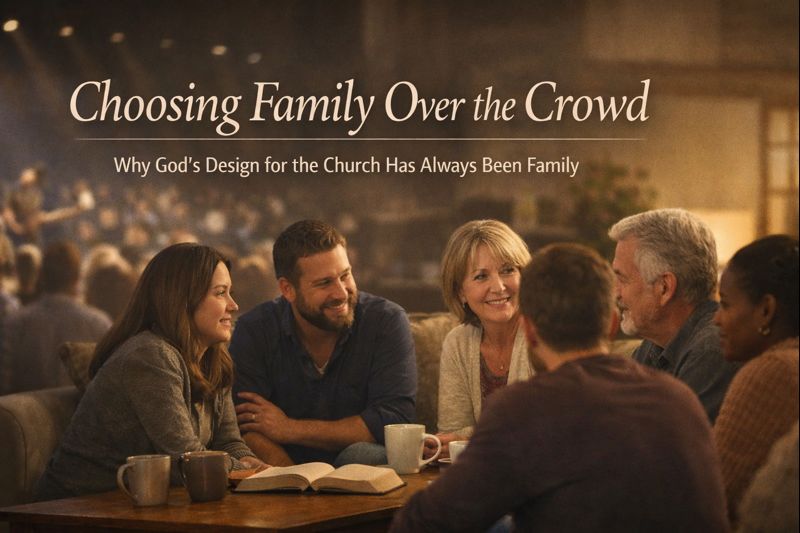
Not to criticize crowds or large gatherings, but to lovingly point toward what many believers quietly long for and were created for—family as Jesus defined it. Not attendance, but belonging. Not proximity, but shared life. Not knowing about one another, but walking together in obedience and love.
Who Is My Family?
Jesus radically redefined family when He said that His true family consists of those who do the will of His Father (Matthew 12:48–50). With those words, belonging was no longer determined by biology or proximity, but by shared obedience and shared life. Significantly, Jesus revealed this truth while He was inside a house, surrounded by a small gathering of believers. He was not only teaching about family—He was living it. Those who heard Him were not receiving a concept; they were witnessing Jesus modeling family in real time, showing them what it truly meant to belong.
From that moment forward, the people of God were no longer meant to function merely as a crowd, but as a family—brothers and sisters, spiritual mothers and fathers—living in covenant love and mutual responsibility.
The Church was never meant to be an audience.
It was meant to be a family.
State of the Family
The breakdown of family is not theoretical. It is measurable, documented, and visible across every layer of society.
As recently as fifty years ago, children spent three to four hours a day interacting with family members. Today, that time has dropped to approximately fourteen and a half minutes, much of it negative in nature [1]. One source reports that the average father who lives in the home spends about 37 seconds per day of undivided attention with his children [2]. Researchers have also documented that parents today spend significantly less time with their children than parents a generation ago [3].
A national poll found that 57% of fathers and 55% of mothers feel guilty about not spending enough time with their children [4]. Millions of children now return home from school to homes absent of adults [5].
These patterns are not isolated. They reflect a sustained departure from God’s design for family—and they shape the next generation.
Related:
The Cost of Losing Family
When family erodes, the consequences are not abstract—they are visible everywhere. Divorce, fatherlessness, loneliness, declining birth rates, generational dishonor, and isolation are now normalized. These are not merely cultural problems; they are documented outcomes [6][7].
Loneliness thrives where family is absent.
Instability grows where covenant is avoided.
Fruitfulness declines where sacrifice is resisted.
God’s design has not failed.
We have simply moved away from it.
The Cost to Pastors and Church Leaders
This breakdown does not stop at the doors of the Church.
Many pastors are surrounded by crowds while living without family—without close relationships that share burdens, provide accountability, and walk through life together. Widely circulated ministry-health data reveals high levels of burnout, depression, isolation, marital strain, and early departure from ministry roles [8].
These are not failures of faith.
They are failures of relational structure.
Crowds cannot carry what only family was designed to bear.
Related:
Childless by Choice: When Fruitfulness Is Refused
America is not only experiencing the breakdown of family—it is increasingly choosing it.
Since 1973, more than 63-65 million children have been aborted in the United States. Beyond abortion, many couples now openly identify as childless by choice, framing the decision as responsible and enlightened.
In a national broadcast, CBS News reported that declining birth rates were not merely accidental but intentional. During that segment, author Jonathan Last explained the financial reasoning often used to justify the decision:
“It’s become nominally expensive to have a child right now in America. When you add up all the costs, it’s about $1.1 million to have a child.” [9]
He then added a statement that revealed the deeper issue beneath the economics:
“That’s a lot of money to spend on, you know, something that, in fifteen years, is going to tell you it hates you.” [9]
CBS also interviewed members of a social group openly titled “No Kidding!”, created for couples who have chosen not to have children. When one woman was asked if the decision was selfish, she responded:
“I’d rather make a mistake and not have a child than have a child and find out that that was a mistake.” [9]
Family—by its very nature—requires sacrifice. Children demand time, patience, emotional investment, and self-denial. Parenting exposes selfishness and forces maturity. For a culture shaped by convenience and self-preservation, that cost feels too high.
So fruitfulness is refused.
What a Childless Culture Substitutes
When a nation chooses not to reproduce, it substitutes:
Consumption for legacy
Entertainment for inheritance
Crowds for covenant
Virtual relationships rather than authentic, lived relationships
What should have been passed down is consumed. What should have been invested in the next generation is spent on the present one. What should have been rooted in family is replaced by crowds—busy, loud, temporary, and non-committal.
The Spiritual Parallel the Church Cannot Ignore
This same pattern has quietly entered the Church.
Just as the culture has become childless by choice, the Church has increasingly become discipleless by choice—and therefore familyless by choice.
Jesus did not merely call us to believe; He called us to be disciples and to make disciples (Matthew 28:19–20). To make a disciple is to participate in spiritual birth—someone being born again into the Kingdom of God (John 3:3–7). But birth is only the beginning. Like natural children, spiritual children must be raised, nurtured, taught, corrected, and loved into maturity.
That process requires:
Selflessness
Time
Patience
Vulnerability
Sacrifice
It is costly.
And because it is costly, many avoid it.
Yet Jesus defined love itself this way: “Greater love has no one than this: to lay down one’s life for one’s friends” (John 15:13). Discipleship—like parenting—is an act of laying down one’s life so another can live, grow, and mature.
Selfishness: A Mark of the Last Days
Scripture warns that in the last days people would become lovers of themselves rather than lovers of God (2 Timothy 3:1–5). That self-love shows up in how people avoid commitment, resist sacrifice, and choose crowds over family.
The refusal of fruitfulness—natural or spiritual—is not merely cultural drift. It is a spiritual indicator.
Why Crowds Are Attractive to a Childless Culture
Crowds offer energy without responsibility, connection without commitment, and belonging without sacrifice. They feel alive without producing life.
Jesus never entrusted the future of the Kingdom to crowds. He entrusted it to disciples who lived with Him, walked with Him, and learned obedience by watching His life.
Related:
Everybody Wants to Go Where They Know Your Name
Long before researchers and public-health officials began describing loneliness as a national crisis, popular culture had already named the ache. One of the most successful television sitcoms of its era, Cheers, was built around belonging. Estimates place the number of American viewers at approximately 93 million, a figure commonly cited in contemporary reporting and network-era cultural summaries, accounting for individual viewers, including those watching together at home and in group viewing settings [10].
Its draw was simple and human: a place where you were not anonymous. The theme captured the exhaustion of life and the desire to be somewhere familiar—“making your way in the world today”—and the pull of being known—“where everybody knows your name.” It was about a few people knowing your name, and you feeling like you belong.
What Cheers fictionalized, Scripture clarifies. People are not created to be lost in crowds. They are created for family—where faces are known, absences are noticed, burdens are shared, and love is practiced over time. The ache to be known is real, and it does not disappear with bigger rooms or louder gatherings. It is answered by covenant life—family as Jesus defined it.
Discipleship Is Not Taught—It’s Caught
Discipleship is not primarily transferred through information. It is caught through proximity and imitation.
Jesus taught His disciples—but He also modeled what He taught by living life with them. They watched how He prayed, how He loved, how He handled loss, how He obeyed the Father, and how He related to people. They did not merely hear truth explained; they saw truth lived.
People imitate what you do, not what you say.
This kind of formation can only happen in family-sized community, where life is shared and obedience is visible. You cannot observe someone’s faith from a distance.
Crowds can inform.
Family forms.
Related:
- The Collapse Nobody Sees Coming: Why Disconnected Young Men Are the Tipping Point—How Faith and the Church Are the Answer
- The Commands of Jesus (Series)
Why Small, Faithful Families Outlast Big Movements
Big movements depend on momentum.
Small families depend on covenant.
Movements impress the moment.
Families shape generations.
At the End of Life, Fruit Is Revealed
Funerals reveal what a person truly built.
Some lives leave behind only a few obligated relatives. Others—often those who lived in deep Christian family—leave behind rooms filled with people whose lives were genuinely touched.
Healthy family multiplies impact.
Small family does not mean small influence.
Scripture reminds us that our days are numbered and that it is appointed for each of us to die once, and after that to face judgment (Hebrews 9:27).
Choosing family now determines what will remain at the end.
Choosing Family Now, Not at the End
This is not about abandoning large gatherings, but about making being family the priority over large gatherings—spending more time with your church family than in crowds. Large gatherings have a place and can be attended periodically—monthly, quarterly, or annually—but they were never meant to replace the shared life, commitment, and obedience that happen best in family-sized community (Acts 2:42–47; Hebrews 10:24–25).
Family does not appear automatically at the end of life.
It is formed intentionally over time.
Jesus calls us to love God, love one another, and lead others to do the same (Matthew 22:37–40; Matthew 28:19–20).
How to Take the First Step Toward Family
Family does not begin when someone else notices you. It begins when you choose to show up.
Choose a few people, not many. Be willing to be known. Commit to consistency. Give before you expect to receive. Accept that family costs something—but that love is always worth the cost.
If you are ready to take a simple, concrete step, Vine Fellowship Network exists to help believers step out of crowds and into family.
You can begin by visiting a VFN-related church—not as a commitment, but as an experience, at your discretion.
You may also explore:
Our Story
Our Vision
Why Relate
Family is not found by accident.
It is chosen.
It is built.
It is protected.
Choose family now.
Endnotes
[1] Robert Hamrin, Straight From a Dad’s Heart.
[2] Robert Hamrin, Straight From a Dad’s Heart.
[3] John P. Robinson, How Americans Use Time; American Demographics.
[4] Lynn Smith and Bob Sipchen, Los Angeles Times, August 12, 1990.
[5] U.S. Bureau of the Census, “Who’s Minding the Kids?”
[6] Arland Thornton, Journal of Marriage and Family.
[7] Frank F. Furstenberg Jr. and Christine Nord, Journal of Marriage and the Family.
[8] Greg Lancaster, Nurturing God-Centered Marriage, The Torch (2023).
[9] CBS News, “Childless by Choice,” including interview with Jonathan Last.
[10] Cheers, NBC television series (1982–1993); contemporary/network-era estimates commonly cited at approximately 93 million American viewers when accounting for cumulative individual viewers and group viewing settings.
[11] U.S. Surgeon General Vivek H. Murthy, Our Epidemic of Loneliness and Isolation (Advisory, 2023).
Begin Your Journey Today
Jesus didn’t just call us to believe in Him—He called us to follow Him.
Step into the life He designed for you through Emmaus Road’s The Commands of Jesus . This is more than learning—it’s an invitation to walk with Him, obey Him, and experience Him in a real and powerful way.
You don’t want to miss this exciting adventure Jesus has called you into.
Start now:
https://GregLancaster.org/StartHere