



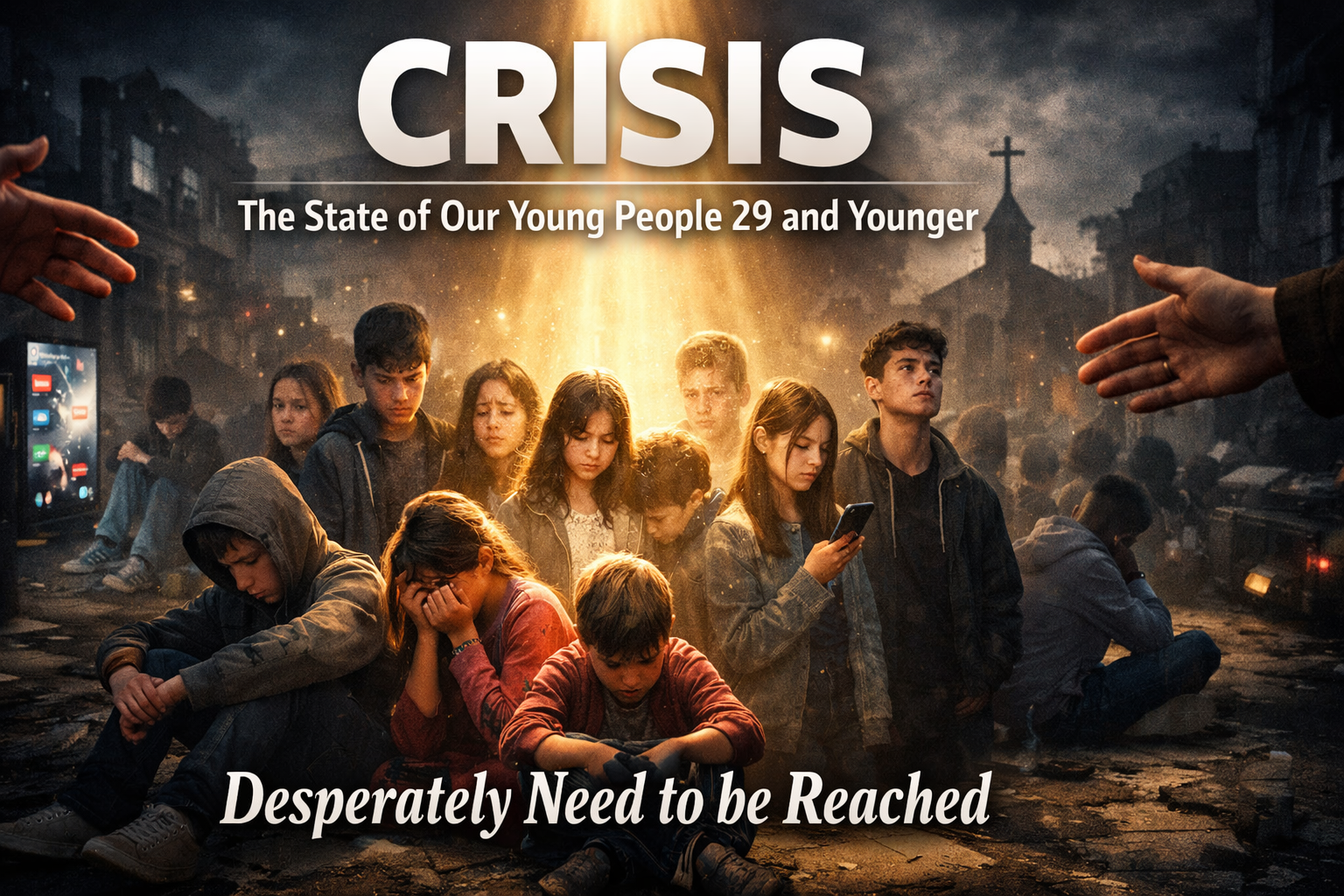
Five Things We Will Learn
- Why America’s children and young adults are facing unprecedented levels of sadness, anxiety, depression, loneliness, and suicide.
- How confusion around identity, sexuality, and belonging is shaping a generation under age 29.
- What young people currently believe about God, Christianity, and Jesus.
- Why a growing number of Gen Z young adults are being drawn toward more structured and traditional expressions of Christianity.
- What these trends reveal about the deep need for truth, stability, hope, community, and a real relationship with Jesus.
A Generation in Crisis
America’s children and young adults are in the middle of a deep crisis. Beneath the constant connection of smartphones, social media, entertainment, and artificial intelligence is a generation struggling with sadness, anxiety, loneliness, confusion, and hopelessness.
These are not isolated stories. They are widespread realities affecting millions of children, teenagers, and young adults ages 29 and younger.
The following statistics reveal just how serious the crisis has become.
America’s Children and Young Adults Are in Crisis
- 40% of high school students report persistent sadness or hopelessness.
Source: Centers for Disease Control and Prevention, Youth Risk Behavior Survey
https://www.cdc.gov/healthy-youth/mental-health/index.html - 20% of high school students have seriously considered suicide.
Source: Centers for Disease Control and Prevention, Youth Risk Behavior Survey
https://www.cdc.gov/healthy-youth/mental-health/index.html - Nearly 9% of high school students have attempted suicide.
Source: Centers for Disease Control and Prevention, Youth Risk Behavior Survey
https://www.cdc.gov/healthy-youth/mental-health/index.html - 1 in 5 youth ages 12–17 experienced a major depressive episode in the last year.
Source: Annie E. Casey Foundation
https://www.aecf.org/blog/youth-mental-health-statistics - 20% of adolescents ages 12–17 report anxiety severe enough to need help.
Source: South Denver Therapy
https://www.southdenvertherapy.com/blog/teen-mental-health-statistics - 20% of adolescents say they need mental health care, but cannot get it.
Source: Centers for Disease Control and Prevention
https://www.cdc.gov/children-mental-health/data-research/index.html - 70–80% of teens with significant mental health needs never receive adequate treatment.
Source: South Denver Therapy
https://www.southdenvertherapy.com/blog/teen-mental-health-statistics - Youth mental-health hospitalizations increased 124% from 2016 to 2022.
Source: Compass Health Center
https://compasshealthcenter.net/blog/teen-mental-health-statistics - Emergency-room visits for teen mental-health crises increased:
- 31% overall
- 50% among girls ages 12–17
Source: South Denver Therapy
https://www.southdenvertherapy.com/blog/teen-mental-health-statistics
- Young adults ages 18–29 have the highest rate of mental-health crisis of any adult age group: 15.1%.
Source: Johns Hopkins Bloomberg School of Public Health
https://publichealth.jhu.edu/2025/mental-health-crisis-hits-nearly-1-in-10-us-adults - 4 in 10 members of Generation Z say they need help with their mental health.
Source: Youth Mental Health Coalition
https://www.youthmentalhealthcoalition.org/gen-z - Among college-age young adults:
- 37% report moderate to severe depression
- 32% report moderate to severe anxiety
- 11% seriously considered suicide in the past year
Source: University of Michigan School of Public Health
https://sph.umich.edu/news/2025posts/college-student-mental-health-third-consecutive-year-improvement.html
- Globally, suicide is now the third-leading cause of death for people ages 15–29.
Source: World Health Organization
https://www.who.int/news-room/fact-sheets/detail/adolescent-mental-health - 1 in 8 young people ages 12–21 have turned to AI chatbots for mental-health advice because they feel they have nowhere else to go.
Source: People Magazine
https://people.com/young-people-use-ai-chatbots-for-mental-health-advice-11864522
The Search for Identity
The crisis is not only emotional. Many young people are also wrestling with identity, belonging, sexuality, and purpose.
A generation that has been told to “find yourself” is increasingly unsure who they are.
- About 22–23% of Gen Z adults, ages 18–27, identify as something other than heterosexual.
Source: Gallup
https://news.gallup.com/poll/656708/lgbtq-identification-rises.aspx - About 9.5% of youth ages 13–17 identify as LGBT.
Source: UCLA Williams Institute
https://williamsinstitute.law.ucla.edu/publications/lgbt-youth-pop-us - Roughly 5–10% of teenagers say they are unsure or questioning their sexual identity.
Source: National Institutes of Health
https://pmc.ncbi.nlm.nih.gov/articles/PMC11450101 - Approximately 1 in 10 teens say they are uncertain about their sexuality.
Source: National Institutes of Health
https://pmc.ncbi.nlm.nih.gov/articles/PMC11450101 - About 3 in 4 Gen Z young adults, roughly 75–80%, identify as heterosexual and would likely desire a heterosexual marriage.
- About 1 in 5, roughly 20–25%, identify as something other than heterosexual.
Source: Thriving Center of Psychology
https://thrivingcenterofpsych.com/blog/millennials-gen-z-marriage-expectations-statistics
These statistics reveal not only a change in behavior, but a deeper uncertainty about identity itself. Many young people are longing for stability, clarity, and belonging.
What Gen Z Believes About God and Christianity
One of the most sobering realities is that fewer young people identify as Christian than previous generations.
- 55% of Gen Z do not identify as Christian.
- About 45% identify as Christian.
Source: Capital News Service Maryland
https://cnsmaryland.org/2025/03/25/a-shift-in-christianity-across-the-u-s-may-continue-as-gen-z-ages - Only 4% of Gen Z hold a biblical worldview.
- 96% do not view life, truth, morality, marriage, family, God, and salvation the way Scripture teaches.
Source: Impact 360 Institute
https://www.impact360institute.org/articles/4-percent-gen-z-biblical-worldview
The issue is not simply that many young people reject Christianity. Many have never truly encountered biblical Christianity. They have heard about religion, but not necessarily the Gospel. They know about spirituality, but not always about repentance, truth, grace, forgiveness, and following Jesus.
Who Does Gen Z Say Jesus Is?
Many young people still have positive feelings about Jesus, but their understanding of who He is often stops short of what Scripture says.
- 49% say Jesus is loving.
- 46% say He offers hope.
- Many describe Him as caring and trustworthy.
- Only 24% believe Jesus makes a real difference in the world today.
- Only 23% believe they can have a personal relationship with Him.
- Many young people see Jesus more as:
- A good moral teacher
- A historical figure
- Someone who represents love and kindness
- Far fewer see Him as:
- The Son of God
- The only way to God
- Lord and Savior
- Someone who calls them to repentance and obedience
Source: Standing for Freedom Center
https://www.standingforfreedom.com/2025/02/11/gen-z-and-the-search-for-jesus
Young people do not simply need another message of self-help or inspiration. They need the real Jesus: the Son of God who loves them, died for them, rose again, forgives sin, gives purpose, and calls them into a life of truth and hope.
A Growing Search for Structure, Truth, and Meaning
Even in the middle of this crisis, there are signs that many young people are searching for something deeper.
There is a growing trend, especially among Gen Z men, toward more structured and traditional forms of Christianity such as Catholicism, Orthodox Christianity, and conservative evangelical churches.
- 42% of Gen Z men ages 18–29 say religion is “very important” in their lives.
Source: Axios
https://www.axios.com/2026/04/16/gen-z-religion-poll-gallup - About 45% of Gen Z identify as Christian, while 55% do not.
Source: Axios
https://www.axios.com/2026/04/16/gen-z-religion-poll-gallup - Catholic dioceses in the United States reported a 38% increase in conversions in Easter 2026 compared to 2025. Much of that increase came from young adults, especially Gen Z.
Source: The Washington Post
https://www.washingtonpost.com/opinions/2026/04/10/catholic-converts-young-tiktok-instagram - Some parishes report record numbers of Gen Z converts and baptisms.
Source: National Catholic Register
https://www.ncregister.com/news/gen-z-revival-for-real - About 34% of Gen Z adults are still religiously unaffiliated.
Source: Axios
https://www.axios.com/2026/04/16/gen-z-religion-poll-gallup
Researchers and pastors consistently say young people are being drawn toward structured faith because they are tired of chaos, loneliness, confusion, and a lack of meaning.
They are looking for:
- Order
- Clear truth
- Tradition
- Community
- Discipline
- Moral boundaries
- A sense of belonging
Many Gen Z young adults say Catholicism and other structured forms of Christianity offer stability and meaning in contrast to what they see as a chaotic, lonely, digital, and morally confused culture.
Source: The Washington Post
https://www.washingtonpost.com/style/trends/2026/04/02/catholicism-gen-z
One report found that many young men are leaving large, seeker-style churches and are drawn instead to Catholic and Orthodox churches because they want something that feels historic, serious, structured, and rooted.
Source: The Washington Post
https://www.washingtonpost.com/style/trends/2026/04/02/catholicism-gen-z
More Than Half of Their Lives Are Now Spent Online
Today’s young people are spending an unprecedented amount of their lives online. Generation Z and young adults under 29 now average more than 9 hours of screen time per day. In a typical 16-hour waking day, that means they are spending more than 56% of their waking life looking at a screen. For many, the online world has become their primary environment for relationships, identity, entertainment, information, and even mental-health advice. When we place that reality beside the rising rates of sadness, anxiety, depression, and suicide among young people, it should not surprise us that so many feel overwhelmed, isolated, and desperate.
Source: Average Screen Time Statistics 2026 [By Age & Country] – DemandSage
The Deep Need Beneath the Numbers
These statistics point to more than a cultural problem. They point to a generation longing for truth, family, purpose, identity, hope, and God.
Young people are not simply rejecting faith. Many are rejecting confusion, emptiness, and shallow answers. They are searching for something real.
The Church has an opportunity to respond, not with condemnation, but with truth, compassion, discipleship, genuine community, and the real Jesus.
A generation that is anxious, lonely, and confused is also a generation that is searching. The same young people who are overwhelmed by chaos are often the very ones most open to hope, belonging, purpose, and truth.
Begin Your Journey Today
Jesus didn’t just call us to believe in Him—He called us to follow Him.
Step into the life He designed for you through Emmaus Road’s The Commands of Jesus. This is more than learning—it’s an invitation to walk with Him, obey Him, and experience Him in a real and powerful way.
You don’t want to miss this exciting adventure Jesus has called you into.
Start now:
https://GregLancaster.org/StartHere
Related:
- Marriage, Remarriage, and Living in Adultery | Truth Has Consequences — What Jesus Says About Covenant, Sin, and Eternity
- Marriage, Divorce, and Remarriage: What the Bible Actually Says | Why God’s design for covenant still stands, even as culture redefines it
- Getting Married Is Not Your Safeguard | Marriage cannot compete with a world designed to capture your heart if you refuse to leave it
- Crisis: The State of Our Young People 29 and Younger | They Are Not Lost Causes: Our Young People Are Precious, Valuable, Loved by God, and Desperately Need Us to Reach Them
- Marriage: For God’s Sake and for the Sake of the Children (Part 1) The Idol of Marriage: Why God’s Design Matters Before or If You Say “I Do”
- Marriage: For God Sake and for the Children’s Sake (Part 2)Mohar: The Price, the Covenant, and God’s Design for Marriage
- God’s Call to the Same-Sex Couple Who Come to Christ | Grace That Welcomes Fully, Truth That Transforms Completely