



Five Things We Will Learn
- Why words like space, heaven, sex, love, work, family, marriage, freedom, and truth once carried clear, foundational meanings.
- When and how these meanings began to shift culturally, philosophically, and spiritually.
- How redefining these words has reshaped identity, relationships, and belief systems.
- Why losing original definitions leads to confusion, instability, and cultural drift.
- How restoring true meaning can realign faith, family, purpose, and society.
The Drift Begins with Words
Every generation inherits language. But what happens when the meaning of that language slowly changes?
At first, the shift is subtle. Words still sound familiar. They are still used in everyday conversation. But over time, their foundations erode. What once anchored reality begins to float.
This is where drift begins.
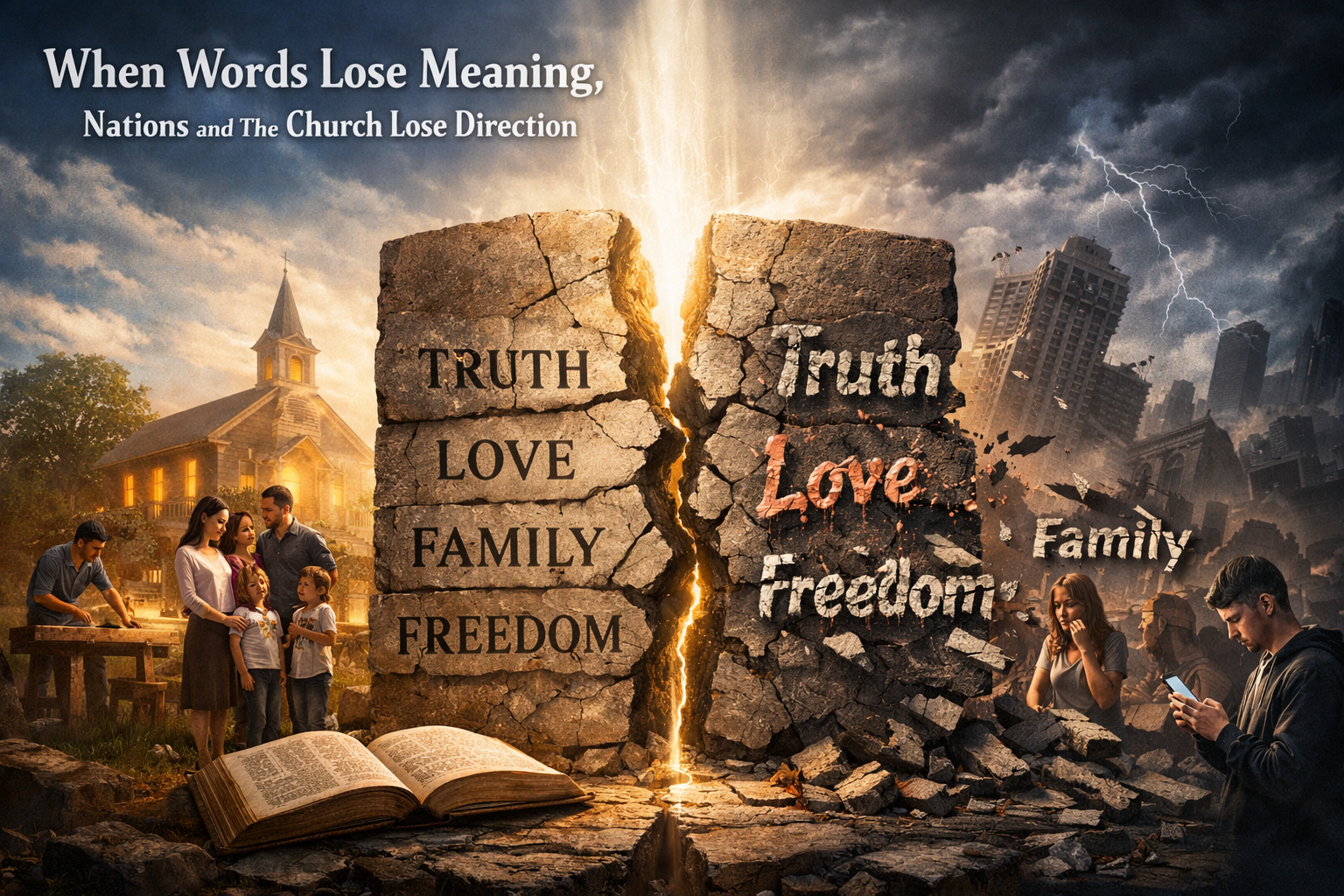
We do not usually notice cultural collapse through laws first. We notice it through language. When words lose their meaning, people lose their direction. When definitions shift, truth becomes negotiable, identity becomes unstable, and purpose becomes unclear.
The current generation has not simply rejected old ideas. In many cases, they were never given the original meanings to begin with.
What These Words Originally Meant
To understand the depth of the drift, we must first recover the original intent behind these foundational words.
Space: Emptiness, Not Identity, and Heaven
Originally, space meant emptiness. It described the vast void—the absence of matter, the distance between objects. It was something to be filled, explored, or measured.
They have turned heaven into “space.” What was once understood as the heavens—the dwelling place of God—is now commonly described as emptiness or a void. Many now speak of it as lifeless, even questioning whether any life exists beyond Earth. In doing so, they have forgotten that heaven is not empty, but filled with God on His throne, surrounded by a multitude of angels and others.
Heaven: The Transcendent Realm
Heaven once referred to a real, transcendent realm beyond the physical world. It was understood as the dwelling place of God—eternal, holy, and outside human control.
Over time, heaven has been reduced in many minds to a vague emotional state, a metaphor, or even a symbolic “good place.” The weight of eternity has been replaced with abstraction. In many cases, even the language has shifted—what Scripture calls “the heavens” is now commonly called “space,” stripping it of meaning and reality.
The Lord’s Prayer
This is how Jesus taught us to pray:
“Our Father in heaven,
hallowed be your name,
your kingdom come,
your will be done,
on earth as it is in heaven.
Give us today our daily bread.
And forgive us our debts,
as we also have forgiven our debtors.
And lead us not into temptation,
but deliver us from the evil one.”
—Matthew 6:9–13 (NIV)
One reason many deny Him is that they no longer recognize where He dwells. This is how it is often reframed:
Our Father in space [emptiness],
hallowed be your name,
your kingdom come,
your will be done,
on earth as it is in space [emptiness].
Give us today our daily bread.
And forgive us our debts,
as we also have forgiven our debtors.
And lead us not into temptation,
but deliver us from the evil one.
As you can see, it is time to return to the basics—the true meaning of the words we profess to know.
Related:
Sex: Biological Distinction
Originally, sex referred to biological reality, the clear distinction between male and female. It was rooted in creation, observable, and fixed.
In recent decades, this meaning has expanded and blurred into identity, preference, and fluidity. What was once a biological category is now often treated as a personal declaration.
Love: Covenant Commitment
Love once meant deep, sacrificial commitment. It was not primarily about feelings, but about devotion, responsibility, and action, especially within covenant relationships.
Today, love is frequently reduced to emotion, attraction, or temporary desire. When feelings fade, love is often assumed to have ended. Commitment has been replaced with convenience.
Work: Labor, Craft, and Purpose
Work originally carried dignity. It meant labor, craftsmanship, contribution, and purpose. It was tied to identity, responsibility, and provision.
Now, work is often seen as a burden to escape, something separate from purpose, or merely a means to fund leisure. The value of labor has diminished, and with it, a sense of calling.
Family: Defined Kinship Structure
Family once described a clear structure: parents, children, and extended kin, bound by responsibility, identity, and generational continuity.
Today, the word has expanded to include almost any form of relational grouping. While relationships matter deeply, the loss of structure has led to confusion about roles, responsibilities, and identity formation.
Marriage: Covenant, Not Convenience
Marriage was once a widely accepted covenant—something people entered into because it was understood to be essential to a healthy society, shaped by biblical truth and established as a cultural norm across generations. It was marked by commitment, sacrifice, faithfulness, and the forming of a stable foundation for family and future generations. It was not primarily about personal happiness, but about promise, endurance, and building something that would outlast feelings.
Marriage was not originally defined by sameness of roles, but by shared purpose and complementary responsibility within that covenant. There was an understood order that helped sustain stability, continuity, and generational strength.
Today, marriage is often viewed as a flexible arrangement based on emotional satisfaction and personal fulfillment. When the feelings change, the commitment is seen as optional. What was once a covenant rooted in responsibility and permanence has, in many cases, become conditional and temporary—shaped more by individual desire than enduring promise.
Freedom: Defined Liberties Within Order
Originally, freedom meant the ability to live within defined liberties, often connected to moral responsibility and law. It was not the absence of boundaries, but the right ordering of them.
Now, freedom is frequently interpreted as the absence of restriction, doing whatever one desires without limitation. This shift turns freedom into chaos rather than stability.
Truth: Objective Reality
Truth once meant objective reality, something fixed, discoverable, and independent of personal opinion.
Today, truth is often treated as subjective, “my truth” or “your truth.” This shift removes any shared foundation for understanding reality itself.
When Did These Changes Happen?
These shifts did not occur overnight. They unfolded over time through several key movements:
- The Enlightenment (17th–18th centuries): Emphasized human reason over divine authority, beginning a slow move away from transcendent definitions.
- The Industrial Revolution (18th–19th centuries): Reframed work and family structures, separating labor from home and redefining purpose.
- Modernism (late 19th–early 20th centuries): Questioned tradition and reinterpreted long-held meanings.
- Postmodernism (mid–late 20th century): Rejected absolute truth, elevating personal experience over objective reality.
- Digital and Social Media Age (21st century): Accelerated the spread of redefined language, normalizing subjective interpretations globally and instantly.
What once took generations to shift now changes in years, even months.
The Cultural Impact of Lost Definitions
When foundational words lose their meaning, the consequences ripple through every area of life.
In Culture
Without shared definitions, culture fragments. Conversations become confusing because people use the same words but mean entirely different things.
In Life and Identity
If words like truth, love, and freedom are undefined, then identity becomes unstable. People struggle to answer basic questions: Who am I? Why am I here?
In Faith
Faith depends on clarity. If heaven is unclear, truth is subjective, and love is redefined, then the foundation of belief becomes uncertain. This leads to weakened conviction and spiritual drift.
In Community
When family, love, and commitment are redefined, relationships lose stability. Communities become transactional rather than covenant-based.
In the Next Generation
Perhaps the greatest impact is seen in younger generations who have never been taught the original meanings. They are not rebelling against truth. Many have simply never encountered it in its original form.
The Result: A Generation Without Anchors
We are now seeing the result of decades of shifting definitions:
- Confusion about identity
- Instability in relationships
- Loss of purpose in work
- Redefinition of truth itself
- A weakening of faith and conviction
This is not just a language issue. It is a foundation issue.
When the meaning of words changes, the structure of reality in people’s minds changes with it.
Recovering What Was Lost
The answer is not simply to argue over words, but to recover their original meaning and intent.
- Reestablish truth as objective and discoverable
- Restore love as commitment, not just emotion
- Reclaim family as a place of identity and responsibility
- Redefine freedom within the context of order and purpose
- Reanchor faith in the reality of heaven and God’s design
Clarity brings stability. Stability brings direction.
And direction restores purpose.
Conclusion: Words Shape Worlds
Words are not small things. They are the building blocks of thought, belief, and culture.
When their meanings are preserved, societies remain grounded. When their meanings are lost, societies drift.
This generation does not need new words. It needs restored ones.
Because when we recover the original meaning of what we say, we begin to recover the original purpose of why we are here.
This should give us all pause.
It should cause us to step back and reconsider why we are doing what we are doing—and whether those reasons are built on truth or on redefined meanings that have quietly replaced reality itself. If we are not careful, we may find that what we have accepted as normal has actually left reality behind, casting it aside into the dustbin of history.
Now is the time to dig again.
It is time to re-dig the wells of what is true—and what truth actually is, or rather, who Truth truly is.
To begin measuring how we think, why we act, and what we expect—not by shifting definitions, but by what is real, enduring, and unchanging.
Because only what is true can sustain a life, a family, a faith, and a future.
The Word: The Foundation of Meaning
Of all the ways God could have revealed His Son, He chose to describe Him as “the Word.”
“In the beginning was the Word, and the Word was with God, and the Word was God.
He was with God in the beginning.
Through Him all things were made; without Him nothing was made that has been made.”
—John 1:1–3 (NIV)
“The Word became flesh and made his dwelling among us. We have seen his glory, the glory of the one and only Son, who came from the Father, full of grace and truth.”
—John 1:14 (NIV)
Jesus is not only a messenger—He is the Word. He is the very expression, meaning, and revelation of God.
When the meaning of words is altered in the minds of people, it is not a small shift—it strikes at the foundation of truth itself. If God is revealed as the Word, then to distort words is, in effect, to distort how people understand God.
This is why it matters. When “heaven” becomes “space,” and is redefined as emptiness rather than the dwelling place of God, the meaning is not just softened—it is replaced. And when meaning is replaced, truth is obscured.
From the beginning, God established Truth through His Word. And that Word became flesh and dwelt among us. To lose the meaning of words is to lose clarity about God Himself, for He is the Word!
Begin Your Journey Today
Jesus didn’t just call us to believe in Him—He called us to follow Him.
Step into the life He designed for you through Emmaus Road’s The Commands of Jesus. This is more than learning—it’s an invitation to walk with Him, obey Him, and experience Him in a real and powerful way.
You don’t want to miss this exciting adventure Jesus has called you into.
Start now:
https://GregLancaster.org/StartHere
Related:
Who Really Files for Divorce—and Who Really Pays the Price?
Living Cells – Rediscovering the Secret That Made the Early Church Alive, Dynamic, and Growing
When God Comes Home: Why the Church Must Return to the Living Room— Bob Jones & Rick Joyner
Prophecy: Koinonia Over Crowds: Why God Is Shifting the Church From Mega to Micro
Original Intent of the Church: Rediscovering Family in a Fragmented World
Choosing Family Over the Crowd
The Children Are Still Waiting, by Katy Faust – Why God’s Design for Family Still Matters