



Five Things We Will Learn
- What Jesus clearly taught regarding marriage, divorce, remarriage, and adultery.
- Why true revival begins with repentance and submission to God’s Word.
- How the modern Church has often drifted from the teachings of Jesus regarding covenant marriage.
- Why the message of holiness has historically been resisted and rejected.
- How God’s mercy, forgiveness, and transforming grace remain available to all who genuinely repent and follow Christ.
Returning to the Authority of Jesus Christ
Dear beloved friend,
I write this with both sobriety and compassion. Few subjects in the modern Church carry more confusion, emotional pain, cultural pressure, and spiritual consequence than marriage, divorce, remarriage, and adultery. Yet few subjects were spoken of more clearly by Jesus Himself.
For many years, countless believers have lived under assumptions shaped more by culture, personal experience, denominational traditions, or emotional reasoning than by the direct teachings of Christ. Much like periods in Church history where the light of Scripture became obscured, many today simply have not carefully examined what Jesus actually said regarding covenant marriage.
But God, in His mercy, is lifting the veil.
True revival is not merely emotional gatherings, worship experiences, or moments of inspiration. Genuine revival occurs when the Word of God pierces the human heart, exposing deception and calling people to repentance, surrender, and transformation.
Acts 3:19 (NIV 1984)
“Repent, then, and turn to God, so that your sins may be wiped out, that times of refreshing may come from the Lord.”
Biblical repentance is not merely sorrow over sin. Repentance means turning away from sin and aligning our lives with the truth and authority of God.
This article is written in that spirit.
Not to condemn.
Not to shame.
But to lovingly call people back to Jesus Christ, His Word, and the transforming power of obedience.
God loves you more than you can imagine. He has an incredible plan for your life. But the doorway into that life begins with surrender to Jesus as Lord.
Jesus did not come to make people comfortable in sin.
He came to save people from sin.
The Rich Young Ruler and the Cost of Obedience
One of the clearest examples of this truth is found in the story of the Rich Young Ruler.
Mark 10:17-22 describes a sincere man who approached Jesus desiring eternal life. He appeared moral, disciplined, and outwardly righteous. Yet Jesus exposed the one thing the man loved more than God.
His possessions.
Mark 10:21 (NIV 1984)
“Jesus looked at him and loved him.”
This is critical to understand.
Jesus loved him deeply, yet still confronted the idol in his life.
The love of Jesus did not remove the demand for surrender.
The same remains true today.
Many people genuinely love aspects of Christianity. They attend church, worship, serve, give, and participate in ministry. Yet when confronted with a command of Jesus that threatens comfort, emotional security, relationships, reputation, or personal plans, many struggle to obey.
The issue ultimately becomes this:
Do we love Jesus more than we love our own will?
The Rich Young Ruler walked away sorrowful because he loved his possessions more than Christ.
Today, many love comfort, relationships, culture, or personal desires more than obedience to Jesus.
Jesus’ Uncompromising Standard on Marriage
The teachings of Jesus regarding marriage and divorce are remarkably direct.
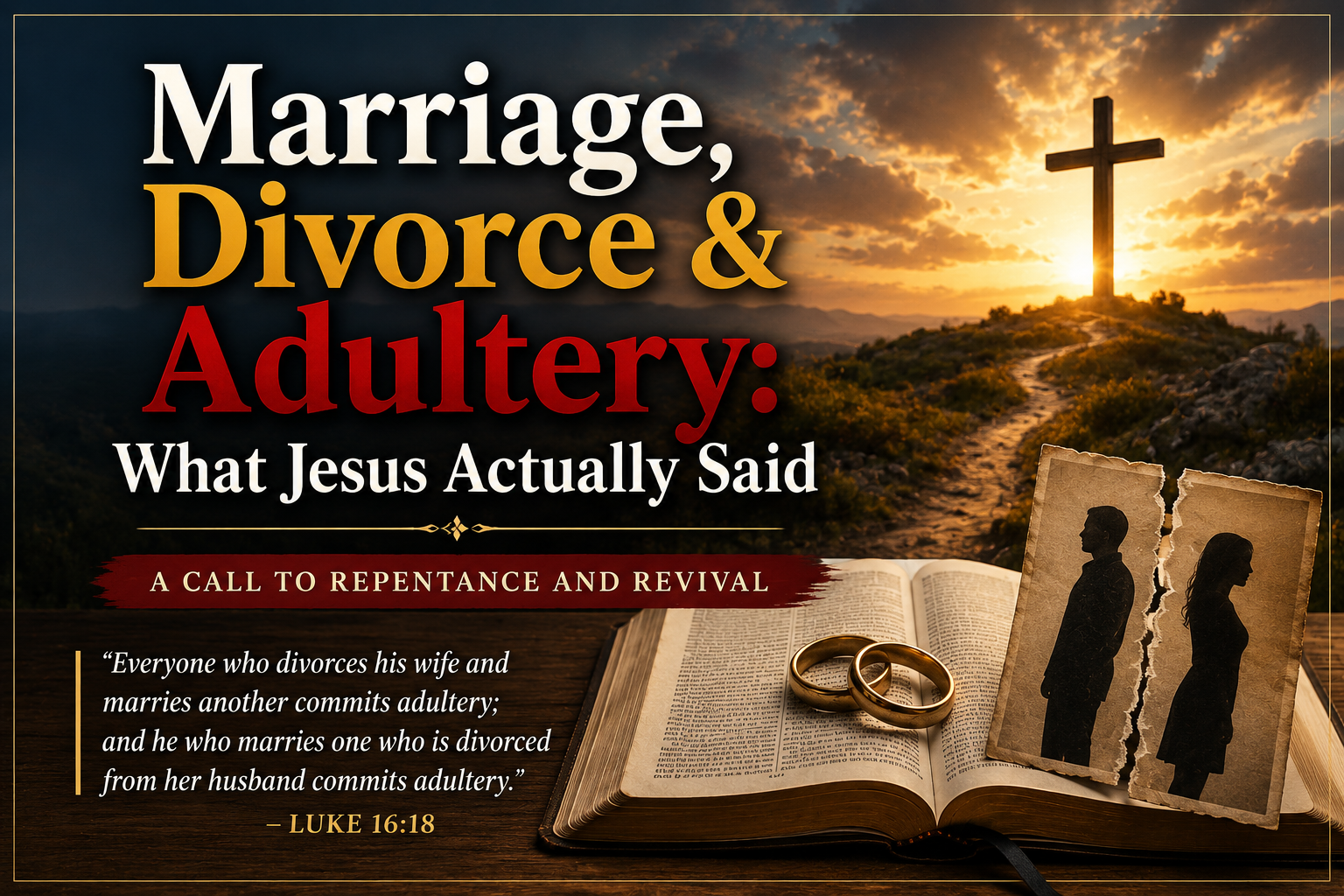
Luke 16:18 (NIV 1984)
“Anyone who divorces his wife and marries another woman commits adultery, and the man who marries a divorced woman commits adultery.”
This teaching is repeated in:
- Matthew 5:31-32
- Matthew 19:3-9
- Mark 10:1-12
Jesus consistently pointed people back to God’s original design established at creation.
Matthew 19:4-6 (NIV 1984)
“Haven’t you read,” he replied, “that at the beginning the Creator ‘made them male and female,’ and said, ‘For this reason a man will leave his father and mother and be united to his wife, and the two will become one flesh’? So they are no longer two, but one. Therefore what God has joined together, let man not separate.”
Marriage was never intended to be temporary, disposable, or governed merely by human convenience.
Marriage is covenant.
It reflects faithfulness.
It reflects sacrifice.
It reflects the covenant relationship between Christ and His Church.
Jesus did not lower God’s standard to fit culture.
He restored the standard back to God’s original intention.
The Sermon on the Mount Raised the Standard
In the Sermon on the Mount, Jesus repeatedly addressed the deeper condition of the human heart.
He did not merely confront outward behavior.
He confronted inward righteousness.
Matthew 5:27-28 (NIV 1984)
“You have heard that it was said, ‘Do not commit adultery.’ But I tell you that anyone who looks at a woman lustfully has already committed adultery with her in his heart.”
Jesus was not loosening God’s commands.
He was revealing their true depth.
In the same sermon, He addressed divorce directly.
Matthew 5:32 (NIV 1984)
“But I tell you that anyone who divorces his wife, except for marital unfaithfulness, causes her to become an adulteress, and anyone who marries the divorced woman commits adultery.”
Jesus confronted a culture that had normalized covenant breaking.
Much like today.
Why This Teaching Was Offensive Then and Still Is Today
Even the disciples reacted strongly to Jesus’ teaching.
Matthew 19:10 (NIV 1984)
“The disciples said to him, ‘If this is the situation between a husband and wife, it is better not to marry.’”
Why were they shocked?
Because Jesus eliminated the casual and self-centered view of divorce that had developed within the culture around them.
He exposed the hardness of the human heart.
Marriage reveals whether people truly understand covenant or merely pursue relationships for personal fulfillment.
This is why the message has always been resisted.
Truth becomes offensive whenever it confronts human desire.
John the Baptist Lost His Life Over This Truth
This issue is not minor in Scripture.
John the Baptist confronted King Herod because Herod had unlawfully taken his brother’s wife.
Mark 6:18 (NIV 1984)
“For John had been saying to Herod, ‘It is not lawful for you to have your brother’s wife.’”
John was imprisoned and eventually executed.
He lost his life because he spoke truth regarding unlawful relationships.
Truth regarding marriage and sexual holiness has always carried a cost.
It was costly for John.
It was costly for the early Church.
And it remains costly today.
Even Jesus Was Rejected for His Teachings
Jesus Himself was ultimately crucified by people who rejected His authority and His teachings.
The Sermon on the Mount confronted religious hypocrisy, lust, pride, greed, anger, and covenant unfaithfulness.
Humanity still resists surrender to God’s authority today.
Culture changes.
God’s truth does not.
The Power of the New Birth
The Gospel is not merely about moral improvement.
Jesus did not come to make bad people slightly better.
He came to make spiritually dead people alive.
2 Corinthians 5:17 (NIV 1984)
“Therefore, if anyone is in Christ, he is a new creation; the old has gone, the new has come!”
Salvation changes identity.
Salvation changes allegiance.
Salvation changes desires.
The blood of Jesus is powerful enough to forgive every sin genuinely repented of.
No person is beyond redemption.
No failure is greater than the mercy of God.
But grace should never be twisted into permission to knowingly continue living in rebellion against God’s commands.
Romans 6:1-2 (NIV 1984)
“Shall we go on sinning so that grace may increase? By no means! We died to sin; how can we live in it any longer?”
The Double Standard in the Modern Church
One painful reality within parts of the modern Church is the existence of a double standard regarding sexual immorality.
Many churches will clearly confront certain forms of sexual sin while remaining nearly silent regarding adultery connected to remarriage while a covenant spouse remains living.
This inconsistency damages the witness of the Church before the world.
God’s standards cannot be adjusted according to popularity, emotional difficulty, or cultural acceptance.
The Church is called to proclaim truth faithfully, compassionately, and without partiality.
The Cost of True Repentance
Repentance is often costly.
For some people, obedience to Christ may require painful decisions, broken pride, surrendered relationships, public humility, or dramatic life changes.
Jesus never hid the cost of discipleship.
Luke 14:26-27 (NIV 1984)
“If anyone comes to me and does not hate his father and mother, his wife and children, his brothers and sisters, yes, even his own life, he cannot be my disciple. And anyone who does not carry his cross and follow me cannot be my disciple.”
Jesus was not teaching hatred toward family members. He was teaching that loyalty to Him must surpass every earthly relationship.
No relationship can take precedence over obedience to God.
No emotional attachment can become greater than truth.
This is where many struggle.
People often want Jesus as Savior without surrendering to Him as Lord.
But the Gospel calls people to both salvation and submission.
A Sobering Warning
The Apostle Paul warns us plainly:
1 Corinthians 6:9-10 (NIV 1984)
“Do not be deceived: Neither the sexually immoral nor idolaters nor adulterers nor male prostitutes nor homosexual offenders nor thieves nor the greedy nor drunkards nor slanderers nor swindlers will inherit the kingdom of God.”
Notice Paul begins with these words:
“Do not be deceived.”
Why?
Because humanity naturally seeks ways to justify sin while still believing everything is spiritually well.
Paul was not writing only to pagans.
He was warning people connected to the Church.
The danger of deception is not merely rejecting truth openly.
The greater danger is convincing ourselves we can continue in sin while claiming fellowship with Christ.
The Difference Between Struggle and Willful Practice
Every believer faces temptation.
Every believer battles weakness.
Every believer needs mercy.
But Scripture distinguishes between struggling against sin and practicing sin without repentance.
1 John 1:9 (NIV 1984)
“If we confess our sins, he is faithful and just and will forgive us our sins and purify us from all unrighteousness.”
God is extraordinarily merciful toward humble and repentant people.
But ongoing rebellion hardens the heart.
The goal of conviction is restoration.
The goal of repentance is reconciliation with God.
A Personal Call to You
This message is not about how others live or what they choose to do. It is not about blind religious leaders who fail to practice the truth they teach. In the end, it is deeply personal.
You and I will each stand alone before God and give an account for our own lives.
Romans 14:12 (NIV 1984)
“So then, each of us will give an account of himself to God.”
Jesus warned in Matthew 7:21-23 that many will say to Him on that day, “Lord, Lord, did we not prophesy in Your name… and do many wonders in Your name?” only to hear Him reply, “I never knew you; depart from Me, you who practice lawlessness.”
If we are living in adultery or any form of sexual immorality and have not truly repented, that is, stopped, then those will be the words we hear.
Do not worry about what others are doing.
You cannot blame anyone else for your own sin.
You can only repent of the sin you are willing to acknowledge as yours.
Yet in that honest confession and turning away, you will find the mercy and grace of God.
For all have sinned and fall short of the glory of God (Romans 3:23).
But to those who repent and turn to Him, He promises forgiveness, cleansing, and times of refreshing from His presence.
The Hope of the Gospel
The message of repentance is ultimately a message of hope.
God does not expose sin in order to destroy people.
He exposes sin in order to save them.
The cross of Jesus Christ remains powerful enough to forgive every sin genuinely repented of.
No failure is beyond the mercy of God.
No life is too broken for restoration.
No heart is too far gone for redemption.
Romans 5:20 (NIV 1984)
“But where sin increased, grace increased all the more.”
The mercy of God is breathtaking.
But grace must never become an excuse to continue living contrary to God’s revealed truth.
True grace transforms.
True grace leads people into holiness.
True grace produces obedience born out of love for Christ.
Revival Begins with Repentance
Throughout Scripture, every genuine awakening began with repentance.
Revival is not merely emotional excitement.
Revival is a return to God’s authority.
A return to holiness.
A return to truth.
A return to the fear of the Lord.
The Church does not need less truth in order to reach the world.
The Church needs more holiness, more humility, more love for Jesus, and more courage to proclaim what He actually said.
The Gospel is still good news.
Jesus still forgives.
Jesus still restores.
Jesus still transforms.
But He also still commands:
“Follow Me.”
A Final Appeal
This is not about how others respond.
This is not about what churches approve.
This is not about cultural trends or public opinion.
This is about Jesus Christ.
This is about truth.
This is about eternity.
Every one of us will stand before God personally.
The question will never be whether culture agreed with Jesus.
The question will be whether we obeyed Him.
The Lord is calling His people back to holiness.
Back to covenant faithfulness.
Back to repentance.
Back to truth.
Will we answer Him?

Jesus didn’t just call us to believe in Him—He called us to follow Him.
Step into the life He designed for you through Emmaus Road’s The Commands of Jesus. This is more than learning—it’s an invitation to walk with Him, obey Him, and experience Him in a real and powerful way.
You don’t want to miss this exciting adventure Jesus has called you into.
Start now:
https://GregLancaster.org/StartHere
Related Articles on The Torch
Revival Through Repentance https://greglancaster.org/revival-through-repentance/
The Danger of Lukewarm Christianity https://greglancaster.org/the-danger-of-lukewarm-christianity/
Does Sin Matter Anymore? https://greglancaster.org/does-sin-matter-anymore/
True Faith vs. Superficial Belief https://greglancaster.org/true-faith-vs-superficial-belief/