


Five Things We Will Learn
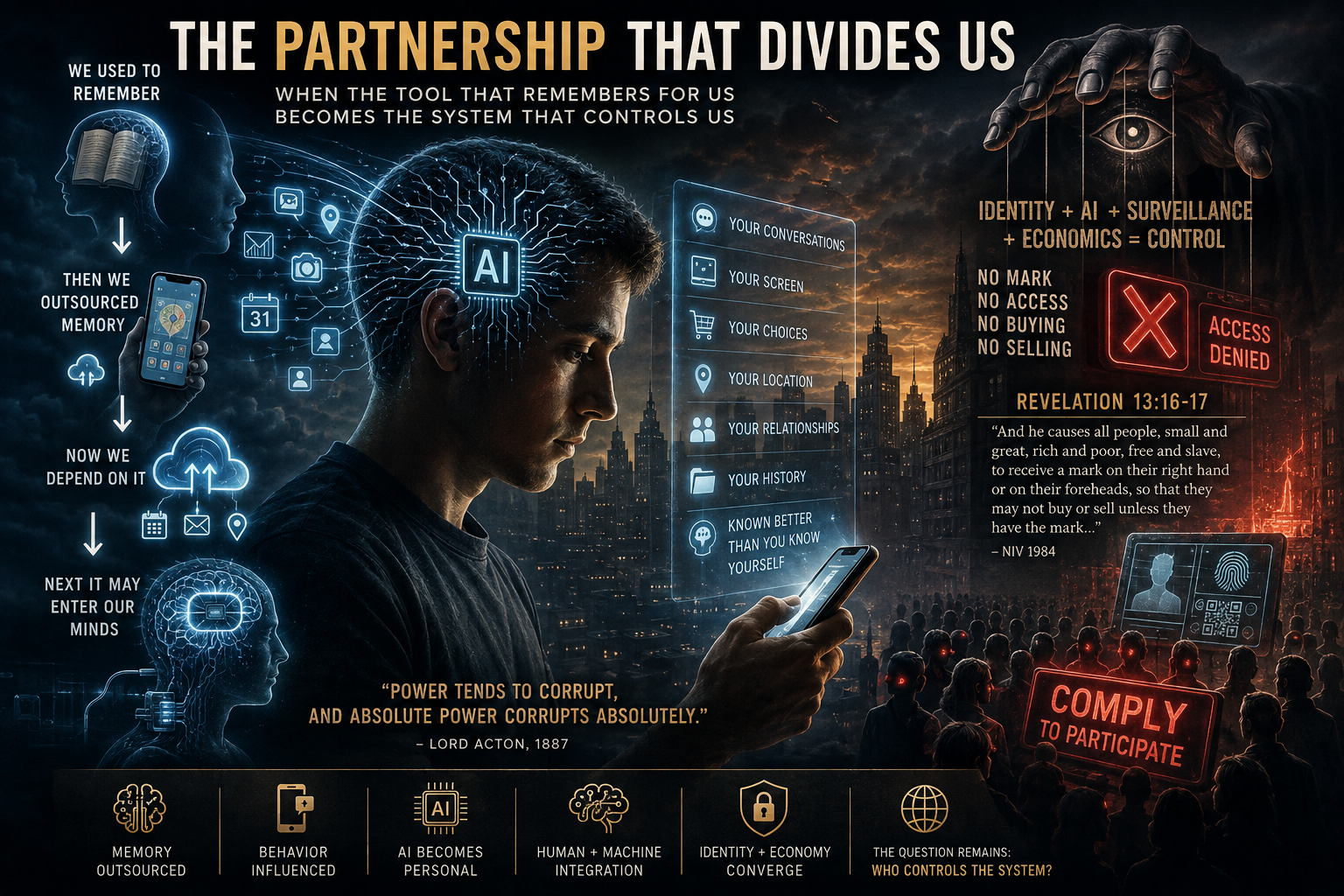
- Human memory is increasingly being outsourced to technology. Phones, cloud storage, GPS, digital calendars, search engines, and AI are becoming external memory systems for information people once retained themselves.
- Technology can move from assisting human memory to becoming a partner in human thought. Neural interfaces and AI integration could deepen that relationship until biological and technological intelligence become increasingly difficult to separate.
- Digital systems already possess powerful tools for influencing human behavior. Notifications, recommendation algorithms, personalized feeds, nudges, and ephemeral content demonstrate how technology can influence attention, choices, opinions, and behavior.
- AI, digital identity, surveillance, and economic access could eventually converge. When systems know who a person is, what they see, what they remember, how they behave, and whether they can participate economically, questions of autonomy and control become much more serious.
- Revelation 13 presents a striking biblical warning about centralized economic control. John describes a future system in which participation in buying and selling is conditioned upon compliance with the beast’s system.
We live in an age of information overload. More data passes through our senses in a single day than earlier generations encountered in a lifetime. That volume forces the brain to filter aggressively. What gets retained is what feels relevant or emotionally charged. Everything else slips away. As a result, people increasingly outsource memory to devices. Phones, search engines, and cloud notes become external hard drives for contacts, directions, facts, and even personal experiences.
Think about how thoroughly this has already happened. Most of us no longer know the phone numbers of close friends or family by heart; the contact list does that work. Business numbers, doctors’ offices, and service providers live only in the phone. Maps and routes that previous generations carried in their heads or on paper now exist solely in GPS apps—many people cannot navigate their own city without turn-by-turn guidance. Birthdays, anniversaries, and appointments are stored in digital calendars rather than remembered. Passwords, account numbers, and even personal stories or photos are kept in the cloud. Knowledge once held internally has been quietly transferred outward.
This is not theoretical. Bill Gates has said he still remembers every line of the first complex software program he wrote, and that people have suggested he has a “photographic memory” especially on topics that interest him, such as science and business. He notes that most people have good memory for domains they care about, but weaker recall outside those areas.
Elon Musk has explained that the brain discards irrelevant information and that assigning meaning or relevance is key to retention. His mother, Maye Musk, has publicly described him as her “encyclopedia” as a child because he remembered everything he read.
- The A.I. Dilemma and The Church, Artificial Intelligence (Part 1: Section 1 & 2) How advanced is AI? Could it be the image of the beast?
- The A.I. Dilemma and The Church, Artificial Intelligence (Part 2) AI and 40% of Jobs Lost, Cyborgs, and Making Sense of the Chaos
- The A.I. Dilemma and The Church, Artificial Intelligence (Part 3) AI robots in our image: Can they really be harmless? Why did the AI creator panic and warn world leaders?
- The A.I. Dilemma and The Church, Artificial Intelligence (Part 4) Exchanging the Glory of God for the Image and Last Days Prophecy
- The A.I. Dilemma and the Church (Part 5) | “A-Eye” is Watching! Is Big Tech, Big Brother?
- The A.I. Dilemma and the Church (Part 6) Deconstruction of Capitalisms, the Rise of a new Economy, and the Beast Economy
The Partnership and the Split
Once memory is handed to an external system, a partnership forms. The individual and the technology share the work of remembering. Experiences that once belonged solely to a person now live partly in a machine. Lose the machine and a piece of the self goes with it. That is a real fragmentation. The more complete the offloading becomes, the more the person is divided from their own history, their own knowledge, and ultimately their own autonomy.
Notifications train the response the way Pavlov’s bell trained the dog. The sound triggers an automatic check. Dopamine reinforces the loop. Over time the habit deepens until the device feels indispensable. At that point the offer of a neural interface—technology moved inside the skull so the AI feels like part of the self—can sound like relief rather than surrender. Ray Kurzweil has long argued that humans will merge with AI, connecting brains to the cloud so that biological and non-biological intelligence blend until the distinction fades.
From Nudge to Control
Richard Thaler and Cass Sunstein’s book Nudge described how small design choices can steer behavior without removing freedom of choice. Recommendation algorithms already do this at scale. Feeds are personalized. Two people on the same platform can receive entirely different information about the same event or candidate.
Researcher Robert Epstein has documented “ephemeral” content—search results, suggestions, and reminders that appear for one user, influence them, then vanish without a permanent public record. His teams have preserved millions of such personalized experiences across elections to demonstrate how they can shape opinions and votes while leaving little trace.
When the same systems move inside the brain, the nudge becomes something closer to direction. The entity that controls the technology gains the ability to shape what is remembered, what is suggested, and eventually what is thought. Lord Acton wrote in 1887: “Power tends to corrupt, and absolute power corrupts absolutely. Great men are almost always bad men, even when they exercise influence and not authority; still more when you superadd the tendency or the certainty of corruption by authority.” Absolute power has never remained benign in human history. Concentrated control over the infrastructure of thought and memory is no exception.
China’s National Online Identity Authentication Public Service, governed by measures that took effect in July 2025, provides a state-run digital identity system. Users can obtain network numbers and credentials linked to real identity information, with facial recognition and other factors used for verification. The system has seen tens of millions of downloads and millions of users, enabling identity checks across platforms while aiming to limit repeated sharing of full personal details.
The Economic Parallel in Revelation
Nearly 1,931 years ago (most scholars date the writing of Revelation to approximately AD 95, near the end of the reign of the Roman emperor Domitian), the Apostle John was shown a revelation of Christ and wrote what he saw. He prophesied an economy in which a mark or system controlled who could buy or sell:
“Also it causes all, both small and great, both rich and poor, both free and slave, to be marked on the right hand or the forehead, so that no one can buy or sell unless he has the mark, that is, the name of the beast or the number of its name.” (Revelation 13:16-17)
The warning is not metaphorical in its core claim: a centralized authority determines participation in the marketplace. Universal basic income or similar guarantees sound generous until the same authority decides who receives them and under what behavioral conditions. Income and access become levers. Dependence becomes compulsory.
Sam Altman’s May 2023 Senate testimony confirmed technical possibility when asked whether AI could enable a drone to select its own target, arm itself, locate the target/person and killed them. After stating that such capability should not be allowed, he answered “Sure” when pressed on whether it could be done.
“I think we are close to a world where you can have a descendant [version] of ChatGPT [“in the next six months” that can] watch your computer screen all the time, watch every meeting you’re in, record every call, everything like that, have perfect context of your whole life, everything you see.” Sam Altman, OpenAi, ChatGBT
More recently, Altman has described an approaching capability in which a descendant of current models could watch a user’s screen continuously, record meetings and calls, and build near-complete context of a person’s life—potentially within roughly one model generation or about six months—creating what amounts to a persistent digital shadow.
The Theological Frame
God is described in Scripture as omnipotent and omniscient. The adversary is not. Throughout history the drive has been to acquire knowledge and control that rival divine attributes. Technology that monitors thought, memory, and even dreams approaches a counterfeit omniscience without a soul. Those who build and govern such systems may not believe in God, yet they can come to act as if they occupy that place.
- The A.I. Dilemma and the Church (Part 7) Are we in George Orwell’s “1984” and the Importance of Nurturing Authentic Human Relationships.
- The A.I. Dilemma and the Church (Part 8) Know Your Enemy
- The A.I. Dilemma and the Church (Part 9) Mount Carmel – God vs. Baal
- The A.I. Dilemma & The Church (Part 10): Baal E-Masculation, ToS, Unveiling the E-Masculation Effect of Artificial Intelligence and its Profound Influence on Masculinity
- The A.I. Dilemma and the Church (Part 11) The Mind of Christ vs. The “Mind” of A.I.
The Battle for the Mind and Soul
This is where the technological question becomes deeply spiritual. What we think, desire, feel, remember, and ultimately choose is not merely a collection of data points. These belong to the deepest parts of our inner life. Scripture repeatedly speaks of the mind, heart, and soul when describing what takes place within a person.
Paul writes:
“Do not conform any longer to the pattern of this world, but be transformed by the renewing of your mind.”
Romans 12:2 (NIV 1984)
The Greek word translated “mind” is nous, referring to the mind, understanding, perception, and faculty of thought. Paul tells us that transformation takes place through the renewing of this inner faculty. Conversely, he warns that there is also a pattern of this world to which the mind can become conformed. Something is always seeking to shape how we see, understand, judge, and respond to the world around us.
Scripture also uses the Greek word psychē for “soul,” the word from which we derive terms such as psyche and psychology. Scripture describes the soul as longing, grieving, rejoicing, remembering, and desiring. Jesus Himself said:
“My soul is overwhelmed with sorrow to the point of death.”
Matthew 26:38 (NIV 1984)
This distinction matters. The Greek word for “mind” in Romans 12:2 is not the same Greek word translated “soul.” Yet Scripture presents the mind, heart, desires, emotions, memory, will, and soul as profoundly connected dimensions of the inner person. What reaches deeply enough to continually influence what we think, what we desire, what we feel, what we remember, and what we choose is reaching far beyond our information. It is reaching into our inner life.
That changes the significance of AI knowing us.
An AI that knows what you search for knows something about your interests. An AI that watches your screen knows what holds your attention. An AI that hears your conversations knows what concerns you. An AI that records your history knows what you have experienced. An AI that studies your responses can learn what moves you emotionally. An AI that predicts your behavior can anticipate what you may choose. And an AI connected directly to the brain would cross a boundary technology has never crossed before, moving from observing the expressions of the inner person toward interacting with the physical processes through which thoughts, memories, perceptions, and decisions occur.
The progression should concern us:
Know what you think.
Learn what you feel.
Predict what you want.
Shape what you see.
Influence what you choose.
Control what you can access.
At that point, privacy is no longer the largest question. The question becomes formation: Who is shaping the person you are becoming?
Romans 12:2 tells the believer not to surrender that process to the pattern of the world. We are commanded to be transformed through the renewing of our minds. If technology becomes capable of continually selecting what we see, suggesting what we should think, anticipating what we desire, influencing what we choose, and eventually interacting directly with the brain itself, then the battle is not merely over information. It is a battle over who and what is permitted to shape the inner person.
Jesus gave an even more sobering warning:
“What good will it be for a man if he gains the whole world, yet forfeits his soul? Or what can a man give in exchange for his soul?”
Matthew 16:26 (NIV 1984)
That question takes on extraordinary significance in an age promising humanity unprecedented knowledge, intelligence, convenience, longevity, connectivity, and power. What if we could remember virtually everything? What if AI could answer almost anything? What if a neural interface could give us immediate access to the accumulated knowledge of the world? What if technology could anticipate our needs before we even expressed them?
Jesus’ question still stands over every promise of human advancement:
What good is it to gain the whole world if, in the exchange, we surrender the very thing that should never have been for sale?
The danger is not simply that technology might become more intelligent. The greater danger is that humanity, in its desire for limitless knowledge, convenience, security, and power, may willingly surrender increasingly intimate portions of the inner life to systems controlled by someone else.
First we allowed technology to remember for us. Then we allowed it to recommend for us. Increasingly, we allow it to decide for us. The next invitation may be to allow it to become integrated with us.
That is why the coming choice is about far more than technology.
It is about the mind. It is about the will. It is about who shapes our desires. And ultimately, it is about the soul.
- The A.I. Dilemma and the Church (Part 12) War on Jesus
- The A.I. Dilemma and the Church (Part 13) Singularity
- The A.I. Dilemma and the Church (Part 14) A.I.’s World War III
- The A.I. Dilemma and the Church (Part 15) Civil War?
- The A.I. Dilemma and the Church (Part 16) – Twisted: A.I., God, & Heaven
- The A.I. Dilemma and the Church (Part 17) – Beyond the Reset: A Dystopian Future
The Decision
We are already past the point of casual convenience. The choice is becoming binary. One path keeps memory limited, accepts the friction of imperfect recall, and preserves the boundary of the inner life. Autonomy, private thought, and the integrity of the soul remain with the individual. The other path accepts deeper integration for the sake of seamless knowledge, convenience, and promised security. In exchange, the partnership tightens until the external system—and those who control it—hold decisive influence over what is known, remembered, and done.
The decision is real. Limited memory and personal autonomy on one side. Full partnership and the surrender of the inner world on the other. History, technology, and Scripture all point to the same question: who will hold the record of a human life, and who will decide what that life is allowed to become?
Jesus didn’t just call us to believe in Him—He called us to follow Him.
Step into the life He designed for you through Emmaus Road’s The Commands of Jesus. This is more than learning—it’s an invitation to walk with Him, obey Him, and experience Him in a real and powerful way.
You don’t want to miss this exciting adventure Jesus has called you into.
Start now:
https://GregLancaster.org/StartHere
Sources
- Bill Gates on memory and domain-specific recall: Genbeta / Gates Notes coverage
- Maye Musk on Elon’s childhood memory: Maye Musk post; IBTimes UK
- Ray Kurzweil on merging with AI / singularity: New York Times; MIT News
- Nudge by Richard H. Thaler and Cass R. Sunstein: Penguin Random House
- Robert Epstein on ephemeral / personalized content: AIBRT 2025 paper; earlier work summarized in ProMarket
- China National Online Identity Authentication measures (effective July 15, 2025): Chinese government announcement; China Law Translate; Wikipedia summary
- Sam Altman 2023 Senate testimony on AI and target selection: PC Gamer; Senate Judiciary Committee hearing record
- Sam Altman on near-term personal AI with screen/meeting context (2026 comments): Times Now
- Lord Acton quote (1887 letter to Bishop Creighton): Phrases.org.uk; Online Library of Liberty
- Dating of the Book of Revelation (approx. AD 95): GotQuestions.org; standard scholarly consensus
- Revelation 13:16-17 (ESV or equivalent standard translation)