

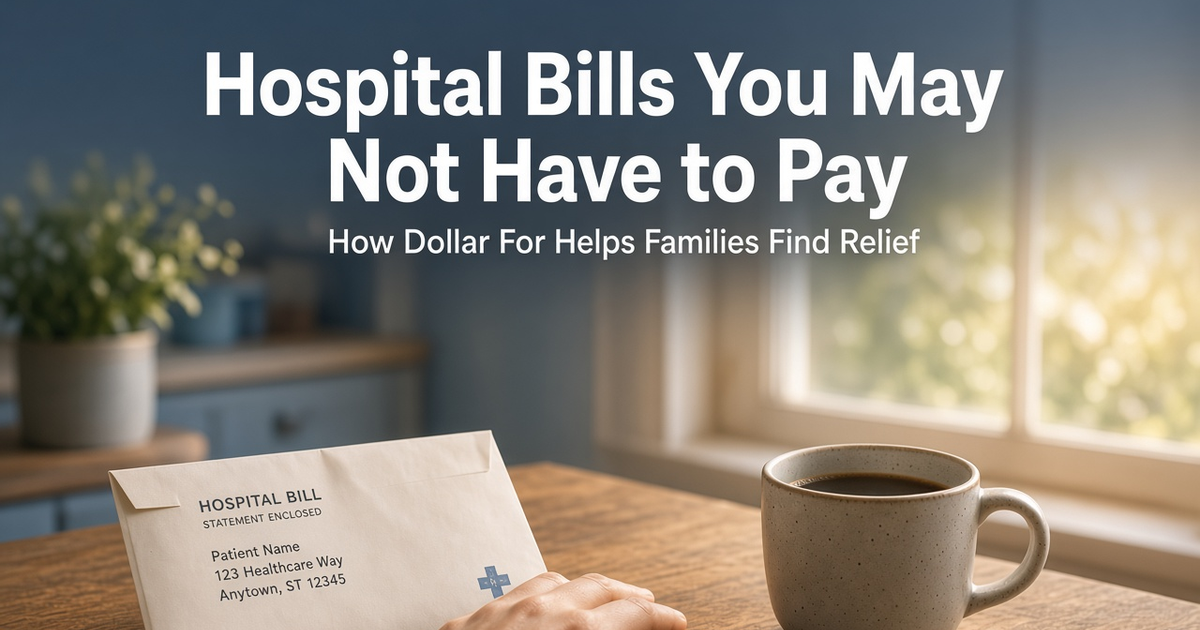
Millions of Americans carry medical debt they cannot pay. Federal law requires many hospitals to offer charity care. Dollar For helps people apply, free of charge.
Based on a CBN News report featuring Dollar For founder Jared Walker and families who found relief through hospital financial assistance, examining why medical debt is so common, what the law requires of nonprofit hospitals, and how the church can point people in need to practical help.
Five Things We Will Learn
- Why medical debt weighs so heavily on American families, including people who have insurance and people who do not.
- What federal law requires of nonprofit hospitals through financial assistance and charity care policies.
- How Dollar For helps patients apply for that help at no cost to the patient.
- Real stories of families whose hospital bills were reduced or erased after they applied.
- How the church can share this resource with people who are quietly carrying a burden they were never meant to carry alone.
When the Bill Feels Heavier Than the Healing
There are moments when the hospital saves a life, and then the bill arrives and it feels as if another weight has been placed on the same family.
A newborn is healthy. A surgery went well. An emergency visit stopped something worse. And then the statements begin. Numbers that do not fit any household budget. Letters that grow more urgent. Fear that the next phone call will be a collector.
If that describes you, or someone you love, please hear this with kindness:
You are not alone. And you may have options you have never been told about.
CBN News recently shared a report titled Here’s How Your Hospital Bill Could Be Reduced or Erased: ‘God Really Did Come Through’. The story points to a free nonprofit called Dollar For, and to a little known reality many patients never hear at discharge:
Many hospitals are required to offer financial assistance, sometimes called charity care. When a patient qualifies, a bill can be reduced or written off entirely.
Watch the CBN News report:
The Quiet Crisis of Medical Debt
Medical debt is not rare. It is one of the most common financial burdens in American life.
A KFF Health Tracking Poll found that about four in ten adults (41%) said they had some form of health care related debt from medical and dental bills. That includes about one in four (26%) who said they had medical or dental bills that were past due or that they were unable to pay.
Among adults with that debt, about seven in ten said it came from a one time or short term medical expense, such as a single hospital stay or treatment after an accident. In other words, many families did not slowly fall into debt. One unexpected crisis opened the door.
A 2024 study published through the National Library of Medicine reported that 36% of U.S. households had medical debt, including 21% with a past due medical bill and 23% paying a medical bill over time to a provider. The same research estimated that medical debt worth about $194 billion was in active collection.
Insurance helps, but it does not always protect a family from sticker shock. High deductibles, uncovered services, out of network surprises, and emergency care can leave even insured households facing bills they cannot pay.
And when people cannot pay, the pressure spreads. Credit scores fall. Sleep disappears. Couples argue. Parents delay their own care because they are afraid of the next bill. Some enter payment plans they cannot finish. Others consider bankruptcy for debts they may never have been required to pay in full.
That last sentence matters. Because for many nonprofit hospitals, financial assistance is not a rumor. It is required.
The Law Many Patients Never Hear About
Under the Affordable Care Act, tax exempt nonprofit hospitals must meet additional requirements in the Internal Revenue Code known as Section 501(r).
According to the IRS, a hospital organization that operates a hospital facility must establish a written financial assistance policy, often called a FAP. That policy must:
- Apply to emergency and other medically necessary care provided by the hospital.
- Be widely publicized.
- Explain eligibility criteria, including whether help includes free or discounted care.
- Explain how a patient applies.
- Describe how amounts charged to eligible patients are limited.
The IRS also requires nonprofit hospitals to make reasonable efforts to determine whether a person is eligible for financial assistance before taking certain extraordinary collection actions. In plain language, a tax exempt hospital should not rush a struggling patient into the hardest collection measures without first considering whether charity care applies. See the IRS pages on financial assistance policies and billing and collections under Section 501(r)(6).
Dollar For explains that nonprofit hospitals generally must accept a financial assistance application for 240 days, about eight months, after they send the first post discharge bill. Some hospitals will still consider older bills. State laws can add more protection. Policies vary by hospital, so eligibility is never automatic, and approval is always the hospital’s decision.
Here is the painful gap: the help can exist on paper while patients never learn it exists in practice.
The Consumer Financial Protection Bureau has highlighted that many patients who appear eligible for assistance under hospital policies still end up billed. One analysis of nonprofit hospitals found at least $2.7 billion in medical bills that were eligible for financial assistance but were still billed to patients. That figure likely understates the full gap.
So the law creates a duty. Hospitals write policies. And too often, families still sit at the kitchen table staring at a bill they do not know how to challenge.
What Dollar For Actually Does
Dollar For is a U.S. 501(c)(3) nonprofit. It does not pay your hospital bill for you. It helps you apply for the hospital’s own financial assistance or charity care program.
On its website, Dollar For says the process is quick, easy, and free. The organization is funded by donors. Founder Jared Walker told CBN News:
“We do not charge people anything. In fact, if there’s any costs, if you have to mail the application and there’s postage, we actually pay that. So our services are completely free, and we are funded through donations.”
Walker also said Dollar For is not a faith based organization, though he is a Christian founder. Speaking to CBN, he described the work in deeply personal terms:
“I just feel like this is the work of Christ. We are supposed to help people that are down and out, and it speaks a lot about how we are supposed to treat people that don’t have the resources.”
According to the CBN report, Dollar For states that since 2021 its help has saved patients about $170 million in medical debt, with individual discounts ranging from as high as $430,000 to as little as $500.
How the help usually works:
- You see if your bill may qualify.
- You complete Dollar For’s patient form with income, household size, hospital, dates of care, and related details.
- You upload documents hospitals commonly request, such as tax returns, recent pay stubs, or bank statements.
- Dollar For prepares the application and sends it to the hospital.
- The hospital decides whether to reduce or forgive the bill under its financial assistance policy.
Not every bill is erased. Some are reduced. Some patients do not qualify. Many people with jobs and insurance are surprised to learn they may still qualify for a discount. Walker told CBN that a family of four making $110,000 a year can still be eligible for some sort of discount at most hospitals in America, because policies are often more generous than people expect.
You can begin at DollarFor.org. Their eligibility screener also lives at dollar4.org, a working short address that belongs to the same organization.
Maggie’s Story: Forgiven, Forgiven, Forgiven
Maggie Williams told CBN News she thanked God for a healthy baby girl after a difficult end to her pregnancy. She had been seeing an OB almost every week and underwent a cerclage because of what doctors called an incompetent cervix.
She was grateful for the care she received at her Omaha, Nebraska hospital. Then the bills arrived: $20,465. She and her husband could not afford them.
Instead of panicking, Maggie prayed.
“I asked that I would walk out of this pregnancy, not only with no complications, but with no financial complications,” she said. “And so I continued praying, and I prayed, and I asked the Lord, I said, ‘Lord, please lead me to a solution, to a source.'”
She searched online for help with hospital bills. Dollar For appeared. She uploaded the documents the process required. Within weeks, the hospital erased all of Maggie’s debt.
“It felt amazing to open every letter and know that it was forgiven, forgiven, forgiven, forgiven,” she said. “God really did come through when I asked Him to do this. He answered my prayers.”
Noel’s Story: From Crushed to Hope
Noel Morris had no job and no insurance. Like many Americans, she avoided care because she feared the cost. Then abdominal pain became unbearable, and she began to bleed from her belly button. She had no choice but to go to the emergency room.
Doctors treated her for a minor hernia. A New Orleans hospital sent a $2,300 bill she could not pay.
“I was worse than defeated,” she told CBN News. “I was absolutely crushed. I was demolished, and all I could do was pray to God for something, some kind of sign of hope, something.”
That sign came through a social media post about Dollar For. With their help, Noel’s bill dropped by $2,100, leaving her with $200 to pay.
She was careful to explain what the nonprofit actually does:
“Dollar For does not pay the bill for you. What they do is they use their resources and go to the hospital that you were at to navigate their financial assistance.”
Why This Matters for the Church
The church is not called to become a billing department. We are called to love people with the love of Jesus, in word and in deed.
Scripture does not treat practical need as a small thing.
“Carry each other’s burdens, and in this way you will fulfill the law of Christ.” (Galatians 6:2 NIV)
“Suppose a brother or sister is without clothes and daily food. If one of you says to him, ‘Go, I wish you well; keep warm and well fed,’ but does nothing about his physical needs, what good is it?” (James 2:15-16 NIV)
“Do not withhold good from those who deserve it, when it is in your power to act.” (Proverbs 3:27 NIV)
Sometimes the good within our power is not writing a check we do not have. Sometimes it is sharing information that can spare a brother or sister years of fear.
If someone in your fellowship is drowning under a hospital bill, please do not assume they already know about charity care. Many do not. Hospitals do not always make it easy. The paperwork can feel impossible when a person is still recovering, caring for a newborn, or grieving.
Point them to DollarFor.org. Sit with them while they start. Pray with them. Help gather documents if they ask. Celebrate every letter that says forgiven.
And if that someone is you, please receive this as an invitation, not a lecture.
God sees you. He cares about your health and your household. Asking for help is not a failure of faith. It may be an answer to prayer, just as it was for Maggie and Noel.
Start Your Application Today
If you have a hospital bill you cannot pay, or if you love someone who does, please take a simple next step:
- Go to DollarFor.org.
- Use their free tools to see if your bill may qualify, including their screener at dollar4.org.
- Complete the patient form and upload the documents requested.
- Let Dollar For prepare and submit the hospital financial assistance application.
- Keep watching for the hospital’s decision, and keep praying.
Start your application today at DollarFor.org.
This article is shared for pastoral and educational purposes. It is not medical, legal, financial, or tax advice. Hospital policies differ. Eligibility and outcomes are decided by each hospital under its own financial assistance policy and applicable law. For official information on nonprofit hospital requirements, see the IRS Section 501(r)(4) page. For Dollar For’s own explanation of its free services, visit their FAQ.
If the Lord has lightened a heavy bill in your life, tell someone. Your testimony may be the sign of hope another family has been praying for.
To continue growing in a life of loving and obeying Jesus, begin The Commands of Jesus through Greg Lancaster Ministries.
GLM
Related Torch Articles
- The Power and Fruit of Forgiveness versus the Cost of Withholding It
- John the Baptist’s Urgent Call to Bear Fruit
- The Man of Peace: How Jesus Actually Built the Church
- Forgiveness: The Freedom That Heals the Heart and Closes the Door to the Enemy