



Five Things We Will Learn
- True repentance produces visible fruit. John the Baptist did not call people merely to say they had repented. He told them to “produce fruit in keeping with repentance.”
- Jesus taught that fruit reveals what is really happening in a person’s life. He said that people would be recognized by their fruit and repeatedly warned about fruitlessness.
- Repentance becomes practical. When people asked John what repentance looked like, he addressed their possessions, money, occupations, authority, and treatment of others.
- Good works cannot replace a relationship with Jesus. Jesus taught that a branch cannot produce fruit by itself. Lasting fruit comes from remaining in Him.
- The question is not simply whether we call ourselves believers, but whether our lives are producing the fruit of following Jesus. Faith that never affects how we actually live is dead.
John the Baptist Did Not Preach a Comfortable Message
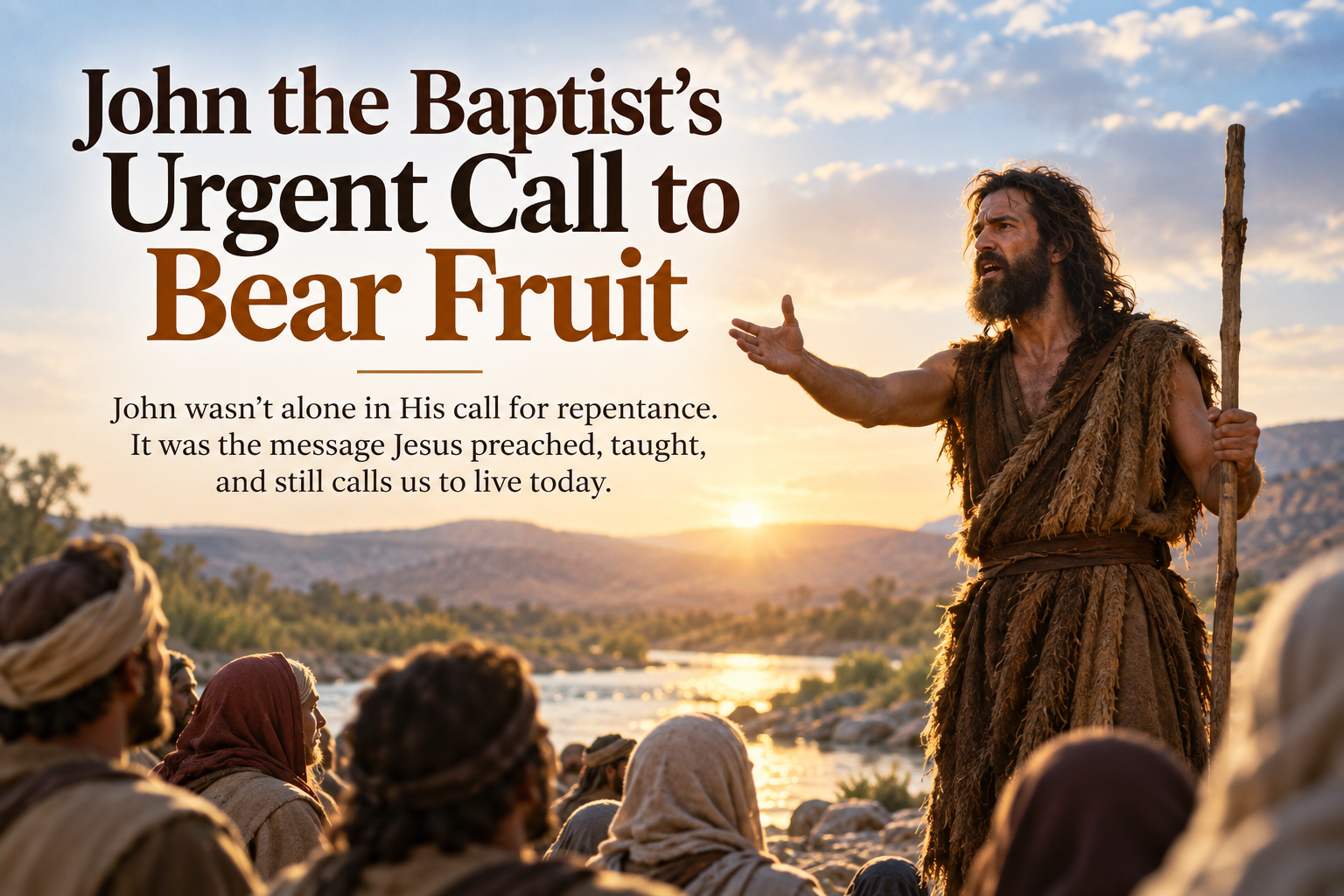
John the Baptist appeared in the wilderness with an urgent message: Repent.
He wasn’t interested in religious appearances, family heritage, titles, or what people claimed to believe. He was looking for evidence that repentance had actually taken place.
When crowds came to him, John confronted them directly:
“You brood of vipers! Who warned you to flee from the coming wrath? Produce fruit in keeping with repentance. And do not begin to say to yourselves, ‘We have Abraham as our father.’ For I tell you that out of these stones God can raise up children for Abraham. The ax is already at the root of the trees, and every tree that does not produce good fruit will be cut down and thrown into the fire.”
Luke 3:7-9
Those are sobering words.
John was telling people that claiming a spiritual heritage was not enough.
They needed to produce fruit in keeping with repentance.
And notice the urgency:
The ax was already at the root.
This wasn’t something to think about someday.
It was time to repent.
What Does Repentance Actually Look Like?
The people listening to John understood the seriousness of what he was saying, so they asked the obvious question:
“What should we do then?”
Luke 3:10
John didn’t give them an abstract theological answer.
He became extremely practical.
“The man with two tunics should share with him who has none, and the one who has food should do the same.”
Luke 3:11
Then tax collectors came to him.
“‘Teacher,’ they asked, ‘what should we do?’
‘Don’t collect any more than you are required to,’ he told them.”
Luke 3:12-13
Then soldiers asked:
“‘And what should we do?’
He replied, ‘Don’t extort money and don’t accuse people falsely, be content with your pay.’”
Luke 3:14
John was naming the sins connected to people’s everyday lives.
To someone with abundance, repentance meant generosity.
To a tax collector, repentance meant financial honesty.
To a soldier possessing authority, repentance meant refusing extortion, false accusations, and greed.
John wasn’t telling them merely to feel bad about sin.
He was telling them to turn from it.
That is fruit in keeping with repentance.
Jesus Taught the Same Thing
John’s message did not disappear when Jesus began His ministry.
Jesus taught the same urgent truth about fruit.
In Matthew 7, Jesus warned about false prophets and said:
“By their fruit you will recognize them.”
Matthew 7:16
He continued:
“Likewise every good tree bears good fruit, but a bad tree bears bad fruit.”
Matthew 7:17
Then Jesus gave a warning remarkably similar to John’s:
“Every tree that does not bear good fruit is cut down and thrown into the fire.”
Matthew 7:19
And again:
“Thus, by their fruit you will recognize them.”
Matthew 7:20
Fruit reveals something.
A person’s words may say one thing.
Their religious identity may say another.
But Jesus tells us to look at the fruit.
Jesus Made It Practical Too
In Matthew 25, Jesus described people standing before Him in judgment.
Again, He pointed to what their lives had actually produced.
He spoke about feeding the hungry.
Giving drink to the thirsty.
Welcoming the stranger.
Clothing those who needed clothes.
Caring for the sick.
Visiting prisoners.
Jesus said:
“Whatever you did for one of the least of these brothers of mine, you did for me.”
Matthew 25:40
Their relationship with Him had affected how they treated people.
That is fruit.
Faith Without Works Is Dead
James makes the point unmistakably clear:
“What good is it, my brothers, if a man claims to have faith but has no deeds? Can such faith save him?”
James 2:14
And then:
“In the same way, faith by itself, if it is not accompanied by action, is dead.”
James 2:17
James isn’t teaching that we can earn salvation by accumulating enough good deeds.
He is exposing a supposed faith that produces nothing.
A living faith produces fruit.
A dead faith doesn’t.
Jesus Takes John’s Tree Analogy Even Further
John spoke about trees.
Jesus takes us directly to the source of the fruit.
In John 15, Jesus says:
“I am the true vine, and my Father is the gardener.”
John 15:1
Then He tells His disciples:
“Remain in me, and I will remain in you. No branch can bear fruit by itself; it must remain in the vine. Neither can you bear fruit unless you remain in me.”
John 15:4
This is where everything comes together.
We cannot manufacture the fruit Jesus desires through human effort.
The branch doesn’t struggle to imitate the vine.
The branch remains connected to the vine.
Jesus continues:
“I am the vine; you are the branches. If a man remains in me and I in him, he will bear much fruit; apart from me you can do nothing.”
John 15:5
Notice what Jesus says.
Not merely fruit.
Much fruit.
And then He gives another sobering warning:
“If anyone does not remain in me, he is like a branch that is thrown away and withers; such branches are picked up, thrown into the fire and burned.”
John 15:6
John said the fruitless tree would be cut down and thrown into the fire.
Jesus said the branch that does not remain in Him withers and is thrown into the fire.
But Jesus also reveals the answer:
Remain in Me.
Abide in Me.
What Would a Modern-Day John the Baptist Sound Like?
Imagine John the Baptist standing in our culture today.
What if people from today’s professions walked out to hear him and asked the same question:
“What should we do then?”
John wouldn’t suddenly become vague.
He would do exactly what he did in Luke 3.
He would address the temptations and sins connected to people’s everyday lives.
To the Banker
Stop using predatory loans to crush struggling families.
Offer honest, fair terms.
Let your repentance affect the way you handle other people’s money.
To the Social Media Influencer
Stop spreading lies, outrage, and deception simply because controversy generates clicks.
Use your influence to build people up with truth.
To the Real Estate Agent
Stop manipulating prices or hiding information to squeeze every possible dollar out of buyers.
Tell the truth.
Deal honestly.
To the Tech Developer
Don’t knowingly design addictive systems that exploit people’s minds simply to increase engagement.
Build technology that serves people rather than enslaving them.
To the Debt Collector
Stop humiliating and threatening people.
Yes, debts matter, but so does the person you are speaking to.
Treat people with dignity.
To the Corporate Executive
Don’t sacrifice hundreds or thousands of workers simply to protect your compensation.
If sacrifice is necessary, share in the sacrifice.
Lead with integrity.
To the Insurance Adjuster
Stop looking for excuses to deny legitimate claims simply to increase company profits.
If something is legitimately owed, pay what is owed.
To the Landlord
Don’t neglect someone’s home while continually increasing the rent.
Maintain safe housing.
Deal fairly with your tenants.
To the Pharmaceutical Representative
Don’t push medications simply because doing so increases commissions or rewards.
Put people’s health ahead of your sales numbers.
To the Nonprofit Fundraiser
Don’t raise money in the name of suffering people and then allow unnecessary overhead to consume what was entrusted to help them.
Steward every gift faithfully.
Make certain the people you said you were helping are actually being helped.
Your Fruit Reveals Your Heart
John’s message wasn’t complicated:
Produce fruit in keeping with repentance.
Jesus’ message wasn’t complicated:
By their fruit you will recognize them.
James’ message wasn’t complicated:
Faith without works is dead.
But Jesus takes us deeper still.
He tells us where the fruit comes from.
The Vine.
You can give money.
You can feed people.
You can volunteer.
You can visit prisoners.
You can behave ethically at work.
You can become known as a generous and moral person.
But without Jesus, none of those things can substitute for being connected to Him.
Jesus said:
“Apart from me you can do nothing.”
John 15:5
The answer isn’t merely:
Try harder.
The answer is:
Abide in Jesus.
When you remain in Him, His life flows through you.
And when His life flows through you, fruit begins to appear.
Your relationships change.
Your business practices change.
The way you use authority changes.
The way you treat people changes.
The way you handle money changes.
The way you respond to temptation changes.
The way you live when nobody is watching changes.
That is why fruit matters.
Fruit doesn’t create the relationship with Jesus. Fruit reveals the life flowing from that relationship.
Are You Abiding in Jesus?
There is a question every follower of Jesus should be willing to ask:
What fruit is my life producing?
Not what do I say I believe?
Not what church do I attend?
Not what did my parents believe?
Not what ministry am I associated with?
Not what Christian words do I know?
What fruit is growing from my life?
John warned his generation not to depend upon being descendants of Abraham.
Jesus warned that fruit reveals the tree.
James warned against a faith consisting only of words.
And Jesus told us exactly how genuine, lasting fruit is produced:
Remain in Him.
If you don’t know how to abide in Jesus, we have a simple abiding plan designed to help you begin spending time with Him, hearing His Word, responding to Him, and learning to remain in His presence throughout your day.
It’s our gift to you at iAbide.org.

Begin Your Journey Today
Jesus didn’t just call us to believe in Him—He called us to follow Him.
Step into the life He designed for you through Emmaus Road’s The Commands of Jesus . This is more than learning—it’s an invitation to walk with Him, obey Him, and experience Him in a real and powerful way.
You don’t want to miss this exciting adventure Jesus has called you into.
Start now:
https://GregLancaster.org/StartHere