



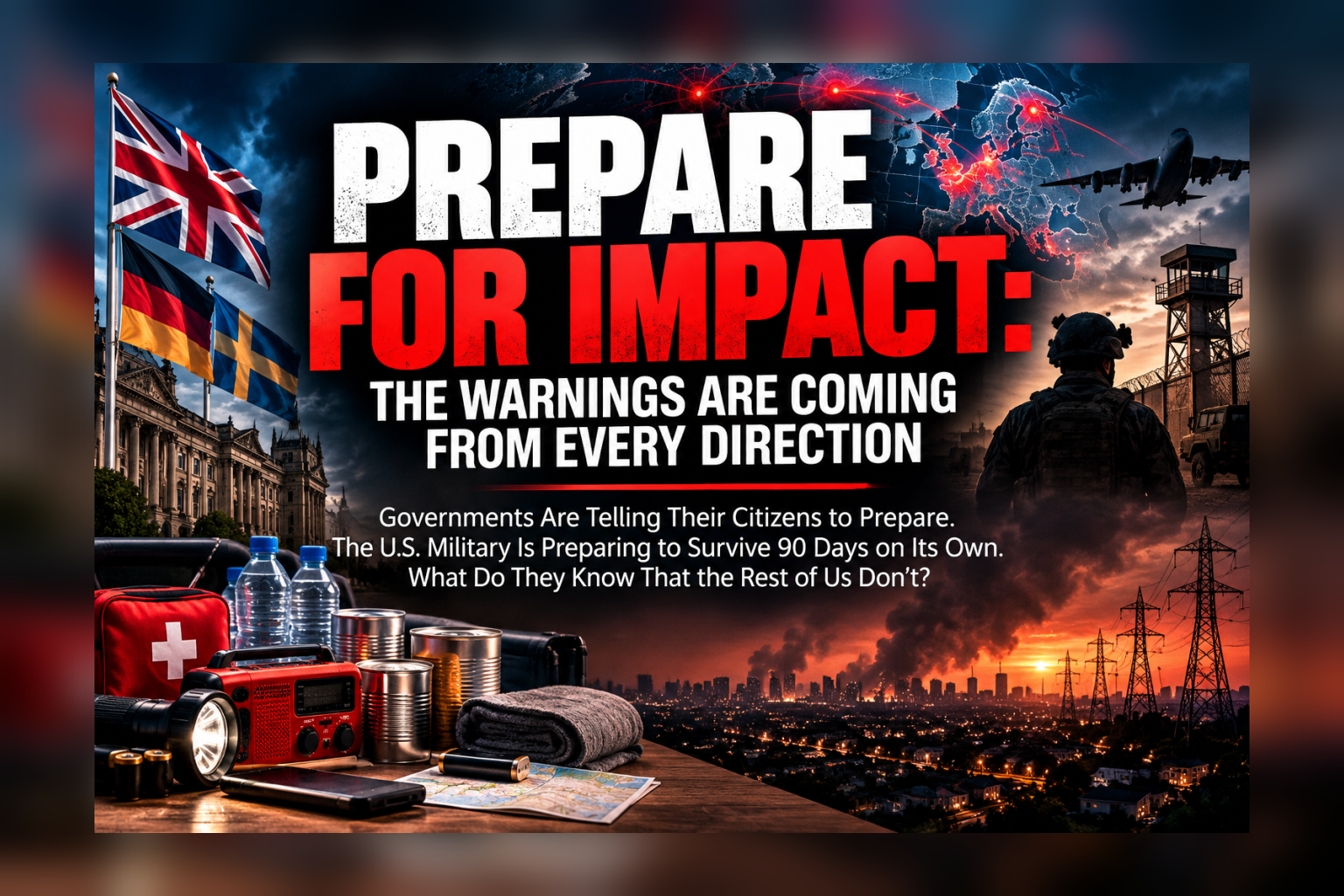
Governments Are Telling Their Citizens to Prepare. The U.S. Military Is Preparing to Survive 90 Days on Its Own. What Do They Know That the Rest of Us Don’t?
Based on a warning delivered by Glenn Beck, examining emergency preparations across Europe, America’s military readiness, threats against Western nations, and why families should take practical steps now without surrendering to fear.
Five Things We Will Learn
- Why governments across Europe are telling their citizens to prepare for emergencies. Britain, Germany, Sweden, and other European nations are emphasizing household preparedness, emergency supplies, and resilience against major disruptions.
- Why the United States military is preparing to operate independently for 90 days. The FORTRESS America initiative raises important questions about the vulnerability of electrical systems, water supplies, communications, fuel, and global supply chains.
- Why threats to national security may look different from traditional warfare. Attacks on infrastructure, suspected foreign intelligence operations, terrorism, cyberattacks, and domestic instability could disrupt ordinary life without a conventional invasion.
- Why history and the experiences of previous generations matter. Those who lived through the Great Depression, world wars, and national emergencies understood how quickly familiar systems could fail.
- How to prepare without living in fear. Families can take practical steps to protect themselves, remain informed, strengthen their households, and continue living their lives without panic.
When Governments Begin Saying the Same Thing, We Should Pay Attention
There are moments when a warning deserves more than a passing glance.
Not because every prediction will come true. Not because every troubling headline means disaster is approaching. And certainly not because we should live in fear.
But when governments across multiple nations begin delivering remarkably similar messages to their citizens, it is worth asking why.
That is the concern behind Glenn Beck’s urgent warning:
Prepare for impact.
Beck says he does not use those words lightly. He recalls a similar period of concern in 2007, before the financial crisis of 2008. He acknowledges that some of his previous warnings have come true and others have not.
He hopes this warning will be one of those that never materialize.
Yet he believes the developments unfolding across Europe and the United States deserve serious attention.
Governments are encouraging households to store emergency supplies. Military leaders are planning for extended disruptions to essential services. Security officials are warning of threats involving foreign intelligence services, terrorism, and vulnerable infrastructure.
Individually, each development may have a reasonable explanation.
But when considered together, they raise a larger question:
Why are so many governments preparing their citizens for a period when ordinary systems may no longer function as expected?
Britain Tells Every Household: Be Ready
On October 22, 2026, the British government launched a national preparedness campaign called Be Ready.
Its message is straightforward. Every household should take practical steps to manage during an emergency that temporarily interrupts essential services.
That includes having enough basic supplies to endure approximately 72 hours without normal access to utilities or other assistance.
The government’s guidance identifies essentials such as drinking water, food that does not require cooking, prescription medications, flashlights, portable radios, batteries, and other household necessities.
It also encourages people to make emergency plans, keep important telephone numbers available, and become familiar with local emergency services.
The campaign explicitly addresses situations involving storms, flooding, power failures, and other disruptions, not solely military conflict.
Britain’s government says its purpose is to improve national resilience and help emergency responders focus on those who need the greatest assistance.
Nevertheless, Beck sees something significant in the timing.
Why now? Why a coordinated national effort? Why are other countries delivering similar instructions?
One reason emergency supplies matter is that major disasters do not always permit immediate assistance to reach every household.
Hurricanes, earthquakes, floods, and widespread power failures can overwhelm transportation networks and emergency personnel.
Hurricane Katrina demonstrated how catastrophic the consequences can become when infrastructure fails and assistance is delayed.
The familiar recommendation to prepare for 72 hours is not a guarantee that help will arrive exactly three days after an emergency. It is a practical starting point for household resilience. Families who want a clear path can begin with Prudent Preparation.
And that leads to Beck’s next concern.
What happens when a disruption lasts longer than three days?
Britain Is Not Alone: Europe Is Preparing
Across Europe, preparedness has become an increasingly prominent government priority.
Germany has encouraged households to maintain emergency supplies for an extended period, often recommending enough provisions for approximately ten days.
France, Ireland, and the Netherlands have also promoted household readiness for at least 72 hours of disruption.
The Dutch have included advice about retaining access to cash.
That detail is particularly important in a society that increasingly depends upon electronic payments.
When was the last time you carried a meaningful amount of cash?
Many people now make nearly every transaction using a credit card, mobile phone, or digital payment service.
Under ordinary circumstances, that convenience is remarkable.
But what happens if the electricity goes out?
What happens if the internet fails?
What happens when payment terminals cannot connect to banking networks?
A family may have sufficient money in its bank account but temporarily lack the means to purchase food, gasoline, or other essentials.
Emergency cash is therefore not necessarily evidence that governments expect banking systems to collapse. It is a practical precaution against payment disruptions.
Yet Beck argues that the growing emphasis on such preparations is worth noticing.
Sweden Returns to Cold War-Era Preparedness
Sweden has also revived and updated public guidance rooted in its long history of civil defense.
The country distributed revised preparedness information addressing emergencies, heightened security threats, and the possibility of war.
The instructions emphasize that national resilience is not exclusively the responsibility of military personnel or elected officials.
Citizens also have responsibilities to their families, neighbors, and communities.
Switzerland has maintained a long-standing culture of civil defense, supported by shelters, emergency planning, and national preparedness systems.
The European Union has similarly called for greater preparedness across member countries.
The significance, according to Beck, is not any single country’s actions.
It is the collective emphasis on the same fundamental reality.
When essential systems are disrupted, ordinary citizens may have to care for themselves and one another before organized assistance becomes available.
Europe is confronting that possibility directly.
FORTRESS AMERICA: (Federal Operations for Resilience, Troop Resources, Energy, Supply, and Survivability)
The concern becomes even more striking when attention turns to the United States military.
On September 30, 2026, the Department of War announced FORTRESS America, a military resilience initiative intended to strengthen the security and operational independence of American military installations.
The initiative includes protection against physical and cyber threats, improved energy resilience, and reduced dependence on vulnerable supply chains.
One of its stated objectives is for major military installations in the continental United States to sustain essential operations independently for at least 90 days.
Think about the implications.
A military installation cannot function merely because its gates are secure and its personnel are present.
It must have electricity.
It must have water.
It must have fuel.
It must maintain communications.
It must obtain food, medicine, equipment, and the supplies necessary to continue its mission.
Modern military bases depend upon extensive civilian infrastructure and commercial supply chains.
Those systems can be interrupted by natural disasters, cyberattacks, sabotage, transportation failures, and military conflict.
FORTRESS America is intended to reduce those vulnerabilities.
Some installations may eventually use advanced energy technologies, including small nuclear reactors, to increase their independence from civilian power networks.
Beck believes the 90-day objective should get every American’s attention.
If the military is preparing to sustain essential operations for three months without outside support, why should American households assume all essential services will always remain available?
There is an important distinction, however. A military resilience objective does not establish that government leaders know a specific war or national collapse is imminent. The initiative represents preparation for possible disruptions, not proof that they will occur.
Still, the underlying vulnerability is real.
Our country depends on systems that are far more interconnected than most people realize.
That 90-day objective should stop every family in its tracks.
FORTRESS America means major military installations in the continental United States are being prepared to sustain essential operations on their own for at least 90 days. Electricity. Water. Fuel. Communications. Food. Medicine. The basic systems that keep a base running, without depending on the same civilian networks the rest of us use every day.
Read that again. Every major installation is preparing to make it for 90 days with no one coming to help it for 90 days. That is not a rumor. It is the announced aim of a Department of War resilience initiative dated September 30, 2026.
If the men and women charged with defending this country are planning to operate for three months without outside support, what does that say to the household that has two days of food and a phone that dies when the power goes out?
You do not need a bunker. You do need a plan. Start with practical steps for your home, and walk through the guidance in Prudent Preparation as you take inventory of water, food, medicine, light, and communications.
Remember What Happened During COVID-19?
During the COVID-19 pandemic, Americans watched ordinary supply chains struggle under extraordinary pressure.
Store shelves were emptied.
Medical supplies became difficult to obtain.
Manufacturing slowed.
Transportation and distribution systems experienced substantial disruptions.
Families discovered that the availability of everyday products depended upon complex networks stretching across the world.
Now imagine those systems being disrupted by military conflict or coordinated attacks on critical infrastructure.
Beck’s warning is that a future emergency could involve far more than temporarily empty shelves.
It could affect power, water, transportation, communications, banking, and access to food simultaneously.
The question is not whether every household must prepare for a 90-day siege.
The question is whether families understand how dependent they have become upon systems over which they have little direct control.
A society can possess extraordinary wealth and advanced technology while remaining vulnerable to the failure of a few essential systems.
RAF Fairford: A Suspicious Incident Near an American Bomber Base
Another development Beck identifies occurred at RAF Fairford in Gloucestershire, England.
RAF Fairford is an important installation for American military aviation. It has supported U.S. bomber operations, including missions associated with the conflict involving Iran.
During the early morning hours of September 27, 2026, suspicious vehicles and masked individuals were reported near the installation.
Police responded and arrested five men.
The investigation was subsequently taken over by British counterterrorism authorities.
On October 27, two 24-year-old British nationals were charged under the United Kingdom’s National Security Act.
Nouman Essghir was charged with an offense involving activity at a prohibited location. Mohmed Ahmad Abdulkarim was charged with assisting a foreign intelligence service.
British counterterrorism officials identified Iran as the country they believed was associated with the alleged foreign intelligence activity.
The charges remain allegations, and the defendants have not been convicted.
This is not merely a theoretical discussion of vulnerabilities.
An actual investigation is underway involving suspicious activity near a military installation used by American forces.
British officials have expressed concern about Iranian-linked operations and other state-directed threats.
Beck points to the incident as evidence of a wider security environment in which governments must increasingly prepare for unconventional attacks.
He also questions whether security officials initially treated the situation with sufficient seriousness and suggests that American bomber movements may have been affected by concerns over the installation’s security.
Those particular interpretations have not been independently established here.
Nevertheless, the confirmed police investigation illustrates the broader concern.
Military installations are not necessarily threatened only by enemy aircraft or missiles. Threats may also emerge much closer to home.
The Threat Is Not Confined to Europe
Beck also draws attention to developments involving American homeland security.
He describes an Avenger air-defense system reportedly positioned on a barge in the Intracoastal Waterway near Mar-a-Lago in Palm Beach, Florida.
According to his account, the system was deployed under the direction of the North American Aerospace Defense Command, or NORAD, at the request of the Secret Service.
An Avenger system is designed to provide short-range air defense against certain aerial threats.
The reported deployment, which requires additional source confirmation, is another example Beck uses to illustrate increased concern about threats that may reach American soil.
But the most consequential warning in this portion of his message concerns Iran.
American Intelligence Warns of Advanced Threats
On October 23, 2026, the U.S. Director of National Intelligence sent a warning to Secretary of State Marco Rubio concerning Iranian efforts to target American personnel and citizens abroad.
The intelligence described increased Iranian activity and indicated that some alleged lethal plots had progressed to advanced stages.
The warning focused on threats in the Middle East and certain other countries. It did not establish that attacks against ordinary Americans inside the United States were imminent.
Beck considers these developments alongside the RAF Fairford investigation and the broader European preparedness campaigns.
He sees a pattern.
Governments are preparing for threats to essential systems. Intelligence agencies are identifying dangerous activity. Military leaders are developing plans to operate during severe disruption.
His concern is that the public may be treating each development as an isolated news story instead of considering what they might collectively reveal about increasing risks.
Our Grandparents Understood Something We Have Forgotten
There is another part of Beck’s warning that deserves attention.
He recalls conversations with his grandparents about the Great Depression.
Like many younger people, he struggled to imagine that the economic disaster his grandparents had experienced could ever happen again.
The nation was different.
Technology was more advanced.
Institutions appeared stronger.
Surely society had learned enough to prevent another collapse.
But his grandfather saw things differently.
Having lived through the Depression, he understood how quickly familiar comforts could disappear.
He knew that banks could fail, jobs could vanish, and families could suddenly find themselves struggling to obtain basic necessities.
Beck remembers his grandfather’s serious response whenever he suggested such conditions could never return.
His grandfather warned him against assuming that modern society was immune from the upheavals experienced by previous generations.
That warning was born from experience.
Our grandparents often kept extra food in their cupboards.
They preserved vegetables.
They knew how to make meals from basic ingredients.
Many maintained gardens, stored supplies, and kept practical tools close at hand.
They did not necessarily call this emergency preparedness.
It was simply part of living responsibly.
They understood that prosperity could be interrupted.
They remembered what happened when people were unprepared.
Today, many households rely on stores being continuously stocked, electricity being continuously available, and electronic payment systems functioning without interruption.
The conveniences of modern life have transformed how we live.
But convenience should not be mistaken for invulnerability.
Sometimes the wisdom of an older generation is not outdated. It is wisdom we have become prosperous enough to forget.
When Leaders See Trouble Coming
Beck’s interpretation of the European preparedness campaigns goes beyond emergency supplies.
He believes Western governments are confronting the consequences of long-standing economic, cultural, and security decisions.
His criticism focuses on several areas.
He argues that parts of Europe have experienced economic stagnation while pursuing energy policies that weakened domestic industrial capacity and increased vulnerability to disruption.
He criticizes governments that, in his view, have failed to invest adequately in national defense.
He also questions immigration and integration policies, arguing that governments have allowed rapid demographic and cultural changes without sufficient consideration of their long-term consequences.
He believes some European leaders have underestimated extremist organizations and ideological movements that openly oppose Western institutions.
These are Beck’s assessments of Europe’s condition and leadership, not conclusions established by the emergency-preparedness campaigns themselves.
The concerns involve complex questions of economics, energy, defense, immigration, security, and national identity. European countries differ considerably in how they have addressed those challenges.
It is also essential to distinguish individuals engaged in actual violence or extremist organizing from peaceful immigrants, religious communities, or people who hold lawful political beliefs.
Beck’s larger argument is that governments sometimes hesitate to acknowledge the consequences of their own decisions.
In his view, public officials are more comfortable distributing preparedness instructions than openly discussing every threat that may have motivated them.
Thus, he sees significance in the pamphlets, emergency announcements, and preparedness campaigns.
To him, these are signs that governments recognize serious vulnerabilities.
The question is whether the public recognizes them as well.
Can an Entire Society Experience a Breakdown?
Beck believes there is a danger that Western societies may experience disruptions they can no longer manage through ordinary means.
He is particularly concerned about the combined effects of economic weakness, social instability, extremist violence, and attacks on essential infrastructure.
He raises the possibility that leaders may discover too late that they cannot control events as effectively as they expected.
This is where his warning becomes especially serious.
Beck fears that large-scale warfare may be approaching.
He does not know its precise timing, location, or form.
He acknowledges that he could be wrong.
And he hopes he is.
But he believes that a major conflict may not begin in the familiar way people imagine.
It may not begin with armored divisions crossing an international border on a particular morning.
Instead, the initial experience for millions of people could be the disruption of everyday life.
The Next Major Conflict May Not Look Like the Last One
When most Americans think about war, they imagine soldiers, tanks, fighter aircraft, naval forces, and battlefields.
Those remain real elements of modern military conflict.
But war can also involve efforts to disable the systems that allow a society to function.
Consider what would happen if a major electrical grid experienced an extended failure.
Homes could lose refrigeration and air conditioning.
Water pumping systems could be affected.
Gas stations might be unable to dispense fuel.
Electronic payment systems could stop functioning.
Hospitals and emergency services might have to depend heavily upon backup power.
Communications could become unreliable.
Transportation networks might face severe interruptions.
Now imagine several of these disruptions occurring together.
A coordinated cyberattack, physical sabotage, or broader military conflict could create consequences far beyond the immediate target.
Beck identifies several categories of potential threats, including attacks on power grids and water systems, suspicious activity near military installations, violence against religious communities, and widespread civil unrest.
He also points to the possibility that extremist groups or foreign intelligence services could exploit moments when government resources are stretched thin.
His warning is not that every such event is necessarily connected.
It is that modern societies contain vulnerabilities that determined adversaries may seek to exploit.
And an attack does not have to destroy an entire nation to disrupt the lives of millions.
When the Government Cannot Immediately Restore Order
Another possibility Beck raises is a severe emergency in which local or national authorities temporarily lack the resources to respond everywhere at once.
During normal times, people expect public services to function.
If someone needs help, they call.
If the electricity fails, they expect crews to restore it.
If a storm damages the roads, they expect repairs.
If disorder breaks out, they expect law enforcement to respond.
But major emergencies can overwhelm response systems.
That is one reason governments recommend households maintain emergency supplies.
It is also why neighbors, churches, families, and local communities matter.
If people are able to care for their immediate needs for several days, emergency personnel can focus their limited resources on the most vulnerable.
Preparedness is not necessarily an expression of distrust in government.
It can also be a way of reducing the burden on emergency responders and making an entire community more resilient.
Why Beck Says He Takes Threats Seriously
Beck recalls another warning he says he delivered during a 1999 radio broadcast in New York City.
According to his recollection, he warned about the possibility of catastrophic terrorist violence involving Osama bin Laden.
He describes predicting buildings and bodies in the streets of New York and connecting that possibility to bin Laden.
The September 11, 2001, terrorist attacks subsequently demonstrated the terrible danger posed by al-Qaeda.
Beck emphasizes that his concern was not based upon secret knowledge.
His stated approach was to listen carefully to what extremist leaders publicly declared they intended to do.
When individuals or organizations repeatedly threaten violence, he believes their statements should be taken seriously rather than dismissed as empty rhetoric.
That principle has practical value, provided there is a clear distinction between actual threats, lawful dissent, and speculation.
A credible threat deserves investigation.
An explicit declaration of violent intent deserves attention.
But identifying a genuine threat also requires evidence, context, and responsible judgment.
Beck acknowledges his own history of predictions that did not come true.
His argument is that the possibility of being wrong should not prevent people from taking reasonable precautions when the consequences of being unprepared could be severe.
His central appeal is simple:
Do not automatically dismiss a warning merely because its implications are uncomfortable.
The Danger of Seeing Only What an Algorithm Allows
Beck also raises a concern about the way Americans receive information.
Modern search engines, social media platforms, and news applications rely heavily on algorithms.
These systems determine which stories appear first, which recommendations users receive, and what content is repeatedly placed before them.
Algorithms can be useful.
They organize enormous amounts of information and help people find what they are seeking.
But ranking systems also influence what people encounter.
Two individuals searching for information about the same event may receive different results depending upon the platform, location, personalization, and methods used to rank content.
Beck encourages people to investigate important issues from more than one source.
He suggests choosing a controversial topic, such as the electricity demands of artificial intelligence data centers and China’s role in emerging energy and technology competition.
Search for the subject on Google.
Then search for the same subject through another search engine.
Compare what appears.
Which articles are prominently displayed?
Which perspectives are emphasized?
Are there credible sources missing from one set of results?
Do the sources agree about the underlying facts even when their interpretations differ?
Beck specifically promotes FreeSpoke, a search platform that advertises access to news across different viewpoints and an emphasis on user privacy.
He says he uses the service because he wants greater control over what he reads and wishes to avoid depending exclusively on Google.
His claims about the comparative privacy and completeness of FreeSpoke’s results are promotional claims, not independently established findings in this article.
Nevertheless, the broader principle is worthwhile.
Do not allow one algorithm, one commentator, or one news organization to become your entire understanding of the world.
Search carefully.
Compare credible sources.
Read primary documents whenever possible.
And distinguish verified information from opinion, advertising, and speculation.
The goal is not merely to discover information that confirms what we already believe.
The goal is to understand what is actually happening.
America's Own Internal Divisions
Beck’s warning also turns toward the United States and the approaching November 3, 2026, election.
He is concerned that Americans may be so occupied with election disputes and domestic disagreements that they overlook threats capable of affecting the entire nation.
He argues that extremist movements can take advantage of national division and political instability.
In the original commentary, Beck criticizes proposals associated with particular political movements, including changes involving the Senate, immigration enforcement, and border policy.
He fears that elected leaders with radical agendas might interpret political victories as permission to make sweeping changes to American institutions.
These are his political judgments and predictions. They should not be confused with established findings about the outcome of an election that has not yet taken place.
He also expresses concern about government power over communication platforms, pointing to disputes involving social media restrictions in countries such as Brazil and France.
He warns of the possibility that governments could restrict access to online information or communications during periods of crisis.
The details and legal circumstances of such measures vary by country, and his claim about an imminent Europe-wide social media shutdown has not been established.
His larger concern is that Americans might underestimate how quickly public institutions and familiar freedoms can come under pressure.
He believes the outcome of elections can influence the country’s direction, but he does not believe an election alone will eliminate all the security and infrastructure threats he has described.
For that reason, he returns repeatedly to the responsibility of individuals and households.
Regardless of who wins an election, families still need to be prepared for emergencies.
Prepare for Impact Does Not Mean Live in Fear
This is perhaps the most important distinction in the entire warning.
Beck is not telling people to abandon their lives.
He is not telling families to stop making plans.
He specifically encourages people to continue preparing for Christmas and Thanksgiving.
Visit relatives.
Enjoy time together.
Continue your responsibilities. When you are ready to take the next practical step, Prepare Now.
Do not allow uncertainty to consume every moment of your life.
But take sensible precautions. Prudent Preparation walks through practical steps without the panic.
Beck compares the warning to a pilot speaking to passengers during an emergency.
When a pilot instructs passengers to brace for impact, the purpose is not to create panic.
The purpose is to prepare them to respond appropriately to a dangerous possibility.
The instruction is direct because the circumstances require attention.
The calmness is intentional because fear can interfere with sound judgment.
Beck wants Americans to approach the present moment in a similar manner.
Stay calm. Stay alert. Make reasonable preparations. Prepare Now if you need a place to begin. Continue living.
If Governments Recommend Three Days, Consider Preparing for Two Weeks
Beck concludes with practical advice.
If governments recommend enough supplies for 72 hours, he suggests preparing for two weeks where financially and physically possible.
This recommendation is his precautionary judgment, not a claim that every household must expect a two-week emergency.
It is also not necessary to purchase everything immediately.
The British government’s own preparedness advice encourages households to build their supplies gradually, according to their resources and individual needs. Prepare Now, according to their resources and individual needs.
Consider the essentials:
- Drinking water. Store sufficient water for the people in your household, remembering that children, pets, and those with medical needs may require additional supplies.
- Food that requires little or no cooking. Choose nonperishable items that your family will actually eat, and keep a manual can opener if needed.
- Necessary medications and first-aid supplies. Maintain an appropriate reserve where permitted and coordinate with healthcare professionals when necessary.
- Flashlights, batteries, and portable lighting. Avoid relying solely on a mobile phone for illumination.
- A battery-powered or wind-up radio. Maintain a way to receive public safety information when electricity or internet service is unavailable.
- Emergency cash. Keep a practical amount in a secure location for situations when electronic payments are disrupted.
- Backup power and charging options. Consider portable power banks and backup batteries for essential communications and medical devices.
- A family communications plan. Know how to contact relatives, where to meet if separated, and what to do if normal communications fail.
- Important documents and contact information. Keep accessible copies of essential records and written telephone numbers.
- A plan to help others. Identify elderly neighbors, people with disabilities, and families who may need additional assistance.
The purpose is not to accumulate supplies out of panic.
The purpose is to make sure a temporary disruption does not immediately become a household crisis.
Preparedness Is Not the Opposite of Faith
For followers of Jesus, there is another important consideration.
Scripture does not teach us to live in fear of tomorrow.
Jesus teaches His disciples not to be consumed by anxiety about their daily needs and reminds them that their heavenly Father knows what they require (Matthew 6:25-34).
But trusting God does not mean ignoring wisdom.
Proverbs 22:3 teaches that a prudent person recognizes danger and takes appropriate precautions, while the inexperienced may proceed without considering the consequences. Scripture puts it this way: “The prudent see danger and take refuge, but the simple keep going and pay the penalty.” (Proverbs 22:3).
Joseph’s leadership in Egypt provides another example.
When Pharaoh received a warning concerning seven years of abundance followed by seven years of famine, Joseph recommended storing food during the prosperous years.
Preparation helped preserve lives when the famine arrived (Genesis 41:33-57).
Joseph did not respond to the warning with helpless fear.
He responded with wise stewardship.
The lesson is not that every modern prediction carries the same authority as Pharaoh’s divinely interpreted dreams.
It is that responsible preparation and trust in God are not mutually exclusive. That is the heart of Prudent Preparation.
Christians can take prudent steps while refusing to surrender their peace to speculation or alarming headlines.
And preparedness should never become an excuse to withdraw from loving others.
Jesus calls His followers to love their neighbors.
That calling remains in times of prosperity and in times of crisis.
If an emergency comes, our responsibility is not merely to have enough for ourselves.
We should also consider how God may use us to help someone else.
A family that is prepared may be better positioned to assist a neighbor.
A church that plans wisely may be better equipped to serve its community.
A believer whose heart is anchored in Christ can offer encouragement when others are overwhelmed with fear.
The Warning Is Serious, but Fear Does Not Have to Be Our Response
There is no verified basis in the developments discussed here to declare that a world war or national collapse is certain or imminent.
The preparedness campaigns, military initiatives, and security investigations are real developments, but they do not collectively prove that a particular catastrophe is approaching on a predetermined schedule.
That distinction matters.
At the same time, emergencies do happen.
Wars do begin.
Infrastructure does fail.
Economic conditions can change.
Natural disasters can interrupt life without warning.
And many families discover too late that they never considered how they would manage without the systems they use every day.
Beck’s appeal is not simply about predicting the future.
It is about the consequences of failing to prepare for possibilities that responsible governments and emergency organizations already recognize.
His warning deserves thoughtful consideration.
Not panic.
Not reckless speculation.
Not suspicion of everyone around us.
Thoughtful consideration followed by responsible action.
Take inventory of your household. Use Prudent Preparation as a checklist for the basics.
Discuss what you would do if the electricity were out for several days.
Review your food, water, medicine, and communications.
Consider whether your family could manage without electronic banking for a short period.
Make a plan.
Help your neighbors.
And continue to live faithfully before God.
Brace for Impact, but Keep Your Eyes on Jesus
There is a great difference between being prepared for trouble and being governed by fear.
We do not know everything tomorrow will bring.
We cannot control every national or international event.
We cannot guarantee that the systems supporting our daily lives will never fail.
But we can exercise wisdom today.
We can prepare our homes.
We can strengthen our families.
We can remain attentive to reliable information.
We can continue loving God, loving others, and leading others to do the same.
Most importantly, we can keep our confidence in Jesus Christ rather than placing our ultimate security in governments, financial institutions, military capabilities, or material supplies.
None of those things can replace our relationship with Him.
The world may experience disruption, but our calling does not change.
Follow Jesus.
Obey His Word.
Love your neighbor.
Remain faithful.
And take reasonable steps to be ready for whatever comes. Prepare Now.
Prepare for impact. Do not panic. Do not stop living. And do not let fear replace your faith.
To continue growing in a life of loving and obeying Jesus, begin The Commands of Jesus through Greg Lancaster Ministries.
GLM
Related Torch Articles
- Ready, Aim… Never Fire: The Difference Between Saying You’ll Follow and Following
- The Cost of Following Jesus: What the Modern Church Has Forgotten
- Have Nothing to Do with Them: Obedience Over Sentiment