



Five Things We Will Learn
- Why Jesus made total surrender a non-negotiable requirement for discipleship.
- How the early church demonstrated radical obedience to Christ’s commands.
- Why the widow’s offering reveals God’s view of true devotion and sacrifice.
- How Martin Luther’s doctrine of faith alone influenced much of modern Protestant Christianity.
- Why genuine faith always produces obedience and how false assurance can lead people astray.
Jesus’ Call to Total Surrender
Jesus made it unmistakably clear:
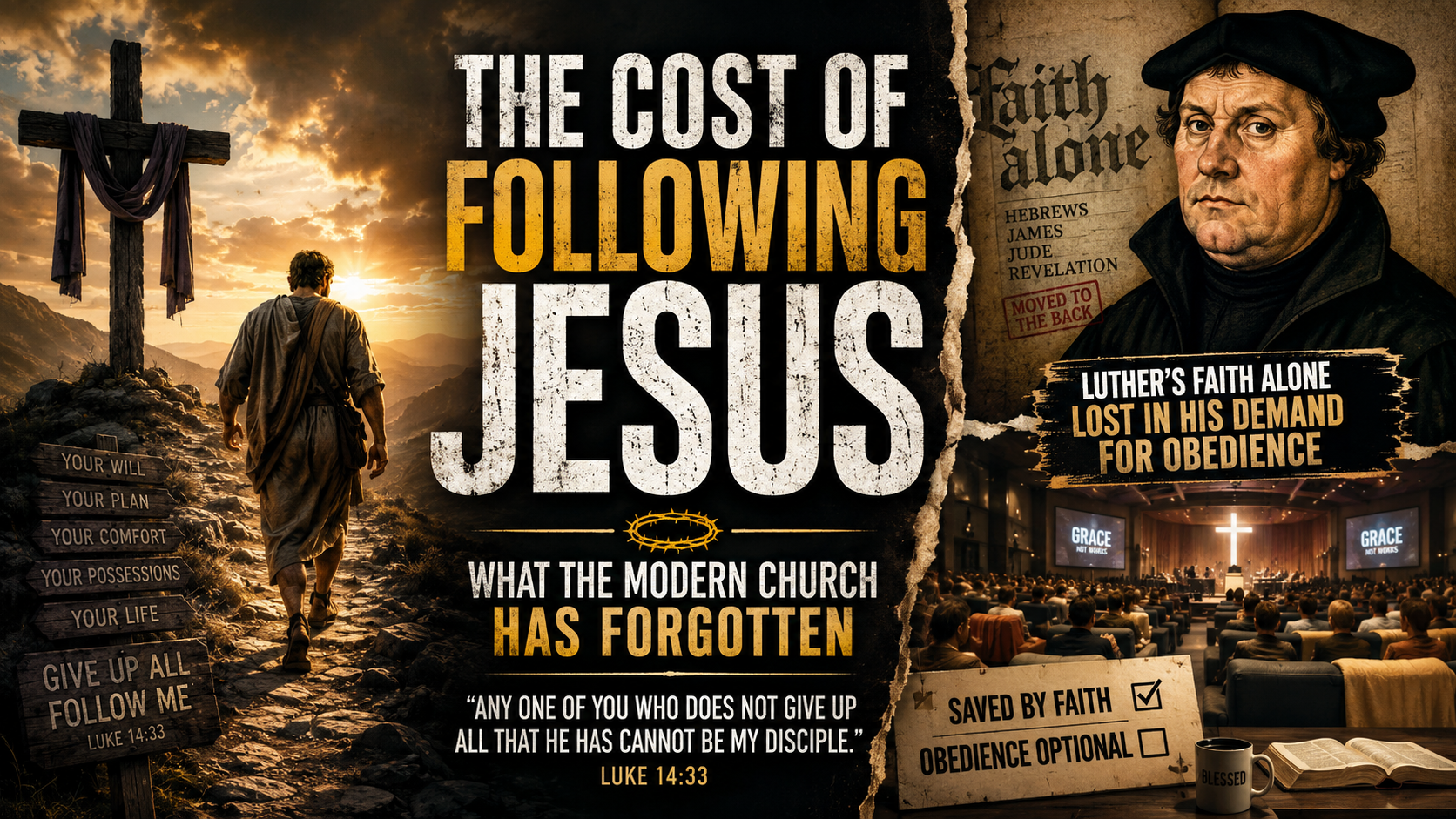
“Any one of you who does not give up all that he has cannot be my disciple.” (Luke 14:33)
This was not a suggestion. It was not a higher calling reserved for a select few. It was not a recommendation for especially committed believers. Jesus presented it as the basic requirement for anyone who desired to follow Him.
The modern church often emphasizes what Jesus will give us, but Jesus consistently emphasized what it would cost to follow Him. He called people to surrender everything, including possessions, ambitions, relationships, reputations, and even their own lives.
The gospel invitation is glorious, but it is also costly. Jesus never hid that reality from those who listened to Him.
The Early Church’s Radical Obedience
The first believers took Jesus at His word.
After Pentecost, the church did not merely agree with Jesus intellectually. They obeyed Him practically.
The book of Acts records believers selling possessions and bringing the proceeds to the apostles for distribution among those in need. They lived with a profound awareness that everything they possessed belonged to God.
This atmosphere of surrender created fertile ground for the work of the Holy Spirit. Miracles occurred. Lives were transformed. The fear of God rested upon the people. The church expanded rapidly.
Their power was not rooted in programs, marketing, or institutional strength. It flowed from obedience.
The early believers understood something many modern Christians have forgotten: Jesus is not merely Savior. He is Lord.
The Widow’s Total Offering
Jesus once sat near the temple treasury and watched people place their offerings into the collection boxes.
Many wealthy individuals gave large amounts. Yet Jesus pointed His disciples toward a poor widow who placed only two small coins into the offering.
From a human perspective, her gift appeared insignificant.
Jesus saw it differently.
He declared that she had given more than all the others because they gave out of their abundance while she gave out of her poverty.
She gave everything she had.
The widow’s offering demonstrates that God measures sacrifice differently than people do. Heaven is not impressed by percentages or comparisons. God looks at the heart and at what remains after the gift is given.
Her example reflects the same total surrender Jesus required of His disciples.
The Root of the Problem: Martin Luther’s Legacy
Much of today’s shallow Christianity traces back to Martin Luther’s strong emphasis on “faith alone.”
Luther preached justification by faith alone, a doctrine that became foundational to the Protestant Reformation. However, many critics argue that later generations took this teaching far beyond what Scripture intended.
Luther himself demanded strict adherence to his teachings and supported the use of state power against certain groups who opposed him.
Even more significantly, Luther downgraded four books of the New Testament: Hebrews, James, Jude, and Revelation. He moved them to the back of his Bible, did not include them in the table of contents, and famously referred to the book of James as “an epistle of straw” because it challenged his understanding of faith alone.
These books contain some of the strongest New Testament teachings regarding perseverance, obedience, judgment, and holy living.
James, in particular, directly confronts the idea that faith can exist independently of obedience.
Modern Protestants have often retained only a small portion of Luther’s teaching, emphasizing “faith alone” while neglecting the biblical emphasis on surrender, holiness, and obedience.
The result has frequently been a version of Christianity that assures people they are eternally secure regardless of how they live after professing faith.
The Hypocrisy of Selective Obedience
One of the greatest dangers in the church is selective obedience.
Many who strongly defend faith alone simultaneously ignore commands that directly confront their own lifestyles.
Some condemn the sins of others while overlooking areas where Jesus explicitly called them to repentance.
For example, some who are on a second or third marriage while a former spouse remains living will strongly oppose other forms of sexual immorality while refusing to consider Jesus’ own warnings concerning adultery and remarriage.
This creates a dangerous inconsistency.
People often demand obedience from others while excusing disobedience in themselves.
Jesus repeatedly confronted this tendency among the religious leaders of His day. They were skilled at identifying sin in others but unwilling to examine their own hearts.
True discipleship requires submission to all of Christ’s teachings, not merely the ones we find convenient.
False Assurance and the Final Judgment
Perhaps the greatest tragedy of easy-believism is the false assurance it provides.
Millions have been taught that because they once prayed a prayer, walked an aisle, or made a profession of faith, their eternal destiny is secure regardless of how they live afterward.
Yet Jesus issued a sobering warning:
“Many will say to me on that day, ‘Lord, Lord, did we not prophesy in your name…?’”
His response is equally sobering:
“I never knew you. Away from me, you evildoers!” (Matthew 7:21-23)
These were not atheists speaking to Jesus.
These were religious people who believed they belonged to Him.
Jesus’ concern was not merely what they claimed. It was how they lived.
When individuals who openly practice serious sin die, many of the same teachers who previously assured them of salvation often reverse course and say, “Well, they were never saved anyway.”
This response can feel both cruel and dishonest because it ignores the role that false assurance may have played in convincing people that obedience was unnecessary.
What Real Faith Looks Like
Real faith is not perfection.
The Apostle Paul openly described his struggle with sin in Romans 7. He acknowledged the conflict between his desire to obey God and the weakness of his flesh.
But Paul never made peace with sin.
He fought against it.
He grieved over it.
He longed for deliverance from it.
That is the difference between genuine faith and false faith.
True believers may stumble, but they do not embrace rebellion as a lifestyle.
James addressed this issue directly:
“Faith without deeds is dead.” (James 2:26)
James was not teaching salvation by works. He was teaching that authentic faith inevitably produces evidence.
A living faith works.
A dead faith does not.
Jesus and James stand in complete agreement.
Both teach that genuine faith produces obedience.
The Call Remains the Same
Jesus has never lowered His standard.
His call remains exactly what it was when He first spoke it:
“Any one of you who does not give up all that he has cannot be my disciple.”
The early church experienced extraordinary manifestations of God’s presence because they responded to that call with wholehearted obedience.
They surrendered everything.
They held nothing back.
They understood that Jesus was worthy of complete devotion.
If believers today desire the same power, presence, and transformation that marked the early church, the path remains unchanged.
The call is not to greater comfort.
The call is not to greater convenience.
The call is not to a faith that costs nothing.
The call is to total surrender.
And Jesus has never asked for anything less.
Begin Your Journey Today
Jesus didn’t just call us to believe in Him—He called us to follow Him.
Step into the life He designed for you through Emmaus Road’s The Commands of Jesus. This is more than learning—it’s an invitation to walk with Him, obey Him, and experience Him in a real and powerful way.
You don’t want to miss this exciting adventure Jesus has called you into.
Start now:
https://GregLancaster.org/StartHere
Secondary Scholarly Sources
- The Gospel Coalition – Reflections on Luther and James (detailed analysis with quotes).
- Catholicism.org – The Epistle of Straw (includes full context from Luther’s preface).
- Stanford Encyclopedia of Philosophy – Martin Luther (detailed on justification, works, Two Kingdoms, and politics). https://plato.stanford.edu/entries/luther/
- Catholic World Report: “Martin Luther: Father of modern liberty or political absolutism?” (discusses sola fide vs. state power). https://www.catholicworldreport.com/2017/10/29/martin-luther-father-of-modern-liberty-or-political-absolutism/
- Journal of Lutheran Ethics – The Two Governments and the Two Kingdoms (explains the doctrine). https://learn.elca.org/jle/the-two-governments-and-the-two-kingdoms-in-luthers-thought/
- Phillip Schaff, History of the Christian Church, Vol. 7 (Peasants’ War and Luther’s response). https://ccel.org/ccel/schaff/hcc7/hcc7.iii.xiv.html (Peasants’ War section)
- Luther’s Works (American Edition) overview/search: https://www.cph.org/search?keywords=luther%27s%20works
- Weimar Edition (original German, public domain): https://archive.org/details/werkekritischege (multiple volumes)