



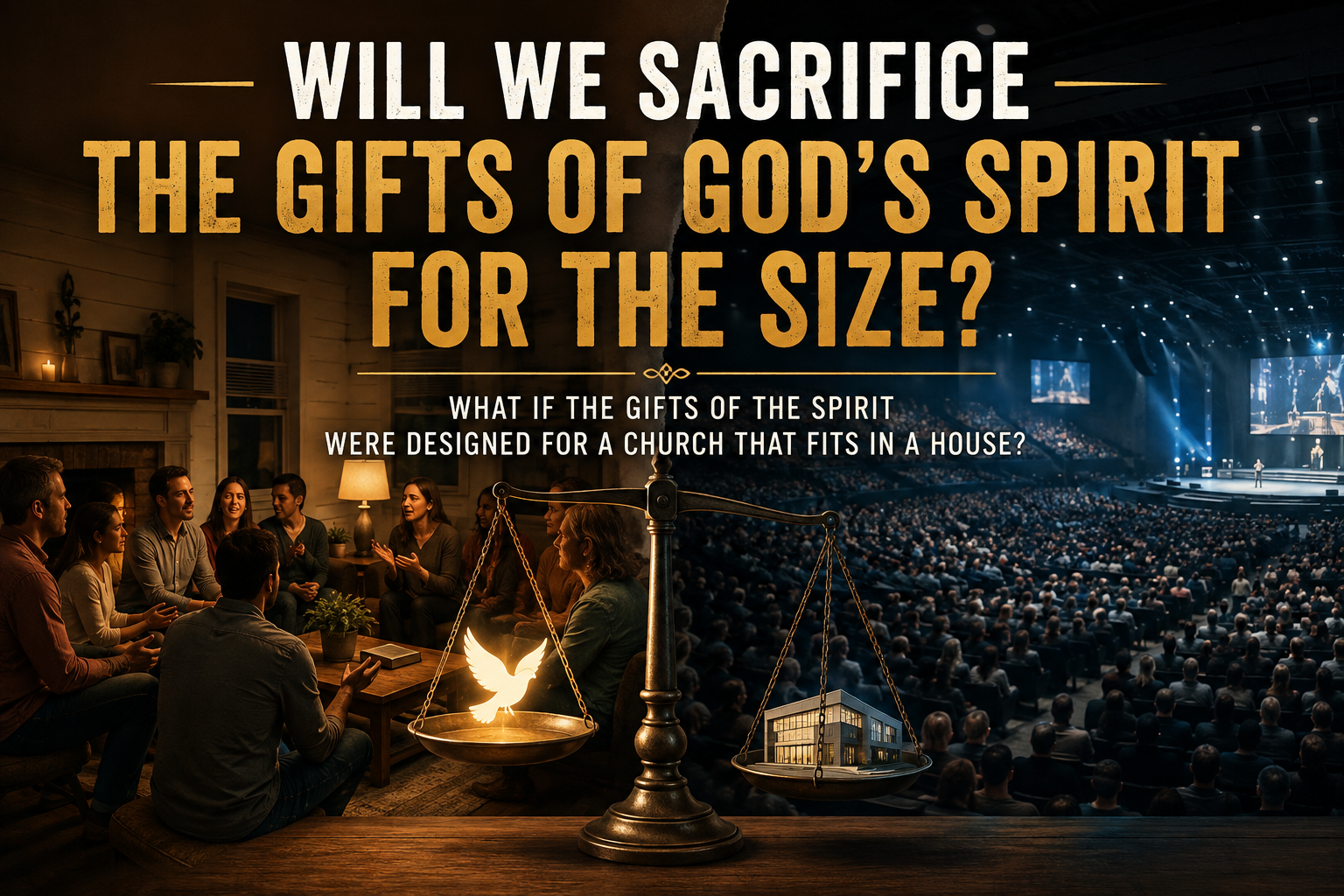
Five Things We Will Learn
- Why the size and structure of a church gathering can affect how the gifts of the Holy Spirit function.
- Why biblical order does not require restraining or quenching the Holy Spirit.
- How Jesus and the early church modeled multiplication through smaller, relational gatherings.
- Why healthy relationships and biblical accountability, rather than the size of a gathering, are the real safeguards for spiritual gifts.
- Why the church must consider whether maintaining large gatherings is worth limiting gifts God gave for building up His body.
The Question Is Bigger Than Tongues
In a recent episode of Live Free with Josh Howerton, Pastors Josh Howerton, Paul Cunningham, and Carlos Erazo addressed the gifts of the Holy Spirit. While much of the conversation focused on tongues as a case study, one of the spiritual gifts of the Holy Spirit, the deeper issue they raised applies far beyond any single gift.
The question is how the church makes room for the full range of the Spirit’s gifts, prophecy, healing, words of knowledge, discernment, tongues with interpretation, and more, especially in light of the size and structure of our gatherings.
They were careful and biblical. They refused both disorder and denial. They affirmed that the gifts are real, that Scripture says “do not forbid” them, and that everything must be done decently and in order.
Yet an important tension surfaced.
Paul Cunningham noted how difficult it is to apply the interactive instructions of First Corinthians 14 to modern large gatherings. Certain gifts operate most naturally in a church that meets in a house, where people know one another and can respond in real time.
Josh Howerton described a kind of “two-key system” in smaller gatherings, in which God might give a word to one person and the interpretation or confirmation to another in the room. That dynamic fits a home. It becomes far more complicated in a service of thousands.
Josh made the practical application clear. He said that if someone planned to walk into a Lakepointe service and begin speaking in tongues in the middle of the gathering, “we will gently escort you out,” because Scripture gives instruction for how these things should and should not happen in the church.
What Happens When the Gathering Becomes Too Large for the Gifts?
Their conversation effectively affirmed a hard reality: if you want the fullness of the Holy Spirit and the gifts spoken of in the Book of Acts that operated in the early church, those gifts are more likely to be present and active in a church that can fit in a house than in one the size of a shopping center.
That raises a deeper question.
Who are we to tell God’s Spirit, the Holy Spirit, what He can or cannot do?
It is His church, not ours.
Jesus said, “I will build my church” (Matthew 16:18). We are to follow Him; He is not to follow us.
Those who are led by the Spirit of God are sons of God (Romans 8:14).
And by the way, He will not follow us. He will simply leave.
Scripture warns us plainly:
“Do not quench the Spirit” (1 Thessalonians 5:19).
I would rather have a few with God’s Spirit free to do what He wants than millions with God’s Spirit restrained or quenched.
Crazy Happens Anywhere People Are
Many argue that if you allow the Holy Spirit to move freely, things will get crazy and people will do bad things, because you cannot trust people.
They say the only safe way is to gather everyone into one large place through addition, because people cannot be trusted on their own or in smaller gatherings.
So they cannot trust people and the Holy Spirit in mega gatherings, and they cannot trust people in smaller gatherings either.
It begins to look like it is not people they cannot trust.
It is God and His Spirit.
The same Holy Spirit who hovered over the deep in Genesis 1 and formed the earth, the same Spirit who overshadowed Mary and planted the seed of God in her womb for His Son, is somehow now too risky to trust with mankind.
If you have studied history or even recent news, it does not matter how big the gatherings are or how small they are. Sinful men still sin.
Yet that has never stopped the church from moving forward.
This Is Primarily a Mega-Church Problem
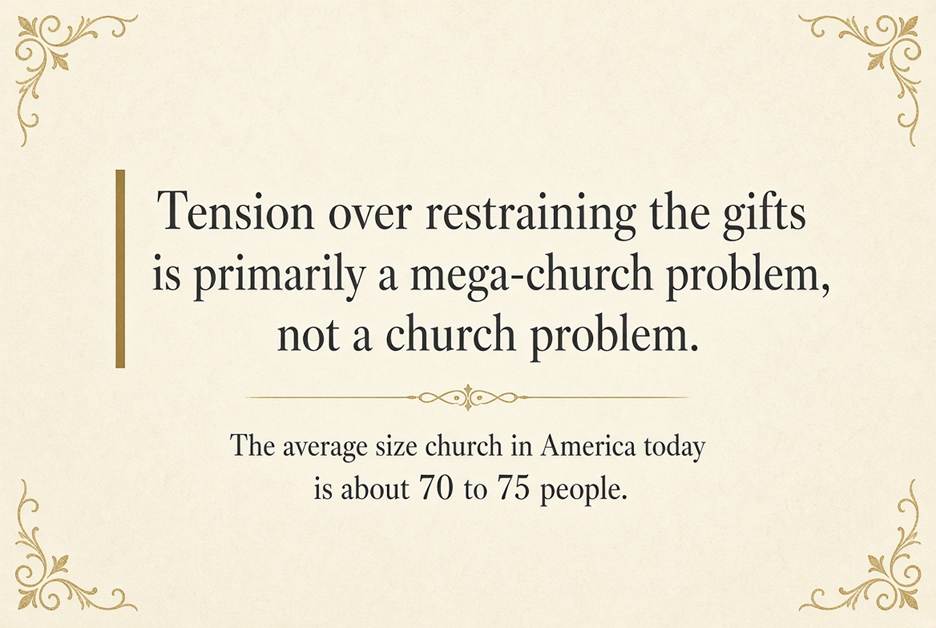
Here is the truth we need to face: the average size church in America today is about 70 to 75 people. That is the median. The vast majority of congregations are already in that range.
Most churches could already exist in the size range where relational accountability and the free operation of the gifts can more naturally coexist.
This tension over restraining the gifts is primarily a mega-church problem, not a church problem.
Yes, the gifts are subject to the prophets. Scripture says:
“The spirits of prophets are subject to prophets” (1 Corinthians 14:32).
But the same prophet can prevent what the Holy Spirit wants to do if that prophet is afraid to let Him operate.
Balaam Shows Us the Danger of Resisting God
Balaam is the classic warning.
He was a prophet who heard from God, yet his divided heart and love of gain kept him from fully aligning with what the Spirit was determined to do.
Jude warns of those who “abandoned themselves for the sake of gain to Balaam’s error” (Jude 11).
God still spoke through him, but Balaam’s resistance shows how easily a prophet can hinder the very movement he is called to steward.
Jesus Built Through Multiplication, Not Just Addition
Look at Jesus.
He taught crowds, but His primary work was with the twelve. He poured into a small group of men who lived with Him and were shaped by Him. From that relational core the church multiplied.
Those who only see growth through addition, getting bigger and bigger, miss Jesus’ way of multiplication.
Both are forms of growth, but they are not the same.
Multiplication is where Jesus gets all the glory.
It is like a Vine (John 15) that grows wherever the Son leads it.
Man gets the glory when he builds a taller and taller tower.
In Genesis the people said:
“Come, let us build ourselves a city and a tower with its top in the heavens, and let us make a name for ourselves” (Genesis 11:4).
God confused their languages and scattered them because they trusted their own leadership of the world instead of His.
The Early Church Followed Jesus’ Pattern
The early church followed Jesus’ pattern.
They met in houses.
The gifts flowed in those intimate gatherings, prophecy, healing, words of knowledge, discernment, tongues with interpretation, because people knew one another.
Accountability was relational, not merely structural.
Billy Graham Saw It Coming
Billy Graham saw this direction decades ago.
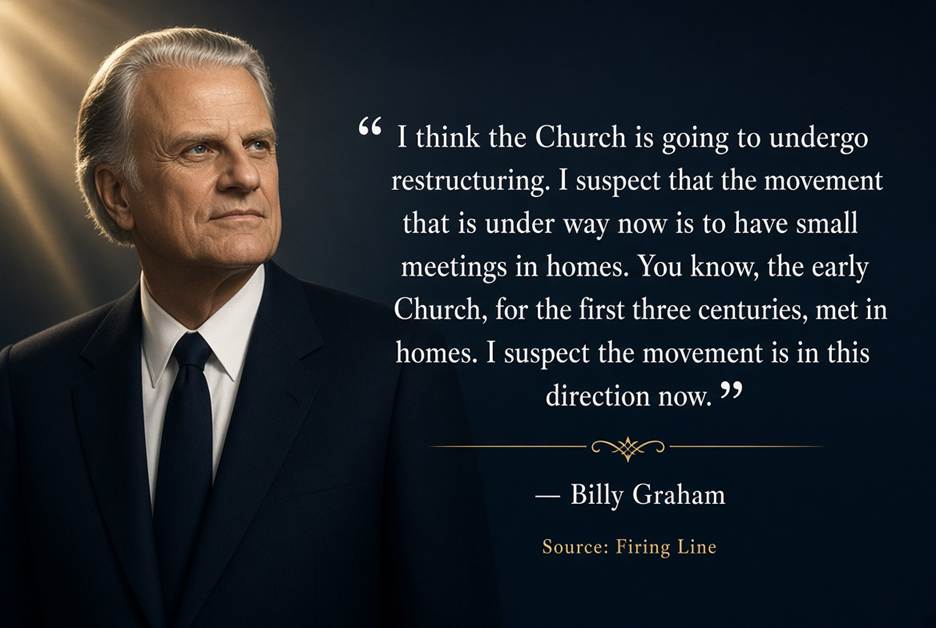
In a 1969 Firing Line interview with William F. Buckley Jr., he said:
“I think the Church is going to undergo restructuring. I suspect that the movement that is under way now is to have small meetings in homes. You know, the early Church, for the first three centuries, met in homes. I suspect the movement is in this direction now. In coming to New York two years ago we found more than a thousand of these groups already meeting. Since then four thousand more groups have emerged so that now there’s about 5,000 groups just in New York.”
He continued:
“The Christians are going to have to get back to the early Church of realizing that we’re living in a hostile secularism and paganism that has enveloped our country, and that we’re going to have to come to small groups and live dedicated, disciplined lives that we might even suffer persecution.”
First Corinthians Assumes Participation
Paul’s instructions in First Corinthians assume the same environment.
The gifts are given for the building up of the body. They function best where people can know one another, test what is said, and respond in love.
The expectation is regulated participation in a community small enough and relational enough for the gifts to edify rather than confuse.
The real safeguard has never been the size of the room.
It is healthy, vital relationships.
When people know one another, love one another, and can speak into one another’s lives, the Spirit’s gifts can operate with both freedom and safety.
We Need All the Gifts
We need all the gifts.
The Holy Spirit is the One who teaches, corrects, convicts, and draws people to Jesus. We are simply the ones who follow His leading and stay in right relationship with one another.
When we restrict the environment in which those gifts can function, we may keep the service smooth, but we also risk quenching what the Spirit desires to do among us.
The choice is not between order and chaos. Paul already settled that.
The choice is whether we will continue to shape the church primarily around large gatherings that, by their very nature, limit certain expressions of the Spirit, or whether we will also cultivate the smaller, relational contexts, churches that meet in homes, discipleship groups, where the full range of gifts can operate as they did in the beginning.
Jesus started with twelve.
The church was birthed in houses.
The gifts were given for the building up of the body.
It is His church. Who are we to tell His Spirit what He is allowed to do?
Jesus didn’t just call us to believe in Him—He called us to follow Him.
Step into the life He designed for you through Emmaus Road’s The Commands of Jesus. This is more than learning—it’s an invitation to walk with Him, obey Him, and experience Him in a real and powerful way.
You don’t want to miss this exciting adventure Jesus has called you into.
Start now:
https://GregLancaster.org/StartHere