



Five Things We Will Learn
- How ancient civilizations achieved extraordinary things while worshipping false gods.
- Why technological advancement does not establish a civilization’s allegiance to God.
- What Scripture records about Satan’s offer of authority and splendor to Jesus.
- How the pursuit of artificial intelligence raises questions about power, obedience, and worship.
- Why Jesus’ refusal of Satan’s bargain challenges us to examine our own allegiance.
Great Achievements, but at What Cost?
A civilization can build something extraordinary while bowing before something false. Its achievements may demonstrate skill, organization, and intelligence. They do not establish that it worships the true God (Romans 1:21-25).
We can stand in awe of what people have built and overlook whom they served. We can admire their knowledge, their architecture, and their influence without asking what governed their hearts.
That question matters when we look at ancient civilizations. It matters just as much when we look at ourselves.
Egypt: Precision in Stone, Idolatry in Worship
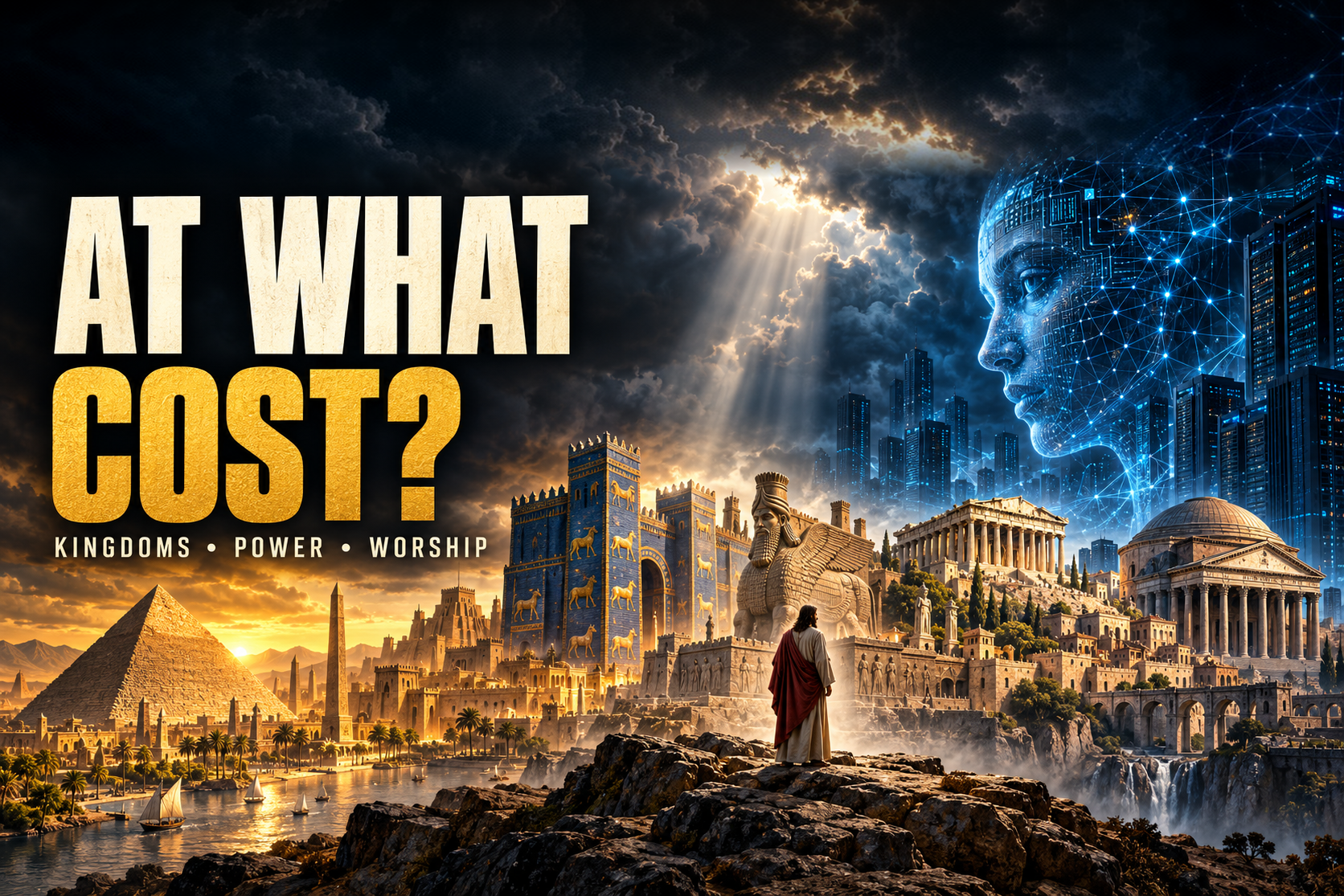
Consider Egypt. The Great Pyramid of Giza contains an estimated 2.3 million stone blocks, some weighing more than fifty tons. Its builders aligned that enormous structure to within one-tenth of a degree of true north, roughly 4,500 years ago, long before laser levels existed. These were people who could move mountains of stone and place them with astonishing precision.
Egypt also produced the Edwin Smith Surgical Papyrus, a surviving medical manuscript from about 1600 BC containing forty-eight cases of wounds and trauma, organized around examination, diagnosis, prognosis, and treatment. Its descriptions include injuries involving the brain and spinal cord.
At Karnak, Egyptians raised an immense complex of temples and chapels where Amun was worshipped. Medical knowledge and monumental construction existed alongside idolatry.
When Pharaoh was confronted with the Lord’s command, his response revealed the issue: he did not acknowledge the Lord or obey Him (Exodus 5:2).
Their ability to build did not mean they were willing to bow before God.
Babylon: Knowledge Could Not Prevent Judgment
Consider Babylon. Its Ishtar Gate formed a monumental entrance into the city. Babylonian scholars developed sophisticated mathematics using a base-sixty system and applied mathematical methods to astronomy. That tradition helped shape the way we still divide time and measure circles. Their intellectual accomplishments were substantial.
Hammurabi’s monument preserved 282 legal judgments carved into black basalt, addressing matters of property, family, commerce, and punishment.
Yet centuries later, Daniel records a Babylonian king praising gods of gold, silver, bronze, iron, wood, and stone while failing to honor the God who held his life in His hand (Daniel 5:4, 22-23).
The writing appeared on the wall. His kingdom was weighed, found wanting, and pronounced divided and given to the Medes and Persians. That very night, Belshazzar was killed (Daniel 5:24-30).
Babylon’s accomplishments could not protect its king from accountability before God.
Assyria: Organized Power and a Proud Heart
Consider Assyria. Its military power was recorded in the Lachish reliefs from Sennacherib’s palace, depicting an assault on a fortified city. Its imperial administration maintained a network of roads and relay stations that carried royal messages across its territories. This was an empire that understood how to coordinate power, move information, and impose its will.
At Nineveh, the Assyrian king Ashurbanipal assembled a vast library. Approximately 32,000 surviving clay tablets and fragments are associated with the collection.
Assyria could gather knowledge while its rulers boasted of conquest. Scripture describes the Assyrian king attributing his victories to his own strength and wisdom, and God confronting that arrogance (Isaiah 10:12-15).
An empire could organize its communications and preserve its learning while its ruler failed to recognize the limits of his own authority.
Greece: Learning Among the Idols
Consider Greece. The Parthenon incorporated subtle curves, carefully adjusted proportions, and slightly swelling columns into its design. Euclid’s Elements became one of history’s most enduring mathematical works. Athens developed a form of democracy whose courts placed consequential decisions before large citizen juries. Greek accomplishments in architecture, mathematics, and government helped shape generations that followed.
Yet when Paul walked through Athens, he saw a city full of idols (Acts 17:16).
Their learning had not brought them to worship the God who made the world and everything in it. Paul called them to repent and spoke of the coming judgment through the Man God had raised from the dead (Acts 17:24-31).
They had much to discuss. They still needed to respond to God.
Rome: Engineering That Endured, a Savior Crucified
Consider Rome. Roman builders developed marine concrete whose surviving structures have endured seawater for approximately two thousand years. The Pantheon’s concrete dome, spanning more than forty-three meters, remains the largest unreinforced concrete dome in the world. Rome’s engineering still commands attention nineteen centuries later.
And under a Roman governor, Roman soldiers crucified Jesus (Matthew 27:24-35).
A civilization capable of extraordinary construction still participated in the crucifixion of the Son of God.
Artificial Intelligence: What Are We Willing to Surrender?
Now consider our own generation.
We are developing artificial intelligence while pursuing what is called artificial general intelligence and discussing artificial superintelligence. But at what cost? What are we willing to surrender for greater capability, greater control, and greater power?
Have people taken Satan up on his offer, seeking power in exchange for their allegiance? Could technology become another instrument through which that temptation operates?
Those questions deserve examination, and Scripture answers them. These nations did not serve the true God. They bowed before idols, and Paul tells us that the sacrifices of pagans are offered to demons, not to God (1 Corinthians 10:20). Satan told Jesus plainly what he gives to those who worship him: “I will give you all their authority and splendor; it has been given to me, and I can give it to anyone I want to” (Luke 4:6). Egypt, Babylon, Assyria, Greece, and Rome made that choice. They gave their worship to false gods, and they were given kingdoms, power, authority, and discoveries, just as we have read. Yet every one of them fell, and none of their achievements could save them.
And Scripture records that same offer being made to Jesus.
The Offer Jesus Refused
In the wilderness, Satan showed Jesus the kingdoms of the world and their splendor. He offered authority and glory in exchange for worship. Jesus rejected him and declared that worship and service belong to God alone (Matthew 4:8-10; Luke 4:5-8).
That is the transaction we must recognize: power offered in exchange for worship.
The temptation does not become harmless because it arrives through something impressive. Jesus asked what a person gains by obtaining the whole world while forfeiting his soul (Mark 8:36-37).
A civilization can build higher, calculate faster, organize more efficiently, and command greater power while refusing to honor God. Its achievements cannot answer the question of its allegiance.
The same examination belongs in our own lives. When gaining influence requires disobedience, what do we choose? When an opportunity demands that we compromise our allegiance to Jesus, how do we respond? When something promises more power, do we first ask whether pursuing it honors God?
Jesus connected love for Him with obedience to His commands (John 14:15).
Who receives our worship? Who receives our obedience?
Satan offered Jesus the kingdoms and their splendor.
Jesus refused the bargain. Will we?
Image: Generated by GLM
GLM
Related Reading
- AI, Work, and Manhood: Don’t Let the Tool Take the Man
- The Partnership That Divides Us: Memory, Technology, and the Coming Choice
- The Great Disconnect: Why Digital Isolation Is the New Idolatry
- The Digital Delilah
Begin Your Journey Today
Jesus didn’t just call us to believe in Him—He called us to follow Him.
Step into the life He designed for you through Emmaus Road’s The Commands of Jesus . This is more than learning—it’s an invitation to walk with Him, obey Him, and experience Him in a real and powerful way.
You don’t want to miss this exciting adventure Jesus has called you into.
Start now:
https://GregLancaster.org/StartHere