



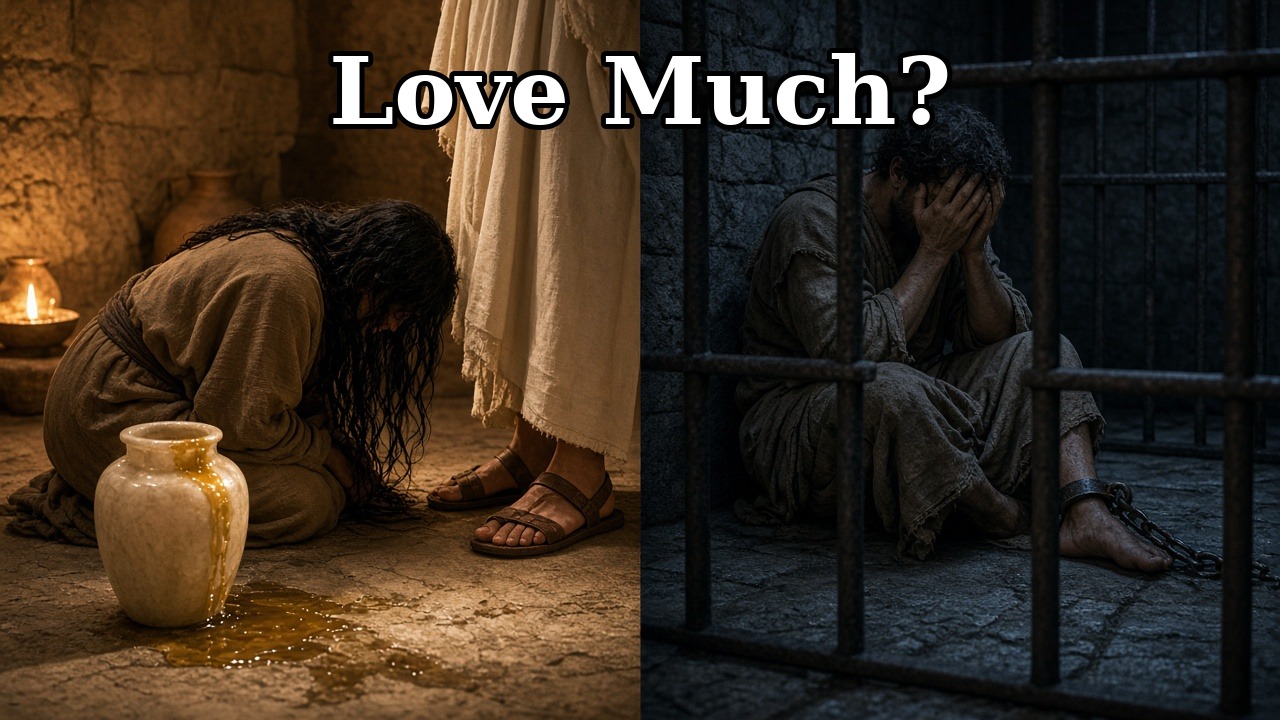
Two people in the Gospels received the same gift. One remembered it. One forgot it. The difference between them is the difference between a life of love and a life of torment.
One poured out her tears and her perfume at the feet of Jesus. The other walked out of the king’s presence debt free and went straight for a fellow servant’s throat. Their stories sit side by side as a mirror, and every one of us is standing in front of it.
Five Things We Will Learn
- Why the woman in Luke 7 loved so much, and what her tears, her hair, and her perfume tell us about remembering what we have been forgiven.
- How the servant in Matthew 18 forgot a debt of ten thousand talents and choked a man over a hundred denarii.
- What Jesus plainly said about the Father’s forgiveness and our forgiveness of others.
- Why the torment is discipline, not abandonment, and what that discipline is meant to produce.
- How to walk out of the jailer’s hands: forgive others, forgive God, and forgive yourself.
The Woman Who Remembered
The first is the woman in Luke seven. She came into Simon the Pharisee’s house carrying an alabaster jar of perfume, stood behind Jesus at his feet weeping, wet his feet with her tears, wiped them with her hair, kissed them, and poured out the perfume. Simon watched and thought, “If this man were a prophet, he would know who is touching him and what kind of woman she is, that she is a sinner.”
Luke 7:36-39 (NIV)
Read Luke 7:36-39 in the NIV on BibleGateway
Jesus answered him with a parable. Two people owed money to a moneylender. One owed five hundred denarii, the other fifty. Neither could pay, so the moneylender forgave both debts. “Which of them will love him more?” Simon said, “I suppose the one who had the bigger debt forgiven.” Jesus said, “You have judged correctly.”
Luke 7:40-43 (NIV)
Read Luke 7:40-43 in the NIV on BibleGateway
Then he turned toward the woman and said to Simon, “Do you see this woman? I came into your house. You did not give me any water for my feet, but she wet my feet with her tears and wiped them with her hair. You did not give me a kiss, but this woman, from the time I entered, has not stopped kissing my feet. You did not put oil on my head, but she has poured perfume on my feet. Therefore, I tell you, her many sins have been forgiven, as her great love has shown. But whoever has been forgiven little loves little.”
Then Jesus said to her, “Your sins are forgiven.” The other guests began to say among themselves, “Who is this who even forgives sins?” Jesus said to the woman, “Your faith has saved you; go in peace.”
Luke 7:44-50 (NIV)
Read Luke 7:44-50 in the NIV on BibleGateway
She had been forgiven much, and she knew it. Her tears, her hair, her perfume: all of it was the overflow of a debt she could never repay. She remembered what had been done for her, and the memory produced love without hesitation.
That is why I wrote years ago that you can’t receive love until you forgive. Love and forgiveness flow through the same channel. Close one and you close the other.

The Servant Who Forgot
The second is the servant in Matthew eighteen. A king settled accounts with his servants and found one who owed him ten thousand talents, an amount no servant could ever repay. The servant fell on his knees and begged, “Be patient with me, and I will pay back everything.” The king took pity on him, canceled the debt, and let him go.
Matthew 18:21-27 (NIV)
Read Matthew 18:21-27 in the NIV on BibleGateway
But that same servant went out and found a fellow servant who owed him a hundred denarii, a fraction of what he had been forgiven. He grabbed him and began to choke him. “Pay back what you owe me!” The fellow servant fell to his knees and begged, “Be patient with me, and I will pay it back.” But he refused. Instead, he went off and had the man thrown into prison until he could pay the debt.
Matthew 18:28-30 (NIV)
Read Matthew 18:28-30 in the NIV on BibleGateway
When the other servants saw what had happened, they were greatly distressed and went and told their master everything. Then the master called the servant in. “You wicked servant,” he said, “I canceled all that debt of yours because you begged me to. Shouldn’t you have had mercy on your fellow servant just as I had on you?” In anger his master handed him over to the jailers to be tortured, until he should pay back all he owed.
Matthew 18:31-34 (NIV)
Read Matthew 18:31-34 in the NIV on BibleGateway
Notice how it started. Someone owed him something, and he took offense. That is exactly how the enemy baits us, which is why I warned, don’t fall for the offense trap.
What Jesus Plainly Said
Then Jesus said, “This is how my heavenly Father will treat each of you unless you forgive your brother from your heart.”
Matthew 18:35 (NIV)
Read Matthew 18:35 in the NIV on BibleGateway
And he said it even more directly in Matthew six: “For if you forgive men when they sin against you, your heavenly Father will also forgive you. But if you do not forgive men their sins, your Father will not forgive your sins.”
Matthew 6:14-15 (NIV)
Read Matthew 6:14-15 in the NIV on BibleGateway
Jesus is the king in this parable, and he is saying plainly: I want to forgive you, but you have to forgive. He will not forgive the one who refuses to forgive. If you have ever wrestled with that question, read Will God forgive you? Dealing with forgiveness, and the two part series Unhinged Forgiveness (Part 2).
The Torment Is Discipline, and the Discipline Has a Purpose
The torment is not abandonment. It is the king pursuing the servant’s soul, releasing him to the jailers so the misery will finally drive him to do what he should have done from the start: forgive. The torment is discipline, and the discipline has a purpose: to bring him to repentance, so that he can be forgiven.
Hebrews twelve says, “No discipline seems pleasant at the time, but painful. Later on, however, it produces a harvest of righteousness and peace for those who have been trained by it.” And, “God is treating you as sons. For what son is not disciplined by his father?”
Hebrews 12:5-11 (NIV)
Read Hebrews 12:5-11 in the NIV on BibleGateway
The torment is not the point. The repentance is. The discipline is God treating you as a son, bringing you back to the place the woman in Luke seven already stood: humble, at his feet, grateful, knowing he is the source of love, forgiveness, and everything.
Understanding how God loves us, even in His correction, keeps resentment from taking root, as I shared in How God Loves Us Is Important to Understand to Keep Resentment from Building Up in Our Hearts. And when repentance comes, it bears fruit you can see, which is the heart of The Fruit of Repentance.

Forgive Others, Forgive God, Forgive Yourself
So consider this: if you feel like you’ve lived a life of torment, miserable at work, miserable at home, miserable at school, miserable with the family, miserable without the family, miserable in this job, miserable in that job, you are just tormented. Consider the possibility that you’ve been released to the tormentor because you refuse to forgive others.
Forgive others. Forgive God. Forgive yourself.
The door out of that prison is the same door the woman walked through in Simon’s house. There is freedom, forgiveness and healing waiting on the other side of it.
Ephesians 4:31-32 (NIV)
Read Ephesians 4:31-32 in the NIV on BibleGateway
The woman remembered what she had been given, and it set her free. The servant forgot, and it cost him everything.
Which one will you be today?
Father, thank You for forgiving a debt I could never repay. Show me anyone I am still holding by the throat. I release them now, from my heart. I let go of every accusation I have held against You, and I receive Your forgiveness for myself. Bring me back to Your feet, humble and grateful, and let my life overflow with love. In Jesus’ name, amen.
Begin Your Journey Today
Jesus didn’t just call us to believe in Him. He called us to follow Him.
Step into the life He designed for you through Emmaus Road’s The Commands of Jesus. This is more than learning. It is an invitation to walk with Him, obey Him, and experience Him in a real and powerful way.
You don’t want to miss this exciting adventure Jesus has called you into.
Start your journey with The Commands of Jesus
Related Reading
You Can’t Receive Love Until You Forgive; Start with Forgiving Yourself.
UNHINGED FORGIVENESS, Part 1 and Part 2.
Freedom, Forgiveness and Healing.
Scripture quotations are taken from the Holy Bible, New International Version®, NIV®. Copyright © 1973, 1978, 1984, 2011 by Biblica, Inc.™ Used by permission of Zondervan. All rights reserved worldwide. www.zondervan.com. The “NIV” and “New International Version” are trademarks registered in the United States Patent and Trademark Office by Biblica, Inc.™