



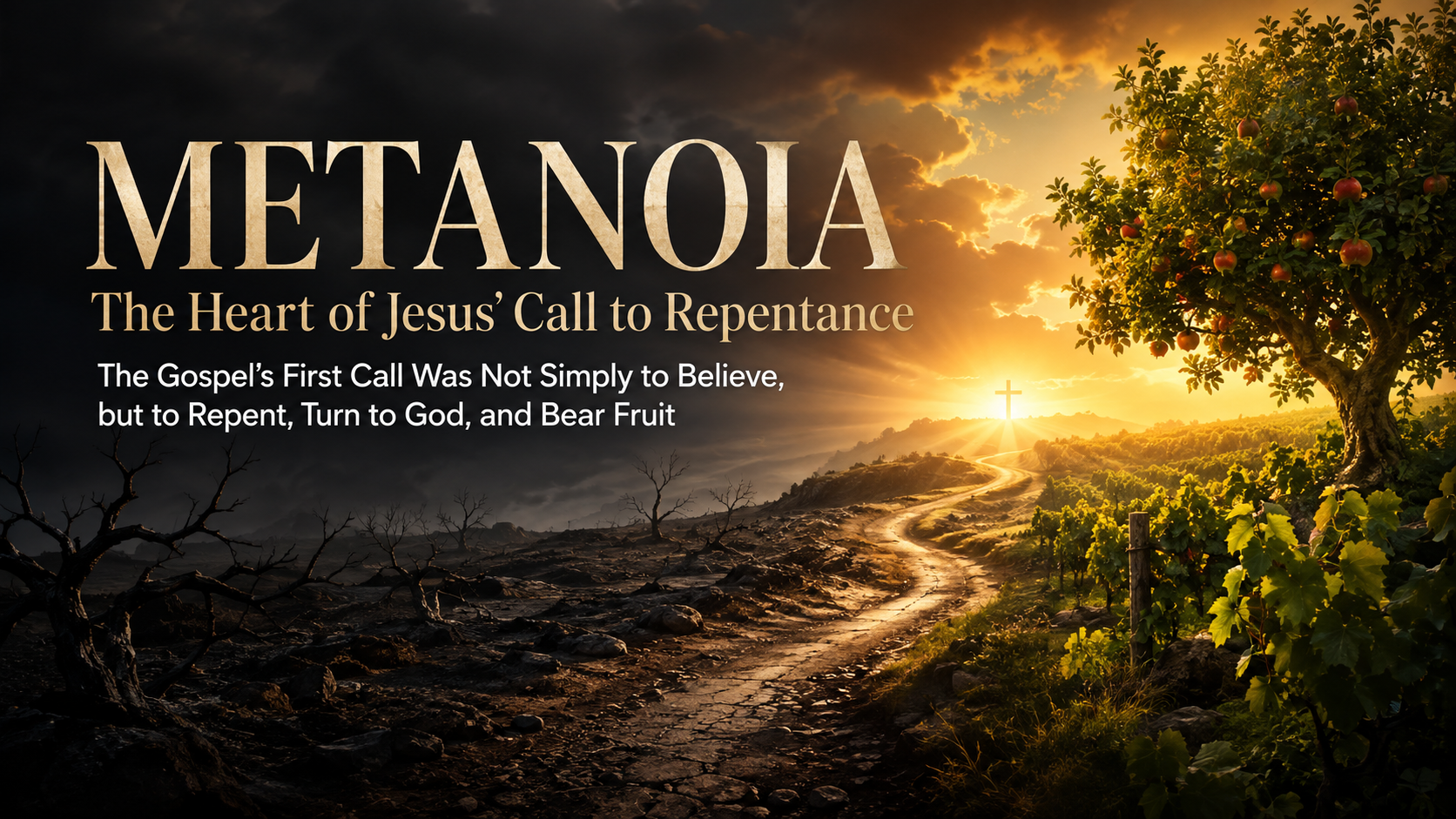
Five Things We Will Learn
- Metanoia is a profound change of mind and heart that reorients our lives toward God.
- Genuine repentance produces visible fruit, not merely religious words or emotional sorrow.
- People often resist repentance because they love darkness and do not want their deeds exposed.
- Believers and entire churches must continue repenting whenever they drift from Christ.
- Metanoia begins the transformed life, but abiding in Jesus is what enables us to remain alive and fruitful.
More Than Feeling Sorry
Metanoia is the heart of Jesus’ call to repentance. It is not merely feeling sorry about something we have done. It is a profound change of mind and heart that produces a complete reorientation of our lives toward God.
The Greek word metanoia, commonly translated “repentance,” carries the idea of a change of mind. Biblically, however, this change reaches far beyond our thoughts. It changes our direction, our conduct, our priorities, and ultimately the fruit our lives produce.
Jesus said:
“For I have not come to call the righteous, but sinners.”
Matthew 9:13, NIV 1984
Some manuscripts and translations add the words “to repentance.” Although the NIV 1984 does not include that phrase in Matthew 9:13, Jesus’ mission is clear throughout the Gospels: He came to call sinners away from sin and into a transformed life with God.
Jesus declared:
“The time has come,” he said. “The kingdom of God is near. Repent and believe the good news!”
Mark 1:15, NIV 1984
Repentance is not an optional addition to the gospel. It stands at the heart of Jesus’ message.
Repentance Was the Gospel’s Opening Message
The Greek word family associated with metanoia appears 58 times in the New Testament. The verb metanoeō, meaning “to repent,” appears 34 times, while the noun metanoia, meaning “repentance,” appears 24 times.
Jesus personally used this Greek word family approximately 14 times in the four Gospels. When His direct words to the churches in Revelation are included, the total rises to approximately 20 times. Jesus also taught the substance of repentance without always using these specific Greek words, so the theme is even more extensive than the count suggests.
The number is significant, but the placement of the message is even more powerful. Repentance stood at the beginning of every major stage in the advancement of the gospel.
John the Baptist Began With Repentance
John the Baptist prepared the way for Jesus with this message:
“Repent, for the kingdom of heaven is near.”
Matthew 3:2, NIV 1984
John did not begin by telling people merely to accept a new religious idea. He called them to change direction because the kingdom of heaven was near.
Jesus Began With Repentance
When Jesus began His public ministry, He proclaimed the same message:
“From that time on Jesus began to preach, ‘Repent, for the kingdom of heaven is near.’”
Matthew 4:17, NIV 1984
Mark records Jesus’ opening proclamation this way:
“‘The time has come,’ he said. ‘The kingdom of God is near. Repent and believe the good news!’”
Mark 1:15, NIV 1984
Repentance and believing the good news were not competing messages. They belonged together. Repentance meant turning from sin, while faith meant turning toward Jesus and submitting to His lordship.
The Apostles Preached Repentance
When Jesus sent out the Twelve, they continued preaching the same message:
“They went out and preached that people should repent.”
Mark 6:12, NIV 1984
Jesus did not commission His disciples to offer people an unchanged life with the promise of heaven added to it. They called people to repent.
Peter’s First Message Called for Repentance
After the Holy Spirit was poured out at Pentecost, Peter preached the crucifixion and resurrection of Jesus. The people were cut to the heart and asked what they should do.
Peter answered:
“Repent and be baptized, every one of you, in the name of Jesus Christ for the forgiveness of your sins.”
Acts 2:38, NIV 1984
The first public message preached after the birth of the New Testament Church called people to metanoia.
Peter repeated this message shortly afterward:
“Repent, then, and turn to God, so that your sins may be wiped out.”
Acts 3:19, NIV 1984
The gospel called people to repent and turn to God. It was a change of allegiance, direction, and life.
Paul Preached Repentance That Produced Deeds
When Paul summarized his ministry before King Agrippa, he explained:
“First to those in Damascus, then to those in Jerusalem and in all Judea, and to the Gentiles also, I preached that they should repent and turn to God and prove their repentance by their deeds.”
Acts 26:20, NIV 1984
Paul did not preach that deeds earned salvation. He taught that genuine repentance would be proven by what it produced. A changed life was the fruit and evidence of a changed heart.
Jesus Commanded That Repentance Be Preached to All Nations
Following His resurrection, Jesus explained what His disciples were to proclaim:
“Repentance and forgiveness of sins will be preached in his name to all nations, beginning at Jerusalem.”
Luke 24:47, NIV 1984
Repentance was not an outdated message for Israel before the cross. Jesus placed repentance at the center of the worldwide mission He gave His disciples after His resurrection.
The pattern running through the New Testament is unmistakable:
John preached repentance.
Jesus preached repentance.
The Twelve preached repentance.
Peter preached repentance at Pentecost.
Paul preached repentance to Jews and Gentiles.
Jesus commanded that repentance and forgiveness be preached to every nation.
Metanoia was not a minor doctrine hidden in the New Testament. It was the opening call of the gospel, the message entrusted to the apostles, and the necessary response of everyone who would follow Jesus.
Metanoia Is a Continuing Transformation
Metanoia is not merely a one-time emotional experience. It is the beginning of an ongoing life of transformation, surrender, and obedience.
A person may experience a decisive moment of repentance, but following Jesus requires continually allowing Him to change our minds, correct our direction, and transform our conduct. Whenever His light exposes something in us that does not agree with Him, we must respond by turning away from it and returning to Him.
This is not an attempt to earn salvation through human effort. It is the continuing response of someone who has encountered Jesus and desires to remain surrendered to Him.
True repentance changes the direction of a life.
True Repentance Produces Fruit
John the Baptist refused to accept religious claims without corresponding evidence. He told the people:
“Produce fruit in keeping with repentance.”
Matthew 3:8, NIV 1984
He then issued a sobering warning:
“The ax is already at the root of the trees, and every tree that does not produce good fruit will be cut down and thrown into the fire.”
Matthew 3:10, NIV 1984
True metanoia always bears fruit. A change of mind that produces no change in direction is not the repentance proclaimed by Jesus and John the Baptist.
Jesus taught the same truth:
“By their fruit you will recognize them.”
Matthew 7:16, NIV 1984
He continued:
“Likewise every good tree bears good fruit, but a bad tree bears bad fruit. A good tree cannot bear bad fruit, and a bad tree cannot bear good fruit.”
Matthew 7:17–18, NIV 1984
The ultimate test is not what someone claims, the religious words they use, or the experience they say they once had. The test is what their life produces.
Repentance produces the fruit of obedience, humility, holiness, love, forgiveness, and faithfulness to Jesus.
The Cost of Refusing Metanoia
Why would anyone reject the light and refuse the opportunity to be transformed?
Jesus gave the answer:
“This is the verdict: Light has come into the world, but men loved darkness instead of light because their deeds were evil.”
John 3:19, NIV 1984
People do not always reject Jesus because the truth is unclear. Sometimes they reject Him because His light exposes what they do not want to surrender.
Metanoia requires us to leave the darkness. It calls us to agree with God about our sin, turn away from it, and step into His light. Those who refuse repentance are choosing darkness over the life Jesus offers.
The cost of metanoia is surrender. The cost of refusing metanoia is far greater.
A Warning to the Church
The call to repentance is not only for people outside the Church. Jesus also commands churches and believers to repent when they drift away from Him.
The church in Ephesus had worked hard, persevered, rejected wickedness, and tested false apostles. Yet Jesus said:
“Yet I hold this against you: You have forsaken your first love. Remember the height from which you have fallen! Repent and do the things you did at first. If you do not repent, I will come to you and remove your lampstand from its place.”
Revelation 2:4–5, NIV 1984
A church can maintain activity, doctrine, and outward discipline while losing its first love for Jesus.
Jesus did not tell the Ephesians merely to remember the past. He told them to repent and return to what they had done at first. Their renewed love needed to become visible through renewed obedience.
This warning reveals that someone can genuinely turn toward Christ and later begin returning to former patterns. Past repentance does not give us permission to ignore present disobedience.
Whenever we drift, Jesus calls us to remember, repent, and return.
The Sobering Warning in Hebrews
Hebrews contains one of Scripture’s gravest warnings:
“It is impossible for those who have once been enlightened, who have tasted the heavenly gift, who have shared in the Holy Spirit, who have tasted the goodness of the word of God and the powers of the coming age, if they fall away, to be brought back to repentance, because to their loss they are crucifying the Son of God all over again and subjecting him to public disgrace.”
Hebrews 6:4–6, NIV 1984
Christians have long debated every theological implication of this passage, but its warning must not be weakened. It describes people who experienced profound spiritual realities and then fell away.
The passage warns us against treating an encounter with God casually. It confronts the dangerous assumption that a past experience makes our present relationship with Christ unimportant.
We must not use theological arguments to make ourselves comfortable with what Scripture plainly warns us against. We are called to continue in faith, remain responsive to God, and hold firmly to Christ.
Metanoia Must Lead to Abiding
Metanoia turns us toward Jesus, but abiding in Jesus keeps us spiritually alive.
Jesus said:
“If anyone does not remain in me, he is like a branch that is thrown away and withers; such branches are picked up, thrown into the fire and burned.”
John 15:6, NIV 1984
The NIV 1984 uses the word “remain,” while other translations use “abide.” Both communicate the continuing relationship Jesus requires.
Fruit does not grow because a branch struggles harder. Fruit grows because the branch remains connected to the vine.
In the same way, spiritual fruit does not come from trying harder in our own strength. It grows from our living relationship with Jesus, the true vine. Apart from Him, we can do nothing.
Metanoia is not simply turning away from something. It is turning toward Someone. We turn from sin so that we may remain in Christ.
The Modern Distortion of Repentance
Somewhere along the way, the profound call to metanoia was often reduced to repeating a sinner’s prayer.
Prayer itself is not the problem. A genuine prayer of repentance and faith can express a sincere turning of the heart toward God. The danger comes when repeating certain words is presented as a substitute for repentance, surrender, discipleship, and abiding in Christ.
Historical research cited by church historian David Bennett identifies a printed form of the sinner’s prayer in Albert Gage’s 1922 book Evangelism of Youth. The practice later became much more widespread through twentieth-century mass evangelism, particularly Billy Graham’s crusades and Bill Bright’s Four Spiritual Laws. Historians generally describe this as a developing practice that became a major form of evangelism around 1960. Historical overview from 9Marks
The concern is not that people prayed at these events. Nor should this erase the genuine fruit that came through evangelists who faithfully proclaimed Christ. The concern is what later generations sometimes did with the method.
What was intended to help people respond to the gospel could become a quick transaction. People could be assured that repeating a prayer settled everything, even when there was no continuing surrender, discipleship, obedience, or fruit.
Jesus did not merely call people to repeat words. He called them to repent, believe, follow Him, remain in Him, obey His commands, and bear fruit.
Metanoia Is Not Extreme
Preaching genuine repentance may now cause someone to be labeled a zealot or a “holy roller.” Calling people to turn from sin, obey Jesus, and bear fruit can be portrayed as extreme.
But metanoia is not religious extremism. It is simply taking Jesus at His word.
Jesus did not call us to add Him to an otherwise unchanged life. He calls us to lose our old lives in order to find life in Him. He calls us out of darkness and into light. He calls us away from barrenness and into fruitfulness. He calls us to deny ourselves, take up our cross, and follow Him.
The gospel is not a quick transaction that leaves us unchanged. It is the power of God bringing us into an entirely new life.
The Continuing Call to Return
Metanoia begins when we agree with God, turn from sin, and reorient our lives toward Him. It continues as we remain responsive to His voice, accept His correction, and abide in Christ.
The evidence of metanoia is fruit.
The safeguard of metanoia is abiding.
The alternative to metanoia is remaining in darkness.
Jesus is still calling sinners to repent. He is still calling drifting believers to return. He is still calling churches to recover their first love.
Metanoia is not an optional part of Christianity. It is not extreme, outdated, or legalistic.
It is the heart of Jesus’ call.
It is the gospel itself.
Jesus didn’t just call us to believe in Him—He called us to follow Him.
Step into the life He designed for you through Emmaus Road’s The Commands of Jesus. This is more than learning—it’s an invitation to walk with Him, obey Him, and experience Him in a real and powerful way.
You don’t want to miss this exciting adventure Jesus has called you into.
Start now:
https://GregLancaster.org/StartHere