



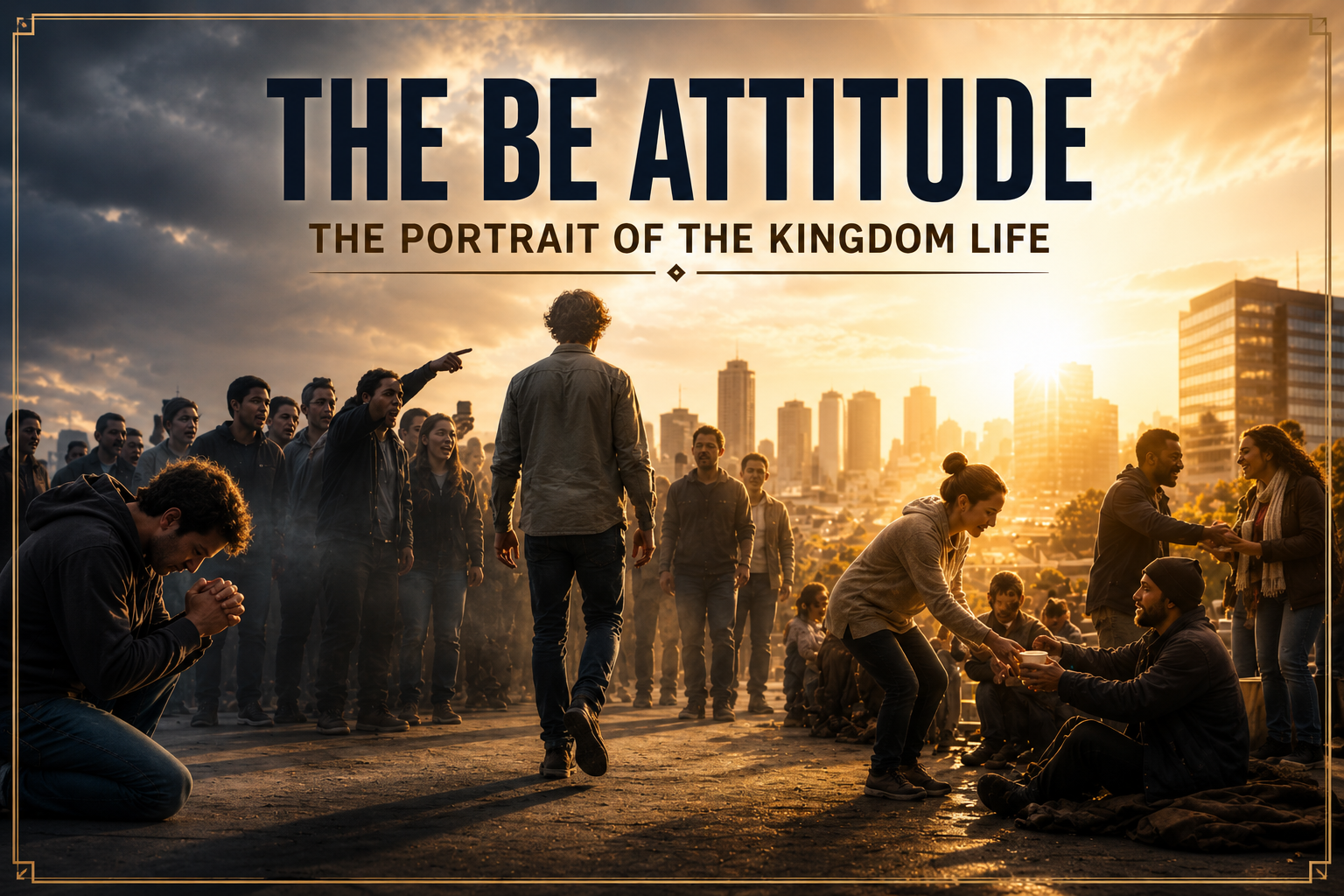
Five Things We Will Learn
- The Kingdom Begins with Total Dependence on God
We will see that the starting point of the kingdom life is becoming “poor in spirit,” recognizing we bring nothing to God and must depend on Him completely. - True Repentance Flows from Seeing Our Condition Clearly
We will understand how mourning over sin is not weakness but the necessary response to spiritual awareness, leading to real repentance and God’s comfort. - Strength Under God’s Control Is the Path to Inheritance
We will learn that meekness is not weakness but power submitted to God, positioning us to inherit what He has promised. - A Transformed Heart Produces a Transformed Life
We will discover how hunger for righteousness, mercy, purity, and peacemaking are not isolated traits but the outward evidence of an inward transformation. - Living This Way Will Lead to Persecution—but Also Eternal Reward
We will see that persecution is not a sign of failure but confirmation of a life aligned with Christ, and that enduring it leads to great reward in heaven.
Introduction
In the opening verses of the Sermon on the Mount, Jesus delivers one of the most profound and counterintuitive teachings in all of Scripture. Known as the Beatitudes, Matthew 5:3–12 lays out a portrait of what it truly means to belong to God’s kingdom, not through outward performance or religious achievement, but through an inward transformation that flows naturally into how we live and how we treat others. Each beatitude builds on the last, forming a complete picture of the kingdom life.
Blessed Are the Poor in Spirit — Matthew 5:3
“Blessed are the poor in spirit, for theirs is the kingdom of heaven.”
— Matthew 5:3 (NIV)
The Greek word for “poor” here is ptochos, the most desperate form of poverty, describing someone who is utterly destitute, a beggar with nothing. This is not simply a humble person who recognizes their limitations; this is someone who has come to the end of themselves entirely and knows they have nothing to offer God.
To be poor in spirit is to be desperately dependent on God for everything. It is the acknowledgment that spiritually, we are bankrupt without Him, that we bring nothing to the table. This is the starting point of the kingdom life. Before any other transformation can take place, we must first recognize that we are nothing apart from God. And the reward is remarkable: theirs is the kingdom of heaven. The ones who know they have nothing are given everything.
Blessed Are Those Who Mourn — Matthew 5:4
“Blessed are those who mourn, for they will be comforted.”
— Matthew 5:4 (NIV)
The Greek word for “mourn” is pentheo, a strong word for deep, intense grief and sorrow. It is not casual sadness or passing disappointment. It is the kind of mourning that moves you to the core.
In the context of the Beatitudes, this mourning flows directly from the poverty of spirit in verse three. Once we recognize our spiritual bankruptcy, the natural response is to feel genuine sorrow over our sin, over the ways we have fallen short of God’s standard, hurt others, and grieved the heart of God. This is the ability to truly repent: to feel the weight of what sin costs and to turn away from it toward God.
The good news is the promise attached: they will be comforted. God meets the repentant heart not with condemnation but with comfort. The mourning leads to restoration.
Blessed Are the Meek — Matthew 5:5
“Blessed are the meek, for they will inherit the earth.”
— Matthew 5:5 (NIV)
The Greek word for “meek” is praus, a word also used to describe the taming of a wild horse. This is critically important. Meekness is not weakness. It is not being spineless or passive. It is controlled strength, power under submission.
A wild horse has enormous strength, but that strength is destructive and untamed. A broken horse has that same strength, but now channeled, directed, and placed under the authority of its master. This is what meekness looks like in the kingdom of God: we take whatever strength, gifts, and abilities we possess and we submit them to God’s purposes.
The reward, they will inherit the earth, points forward to Revelation 11:15, where the kingdoms of this world become the kingdoms of our Lord and His Christ. The meek will not only live in a restored earth; they will inherit a redeemed creation under the reign of Jesus.
Blessed Are Those Who Hunger and Thirst for Righteousness — Matthew 5:6
“Blessed are those who hunger and thirst for righteousness, for they will be filled.”
— Matthew 5:6 (NIV)
The Greek words here are peinao for hunger and dipsao for thirst, both words carrying the weight of desperation, not casual desire. This is not the feeling of wanting a snack. This is starvation. This is the thirst of someone who has been without water in the desert and fears for their life.
Jesus is describing a desperate, urgent longing for righteousness, for what is right in God’s eyes. It is the kind of longing that crowds out lesser things. This is the person who, even when life offers the comforts and pleasures of this world, remains oriented toward God. As Paul wrote, even those who are married should live as though devoted entirely to the Lord, for the days are short (1 Corinthians 7:29–31). That is someone living within the spirit of this beatitude, placing the eternal above the temporal.
The promise: they will be filled. God satisfies this hunger. He does not leave the desperate seeker empty.
Blessed Are the Merciful — Matthew 5:7
“Blessed are the merciful, for they will be shown mercy.”
— Matthew 5:7 (NIV)
The Greek word is eleemon, from the root eleos, meaning mercy, compassion, and pity that responds to suffering. It is not merely a feeling; it is a heart that is moved and then acts.
With this beatitude, the focus begins to shift. The first four beatitudes deal primarily with our inward condition before God, our poverty, our repentance, our submission, our desperate longing. Now in verse seven, the transformation begins to flow outward. How we have been treated by God, with mercy and grace, now shapes how we treat others. The merciful are those who extend to others what they themselves have received from God.
Blessed Are the Pure in Heart — Matthew 5:8
“Blessed are the pure in heart, for they will see God.”
— Matthew 5:8 (NIV)
The Greek word for “pure” is katharos, meaning clean, uncontaminated, unmixed. It describes something with no foreign substance in it, nothing divided, nothing hidden. A pure heart is an undivided heart: one that is oriented entirely toward God with no competing loyalties, no secret agendas, no double-mindedness.
Here is the beautiful progression in the Beatitudes: as you apply verses three through seven, acknowledging your spiritual poverty, mourning your sin and repenting, submitting your strength to God, hungering for righteousness, and extending mercy to others, you are being purified. The inward work and outward action together cleanse the heart, removing the divided loyalties and hidden agendas until what remains is a heart that is wholly fixed on God.
The promise is the greatest of all: they will see God.
Blessed Are the Peacemakers — Matthew 5:9
“Blessed are the peacemakers, for they will be called children of God.”
— Matthew 5:9 (NIV)
The Greek word is eirenopoioi, a compound word combining eirene (peace) and poieo (to make or to do). It is an action word. Peacemakers are not simply peaceful people; they are people who actively create peace. They initiate. They intervene. They bring people together. They drag the combatants to the table and give them a reason to stay.
There is a reason we once called police officers “peace officers,” their role was not simply to be peaceful themselves, but to actively maintain and create peace in their communities. The kingdom peacemaker does the same through reconciliation, not division or discord.
The result of this active, purposeful peace-making: they will be called children of God, reflecting the character of their Father, who sent His own Son to make peace between humanity and God.
Blessed Are the Persecuted — Matthew 5:10–12
“Blessed are those who are persecuted because of righteousness, for theirs is the kingdom of heaven. Blessed are you when people insult you, persecute you and falsely say all kinds of evil against you because of me. Rejoice and be glad, because great is your reward in heaven, for in the same way they persecuted the prophets who were before you.”
— Matthew 5:10–12 (NIV)
The Greek word for “persecuted” is dioko, meaning to pursue, to chase, to hunt down. It is the image of being hounded, driven away, relentlessly harassed. And yet Jesus says: blessed.
Why? Because those who face persecution for the sake of righteousness and for the sake of Christ are proving the reality of their transformation. They have come through all the previous beatitudes, they have acknowledged their need, repented, submitted, hungered, shown mercy, pursued purity, and worked for peace, and now the world is pushing back against them for it.
Jesus makes it personal in verse eleven: blessed are you when people insult you, persecute you, and falsely say all kinds of evil against you because of me. This is not just persecution for doing good; it is persecution specifically for belonging to Jesus. And this is where many people turn back. They cannot withstand the ridicule, the rejection, the loss of relationships, or the social pressure. The cost becomes too high, and they walk away.
But Jesus says rejoice. Why? Because your reward in heaven is great. And you are in good company, the prophets before you faced the same thing. And Jesus Himself was called Satan, falsely accused, mocked, beaten, whipped, and crucified. He did not ask us to walk any road He had not already walked first. As He later said, the student cannot expect to be treated better than the teacher (John 15:20).
Conclusion: Rejoice — Your Reward Is Coming
The Beatitudes are not a checklist of religious performance. They are a portrait of a transformed life, one that has been broken open in spiritual poverty, moved to genuine repentance, submitted in meekness, fired with longing for righteousness, softened into mercy, purified in heart, and sent out as an active agent of peace, even when it costs everything.
And the costs are real. Even members of your own household may turn against you (Matthew 10:36). Ridicule, rejection, and loss are not exceptions to the kingdom life, they are part of it.
But the reward is also real, and it is eternal.
We are not simply waiting for heaven as a distant spiritual destination. We are waiting for the renewal of all things, a redeemed earth. As Revelation 11:15 declares: “The kingdom of the world has become the kingdom of our Lord and of his Messiah, and he will reign for ever and ever.” The meek will inherit this redeemed earth. The mourning will be comforted on it. The hungry will be filled within it. The pure in heart will see God face to face upon it.
This is our hope. And so we do what Paul instructs, we encourage one another by looking toward His coming (1 Thessalonians 5:11). Not with passive waiting, but with active, expectant faith. We press on through the ridicule, the persecution, the insults, the false accusations, because we know that what is coming is infinitely greater than what we are enduring now.
Like the daughter who pressed on while her mother turned back from the ridicule, we keep going. We keep our eyes fixed on Jesus, the author and perfector of our faith, who for the joy set before Him endured the cross (Hebrews 12:2).
Great is your reward in heaven. Hold fast.
Based on a study of Matthew 5:3–12 (NIV), with reference to Matthew 10:36; Revelation 11:15; 1 Corinthians 7:29–31; 1 Thessalonians 5:11; John 15:20; Hebrews 12:2.
Begin Your Journey Today
Jesus didn’t just call us to believe in Him—He called us to follow Him.
Step into the life He designed for you through Emmaus Road’s The Commands of Jesus . This is more than learning—it’s an invitation to walk with Him, obey Him, and experience Him in a real and powerful way.
You don’t want to miss this exciting adventure Jesus has called you into.
Start now:
https://GregLancaster.org/StartHere