



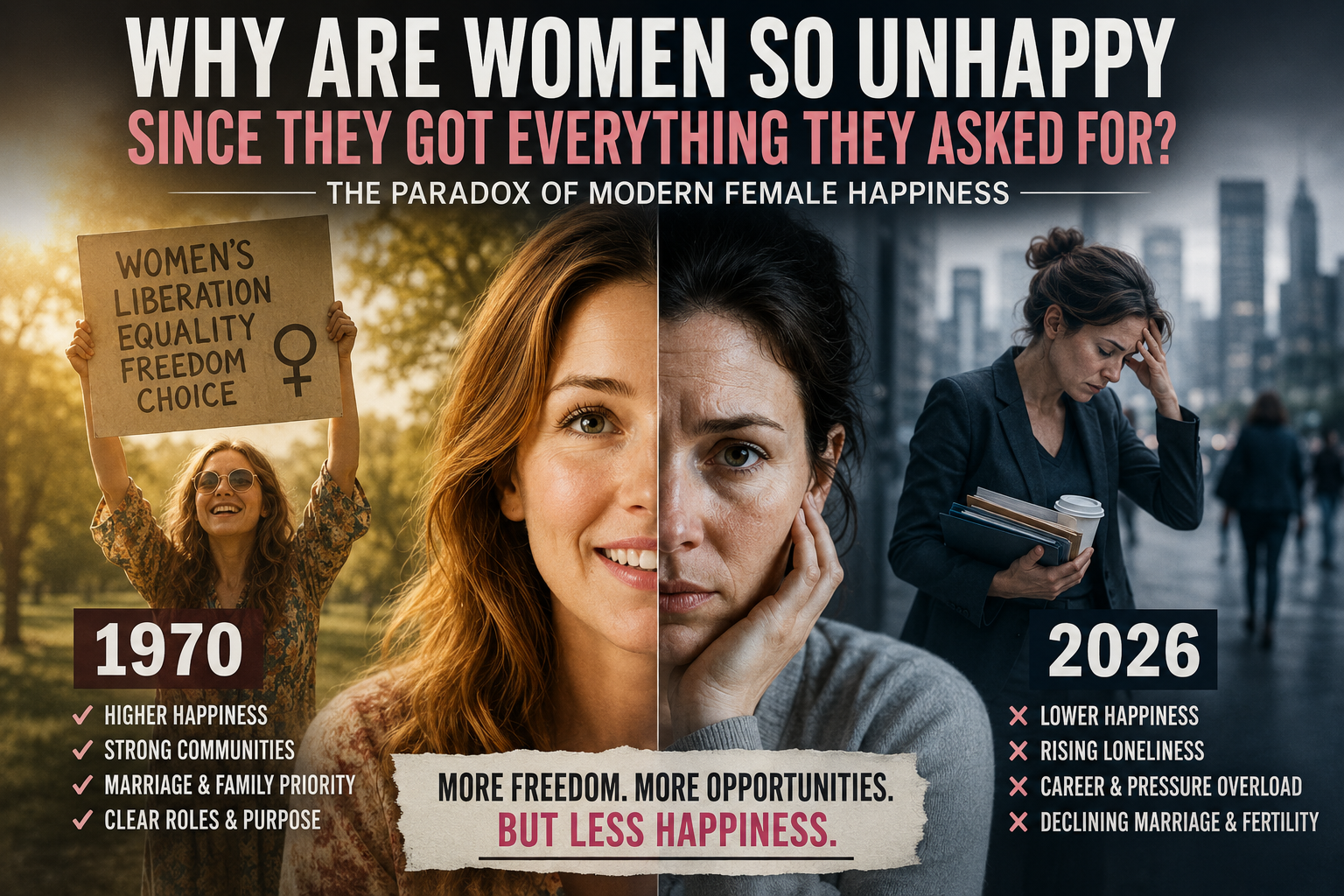
Five Things We Will Learn
- Why modern women report lower happiness levels despite greater freedom, education, and career opportunities.
- What major research studies reveal about the decline in female happiness since the rise of modern feminism.
- How marriage, motherhood, family stability, and community are deeply connected to long-term fulfillment.
- Rachel Wilson’s critique of feminism and why she believes modern culture has undermined women’s flourishing.
- Why this growing cultural conversation challenges society’s assumptions about independence, success, and happiness.
The Paradox of Modern Female Happiness
American women today enjoy unprecedented levels of education, financial independence, career opportunities, and legal equality. Yet despite these gains, many women report record levels of unhappiness, depression, loneliness, and dissatisfaction. This contradiction has become known as “The Paradox of Declining Female Happiness.”
For decades, society promised women that greater independence, career advancement, sexual freedom, and autonomy would naturally lead to greater fulfillment. But according to a growing body of research, the opposite appears to have happened for many women.
Author and commentator Rachel Wilson has become one of the most recognized voices discussing this issue publicly. Through interviews, podcasts, and her writings, she argues that the promises of feminism have not produced the happiness many expected.
Research Showing the Decline in Female Happiness
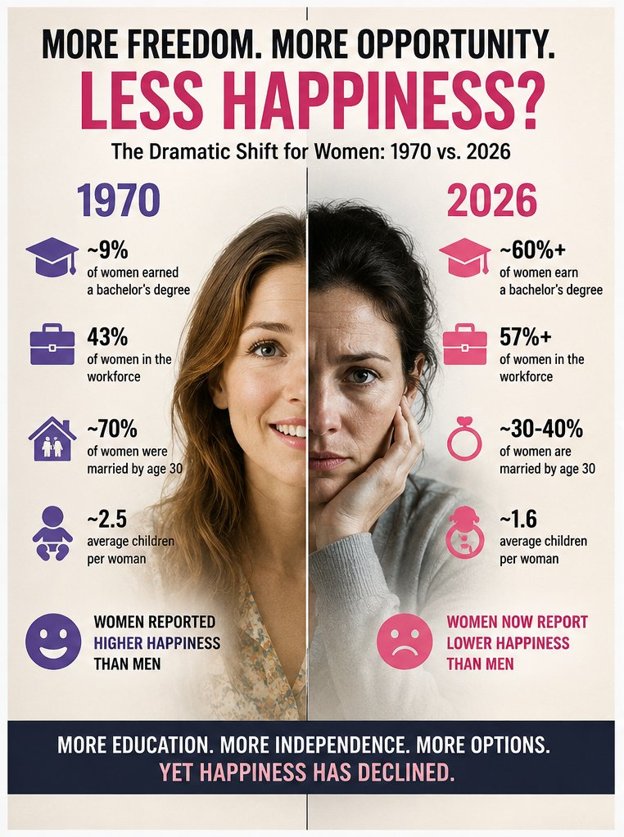
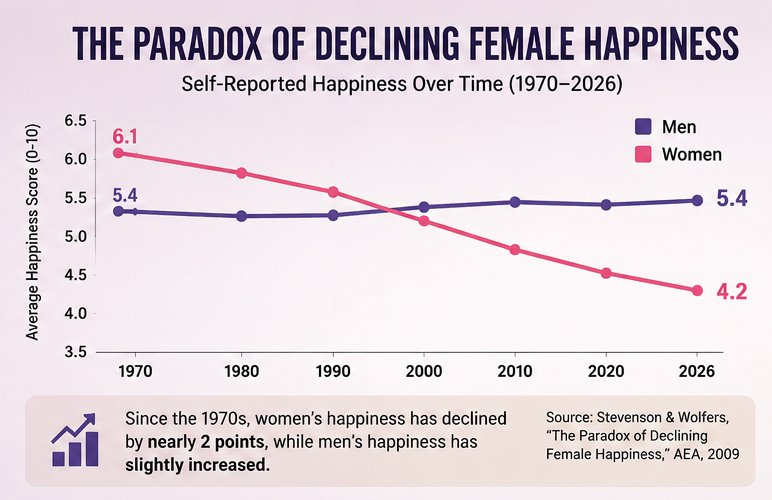
In 2009, economists Betsey Stevenson and Justin Wolfers published a widely discussed paper titled “The Paradox of Declining Female Happiness.” Their analysis of decades of survey data, including the General Social Survey, found that women’s self-reported happiness had declined both absolutely and relative to men since the 1970s.
This trend appeared consistently across multiple demographic groups, datasets, and even other industrialized nations.
Ironically, the decline happened during the same period in which women gained enormous advances in education and workforce participation. Women now earn the majority of college degrees and outpace men in bachelor’s degree attainment among younger adults.
In the early 1970s, around the time second-wave feminism became culturally dominant, women generally reported higher levels of contentment. By the 2000s, despite the gains in career opportunities and economic independence, subjective well-being had noticeably declined.
Rachel Wilson frequently references these findings in interviews and podcast appearances, including discussions on The Joe Rogan Experience, arguing that the data reveals a deep mismatch between what feminism promised and what many women actually experience in daily life.
The Pressure to “Have It All”
Wilson points to what she sees as one of the central tensions facing modern women: society encouraged women to prioritize careers, autonomy, and personal achievement, often at the expense of family formation and motherhood.
Many high-achieving women now face difficulty finding marriage partners who match or exceed their socioeconomic status, something that still commonly influences mate selection. This dynamic contributes to delayed marriage, delayed childbearing, lower fertility rates, and increasing loneliness later in life.
At the same time, women are often expected to excel in both professional and domestic spheres simultaneously.
Wilson argues that the modern ideal of “having it all” frequently becomes “doing it all.”
The result for many women is exhaustion, emotional burnout, stress, and dissatisfaction.
Mental Health Trends Among Women
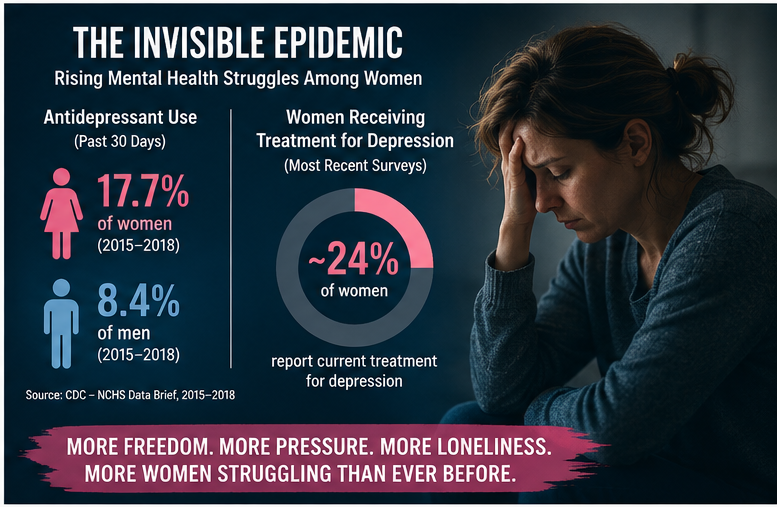
The discussion becomes even more sobering when looking at mental health data.
According to CDC data from 2015–2018, 17.7% of adult women used antidepressants in the previous 30 days compared to 8.4% of men. More recent surveys suggest that roughly 24% of women report receiving treatment for depression.
Loneliness, anxiety, and emotional strain continue to rise across modern culture.
Wilson and others argue that these trends are connected not merely to economics or technology, but to the breakdown of family structures, weakening community bonds, declining birth rates, and the loss of clear purpose rooted in marriage and motherhood.
Marriage, Motherhood, and Happiness
Research consistently shows that married mothers report some of the highest levels of happiness among women.
According to analyses from the 2022 General Social Survey and the 2025 Women’s Well-Being Survey, approximately 40% of married mothers described themselves as “very happy,” compared to roughly 10% of unmarried childless women.
Wilson argues that modern feminism often devalued motherhood and domestic life while elevating career achievement as the highest expression of fulfillment.
In her view, society dismantled many of the very structures that historically gave women stability, protection, meaning, and relational fulfillment through marriage, children, and family-centered living.
Whether one agrees with her conclusions or not, the data surrounding loneliness, declining birth rates, delayed family formation, and emotional dissatisfaction continues to fuel cultural debate.
Rachel Wilson’s Broader Critique of Feminism
Rachel Wilson is an Orthodox Christian, homeschooling mother of five, and author of the book Occult Feminism: The Secret History of Women’s Liberation.
In her book, Wilson argues that the feminist movement was not merely a grassroots effort for equality but also carried deeper philosophical and spiritual influences that undermined traditional family structures and gender roles.
She explores what she describes as occult, esoteric, and gnostic influences connected to parts of the women’s liberation movement, including spiritualism and ideological currents that rejected biblical understandings of family and authority.
Wilson believes feminism is fundamentally incompatible with Christianity and argues instead for complementary gender roles and family structures rooted in biblical principles and Orthodox Christianity.
In interviews and public discussions, she contrasts the unhappiness she sees in career-first, highly individualistic lifestyles with the contentment she believes is more commonly found in faith-centered family life and homemaking.
Why the Disconnect Continues
The central question Wilson raises continues to resonate in cultural discussions:
If women gained so much freedom, opportunity, education, and independence, why are happiness levels declining instead of increasing?
Several possible explanations are frequently discussed:
- Expanded expectations across multiple competing domains, including career success, motherhood, relationships, appearance, and personal fulfillment.
- Increased isolation and weakened community structures.
- Cultural devaluation of marriage, motherhood, and domestic life.
- Delayed marriage and declining fertility.
- Mate-selection challenges in highly educated dual-earner societies.
- Greater pressure to simultaneously succeed in every area of life.
For Wilson, the answer lies in rejecting feminist ideology and restoring emphasis on marriage, children, faith, family, and complementary roles rooted in biblical Christianity.
A Cultural Conversation That Is Growing Louder
This discussion remains deeply controversial and emotionally charged.
Some see Wilson’s perspective as a needed correction to modern cultural assumptions. Others strongly disagree with her conclusions and view feminism as essential for justice, dignity, and opportunity.
Yet regardless of where one stands ideologically, the data itself has forced many people to reconsider an assumption modern culture long treated as unquestionable:
That more independence and personal autonomy automatically produce greater happiness and flourishing.
The growing conversation surrounding women’s happiness, loneliness, family decline, mental health, and purpose is likely to continue for years to come.
And whether one agrees with Rachel Wilson or not, her work challenges modern society to honestly ask what truly leads to human flourishing, fulfillment, stable families, meaningful relationships, and lasting joy.

Begin Your Journey Today
Jesus didn’t just call us to believe in Him—He called us to follow Him.
Step into the life He designed for you through Emmaus Road’s The Commands of Jesus. This is more than learning—it’s an invitation to walk with Him, obey Him, and experience Him in a real and powerful way.
You don’t want to miss this exciting adventure Jesus has called you into.
Start now:
https://GregLancaster.org/StartHere
Related Articles on The Torch
- Marriage, Remarriage, and Living in Adultery https://greglancaster.org/2026/04/marriage-remarriage-and-living-in-adultery.htmlStrong connection: Directly addresses biblical teaching on marriage and family — core to the happiness/family breakdown discussion.
- Marriage, Divorce, and Remarriage: What the Bible Actually Says https://greglancaster.org/2026/04/marriage-divorce-and-remarriage-what-the-bible-actually-says.htmlStrong connection: Explores God’s design for covenant marriage, which ties into the critique of modern independence vs. traditional family structures.
- Getting Married Is Not Your Safeguard https://greglancaster.org/2026/04/getting-married-is-not-your-safeguard.htmlStrong connection: Discusses pressures on modern marriage, digital age challenges, and family in today’s culture — very relevant to women’s happiness and relational realities.
- God’s Call to the Same-Sex Couple Who Come to Christ https://greglancaster.org/2026/04/gods-call-to-the-same-sex-couple-who-come-to-christ.htmlGood connection: Touches on biblical sexuality, transformation, and cultural vs. scriptural views on relationships.
- The Great Disconnect: Why Digital Isolation Is the New Idolatry https://greglancaster.org/2026/04/the-great-disconnect-why-digital-isolation-is-the-new-idolatry.htmlGood connection: Addresses screen time, loss of real community, and isolation — themes that appear in your article (1933 vs. today, loss of family/neighborhood time).
Sources
- Stevenson, Betsey & Wolfers, Justin. “The Paradox of Declining Female Happiness.” National Bureau of Economic Research / American Economic Association.
https://www.aeaweb.org - Pew Research Center. Research on women’s educational attainment and workforce trends.
https://www.pewresearch.org - Centers for Disease Control and Prevention (CDC). Data on antidepressant use and women’s mental health statistics.
https://www.cdc.gov - Institute for Family Studies. Analysis of the General Social Survey and women’s well-being data regarding marriage, motherhood, and happiness.
https://ifstudies.org - Rachel Wilson interview appearances and cultural discussions, including appearances on “The Joe Rogan Experience.”
https://www.youtube.com - Occult Feminism: The Secret History of Women’s Liberation by Rachel Wilson
https://www.amazon.com

Begin Your Journey Today
Jesus didn’t just call us to believe in Him—He called us to follow Him.
Step into the life He designed for you through Emmaus Road’s The Commands of Jesus . This is more than learning—it’s an invitation to walk with Him, obey Him, and experience Him in a real and powerful way.
You don’t want to miss this exciting adventure Jesus has called you into.
Start now:
https://GregLancaster.org/StartHere