


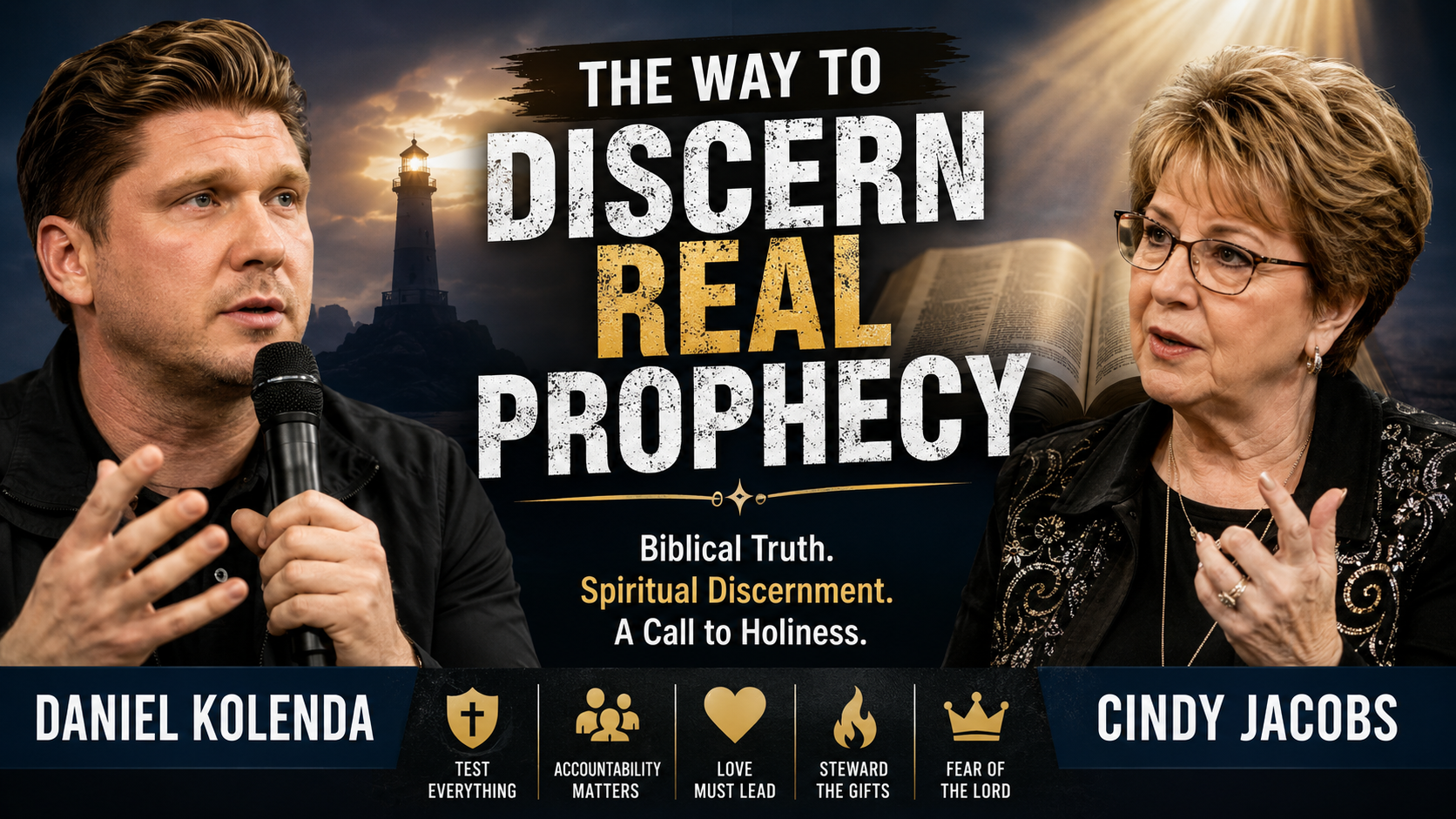
Daniel Kolenda with Cindy Jacobs
Five Things We Will Learn
- Why prophecy must always be tested, judged, and submitted within biblical community.
- How sensationalism, social media influence, and “Google prophets” have damaged trust in prophetic ministry.
- Why accountability, pastoral care, and healing are essential safeguards for prophetic voices.
- How believers can discern manipulation, grooming, and unhealthy prophetic practices without despising prophecy itself.
- Why love, holiness, humility, and the fear of the Lord must remain the foundation of every spiritual gift.
The Church Must Learn How to Steward the Prophetic
“We’ve got to stay nimble. We’ve got to be able to hear from the Lord. But we’ve also got to have safeguards in place.”
That statement from Daniel Kolenda summarizes the burden carried throughout this entire conversation with Cindy Jacobs. The discussion was not about abandoning prophecy or rejecting the gifts of the Holy Spirit. It was about stewarding them rightly.
Daniel warns that if the charismatic movement does not learn how to “clean up its own messes,” the gifts themselves could become discredited through abuse, manipulation, performance culture, and lack of accountability. Cindy Jacobs agrees wholeheartedly, repeatedly emphasizing that prophetic ministry must be rooted in holiness, humility, brokenness before the Lord, and biblical accountability.
This was not a conversation attacking the prophetic. It was a call to restore it.
Cindy Jacobs’ Early Prophetic Experiences
Cindy Jacobs shares that she grew up Baptist, in a tradition that did not formally believe in prophecy, yet prophetic experiences still occurred around her family, especially through her father. She recalls prophesying at four years old about the birth of her little sister.
Unlike some who experience prophetic gifting later after conversion, Cindy explains that she always sensed things spiritually from childhood onward.
Over time, her heart became deeply burdened for nations. Psalm 2:8 became foundational to her vision:
“Ask of me, and I will make the nations your inheritance, the ends of the earth your possession.”
She began understanding that entire nations could be healed and transformed through repentance, reconciliation, prayer, and prophetic ministry. At the time she began teaching this in the early 1980s, the concept of praying for the healing of nations was uncommon.
Why Leaders Need Prophetic Voices
Cindy explains that she eventually realized government leaders seek spiritual counsel whether believers participate or not. She observed presidents and leaders consulting psychics and occult sources for guidance. That realization burdened her deeply because Scripture consistently shows prophets speaking into leadership and governmental situations.
Throughout the Bible, prophets stood beside kings, confronting, guiding, warning, and counseling leaders.
She began intentionally pursuing opportunities to minister prophetically to national leaders and government officials around the world.
One striking example she shares involved South Korea. Feeling prompted by the Holy Spirit, she requested an appointment with the mayor of Seoul despite not knowing him personally. During that meeting, she prophesied that he would become president and would help heal the ecology of the city. She later discovered environmental restoration was already his specialty, including uncovering a river buried during wartime construction.
He later became president exactly as prophesied.
Prophecy Concerning Nations
Much of the discussion centers around nations, political upheaval, and prophetic insight regarding world events.
Cindy references prophetic words concerning Venezuela, warning President Maduro that he should step down peacefully or face severe consequences. She also prophesied to military leaders that defecting from the regime would spare them future judgment and hardship.
She explains that her prophetic council later declared that dictatorships in Venezuela and Cuba would eventually fall. Regarding Cuba specifically, she believes communism there will collapse.
Daniel and Cindy discuss the volatility occurring globally and how nations are being repositioned for what they believe is an end-time harvest. Cindy points specifically to Isaiah 19, where Egypt, Assyria, and Israel become spiritually connected in God’s redemptive purposes.
She also discusses Iran, calling it a major source of terrorism and describing a prophetic word she received that God did not need political figures alone to overthrow oppressive regimes because the people themselves were rising up internally.
The Beginning of the End-Time Harvest
Cindy expresses strong conviction that the Church is entering the beginning stages of a massive global harvest of souls. She notes that billions of people still have not heard the Gospel, emphasizing the urgency of evangelism and discipleship.
She references the collapse of communism in the Soviet Union and laments that the Church did not respond quickly enough to disciple nations during that opening, allowing atheism, New Age ideology, and other influences to fill the vacuum instead.
This is one reason she commends Christ for All Nations and Daniel Kolenda’s evangelism training efforts. She believes the Church desperately needs more laborers equipped for harvest.
Where Were the Prophets?
Daniel raises one of the most difficult modern questions surrounding the prophetic movement: “Where were the prophets?” during major global events like COVID-19.
He notes widespread disillusionment among believers because many prophetic voices appeared to miss such a major world-shifting event entirely.
Cindy responds by explaining that prophets are neither omniscient nor omnipresent. Prophets only know what God reveals. She admits prophetic voices themselves often wish they understood more than they do.
However, she points out that her Apostolic Council of Prophetic Elders did publicly warn about a coming flu virus that would seem to have no cure.
Still, she believes the prophetic movement itself is undergoing exposure and purification. God is allowing hidden problems, abuse, manipulation, and unhealthy practices within prophetic circles to come into the light because the prophetic must be cleaned up before it can properly function as a forerunner ministry.
“Google Prophets” and Data Mining
One of the most sobering portions of the conversation addresses fraudulent prophetic practices.
Daniel references “data mining,” where individuals gather personal information from social media or public sources and then present it as supernatural revelation. Cindy says these discussions have become increasingly common among leaders asking, “How did we get here?” and “What do we do about it?”
She refers to these individuals as “Google prophets.”
According to Cindy, social media influence, sensationalism, platform culture, and the desire for power or recognition have contributed heavily to this corruption. Some people feel pressure to become more spectacular, more dramatic, and more impressive in order to gain influence online.
But she speaks very plainly:
“It’s sin.”
She warns that falsely representing God is a serious matter.
What Real Prophecy Looks Like
Cindy explains that God sometimes gives very specific details through prophetic ministry, including names, numbers, or personal identifiers. However, she insists these details should never be manufactured, researched, or pursued through natural means.
In fact, she intentionally avoids learning personal information before ministering to someone because she wants the word to remain purely from God.
She stresses that the purpose of prophecy is not to impress people but to draw them closer to Jesus. The goal is not amazement at the prophet, but increased love for Christ.
“When a word is given, you should be closer to Jesus.”
Broken People Breaking Other People
Cindy repeatedly returns to the issue of inner healing and brokenness within ministry leaders.
She believes many abuses occur because wounded, unhealthy people are elevated into ministry without deep healing, sanctification, accountability, or soul care. She humorously describes the need for prophetic people to go through a “car wash” spiritually before ministering to others.
She points out that many independent charismatic ministries lack structures for reporting abuse, investigating misconduct, or protecting vulnerable people. Policies, procedures, and safeguards are desperately needed.
Daniel strongly agrees, emphasizing that spiritual gifts without biblical maturity and accountability can become dangerous.
Pressure to Perform
Daniel shares personal experiences about the pressure ministers can feel to produce dramatic supernatural moments because audiences expect spectacle.
He describes situations where churches lined wheelchairs across the front row expecting immediate miracles within minutes. He admits that such expectations can create enormous pressure on ministers to perform rather than simply obey God faithfully.
Cindy responds that she does not feel pressure to be sensational. Instead, she feels the burden to remain a holy vessel through whom God can genuinely speak.
She acknowledges younger prophetic voices can easily feel drawn toward performance culture, especially when word-of-knowledge ministry became strongly associated with increasingly spectacular specifics.
But she explains that the true goal of prophecy is to speak to the wilderness inside someone’s soul, revealing God’s love in a deeply personal way.
Accountability in the Prophetic
Daniel asks perhaps the central question of the discussion:
“What does accountability in the prophetic look like in 2026?”
Cindy answers with several layers of accountability:
- Submission to local church leadership
- Pastoral oversight
- Boards of directors
- Corporate prophetic discernment
- Mature elders judging significant words
- Collaborative discernment within prophetic councils
She explains that if a prophetic word concerns a nation or major issue, it is weighed collectively among trusted prophetic leaders before being publicly released.
She also gives a strong warning:
“If you ever hear anybody say, ‘I’ve heard from God and nobody else has to judge this,’ go out the door.”
The 2020 Election and Prophetic Fallout
The discussion turns toward one of the most controversial prophetic subjects in recent years: Donald Trump’s second term.
Cindy explains that her prophetic council did not publicly declare Trump would definitively remain president after the 2020 election because they did not have consensus or clarity from the Lord on that timing.
She says she warned broader prophetic circles that irresponsible declarations could deeply hurt younger believers and damage trust in prophetic ministry if things unfolded differently than predicted.
According to Cindy, she experienced significant backlash for refusing to say what certain audiences wanted to hear. Some canceled her appearances because she would not affirm predictions she lacked confidence in.
Her burden was pastoral. She feared the fallout that would occur if people tied their faith to specific prophetic outcomes that later appeared incorrect.
Timing Matters in Prophecy
Daniel asks an important question: can someone receive a legitimate prophetic sense yet misunderstand the timing?
Cindy says yes.
She explains that many prophetic people may correctly perceive something God intends to do eventually but incorrectly assume it belongs to the immediate moment.
This is why mature prophetic ministry must carefully discern not only what God is saying, but when He is saying it.
Her prophetic council uses corporate discernment to test timing and clarity. If consensus is lacking, they do not release the word publicly.
Teaching Believers to Discern
As the conversation closes, both Daniel and Cindy focus heavily on empowering believers to discern for themselves.
Cindy warns about grooming, manipulation, and unhealthy spiritual influence. She says believers must understand they do not have to receive everything someone says simply because they claim divine authority.
Daniel emphasizes the priesthood of every believer under the New Covenant. Every born-again believer has the Holy Spirit and therefore possesses the ability to discern truth from error.
He even shares how he teaches his own children to reject prophetic words that produce inward discomfort or confusion.
That is not rebellion. That is discernment.
Love Must Remain the Foundation
Near the conclusion, Daniel highlights the importance of reconnecting 1 Corinthians 13 to discussions about spiritual gifts.
Love is not separate from the gifts. Love governs the gifts.
Without love, spiritual gifts become manipulative, self-serving, toxic, and destructive.
Cindy agrees completely, saying that corrective words should only come from a place of brokenness, humility, and grief, never pride or superiority.
She concludes that the prophetic movement must return to:
- the fear of the Lord,
- the love of God,
- holiness,
- humility,
- accountability,
- and biblical community.
Final Prayer
Cindy closes by praying for healing for those who have been hurt, disappointed, or disillusioned through prophetic abuses. She asks God to restore hope, wisdom, and discernment to both leaders and believers during this volatile season.
Begin Your Journey Today
Jesus didn’t just call us to believe in Him—He called us to follow Him.
Step into the life He designed for you through Emmaus Road’s The Commands of Jesus. This is more than learning—it’s an invitation to walk with Him, obey Him, and experience Him in a real and powerful way.
You don’t want to miss this exciting adventure Jesus has called you into.
Start now:
https://GregLancaster.org/StartHere