



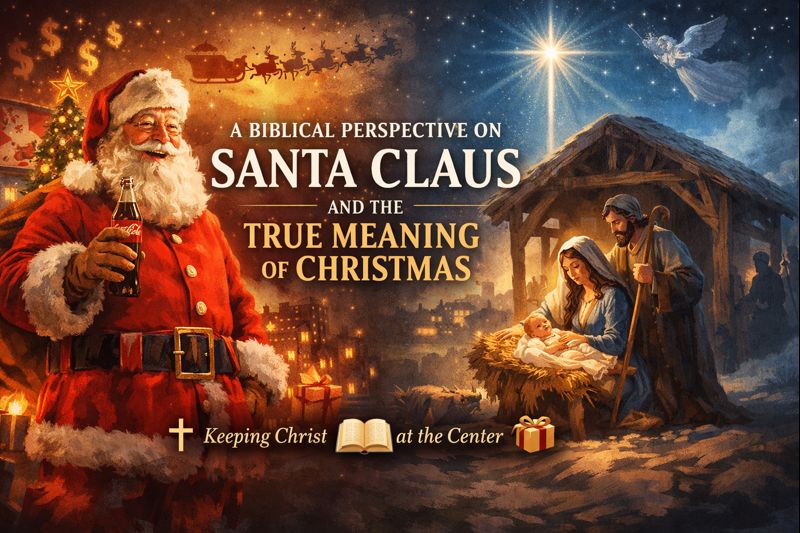
Six Things We Will Learn
- What Scripture reveals about God’s exclusive claim to glory—especially concerning the birth of His Son.
- Why the incarnation of Jesus Christ is the most significant event in eternity and human history.
- How human traditions and cultural narratives can subtly displace Christ at the center of God’s redemptive act.
- How commercialization reshaped Christmas in America and displaced the nativity in public consciousness.
- The specific role Coca-Cola played in standardizing and commercializing Santa Claus in American culture.
- How parents and believers can return Christmas to its rightful focus with truth, repentance, and clarity.
The Incarnation: God’s Greatest Act of Love
The birth of Jesus Christ is not a sentimental holiday moment. Scripture presents it as the decisive intervention of God into a fallen world.
God created the heavens and the earth and formed mankind in His own image and likeness (Genesis 1:26–27). Through sin, separation entered the world (Genesis 3; Romans 5:12). Humanity could not repair this breach on its own. Redemption required divine action.
Out of love, God gave the greatest gift ever conceived:
“For God so loved the world that He gave His one and only Son, that whoever believes in Him shall not perish but have eternal life” (John 3:16).
The incarnation was foretold by the prophets (Isaiah 7:14; Isaiah 9:6), fulfilled in history (Matthew 1:22–23), and announced by heaven itself as “good news of great joy for all the people” (Luke 2:10–11). God entered His own creation so that mankind could be restored to relationship with Him (Galatians 4:4–5; Philippians 2:6–11).
This moment stands at the center of eternity and the hinge of history.
God’s Glory Is Not Shared
Scripture is explicit about God’s glory:
“I am the LORD; that is My name! I will not yield My glory to another or My praise to idols” (Isaiah 42:8).
The birth of Christ was marked by worship, not distraction. Angels proclaimed it. Shepherds rejoiced. Wise men traveled far to honor the Child (Luke 2:13–14; Matthew 2:1–11). No rival figure shared the stage.
Whenever honor, wonder, belief, anticipation, or gratitude are redirected from God to another source—even symbolically—Scripture identifies this as misplaced glory (Romans 1:21–25).
Human Traditions That Compete With Divine Truth
The Bible repeatedly warns against elevating human traditions above God’s truth:
“You nullify the word of God for the sake of your tradition” (Matthew 15:6).
Santa Claus is not mentioned in Scripture. Yet Scripture does address the danger of fabrications that imitate divine attributes—such as omniscience, moral judgment, supernatural provision, and reward—qualities that belong to God alone (Psalm 33:13–15; Hebrews 4:13; James 1:17).
When Christmas is taught to children primarily as being “about Santa,” belief, anticipation, letters, songs, and gratitude are redirected from Christ to a fictional figure. Scripture identifies this redirection as deception, even when culturally normalized (Colossians 2:8; Ephesians 4:14–15).
Divided Hearts and Blinded Minds
Scripture explains why such distractions persist:
“The god of this world has blinded the minds of unbelievers” (2 Corinthians 4:4).
A divided heart cannot fully honor God:
“No one can serve two masters” (Matthew 6:24).
Many do not intend to dishonor Christ. Yet Scripture teaches that sincerity does not override truth (Proverbs 14:12). When a fable is elevated alongside Christ—especially in formative childhood years—it introduces confusion where clarity was meant to be planted (Deuteronomy 6:6–7; Matthew 18:6).
The Difficulty of Speaking Truth to One’s Own Family
Scripture acknowledges how difficult it is to undo what was planted early:
“Train up a child in the way he should go” (Proverbs 22:6).
When parents introduce a fable and later attempt to remove it, resistance is inevitable. Patterns once formed become strongholds. Yet Scripture offers hope:
“My grace is sufficient for you” (2 Corinthians 12:9).
God calls parents not to despair, but to return, realign, and speak truth with humility and courage (Joshua 24:15).
When the Fable Began
The modern Santa Claus narrative did not originate in Scripture or the early Church. While historical figures such as St. Nicholas existed, the modern Santa mythos developed primarily in the early 19th century, particularly through literature such as A Visit from St. Nicholas (1823).
Over time, folklore replaced faith, and imagination displaced incarnation. Scripture warns against adopting customs that subtly reshape truth through repetition and imagery (Jeremiah 10:2–5; Ecclesiastes 1:2).
How Santa Became Culturally Dominant: Coca-Cola’s Role
While Santa existed in various forms before the 20th century, it was corporate marketing—not Scripture and not the Church—that standardized and amplified Santa into a dominant cultural figure.
Beginning in 1931, Coca-Cola launched a massive, recurring Christmas advertising campaign centered on Santa Claus. The company commissioned illustrator Haddon Sundblom, whose artwork defined Santa as jolly, warm, grandfatherly, consistently red-and-white, approachable, and distinctly human.
These advertisements ran every Christmas season for decades across national magazines, billboards, store displays, and later television. Because Coca-Cola possessed enormous national reach, their portrayal of Santa became the dominant image in American culture, replaced older regional depictions, and cemented Santa as a commercial holiday figure.
In short, Coca-Cola did not invent Santa—but they branded him.¹²³
Why This Matters Culturally
Coca-Cola’s Santa helped shift Christmas in America in measurable ways:
- From a Christian holy day to a consumer-driven cultural event
- From Christ-centered celebration to sentiment, nostalgia, and buying
- From the nativity to marketing imagery and retail anticipation
Santa became a marketing vehicle rather than a theological or moral one. Over time, this commercialization displaced the nativity from public consciousness.
Scripture warns that repeated images shape devotion and belief (Habakkuk 2:18–19).
Black Friday: The Birth of the Merchant Harvest
What Scripture reveals spiritually, culture now displays openly. The day known as Black Friday stands as a stark witness to how Christmas has been transformed from the celebration of God’s gift to mankind into the harvest season of merchants. Historically, the term refers to the point at which retailers—operating in loss for much of the year—finally move from debt into profit, from red into black.⁴
Over time, it has become a ritualized spectacle in which crowds line up through the night, doors are thrown open, and people surge forward—sometimes violently—pushing past one another, grabbing merchandise from each other’s hands, trampling bodies, and fighting over objects that only days later will be discarded or forgotten.⁵⁶
What was once the proclamation of “peace on earth” has been eclipsed by engineered urgency, lust for possession, and mass psychological manipulation through marketing narratives centered on Santa, gift lists, reward systems, and manufactured scarcity. Even sacred symbols have been hollowed out: gifts piled beneath the Christmas tree—once understood as pointing to the cross on which Christ gave His life (1 Peter 2:24)—now represent plastic extrusions, digital entertainment, devices, media, and endless “stuff & things.” The lights that once proclaimed the Light of the World (John 8:12) now illuminate transactions.
In this inversion, the birth of God’s Son has been overshadowed by the birth of the merchant harvest, where the wealth of the people is transferred into corporate coffers, and Christmas is no longer announced by angels, but launched by advertisements.
Related:
- Video shows fist fight over Black Friday deals
- Violence at stores on Black Friday
- Black Friday Frenzy Turns Violent
- The Worst Black Friday Disasters
A Human Illustration of Divine Hurt
Imagine a man attending his own birthday celebration, only to discover that the gathering celebrates someone else. Gifts are exchanged in another’s name. Songs are sung about another. Gratitude is directed elsewhere.
At first, confusion. Then hurt. Eventually grief.
Scripture reveals that God is relational and grieved when truth is replaced with a lie:
“They exchanged the truth about God for a lie” (Romans 1:25).
“These people honor Me with their lips, but their hearts are far from Me” (Matthew 15:8).
Is Santa Claus Really Coming to Town?
One of the clearest ways culture has transferred attributes that belong to God alone onto a fictional figure is found in the song Santa Claus Is Coming to Town. The lyrics warn, “You better watch out… Santa Claus is coming to town,” placing Santa in a role of moral watching and judgment. Scripture teaches that God alone is all-knowing, seeing every heart and every thought (Psalm 139:1–4; Hebrews 4:13), yet the song declares, “He sees you when you’re sleeping, He knows when you’re awake,” echoing what the Bible says only of God’s watchful care (Psalm 121:3–4). The line, “He knows if you’ve been bad or good,” assigns moral judgment to Santa, though Scripture is clear that God alone judges human behavior and motives (Ecclesiastes 12:14; Romans 2:16). Even the message of reward—“So be good for goodness sake”—promotes a works-based approval system, while Scripture teaches that righteousness and blessing come from God by grace, not performance (Isaiah 64:6; Ephesians 2:8–9). What makes this especially sobering is that these divine attributes—omniscience, judgment, moral authority, and reward—are sung on the birthday of God’s Son, the One to whom all authority in heaven and on earth belongs (Matthew 28:18). What Scripture reserves for the Lord is reassigned through song to Santa, quietly shifting fear, obedience, and expectation away from Christ and onto a fabricated substitute (Jeremiah 17:9–10; Colossians 2:8).
Every Good Gift Comes From God
Scripture is unequivocal:
“Every good and perfect gift is from above, coming down from the Father of the heavenly lights” (James 1:17).
When gifts are attributed to a fictional figure rather than to God, glory is misdirected. What appears harmless becomes spiritually formative (Matthew 7:11; Psalm 127:1).
A Call to Return
God’s call is not condemnation but restoration:
“Return to Me, and I will return to you” (Malachi 3:7).
Christmas exists to reveal Jesus Christ—Savior, Redeemer, and King (Luke 2:11; Colossians 1:15; Acts 4:12).
Let the gifts point to the Giver.
Let the songs exalt the Son.
Let the wonder belong to Christ alone.
“For from Him and through Him and for Him are all things. To Him be the glory forever. Amen.” (Romans 11:36)
Endnotes
¹ The Coca-Cola Company Archives, The Coca-Cola Santa Claus
² Smithsonian Magazine, How Coca-Cola Shaped Santa Claus
³ The New York Times, The History of Santa Claus and Coca-Cola
⁴ Investopedia, Why Is It Called Black Friday?
⁵ U.S. Consumer Product Safety Commission, Black Friday injury reports
⁶ The New York Times / Associated Press, reporting on Black Friday crowd behavior and retail violence
⁷ J. Fred Coots and Haven Gillespie, Santa Claus Is Coming to Town (1934)

Begin Your Journey Today
Jesus didn’t just call us to believe in Him—He called us to follow Him.
Step into the life He designed for you through Emmaus Road’s The Commands of Jesus . This is more than learning—it’s an invitation to walk with Him, obey Him, and experience Him in a real and powerful way.
You don’t want to miss this exciting adventure Jesus has called you into.
Start now:
https://GregLancaster.org/StartHere