



Five Things We Will Learn
- How American media shifted from honoring fathers to consistently mocking and diminishing them over the last seventy years.
- What major academic studies reveal about the rise of the “dumb dad” and “bumbling father” trope in television, advertising, and entertainment.
- How these repeated portrayals shape culture, family expectations, and even children’s understanding of fatherhood.
- Why Scripture’s command to honor fathers is foundational to healthy families and societies.
- What the growing dishonor of fatherhood may be doing to men, women, children, and the stability of culture itself.
The Slow Cultural Assault on Fatherhood
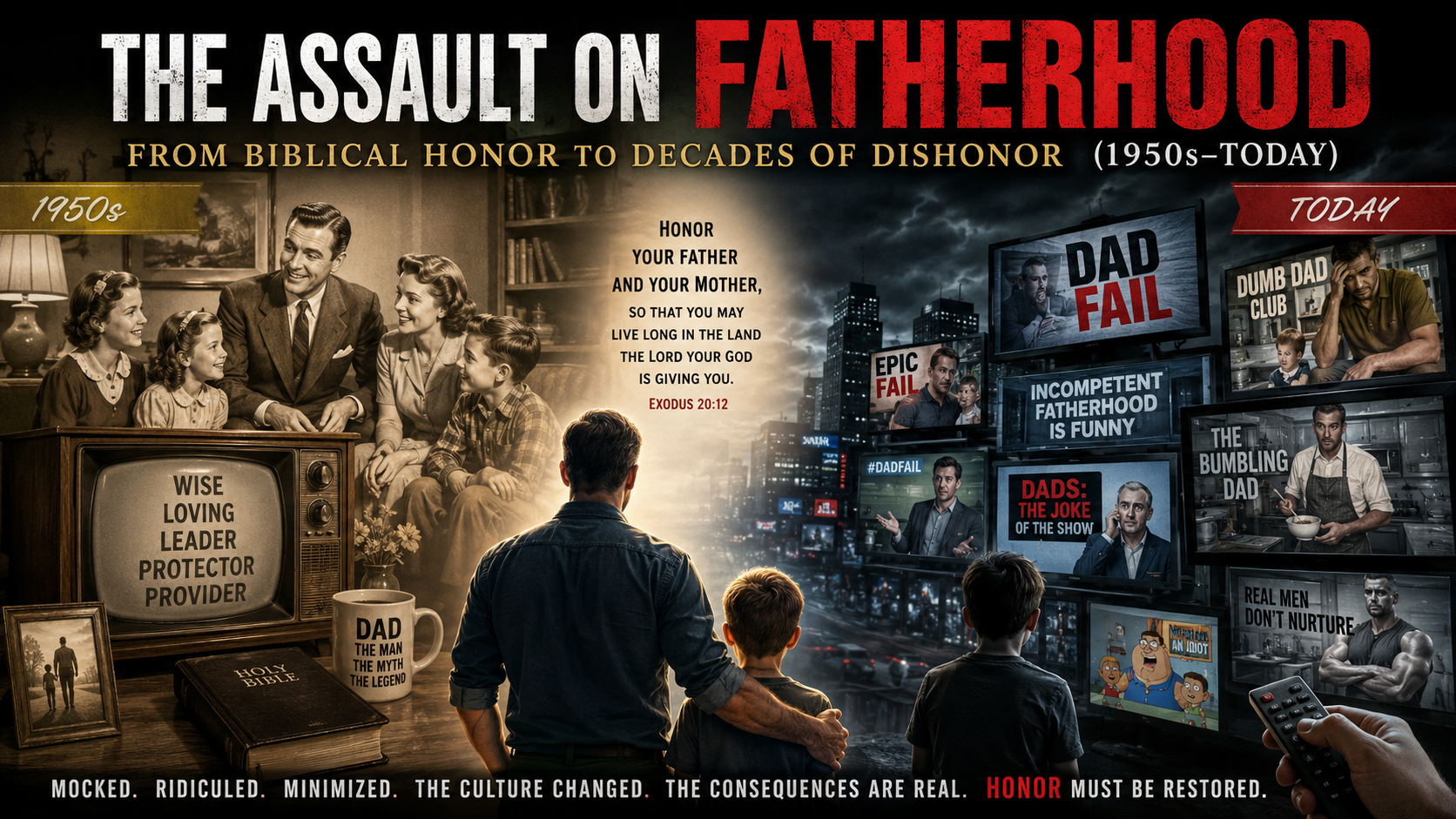
The Bible is clear: “Honor your father and your mother, so that you may live long in the land the Lord your God is giving you” (Exodus 20:12). This command is not optional. It is foundational to a blessed society.
Yet over the past seventy-plus years, American media has steadily moved in the opposite direction. What once portrayed fathers as honorable, wise, loving, and responsible increasingly began portraying them as foolish, weak, disconnected, childish, incompetent, or unnecessary.
This was not merely an occasional joke or isolated sitcom character. Over decades, it became a normalized cultural pattern repeated through television shows, commercials, movies, children’s programming, and advertising campaigns.
The result has been a long-term erosion of honor toward fathers and men.
From “Father Knows Best” to the “Bumbling Dad”
One of the clearest examples of this shift can be seen in television sitcoms.
Early family television programs from the 1950s commonly reflected the “Father Knows Best” model. Fathers were generally shown as wise, responsible, protective, and worthy of respect.
But researchers documenting decades of television history discovered a dramatic reversal.
Researcher Erica Scharrer’s landmark 2001 study analyzed domestic sitcoms from the 1950s through the 1990s and found that fathers’ authority and wisdom were increasingly questioned, mocked, or ridiculed. Mothers’ jokes directed against fathers rose dramatically over the decades.
Scharrer’s later follow-up research, conducted around 2020–2021, examined 34 top-rated U.S. family sitcoms aired between 1980 and 2017. The study coded 578 scenes involving “disparagement humor” toward fathers.
The findings were striking:
- In the 1980s, fathers acting foolishly in parenting scenes appeared in about 18 percent of cases.
- In the 1990s, that rose to 31 percent.
- By the 2000s and 2010s, it exceeded 50 percent.
Even more revealing, these portrayals increased during the very same decades real fathers became more involved in parenting, caregiving, and daily family life.
The more engaged fathers became in reality, the more entertainment media often mocked them for it.
The Pattern Was Not Accidental
Additional studies throughout the 1990s confirmed the same pattern.
Researchers Olson & Douglas and Kaufman documented recurring portrayals of fathers as:
- Inept
- Aloof
- Chauvinistic
- Emotionally disconnected
- Foolish
Despite these portrayals, the shows remained culturally influential and highly successful. The “incompetent dad” became a dependable comedic formula.
Over time, this moved beyond entertainment and became part of the cultural imagination.
The father increasingly became the punchline.
Advertising Reinforced the Same Message
Television commercials and advertising campaigns reinforced these portrayals for decades.
A 2010 study by Gentry & Harrison examined portrayals of fathers in television advertising and found:
- Fathers were rarely shown as nurturers.
- Mothers were commonly portrayed as competent caregivers.
- Fathers were often depicted as foolish, emotionally disconnected, or incapable.
- Many commercials portrayed dads as needing rescue from the competent mom.
Broader advertising reviews found fathers were commonly reduced to two extremes:
- The idiot
- The macho caricature
Rarely were they shown as balanced, capable, loving leaders within the home.
Boys’ Programming and Modern Media
The trend extended into children’s and boys’ programming as well.
The Geena Davis Institute on Gender in Media’s 2020 analysis of boys’ television programming found that male characters, including fathers, were often portrayed as:
- Aggressive
- Less empathetic
- Stoic
- Less competent as parents than women
Only 3.9 percent of male parents were portrayed as “very competent,” compared to 7.5 percent of mothers.
Hands-on fathering was also shown far less frequently.
This matters because repeated media exposure shapes expectations, especially in children.
Media Shapes Culture
Scholars frequently connect these portrayals to social cognitive theory and cultivation theory. In simple terms, repeated exposure to the same ideas shapes how people view reality.
When fathers are mocked repeatedly across decades:
- Boys begin seeing manhood as foolish or unnecessary.
- Girls begin expecting less from men.
- Fathers themselves may internalize diminished expectations.
- Respect for authority within the family weakens.
- Society slowly loses honor for the role God designed fathers to carry.
The “bumbling dad” eventually stops feeling like fiction and starts becoming culturally normal.
Scripture Warned Us About Honor
God’s command to honor fathers was never merely about politeness.
It was tied directly to blessing, order, longevity, stability, and generational health.
When honor disappears, disorder follows.
The breakdown of fatherhood affects:
- Identity
- Stability
- Discipline
- Protection
- Leadership
- Emotional security
- The raising of children
A society that continually dishonors fathers should not be surprised when fatherlessness, confusion, instability, resentment, and fractured homes increase.
The fruit reveals the root.
The Cultural Consequences We Are Now Seeing
Many modern analysts now openly acknowledge the damage.
A 2025 poll by the Centre for Social Justice in the UK found that 57 percent of respondents believed media portrays men at unhealthy extremes, either as:
- Pathetic and weak
- Excessively masculine and frightening
The same poll concluded that current media fails to provide healthy role models for boys.
Another survey found that 74 percent of millennial fathers believed advertising does not understand modern fatherhood and consistently underestimates dads.
The concern is no longer hidden.
Even the culture increasingly recognizes the problem.
Honoring Fathers Again
If then I am a father, where is my honor? Malachi 1:6 (NIV)
This does not mean fathers are perfect.
Scripture does not call us to idolize men, but does unquestionably tell us to honor our fathers.
The media culture of dishonoring fathers has now run for generations. The question before us is whether we will continue allowing screens to define fatherhood through mockery, or whether we will recover the biblical vision of honor, responsibility, and covenant family life that God established from the beginning.

Begin Your Journey Today
Jesus didn’t just call us to believe in Him—He called us to follow Him.
Step into the life He designed for you through Emmaus Road’s The Commands of Jesus. This is more than learning—it’s an invitation to walk with Him, obey Him, and experience Him in a real and powerful way.
You don’t want to miss this exciting adventure Jesus has called you into.
Start now:
https://GregLancaster.org/StartHere
Sources
- Erica Scharrer, “From Wise to Foolish: The Portrayal of the Sitcom Father, 1950s–1990s” (2001)
- Erica Scharrer et al., follow-up family sitcom disparagement humor analysis of 34 top-rated U.S. sitcoms aired from 1980–2017 (2020/2021)
- Olson & Douglas research on television father portrayals
- Kaufman studies on incompetent and aloof television fathers
- Gentry & Harrison, study of father portrayals in television advertising (2010)
- Geena Davis Institute on Gender in Media, analysis of boys’ television programming and parental portrayals (2020)
- Centre for Social Justice UK survey on media portrayals of men and fatherhood (2025)
- Survey of millennial fathers regarding modern advertising portrayals of dads (2025)