


Five Things We Will Learn
- Why self-censorship has become one of the greatest threats to liberty and open dialogue in America.
- How courage is the foundational virtue that holds all other virtues together.
- Why societies without shared truth and moral foundations drift toward chaos and totalitarianism.
- How modern self-love culture can undermine growth, discipline, and personal responsibility.
- Why preserving freedom requires ordinary people to stop remaining silent and begin standing publicly for truth.
A Crisis of Courage in America
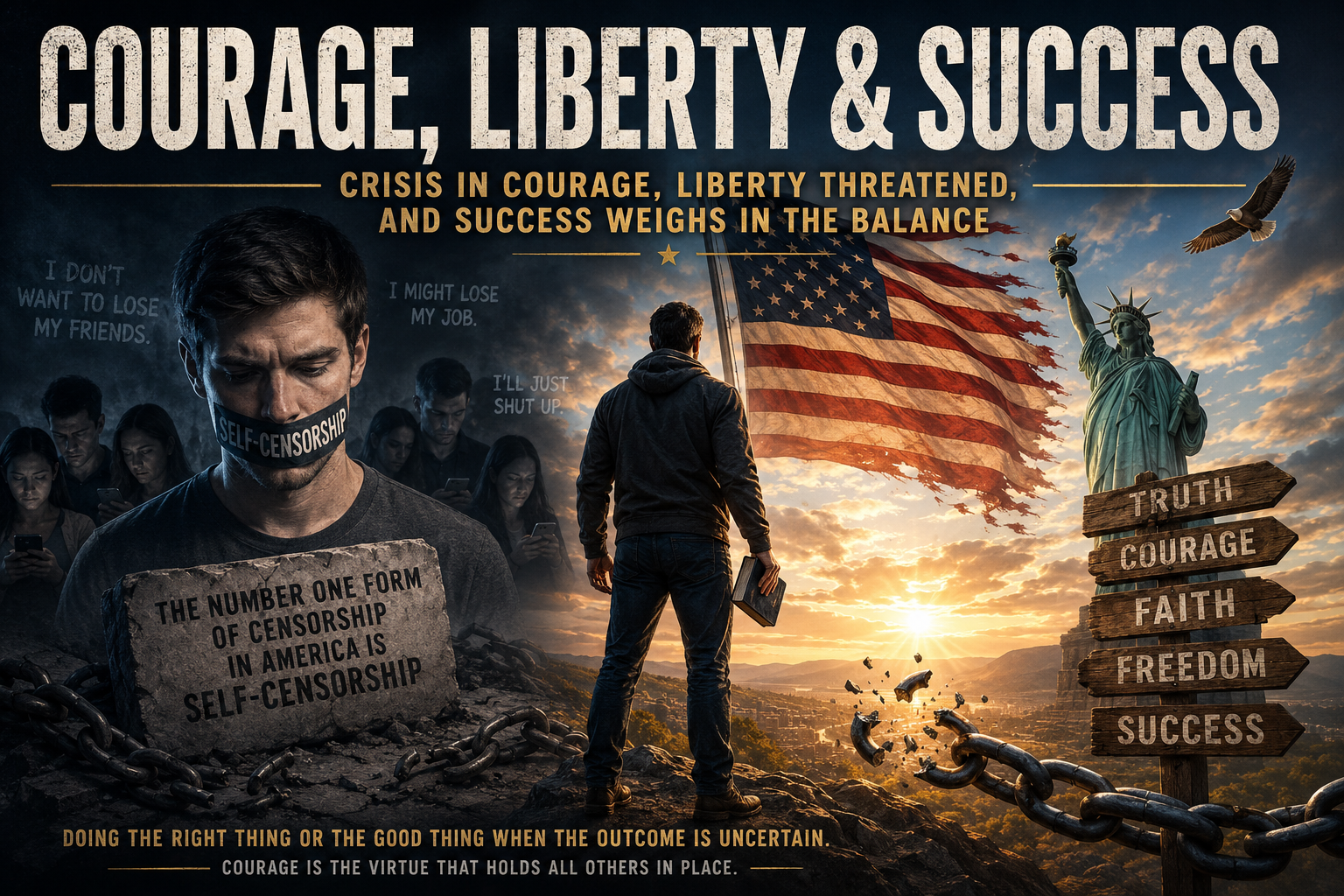
There is a crisis of courage in our country. The number one form of censorship in America is not big tech censorship. It’s self-censorship. From Charlie Kirk speeches on truth.
It’s shutting yourself up.
“I’m not going to talk about politics at the meal. I don’t want to lose these friends. I’m not going to tell my neighbors what I think.” I get it. People live good lives. People care deeply about what others think about them. But should that fear govern what someone is willing to say or stand for?
Many people today measure value through approval, social acceptance, and online affirmation. Yet courage is what gives strength and durability to every other quality in a person’s life. Someone can be smart, creative, funny, successful, or charming, but without courage those traits become fragile.
George S. Patton famously said that moral courage is the most necessary, yet absent, characteristic in men. Aristotle also declared that without courage there is no other virtue because courage is the virtue that holds all the others in place.
What Courage Really Is
What is courage?
Courage is not recklessness. It is not loudness. Courage is doing the right thing or the good thing when the outcome is uncertain.
If someone already knows exactly how things are going to turn out, there is no real courage involved. Courage only exists when there is risk, uncertainty, or possible loss attached to the decision.
This generation is living on the coattails of the courage of those who came before us, especially the Greatest Generation that fought in World War II.
These men and women sacrificed everything to confront tyranny and evil on a global scale. They sacrificed industries, resources, comfort, and countless lives. But their courage did not stop when the war ended. Afterward, they committed themselves to marriage, family, strong communities, and rebuilding the nation.
“The most valuable thing any leader can have in this time is courage, boldness. The people are going to follow courage.”
Rick Joyner
Why Courage Is Disappearing
The modern crisis of courage exists partly because people believe they have too much to lose.
People fear losing jobs, friendships, social circles, reputations, and opportunities. Revolutions and movements often emerge from people who have very little left to lose.
The deeper question becomes this:
Does maintaining comfort matter more than pursuing truth with courage?
Some may lose jobs. Some may lose friends. Yet courageous people throughout history chose conviction over comfort. And often, those who stand courageously eventually find new relationships, new allies, and deeper purpose.
One practical exercise suggested is to write down the courageous people seen throughout life and history, then ask honestly: “Do I want to become more like them?”
Liberty Depends on Truth and Shared Foundations
A nation without shared language, culture, history, and truth eventually loses its identity. It becomes little more than a temporary economic colony with no deep connection between its people.
Freedom of speech matters because it allows people to govern themselves through dialogue instead of physical conflict. The Western tradition historically valued debate, reasoning, and the open exchange of ideas.
But as speech disappears and self-censorship grows, people isolate themselves from meaningful conversation and increasingly silence themselves.
The greatest form of censorship is not always imposed externally. It is often voluntary silence born out of fear.
Many people suppress their views because they fear losing jobs, being socially rejected, or being mocked. That fear-driven silence creates a dangerous culture where fewer and fewer people are willing to openly pursue truth.
The Collapse of Shared Truth
Modern society increasingly embraces the idea that everyone can create their own truth. Yet stable civilizations require shared understandings of reality.
If multiple witnesses observe a car accident, there may be different perspectives, but society still seeks the actual truth of what happened. A functioning civilization requires some shared orientation toward truth, morality, and reality.
Without this, society becomes disoriented. If everyone defines “north” differently, nobody can navigate together.
C. S. Lewis referenced this idea in The Abolition of Man through the concept of the Dao, the shared moral law and principles that uphold civilization.
Within liberty there must still be agreement on foundational principles such as separation of powers, consent of the governed, independent courts, and private property rights.
Chaos Leads to Totalitarianism
When truth collapses, chaos follows. But chaos is not the final stage. The next stage is totalitarianism.
When society becomes fragmented into competing tribes and competing realities, people eventually crave order. That creates the conditions for authoritarian figures like Joseph Stalin to rise to power.
Chaos becomes the pathway toward centralized control. And often, many people participating in that chaos do not even realize where it is leading.
The modern pattern quickly moves from “this is my truth” to “you must affirm my truth or face punishment.”
The Problem with the Culture of Self-Worship
He also critiques the modern obsession with self-love and narcissism. People are encouraged constantly to affirm themselves without challenge or correction.
The better path is not endless self-celebration, but growth, discipline, and development. Human beings should recognize they are not yet all they could become.
One example given recalls seeing signs in school that said, “You are perfect the way you are.” The response was simple: “Then why am I in school?”
A healthier message would be: “You have great potential.”
That message encourages personal responsibility, improvement, discipline, and growth. It acknowledges human imperfection while still inspiring hope and development.
Christianity, Morality, and Civilization
Our discussion now turns toward the necessity of moral foundations for society. Without a shared moral framework, something else will inevitably replace it.
As younger generations move further away from Christianity, many seek replacement ideologies, causes, and identities to fill the spiritual vacuum.
The argument presented is that many modern cultural movements function as substitute religions, offering moral systems, rituals, and forms of devotion disconnected from biblical Christianity.
The warning is that when societies abandon biblical morality and foundational truth, confusion follows regarding what is good, evil, just, unjust, holy, and profane.
Charlie argues that the Western tradition, constitutional government, and individual liberty all emerged historically from biblical ideas about human dignity, equality, conscience, and accountability before God.
No More Spectator Conservatism
A major theme throughout the message is that many trusted institutions have failed to preserve truth and liberty. Media, academia, corporations, and other major institutions are viewed as having betrayed the public trust.
As a result, ordinary citizens are increasingly realizing that preserving liberty requires personal involvement. People can no longer remain passive spectators hoping someone else will fix the problems.
The call is toward engagement, courage, and consistency.
People must become the same person publicly that they are privately.
Silence born out of fear, ridicule, or social pressure eventually destroys freedom.
Courage, Liberty, and the Future
At the heart of this entire discussion is the understanding that courage is not optional for a free society.
Without courageous people willing to speak truth, defend liberty, and stand publicly for conviction, every other virtue becomes fragile. Freedom weakens. Dialogue collapses. Shared truth dissolves. And fear begins to govern society.
The warning is clear: self-censorship may ultimately become a greater threat than institutional censorship because it silences people before anyone else even has to.
And yet the message also carries hope. Courage can still be chosen. Communities can still be rebuilt. Truth can still be pursued. Liberty can still be defended. But it requires ordinary people deciding that comfort and approval are no longer worth more than truth itself.
Begin Your Journey Today
Jesus didn’t just call us to believe in Him—He called us to follow Him.
Step into the life He designed for you through Emmaus Road’s The Commands of Jesus. This is more than learning—it’s an invitation to walk with Him, obey Him, and experience Him in a real and powerful way.
You don’t want to miss this exciting adventure Jesus has called you into.
Start now:
https://GregLancaster.org/StartHere
Related Articles on The Torch
- “When Words Lose Meaning, Nations and the Church Lose Direction”
https://greglancaster.org/torch/when-words-lose-meaning-nations-and-the-church-lose-direction
- “The Lamb Who Claims the Earth: Unpacking Revelation 5”
https://greglancaster.org/torch/the-lamb-who-claims-the-earth-unpacking-revelation-5
- “Urgent Preparation for the Coming Harvest”
https://greglancaster.org/torch/urgent-preparation-for-the-coming-harvest
- “A New Way of Doing Church to Save This Generation”
https://greglancaster.org/torch/a-new-way-of-doing-church-to-save-this-generation
- “There Is a Resting Place”
https://greglancaster.org/torch/there-is-a-resting-place