



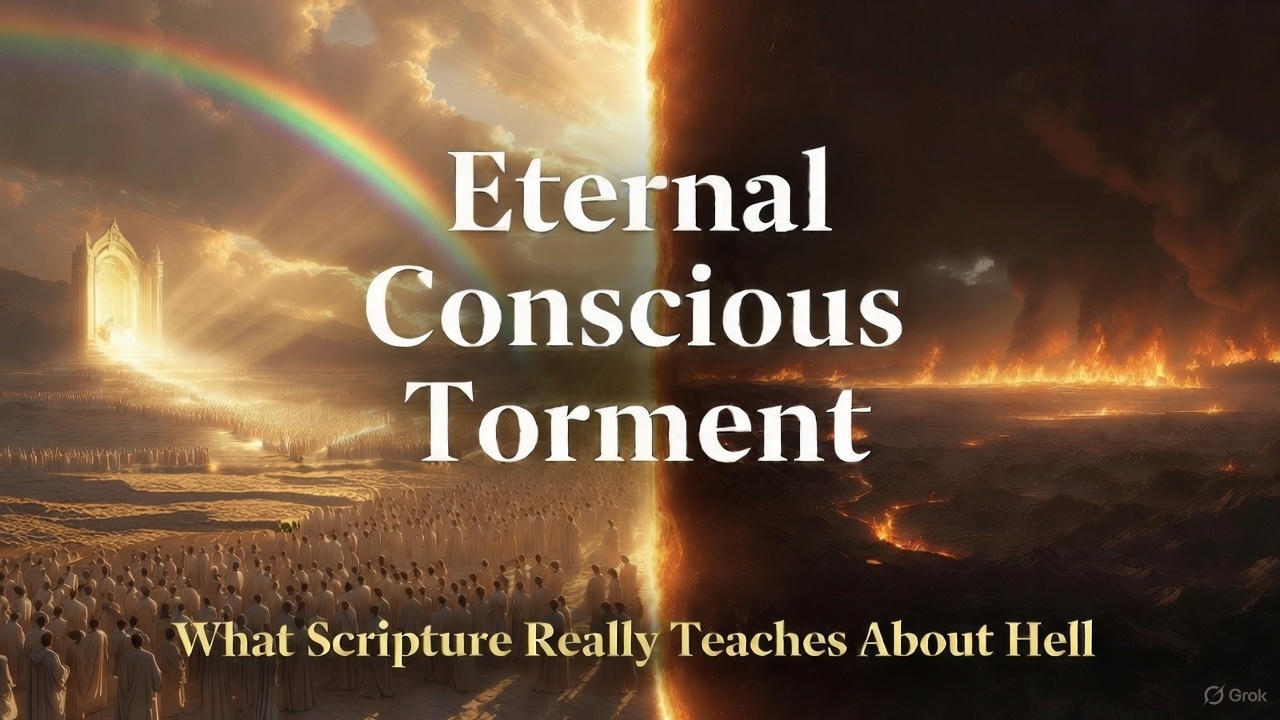
Five Things We Will Learn
- Wes Huff’s view of hell as eternal conscious separation from God’s presence and goodness.
- Kirk Cameron’s leaning toward annihilationism, where the wicked are ultimately destroyed and cease to exist.
- Key Scriptures that describe eternal fire, torment day and night forever, and conscious anguish.
- The Biblical teaching that human souls are immortal and face eternal conscious existence after death.
- The urgency of the Gospel and the profound grace revealed against the backdrop of hell’s reality.
Wes Huff’s Perspective on Hell
Wes Huff, in his May 2025 appearance on the Flagrant Podcast, describes hell as eternal conscious separation from God’s presence and goodness. This separation itself is the primary torment. He rejects medieval images of endless physical torture, noting those are more influenced by Greek philosophy and Dante than Scripture. Yet he holds firmly to the traditional view of eternal conscious torment, aligning with the plain reading of Biblical passages on unending punishment.
Kirk Cameron’s Perspective on Hell
Kirk Cameron, known from “Growing Pains,” shared on his December 3, 2025 podcast “The Kirk Cameron Show” that he leans toward annihilationism or conditional immortality. Influenced by Edward Fudge’s book The Fire That Consumes, he suggests the wicked face punishment but ultimately cease to exist rather than suffer endless torment. He described infinite conscious suffering as potentially “cruel.” As of mid-December 2025, he still holds this view publicly, with no retraction, though privately he is “not fully settled” according to Ray Comfort. Critics like Ray Comfort of Living Waters and Wes Huff have called this view erroneous and unorthodox, though not heresy.
The Biblical Teaching on Eternal Conscious Torment
Scripture consistently teaches eternal conscious torment in hell for those who reject Christ. Human souls are immortal and continue in conscious existence forever after death: believers in eternal life with God, and rejecters in eternal punishment and torment in fire, shared with Satan and his angels.
Key passages emphasize unending duration and conscious anguish:
Eternal Punishment & Fire
- Matthew 25:41: “Depart from me, you cursed, into the eternal fire prepared for the devil and his angels.”
- Matthew 25:46: “And these will go away into eternal punishment, but the righteous into eternal life.” (The same Greek word “aionios”/eternal applies to both.)
- Matthew 18:8: “…thrown into the eternal fire.”
Tormented Forever / No Rest
- Revelation 20:10: “And the devil… was thrown into the lake of fire and sulfur… and they will be tormented day and night forever and ever.”
- Revelation 14:10-11: “…tormented with fire and sulfur… the smoke of their torment goes up forever and ever, and they have no rest, day or night…”
Lake of Fire / Second Death
- Revelation 20:14-15: “Then Death and Hades were thrown into the lake of fire. This is the second death, the lake of fire. And if anyone’s name was not found written in the book of life, he was thrown into the lake of fire.”
- Revelation 21:8: “…their portion will be in the lake that burns with fire and sulfur, which is the second death.”
Weeping and Gnashing of Teeth (Conscious Anguish)
- Matthew 13:42,50: “…throw them into the fiery furnace. In that place there will be weeping and gnashing of teeth.”
- Matthew 22:13; 24:51; 25:30: “…cast him into the outer darkness. In that place there will be weeping and gnashing of teeth.”
- Luke 13:28: “In that place there will be weeping and gnashing of teeth…”
Soul Immortality and Eternal Conscious Existence
- Matthew 10:28: “Do not fear those who kill the body but cannot kill the soul. Rather fear him who can destroy both soul and body in hell.” (The soul survives physical death.)
- Luke 16:19-31 (Rich Man & Lazarus): The rich man in Hades experiences conscious torment, retains memory, speaks, and pleads across a great fixed chasm.
- John 5:28-29: “All who are in the tombs will… come out, those who have done good to the resurrection of life, and those who have done evil to the resurrection of judgment.”
- Daniel 12:2: “Many… shall awake, some to everlasting life, and some to shame and everlasting contempt.”
“It’s incredibly arrogant to pick and choose which incomprehensible truths we embrace. No one wants to ditch God’s plan of redemption, even though it doesn’t make sense to us. Neither should we erase God’s revealed plan of punishment because it doesn’t sit well with us. As soon as we do this, we are putting God’s actions in submission to our own reasoning, which is a ridiculous thing for the clay to do.”¹
“In my desire to distance myself from sadistic Christians who revel in the idea of wrath and punishment, I may have crossed a line. Refusing to teach a passage of Scripture is just as wrong as abusing it. I really believe it’s time for some of us to stop apologizing for God and start apologizing to Him for being embarrassed by the ways He has chosen to reveal Himself.”²
The Dangers of False Teaching on Hell and the Joy of True Salvation
Views like annihilationism are inconsistent with the explicit language of “tormented day and night forever and ever” and “no rest day or night.” Teaching that hell ends in cessation of existence removes the fear of eternal consequences for rejecting Christ. Jesus Himself, the Son of God, warns of unending fire and conscious suffering to underscore the gravity of sin and the necessity of repentance.
This false teaching dulls Gospel urgency. Without the reality of eternal torment as the just penalty for unforgiven sin, people may not grasp why salvation is called “being saved.” Jesus saves us from hell—the eternal consequence of sin apart from His forgiveness and Lordship in our lives (John 3:16; Romans 6:23).
“Hell is the backdrop that reveals the profound and unbelievable grace of the cross. It brings to light the enormity of our sin and therefore portrays the undeserved favor of God in full color.”³
“Jesus didn’t speak of hell so that we could study, debate and write books about it. He gave us these passages so that we would live holy lives.”⁴
“We need to surrender our perceived right to determine what is just and humbly recognize that God alone gets to decide how He is going to deal with people.”⁵
For those who accept Jesus Christ as Lord and Savior, there is profound rejoicing: they are rescued from eternal judgment and granted eternal life with God. This is the heart of the Good News.
Endnotes ¹ Francis Chan and Preston Sprinkle, Erasing Hell: What God Said About Eternity, and the Things We’ve Made Up (Colorado Springs: David C Cook , 2011), 88 (context: Chapter 4, discussing submission to God’s sovereignty). ² Francis Chan and Preston Sprinkle, Erasing Hell, Chapter 1 (personal reflection on teaching difficult doctrines). ³ Francis Chan and Preston Sprinkle, Erasing Hell, 148 (context: Chapter 6, on the grace magnified by hell). ⁴ Francis Chan and Preston Sprinkle, Erasing Hell, Chapter 5 (on Jesus’ warnings about hell and their purpose). ⁵ Francis Chan and Preston Sprinkle, Erasing Hell, 131 (context: Chapter 6, addressing questions of justice and God’s authority).
Bibliography Chan, Francis, and Preston Sprinkle. Erasing Hell: What God Said About Eternity, and the Things We’ve Made Up. Colorado Springs: David C Cook, 2011.

Begin Your Journey Today
Jesus didn’t just call us to believe in Him—He called us to follow Him.
Step into the life He designed for you through Emmaus Road’s The Commands of Jesus . This is more than learning—it’s an invitation to walk with Him, obey Him, and experience Him in a real and powerful way.
You don’t want to miss this exciting adventure Jesus has called you into.
Start now:
https://GregLancaster.org/StartHere