



Five Things We Will Learn
- Why America may be facing the worst year for church closures in its history.
- What the closing of rural churches reveals about the spiritual health of communities.
- The warning signs that signal when a church is nearing spiritual death.
- How one small rural church is experiencing renewal through evangelistic focus and humility.
- Why the future of the Church may look more like Acts than modern institutions.
A Crisis Quietly Sweeping Rural America
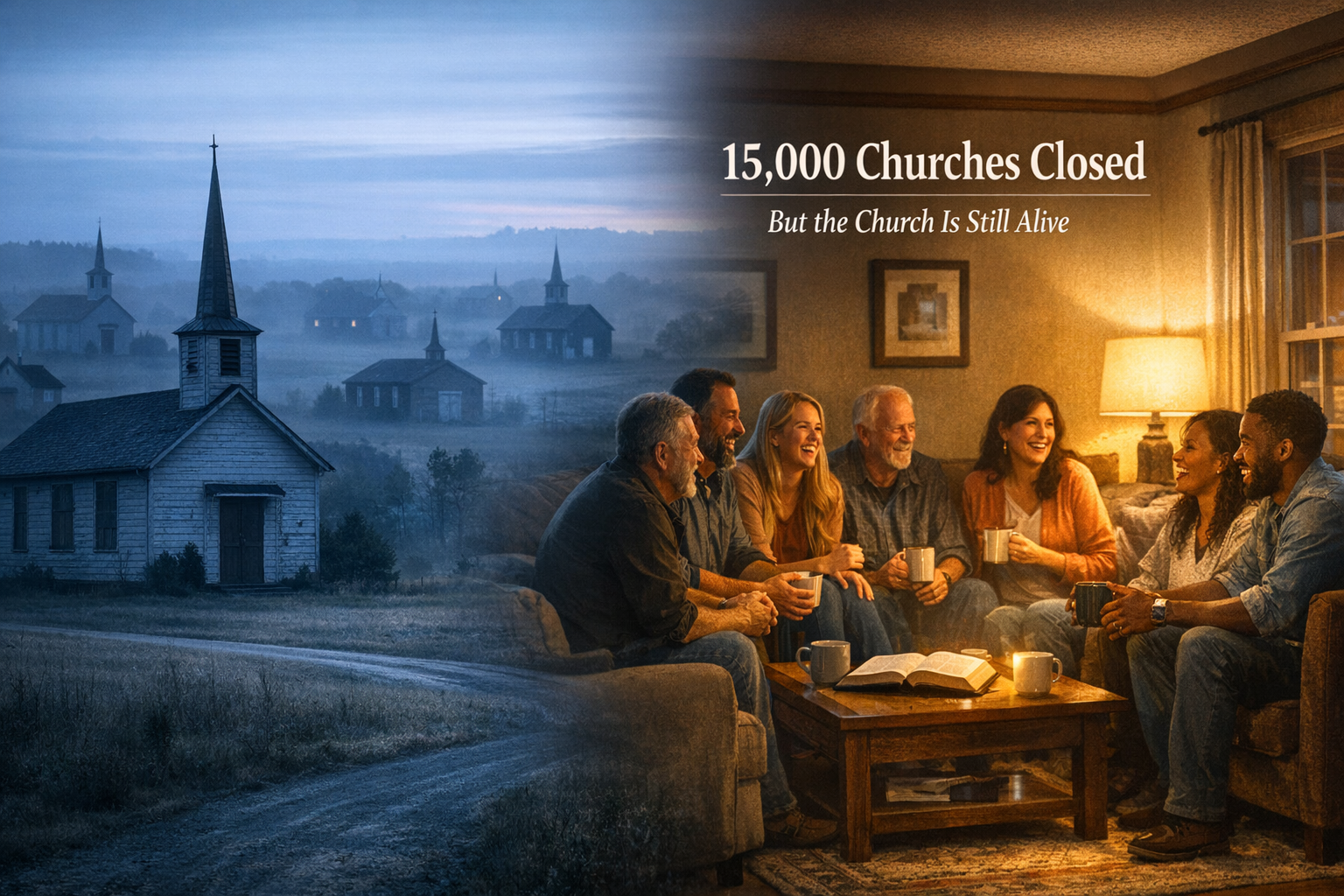
This could be the worst year on record for church closures in America. As many as 15,000 churches may shut their doors in a single year. Many of them are located in rural communities where churches have long served as the heartbeat of local life.
In towns across rural America, churches are more than places of worship. They are community anchors. But that pulse is fading.
In Gates County, North Carolina, several churches have already closed. Yet one small church there appears to be opening its doors wider than ever.
When Churches Become Museums
Gatesville, North Carolina, sits just south of the Virginia line. With a population of around 250, roughly half of its residents attend Upper Room Assembly of God, a small church on the edge of town.
A short drive through Gates County reveals a landscape of faith and transition. Some churches remain technically open on paper but have effectively closed. Others have shuttered completely.
Caretaker groups maintain many of these buildings—cutting grass, repairing roofs—but the life inside is gone. What remains is an edifice, a museum to what Jesus did generations ago rather than a living witness to what He is doing now.
Nationally, the National Council of Churches estimates that as many as 100,000 churches could close in the coming years, with mainline Protestant and Catholic parishes hit the hardest.
Warning Signs of a Dying Church
Tom Rainer, CEO of Church Answers, has spent nearly 40 years helping churches on the brink of closure. He says the demand for revitalization help has become overwhelming.
According to Rainer, two warning signs consistently precede decline:
- A lack of evangelistic intentionality
- A loss of gospel centrality combined with self-serving motives
When those conditions exist, decline is almost guaranteed. Churches may still function structurally, but spiritually they are critically ill—what Rainer describes as “near death.”
Redemption from a Prison Cell
Inside Upper Room Assembly of God, the story is very different.
Pastor Eric Heart did not grow up in church culture. He met Jesus while serving time in prison for drug distribution in the late 1990s. His first experience of church was a cell block with a handful of believers and the Word of God.
After his release, he felt called to plant a church just three miles from the prison camp where his life had been transformed.
As a congregation that has embraced an Acts 2-style revitalization journey, Upper Room Assembly has focused on lowering barriers and looking outward rather than inward.
Revitalization, Pastor Heart explains, begins when a church’s heart becomes tender toward the people just outside its doors—people desperate for hope, desperate for Christ, many of whom have never even heard His name.
The Church Beyond the Walls
While thousands of churches are closing across America, this small rural congregation demonstrates that renewal is still possible when the church remembers its true purpose.
For the first 300 years of Christianity, believers had no church buildings. They met in homes, underground, and wherever they could gather. Yet the love of Christ spread throughout the Roman Empire and turned it upside down.
Fine out more about how the church is moving back to be the family
we are called to be at Vine Fellowship Network.
The church was never meant to be confined within four walls. The church is the Body of Christ—salt and light for entire communities and the world.
The gifts of the Spirit, the baptism of the Holy Spirit, and all spiritual empowerment were never meant for self-edification alone. They exist so the love of Christ can reach a lost and hurting world.
The future of the Church may not be found in preserving buildings, but in lifting the light again—boldly, openly, and beyond the walls.
Begin Your Journey Today
Jesus didn’t just call us to believe in Him—He called us to follow Him.
Step into the life He designed for you through Emmaus Road’s The Commands of Jesus . This is more than learning—it’s an invitation to walk with Him, obey Him, and experience Him in a real and powerful way.
You don’t want to miss this exciting adventure Jesus has called you into.
Start now:
https://GregLancaster.org/StartHere