Home » Greg Lancaster Ministries » Just One More Scroll: The Neuroscience of Social Media and the Biblical Call to Self-Control | I’m not addicted to social media. Just one more scroll and I’m done… Okay, one more, then I’m done for real.
Just One More Scroll: The Neuroscience of Social Media and the Biblical Call to Self-Control | I’m not addicted to social media. Just one more scroll and I’m done… Okay, one more, then I’m done for real.
by
735
Five Things We Will Learn
How social media platforms are intentionally designed to keep users scrolling through dopamine-driven reward systems.
Why variable rewards make scrolling as difficult to stop as gambling and other addictive behaviors.
How seductive images and endless novelty affect the brain, attention span, relationships, and overall well-being.
What neuroscience reveals about brain changes associated with compulsive social media use.
How Scripture provides practical and spiritual guidance for breaking free from digital bondage and reclaiming self-control.
The “Just One More Scroll” Trap
Many people open social media intending to check one notification, read one post, or spend a few minutes catching up. Before they know it, thirty minutes, an hour, or even several hours have disappeared.
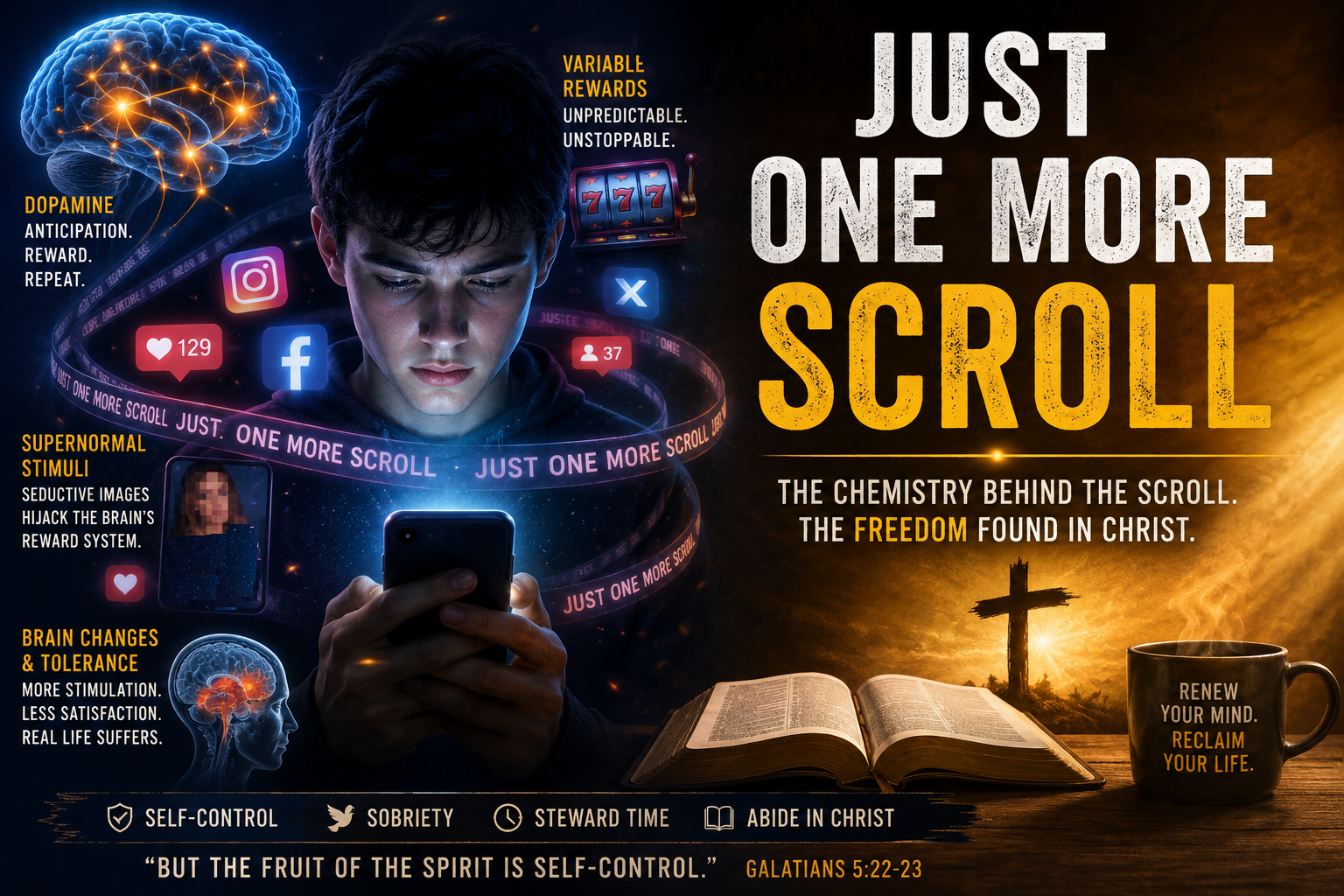
Platforms such as X, Instagram, Facebook, TikTok, and others are not accidental in their design. They are engineered to capture and retain attention by leveraging the brain’s reward system. The result is the familiar cycle of “just one more scroll,” where users continue engaging long after they intended to stop.
This phenomenon is driven by neurochemical processes, particularly dopamine pathways, combined with unpredictable rewards and highly stimulating content strategically placed throughout the feed.
The Dopamine Loop: Anticipation Is the Hook
Dopamine is often misunderstood as the brain’s pleasure chemical. In reality, dopamine is more strongly connected to motivation, anticipation, and the pursuit of rewards.
Every notification, refresh, swipe, or scroll creates anticipation. The brain begins expecting something rewarding: a like, a comment, a funny video, breaking news, or an emotionally stimulating image. Dopamine surges not primarily when the reward arrives, but when the brain anticipates the possibility of a reward.
When the expected reward does not appear immediately, the brain seeks another opportunity. Users keep scrolling, searching for the next hit of novelty or stimulation. This creates a self-perpetuating cycle that can continue long after the original purpose for opening the app has been forgotten. Chronic engagement can contribute to measurable changes in reward-processing areas of the brain and reduced impulse control.
Variable Rewards: The Slot Machine in Your Pocket
One of the most powerful psychological mechanisms used by social media platforms is variable ratio reinforcement.
This is the same principle that makes slot machines so addictive.
Likes, comments, viral content, unexpected messages, and highly engaging videos appear after an unpredictable number of actions. Because the rewards arrive inconsistently, the brain becomes even more motivated to continue searching for the next reward.
Psychologist B.F. Skinner’s research demonstrated that unpredictable rewards produce persistent behavior that is resistant to stopping. Social media platforms maximize this effect through:
Infinite scrolling
Autoplay videos
Pull-to-refresh features
Algorithmic content delivery
Personalized recommendations
Without natural stopping points, users often continue scrolling even when they are no longer enjoying the experience. Over time, this constant pursuit of novelty creates what many refer to as “popcorn brain,” where attention becomes conditioned to rapid stimulation and everyday activities begin to feel less engaging.
Over time, this constant pursuit of novelty creates what many refer to as “POPCORN BRAIN,” where attention becomes conditioned to rapid stimulation and everyday activities begin to feel less engaging.
Seductive Images and Supernormal Stimuli
Social media feeds often mix ordinary content with highly stimulating images.
Cute animals, humorous videos, news stories, and personal updates are frequently interspersed with attractive, suggestive, or sexualized imagery. These images function as what researchers call “supernormal stimuli” — exaggerated versions of naturally rewarding cues that trigger unusually strong responses in the brain.
Because these images generate larger dopamine responses, they become powerful rewards within the scrolling experience. The feed becomes a roller coaster of mild stimulation and intense stimulation, making it increasingly difficult to disengage.
Research involving brain imaging has shown that attractive and sexual cues activate many of the same reward circuits involved in other addictive behaviors. Platforms learn from user engagement and continually adjust content to maximize attention, creating a personalized stream of increasingly compelling material.
How Endless Scrolling Changes the Brain
Over time, prolonged exposure to highly stimulating digital environments can affect both brain function and behavior.
Research cited in the article points to several concerning trends among heavy users:
Reduced gray matter in reward-processing regions
Blunted responses to natural rewards
Weakened prefrontal cortex regulation
Impaired attention span
Reduced working memory
Greater difficulty maintaining focus
Short-form video consumption and rapid content switching may contribute to cognitive overload and attention-related challenges that resemble ADHD-like symptoms in some individuals.
As dopamine sensitivity becomes blunted, users often require greater levels of stimulation to achieve the same sense of engagement. This is known as tolerance, a phenomenon commonly observed in behavioral and substance addictions.
The Impact on Relationships and Real Life
The effects of endless scrolling do not remain confined to the screen.
As the brain becomes accustomed to constant novelty and stimulation, ordinary experiences may feel less rewarding. Real-life conversations, relationships, intimacy, work, study, and spiritual disciplines can all seem less engaging compared to the endless stream of digital stimulation.
Additional consequences may include:
Increased anxiety
Depression
Impulsivity
Reduced productivity
Distorted expectations regarding attraction and relationships
Lower overall life satisfaction
Greater body image dissatisfaction
When digital stimulation begins overshadowing real-world relationships and responsibilities, the consequences become increasingly significant.
Why It Is So Hard to Stop
Many people blame themselves for lacking discipline, but the issue is larger than simple willpower.
The endless feed is intentionally designed to bypass natural stopping cues. As mental fatigue sets in, the prefrontal cortex becomes less effective at regulating impulses while the reward system continues demanding more stimulation. Fear of missing out, boredom, social validation, and algorithmic personalization all contribute to the difficulty of disengaging.
The struggle is not merely a personal weakness. It is a predictable response to systems specifically engineered to capture attention and maximize engagement.
Reclaiming Control
Understanding how these systems operate is the first step toward freedom.
Practical strategies include:
Setting app time limits
Removing notifications
Curating feeds
Using grayscale displays
Scheduling designated times for checking social media
Taking regular digital fasts
Replacing scrolling habits with healthier activities
Awareness interrupts the automatic nature of the scrolling cycle and helps restore appreciation for natural rewards, meaningful relationships, and purposeful living.
The Biblical Perspective: Self-Control Is a Fruit of the Spirit
Scripture speaks directly to the struggle of being mastered by desires and habits.
Galatians 5:22-23 declares:
“But the fruit of the Spirit is love, joy, peace, patience, kindness, goodness, faithfulness, gentleness and self-control. Against such things there is no law.”
Self-control is evidence of the Holy Spirit’s work in a believer’s life. When scrolling habits repeatedly override intentions and convictions, believers are reminded that the flesh wars against the Spirit and that victory comes through God’s power.
Titus 2:11-12 teaches that God’s grace trains believers to say no to worldly passions and to live self-controlled lives. Grace is not permission for indulgence; it is empowerment for obedience.
Not Being Mastered by Anything
Paul writes in 1 Corinthians 6:12:
“Everything is permissible for me”—but not everything is beneficial. “Everything is permissible for me”—but I will not be mastered by anything.
The issue is not merely whether social media is inherently sinful. The deeper question is whether it has become a master. When scrolling consistently consumes attention, time, focus, and devotion, believers must honestly evaluate whether they are walking in freedom or bondage.
Renewing the Mind
Romans 12:1-2 calls believers not to conform to the patterns of this world but to be transformed by the renewing of their minds.
Endless streams of sensational, seductive, and emotionally charged content continually shape thought patterns. Scripture calls Christians to a different path: renewing the mind through God’s Word, prayer, worship, and obedience.
Ephesians 4:22-24 similarly urges believers to put off the old self and be made new in the attitude of their minds. The promises offered by endless scrolling often prove deceptive, promising satisfaction while producing deeper craving.
Fleeing Temptation
Jesus warned in Matthew 5:28 that lust begins in the heart.
Social media platforms frequently place seductive content directly before users, often without seeking it. Scripture’s response is not passive management but active resistance.
Paul writes in 2 Timothy 2:22:
“Flee the evil desires of youth and pursue righteousness, faith, love and peace, along with those who call on the Lord out of a pure heart.”
Sometimes wisdom means removing the app, changing habits, installing accountability measures, or avoiding environments that continually stir temptation.
Stewardship of Time and Sobriety
Ephesians 5:15-16 instructs believers:
“Be very careful, then, how you live—not as unwise but as wise, making the most of every opportunity, because the days are evil.”
Time is one of God’s most valuable gifts. Hours lost in compulsive scrolling cannot be recovered. Scripture repeatedly calls believers to live intentionally, stewarding their attention and energy wisely.
Likewise, 1 Peter 5:8 commands:
“Be self-controlled and alert. Your enemy the devil prowls around like a roaring lion looking for someone to devour.”
A sober mind stands in direct contrast to the overstimulated, distracted state often produced by endless digital consumption.
The Real Battle
The “just one more scroll” struggle is about more than technology.
It is a battle for attention, affection, desire, and ultimately worship.
It is a battle for attention, affection, desire, and ultimately worship.
Anything that consistently demands greater allegiance than Christ can become an idol. Scripture calls believers to flee idolatry, renew their minds, exercise self-control, and walk in the power of the Holy Spirit. The answer is not merely stronger willpower but deeper dependence on God.
The endless feed may be designed to keep people scrolling, but freedom remains available. Through awareness, discipline, accountability, and the empowering work of the Holy Spirit, believers can reclaim their attention and direct it toward what is true, noble, right, pure, lovely, and admirable.
God Set Him Free
In his interview on Pastor Jack Hibbs’ podcast Happening Now, Ruslan Karaoglanov (professionally known as Ruslan KD or RuslanKD) openly discussed his pornography addiction that began at a young age. He explained how he overcame it through Christ and the practical steps he still takes to maintain victory in this area.
“I had to come to a place of like, hey, there’s no condemnation for me because Jesus already dealt with my sin… However, Paul then goes on to give us some instruction… we have an obligation, but it is not to the flesh… if by the Spirit you put to death the misdeeds of the body, you will live.”
“I have to wage war. I have to kill my sin or my sin will kill me. I have to have a plan and a mission and a strategy…”
“I personally I don’t have social media on my phone like that because I know it could immediately be a trigger for me… I have to be intentional to wage war… I have to be careful what I’m listening to…”
“That there’s a physical sacrifice I need to be making with my body. I need to be doing hard things. I need to be going outside. I need to be challenging myself.”
He also emphasized that this is an ongoing process of vigilance (“Still got to be careful. I still got to be hypervigilant. I still have to have boundaries”), but he now walks in freedom rather than slavery to sin.
This is an ongoing process of vigilance (“Still got to be careful. I still got to be hypervigilant. I still have to have boundaries”), but he now walks in freedom rather than slavery to sin.
RuslanKD
The Biggest Untold Story of 2026: The Changing Algorithm
Jeremy Boreing, Founder and former CEO Dailwire.com stated on the PBD Podcast with Patrick Bet David, “You know, this is something I’ve started talking about a lot in the last few weeks. The X algorithm is open source, so you can go look at it. The X algorithm isn’t unique — they’re doing what the entire industry is doing. So seeing X’s algorithm gives you real insight into what all the platforms are doing.
And what the platforms are doing in 2026 that’s distinct from anything they’ve ever done before is this: they’re no longer taking into consideration whether or not you follow an account.
If you follow me but you don’t follow Tom, it doesn’t matter. If you engage more with Tom’s content when it shows up in your feed — and engagement can be as simple as slowing down your scroll, not even clicking — then you’re going to start seeing all of his stuff, and you’re going to see less of mine.
The algorithm is now being built to maximize the addictiveness of the content.
Think about what that means as a Christian. There’s a battle in every man between the flesh and the spirit. The flesh is our baser instincts. The spirit requires formation, structure, and governance.
Up until now, your social media feed might have included both good things and bad things — content that edifies your soul and content that destroys it. But at least you had some say in what you were fed. You could follow better accounts and actively curate your feed.
Today, that is no longer true.
If you’re scrolling and a girl in a bikini pops up, almost every man — even the Pope in Rome — slows down. Because all have sinned and fall short of the glory of God. But you are not just your lizard brain. You are not just your flesh. There is a part of you that governs against being ruled by your base instincts.
In the past, you could say, “I’m seeing too many bikini pictures,” and then go follow Patrick Bet-David, Ben Shapiro, or solid Christian content — and the algorithm would adjust. Now, the algorithm only serves you what you slow down on. You no longer have a real say in what you’re fed.
When you combine this with anonymity, foreign influence, and pure addictiveness… the damage being done — not just to kids, but to all of us — by the ubiquity of social media is potentially civilization-destroying.”
When you combine this with anonymity, foreign influence, and pure addictiveness… the damage being done — not just to kids, but to all of us — by the ubiquity of social media is potentially civilization-destroying.”
He acknowledged his past struggle with pornography (stemming from childhood sexual abuse and hypersexualization at a young age).
No condemnation in Christ: He came to the realization from Romans 8:1 — “There is now no condemnation for those who are in Christ Jesus” — because Jesus dealt with all his sin (past, present, future) on the cross. This removed shame/guilt while still calling him to action.
Obligation to the Spirit, not the flesh (Romans 8:12): “We have an obligation, but it is not to the flesh to live according to it.”
Put sin to death (Romans 8:13): “If by the Spirit you put to death the misdeeds of the body, you will live.” → His key phrase: “I have to wage war. I have to kill my sin or my sin will kill me.”
Practical Strategies He Implemented
Strict boundaries on devices and triggers:
Removed easy access to social media that could trigger him.
Instagram is heavily restricted: behind Face ID + code, with only 30 minutes per day.
Does not have X (Twitter) on his phone.
“I have to wage war. I have to be careful…”
Sleep and daily rhythms:
Careful about staying up late — tiredness leads to vulnerability.
Maintains an “off time” (structured cutoff for screens/activities).
Media and content consumption:
Intentional about what he listens to and the music he consumes.
Avoids things that feed the old patterns.
Physical / Embodied Discipline (Romans 12:1-2):
Offer his body as a “living sacrifice, holy and pleasing to God — this is your true and proper worship.”
Do hard things physically: go outside, challenge himself, engage in real-world activity instead of passive consumption.
Renew his mind daily to test and approve God’s will.
Overall Integration:
Rejected Gnostic-style compartmentalization (spiritual life separate from physical/financial/practical life).
Became a “fully integrated person” — spirit, soul, and body all submitted to Christ.
Focused on loving Jesus more than the sin, which created a genuine “loathing” and hatred for it over time.
Begin Your Journey Today
Jesus didn’t just call us to believe in Him—He called us to follow Him.
Step into the life He designed for you through Emmaus Road’s The Commands of Jesus. This is more than learning—it’s an invitation to walk with Him, obey Him, and experience Him in a real and powerful way.
You don’t want to miss this exciting adventure Jesus has called you into.