



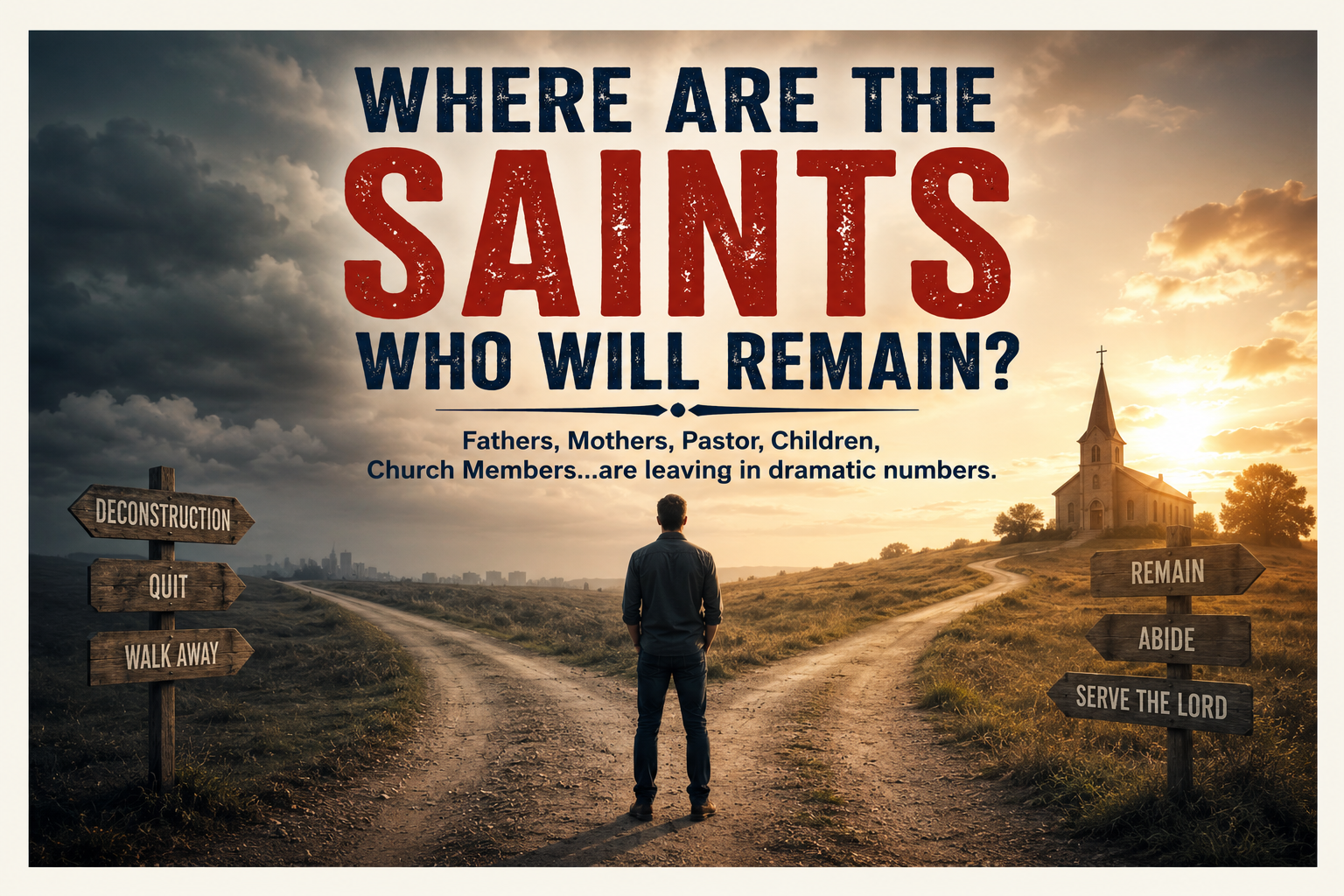
Five Things We Will Learn
- The call to remain is a conscious decision — faithfulness is not accidental; it is a daily, deliberate choice made in the face of shifting circumstances.
- Faith deconstruction is reaching crisis levels — across denominations and generations, people are walking away from the Church at unprecedented rates.
- Longevity in faith is becoming increasingly rare — the culture of spiritual consistency is eroding, and finding those who have “abided over time” is harder than ever.
- Fame and faithfulness are not the same thing — the world celebrates the visible, but God honors the steadfast.
- The antidote to drifting is a made-up mind — a firm, personal covenant to serve the Lord regardless of pressure, politics, or peers is the foundation of lasting faith.
“Come Hell or High Water”: The Decision to Remain
There is a question echoing through the hallways of churches, across family dinner tables, and deep inside the conscience of believers everywhere: Where are the saints who will remain?
“I am the vine; you are the branches. If a man remains in me and I in him, he will bear much fruit; apart from me you can do nothing. – Jesus, John 15:5 (NIV 1984)
It is a question that pastor and speaker Priscilla Shirer is not afraid to ask out loud. In a season where spiritual drift has become normalized, where faith deconstruction is trending on social media, and where quitting a calling has become an option people actually consider, Shirer draws a line in the sand.
“As for me and my house,” she declares, echoing the ancient resolve of Joshua 24:15, “what we going to do is we going to serve the Lord.”
That statement is more countercultural today than it has ever been. In a world defined by shifting landscapes — political upheaval, financial uncertainty, relentless peer pressure, and the noise of cultural change — the decision to remain is itself an act of profound spiritual courage.
The stats back this up. According to a 2023 Gallup survey, only 45% of Americans report belonging to a church, or synagogue — down from 70% in 1999. That is a 25-percentage-point drop in just over two decades. The Church is not losing people at the margins. It is losing them at the core.
A Nation Drifting: The Data on Faith Departure
Shirer’s warning is not hyperbole. The data on religious disaffiliation in America paints a sobering picture.
Churchgoing is in steep decline. The Pew Research Center (2023) found that 28% of American adults now identify as religiously unaffiliated — a group researchers call the “nones.” That number was just 16% in 2007. In sixteen years, the unaffiliated population nearly doubled.
The young are leading the exodus. According to Barna Group research, approximately 64% of young people who grew up in the Church will walk away from faith in their twenties. Of those, only a fraction return. The Springtide Research Institute (2021) found that 40% of young people (ages 13–25) identify as “disengaged” from religion, even if they were raised in a faith tradition.
Pastors are quitting in record numbers. A 2022 Barna report revealed that 42% of senior pastors have considered leaving vocational ministry in the past year — the highest level recorded since Barna began tracking the data. This is precisely the crisis Shirer names: “Ministers are quitting what they said was a calling. How do you quit a calling?”
Families are fragmenting spiritually. A 2021 Lifeway Research study found that 66% of young adults who attended church regularly as teenagers will drop out for at least a year between the ages of 18 and 22. Parents raising children in faith are doing so against stronger cultural headwinds than any previous generation has faced.
Houses are leaving. Parents are giving up. Dreamers are throwing in the towel. This is not a feeling. This is a documented reality.
The Falling Away Is a Sign, Not a Surprise
The drift we are witnessing is not simply a sociological trend or a failure of church programming — it is prophetic. Paul warned the church at Thessalonica not to be shaken or alarmed, but he was equally clear: before the return of Christ, a great rebellion would come first. The Greek word used is apostasia — translated “rebellion” or “falling away” — the very root of our English word apostasy. What Shirer is observing in real time, what the data is confirming in cold numbers, is not a surprise to anyone reading their Bible. The abandonment of faith, the quitting of callings, the dismantling of spiritual houses — these are not signs that God has lost control. They are signs that the hour is later than we think. This is precisely why the call to remain is so urgent. Paul’s instruction was not to panic, not to be unsettled, and not to be deceived — but it was also a call to stay. Those who remain, who abide, who refuse to be moved, are not simply being stubborn. They are being prophetically obedient. The faithful few who hold their ground in a season of mass departure are, in the truest sense, the ones history will remember.
“Don’t let anyone deceive you in any way, for that day will not come until the rebellion occurs.”
— 2 Thessalonians 2:3 (NIV 1984)
The Problem with Deconstruction
Shirer draws a careful and important distinction. She is not against questions. She is not against doubt. Honest wrestling with faith has always been part of the believer’s journey — from Jacob wrestling with God at the Jabbok (Genesis 32) to Thomas demanding to see the wounds of the risen Christ (John 20).
“We’ve decided that even if we have to ask our questions,” Shirer says, “we will not deconstruct our faith to the point that it looks like we don’t even have faith anymore.”
This is the crux. There is a difference between questioning faith and dismantling it. There is a difference between honest doubt and performative unbelief. The deconstruction movement — which gained enormous momentum in the late 2010s and accelerated through the 2020s, largely fueled by social media — has become, for many, not a path toward deeper faith but a departure from it altogether.
Research supports this concern. A 2023 survey by the Cultural Research Center at Arizona Christian University found that only 4% of American adults hold a biblical worldview — meaning they affirm the authority of Scripture, the reality of absolute moral truth, and the core tenets of the Christian faith. That number was already low a decade ago. It continues to fall.
Asking questions of faith is healthy. Walking away from faith while calling it “freedom” is something else entirely. Shirer urges believers to hold the tension — to remain curious without becoming unmoored.
The Community That Used to Hold Us
There is a communal dimension to Shirer’s lament that deserves serious attention.
“The community of faith we used to have that was so strong,” she reflects, “over the course of time, it’s becoming harder and harder to find people with some longevity, with some consistency.”
This is not nostalgia for a golden age that never existed. This is a recognition that spiritual community — the kind that holds people accountable, carries them through hardship, and celebrates perseverance — has been quietly eroding.
The statistics on loneliness and disconnection make this visible:
- A 2023 report from U.S. Surgeon General Dr. Vivek Murthy declared loneliness a public health epidemic, noting that Americans have fewer close friendships and less community involvement than at any point in modern recorded history.
- The average number of close friends Americans report has dropped from approximately 3 in 1990 to fewer than 2 in 2021 (Survey Center on American Life, 2021).
- Regular church attendance — defined as attending at least once a month — has dropped to 22% among adults under 35 (Gallup, 2022).
When the community of faith weakens, individuals are left to sustain their spiritual lives alone. And alone is where most people eventually drift. The people who remain, research consistently shows, are those embedded in accountable, consistent spiritual community. Isolation is not a path to faithfulness. It is a path to departure.
Dreamers, Parents, and Ministers: The Ones Who Are Walking Away
Shirer names three specific groups whose departure is particularly painful: dreamers, parents, and ministers.
Dreamers who abandon the dream. There is a particular heartbreak in watching someone who was once gripped by a God-given vision gradually release it. The entrepreneurial, creative, and prophetic dreamers of the Church — those who once burned with purpose — are increasingly capitulating to discouragement, comparison, and the grinding reality that obedience rarely trends on Instagram. Shirer’s challenge to dreamers is simple and severe: the dream was God’s before it was yours. You don’t get to throw in the towel.
Parents who give up. The weight of raising children in faith is immense. And in a culture that aggressively competes for the hearts and minds of young people, many parents have simply exhausted their resources and surrendered the spiritual formation of their children to default — which is almost always secular. The Barna Group’s research indicates that parents remain the single greatest influence on the faith formation of children. The abdication of that role has generational consequences.
Ministers who quit a calling. Perhaps the most alarming of the three. A calling, by theological definition, is not a job. It is not a career. It is a divine assignment — and divine assignments do not come with resignation options. Yet the hemorrhaging of pastoral leadership from the Church is real, documented, and ongoing. The pastoral burnout crisis is not merely an institutional problem. It is a spiritual one. And the congregations left behind in the wake of pastoral departure are, in many cases, left without shepherds.
Fatherless
God’s very own people, His flock, are being overtaken by the very same spirit that has overtaken “the family” — the spirit of fatherlessness. Abandoning children — yours, theirs, and His — for their own desires, or simply quitting as if that is an option for fathers.
Paul said we have 10,000 teachers, but very few fathers — “for I am your father in Christ Jesus.” ( I Corinthians 4:15-17) Paul, as a spiritual father, raised his spiritual sons like Timothy, Titus, and others to father the Church. He knew how important fathers were. Though Paul had divine revelation and wrote nearly half of the New Testament, he spoke of himself as a father to God’s flock. Of course, Father God is the God of His Church, the Father of His Church, and Jesus is the Lord of His Church — but He calls spiritual fathers and mothers to love and protect His people the way He designed natural families to have fathers and mothers. It is family where we have been called to reside, and “families have fathers,” as Ken Sumrall [a spiritual father to me in Christ-Jesus] continually told those called to relate to him as a spiritual father.
It is only family that truly gives someone the grace to continue on and find meaning amid the pressures and troubles of life, held together by love — love for God and for one another. Agape love: the kind of love that is a choice, knowing that it is God’s design and will for us.
“See, I will send you the prophet Elijah before that great and dreadful day of the LORD comes. He will turn the hearts of the fathers to their children, and the hearts of the children to their fathers; or else I will come and strike the land with a curse.”
— Malachi 4:5–6 (NIV 1984)
A question worth asking ourselves: Are people “leaving the church” or are they leaving man’s traditions and religion for a personal relationship with Jesus and His family — just as Jesus Himself demonstrated for us all?
Back to Shirer’s
Related:
Fame Versus Faithfulness
“The older and older I get,” Shirer confesses with disarming honesty, “the less impressed I am with the famous, and the more and more impressed I am with the faithful.”
This is a word for this precise cultural moment. The metrics by which the modern Church measures success — social media followers, book deals, speaking platforms, building size, annual attendance figures — are not the metrics of heaven. And Shirer is done pretending otherwise.
The faithful may not be famous. They may not be rich. They may not be applauded by the masses. They may not have best-selling books or millions of followers on Instagram. But they have done the one thing that actually matters: they remained.
Consider the contrast through data:
- The average viral Christian content creator sees 80% of their peak engagement gone within 18 months (Social Blade trend analysis).
- Meanwhile, research from the Fuller Youth Institute shows that the young people most likely to maintain faith into adulthood are those connected to consistent, non-celebrity adult mentors who model quiet, faithful Christian living over decades.
Fame is a vapor. Faithfulness is a foundation.
The biblical standard Shirer invokes is 1 Corinthians 15:58: “Therefore, my dear brothers and sisters, stand firm. Let nothing move you. Always give yourselves fully to the work of the Lord, because you know that your labor in the Lord is not in vain.”
Steadfast. Immovable. Always abounding. Not trending. Not viral. Remaining.
A Call to Decision: What Will You Do?
The heart of Shirer’s message is ultimately not a lament. It is an invitation — or more precisely, a challenge.
In a season when everything shifts, when the cultural ground moves beneath our feet, when even the church community around us thins and quiets and slowly empties, the question is not about anyone else. It is about you.
Will you remain?
Not because it is easy. Not because it is popular. Not because everyone around you is doing it — because, increasingly, they are not. But because you have made a decision. A covenant. A resolve. As for you and your house, you have settled it.
The saints who remain may not make headlines. They will not trend. They will not be celebrated by the masses. But they will be found — by the generations that come after them, searching desperately for someone who did not quit — faithful, consistent, and still standing. They will be found in eternity with Jesus and our Father God Who will never abandoned us.


Begin Your Journey Today
Jesus didn’t just call us to believe in Him—He called us to follow Him.
Step into the life He designed for you through Emmaus Road’s The Commands of Jesus. This is more than learning—it’s an invitation to walk with Him, obey Him, and experience Him in a real and powerful way.
You don’t want to miss this exciting adventure Jesus has called you into.
Start now:
https://GregLancaster.org/StartHere
Sources Referenced:
- Gallup (2023). Church Membership in U.S. Falls Below Majority for First Time.
- Pew Research Center (2023). Religious Landscape Study.
- Barna Group (2022). Pastors on the Brink.
- Springtide Research Institute (2021). The State of Religion & Young People.
- Lifeway Research (2021). Reasons 18–22 Year Olds Drop Out of Church.
- Cultural Research Center, Arizona Christian University (2023). American Worldview Inventory.
- U.S. Surgeon General’s Advisory (2023). Our Epidemic of Loneliness and Isolation.
- Survey Center on American Life (2021). The State of American Friendship.
- Fuller Youth Institute. Growing Young Research.
- Joshua 24:15; John 20:24–29; Genesis 32:22–32; 1 Corinthians 15:58 (NIV)