



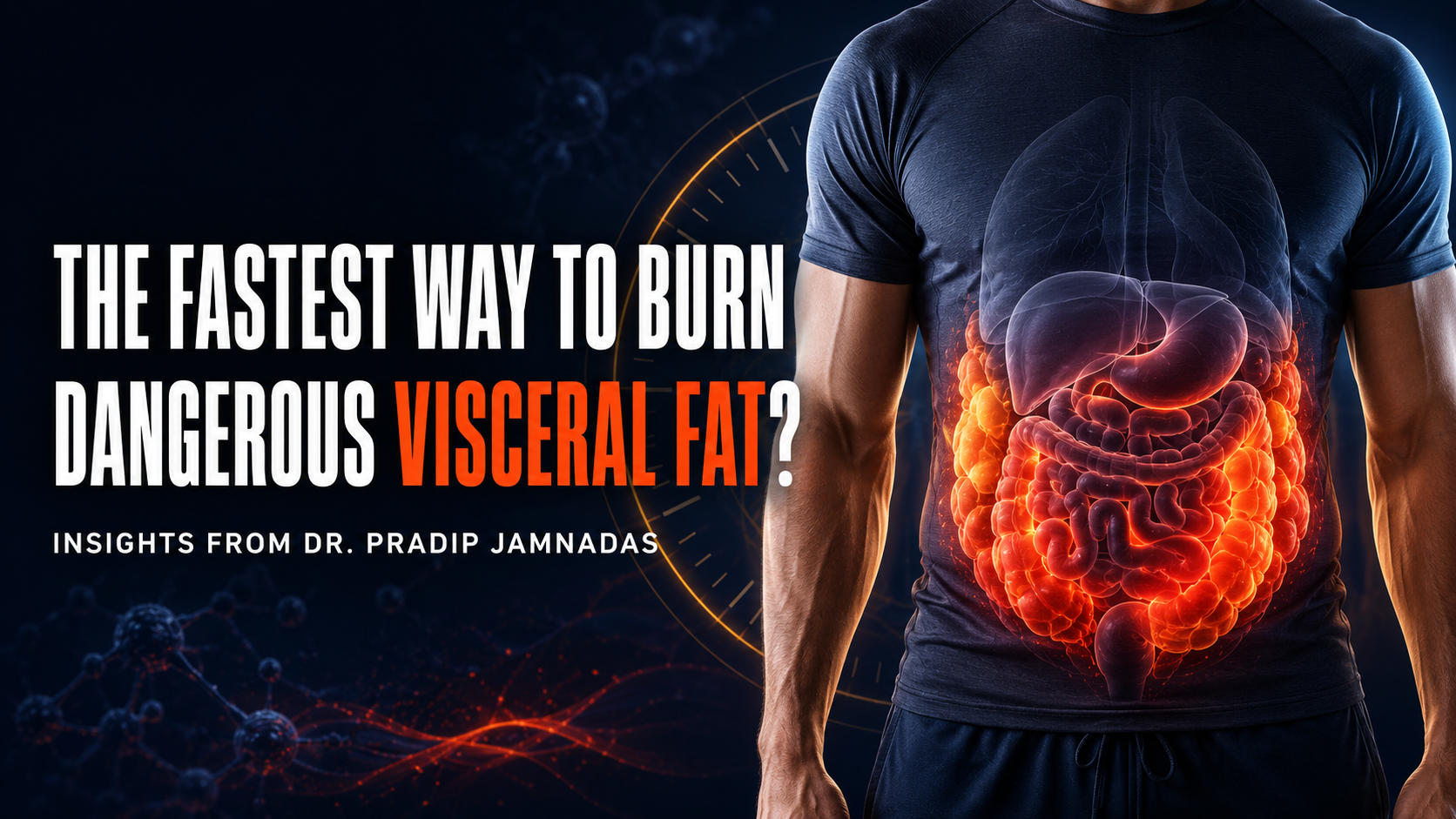
In a revealing conversation on Steven Bartlett’s podcast, The Diary of a CEO, cardiologist Dr. Pradip Jamnadas explained why dangerous visceral fat can begin accumulating earlier than many people realize. He also described how fasting affects insulin, stored fat, ketones, autophagy, and metabolic health.
The discussion comes from the public YouTube episode, “Insulin Doctor: The Fastest Way to Burn Dangerous Visceral Fat!” hosted by Steven Bartlett and featuring Dr. Jamnadas. Their conversation offers a compelling explanation of why when we eat may matter alongside what and how much we eat.
Five Things We Will Learn
- Why Dr. Pradip Jamnadas views a protruding abdomen as a possible warning sign of visceral fat and insulin resistance.
- Why he distinguishes fasting from simply reducing daily calories.
- How he progresses patients from a 12:12 fasting schedule toward 18:6 and, in selected cases, longer medically supervised fasts.
- What he says happens as glycogen is depleted, ketones rise, and cellular recycling processes such as autophagy begin.
- Why fasting must be individualized, especially for women, people taking diabetes medication, and anyone considering a prolonged fast.
When Does Metabolic Damage Begin?
During the interview, Steven Bartlett asked Dr. Jamnadas when metabolic damage begins for someone his age.
“And someone like me, I’m 33 years old now. When does the damage begin?” Bartlett asked.
“It starts right now,” Dr. Jamnadas answered. “It starts right now. As soon as you’re around 30, you’re already starting to have trouble.”
One of the first things Dr. Jamnadas observes is the patient’s abdomen. When someone enters his office with a belly that projects outward while the rest of the body does not carry the same degree of fat, he suspects insulin resistance and hyperinsulinemia.
He explained:
“This is what I do. I look at that patient walking into my room, and if I see that he’s got a belly sticking out, I already know he’s probably got insulin resistance. Because all the fat is in here.”
Dr. Jamnadas described a person who may look relatively normal from the back but has a noticeably increased waistline from the side. According to him, that body pattern can be characteristic of someone with elevated insulin levels.
Appearance alone cannot diagnose insulin resistance. However, abdominal obesity is a recognized metabolic risk marker and should not be ignored.
Releated:
Insulin Is a Storage Hormone
Dr. Jamnadas explained that insulin is a storage hormone. In his view, a person with chronically elevated insulin may gain weight easily and find it unusually difficult to release stored fat.
He illustrated this by describing what can happen when such a person takes a cruise.
“That same person goes on a cruise, he’ll come back 5 to 10 pounds more because he’s got so much insulin in his body. Insulin is a storage molecule. It puts everything away. And it’s very hard for him to lose weight.”
Frequent eating repeatedly stimulates insulin. When insulin remains elevated, the body receives a continuing signal to store energy rather than release it.
This is why Dr. Jamnadas believes that changing what someone eats may not be enough. He argues that many people also need periods in which they are not eating.
Why Visceral Fat Is Different
Not all body fat behaves in the same way.
Dr. Jamnadas contrasted visceral fat, which accumulates around the abdominal organs, with subcutaneous fat stored beneath the skin in places such as the buttocks.
He explained that if biopsies were taken from these two types of fat, they would reveal important differences.
“One is full of inflammatory molecules. The other is not. One is producing interleukin-6 and tumor necrosis factor. The other fat is not. These are two different fat storages.”
According to Dr. Jamnadas, visceral fat is biologically active and highly inflammatory. It can be associated with inflammatory signals such as interleukin-6, tumor necrosis factor, and C-reactive protein.
The danger, therefore, is not merely how the abdomen looks. The deeper concern is what this fat may be doing inside the body.
The Danger of Ectopic Fat
Dr. Jamnadas also discussed ectopic fat, which is fat stored in places where it does not belong.
Ectopic fat can accumulate in and around the liver, pancreas, heart, and coronary arteries.
“Ectopic fat, we’re now realizing, is not just around the liver and pancreas. It’s also around the heart.”
Dr. Jamnadas described seeing yellow fat surrounding coronary arteries. He characterized this fat as inflammatory and plaque-forming.
He also pointed to developing CT technology that can evaluate inflammation in the fat surrounding coronary arteries. This helps physicians understand that abnormal fat storage may be connected with cardiovascular risk even before more obvious symptoms appear.
Fasting Is Not the Same as Calorie Restriction
Steven Bartlett then asked whether fasting and a calorie deficit are essentially the same thing.
“No. They’re not the same thing,” Dr. Jamnadas answered.
His central argument is hormonal. Eating stimulates the pancreas and raises insulin. Not eating allows insulin to fall. As insulin decreases, stored fat becomes more available for fuel.
“When you don’t eat, your insulin levels come down because you’re not stimulating your pancreas anymore. You want to bring your insulin levels down. The best thing you can do in the world is to do fasting.”
Dr. Jamnadas contrasted fasting with simply reducing daily calories.
In his explanation, sustained calorie restriction can cause the body to sense a shortage of energy. The body may respond by slowing the metabolic rate and breaking down both fat and muscle.
Fasting, he argues, produces a different physiological response.
“Fasting is: I’ve put on fat, now I’m going to take it out of the bank. Now the bank is available for me to pull out my calories and use them. And you start burning the fat.”
Research supports intermittent fasting as one possible approach to weight management. Some studies report reductions in body weight, waist circumference, insulin resistance, and visceral fat.
However, the scientific literature does not establish that fasting is always superior to continuous calorie restriction. Results vary according to the fasting protocol, total food intake, food quality, physical activity, adherence, and the population being studied.
What Happens During the First Hours of a Fast?
According to Dr. Jamnadas, the body initially uses glucose stored as glycogen in the liver and muscles.
“In the first 12 hours of a fast, you take out all the glucose in the form of glycogen from your muscles and your liver. After 12 hours, you start pulling the fat out.”
As insulin falls and stored glycogen is used, the body begins relying more heavily on stored fat for energy.
Dr. Jamnadas said that visceral fat is among the first harmful fat stores the body begins targeting.
“And the first place the fat comes out of is going to be visceral fat.”
This is one reason he considers fasting particularly valuable for patients with abdominal obesity.
The exact timing and order in which fat deposits shrink will vary among individuals. Therefore, the 12-hour point should be understood as a simplified clinical explanation rather than a universal stopwatch that applies identically to everyone.
Beginning With a 12:12 Fasting Schedule
Steven Bartlett asked what kind of fast a person should do, especially since there are so many different fasting plans.
Dr. Jamnadas explained that the fasting schedule should depend upon the patient and the specific goal.
For someone whose primary goal is reducing visceral fat, he begins conservatively with a 12:12 schedule.
“If a patient is just looking to reduce visceral fat, I start with 12:12. Twelve hours you don’t eat anything. You just drink liquids with no calories in them. Then 12 hours is your feeding period.”
Dr. Jamnadas generally has the patient follow this schedule for approximately two to three weeks.
This approach allows the body and the person’s daily routine to begin adjusting without immediately attempting an extreme fasting protocol.
Progressing to an 18:6 Schedule
After the initial adjustment period, Dr. Jamnadas commonly advances patients to an 18:6 fasting schedule.
“Then we quickly move to 18:6. 18:6 means six hours you get to eat. For 18 hours it’s only water, black tea, black coffee, green tea, no calories.”
Under this schedule, a person consumes food during a six-hour window and fasts for the remaining 18 hours.
Dr. Jamnadas permits noncaloric beverages during the fasting period, including:
- Water
- Black coffee
- Black tea
- Green tea
The progression from 12:12 to 18:6 emphasizes that fasting does not have to begin with a prolonged or extreme fast. A gradual approach may be more sustainable and easier for the individual to tolerate.
Longer Fasts Are for Specific Medical Needs
Dr. Jamnadas uses a different strategy for patients with severe obesity, diabetes, or a need to lose a substantial amount of weight.
He may prescribe a 48-hour fast once a week for selected patients. He also mentioned protocols that include a three-day water fast every nine days, one meal a day for a defined period, or a longer water fast.
These are not casual, do-it-yourself recommendations.
Multi-day fasting can significantly affect blood glucose, blood pressure, hydration, electrolytes, and medication requirements. Dr. Jamnadas discussed these longer fasting protocols in the context of medical supervision for patients with obesity, diabetes, and hypertension.
People should not hear an aggressive fasting schedule mentioned during a podcast and attempt to duplicate it without professional guidance.
The National Institute of Diabetes and Digestive and Kidney Diseases warns that continuing glucose-lowering medication while fasting can increase the risk of hypoglycemia. Anyone taking insulin or other diabetes medications should work directly with a qualified clinician before changing meal timing.
Ketones and the Transition to Stored Fat
As glycogen becomes depleted and insulin remains low, the liver begins producing ketones from fatty acids.
Dr. Jamnadas described ketones as a cleaner fuel than glucose because they produce fewer reactive oxygen species. He also said that ketones can signal brain-derived neurotrophic factor, commonly called BDNF, in the brain.
Ketones represent a significant change in how the body is obtaining energy. Rather than depending primarily on incoming glucose, the body begins converting stored fat into an alternative source of fuel.
Autophagy and Cellular Recycling
Dr. Jamnadas connected this fasting state with autophagy.
During autophagy, a cell breaks down damaged, unnecessary, or redundant components and recycles their parts.
When the body is no longer expecting a continual supply of incoming materials, cells can begin using and recycling components already present within them.
Mitophagy is the more specific process of recycling damaged or unnecessary mitochondria.
Dr. Jamnadas associated these processes with:
- More efficient mitochondria
- Reduced fatigue
- Removal of damaged cellular material
- Cellular repair
- Possible stem-cell and regenerative effects
Autophagy is a real and important cellular process. However, precisely measuring when clinically meaningful autophagy begins in a fasting human is difficult.
Claims about its exact timing or its ability to treat particular diseases should therefore be presented cautiously.
The Goal Is Not Constant Ketosis
Dr. Jamnadas does not advise people to remain in ketosis continuously.
He views fasting and ketosis as tools that can help someone reach a metabolic goal. After reaching that goal, the person can move into a more sustainable maintenance pattern.
His example of a maintenance schedule includes 18:6 fasting combined with occasional longer fasts.
For healthy people who can safely tolerate fasting, he mentioned a 36-hour fast at least once a month.
Even this recommendation must be adapted to the individual. It should not be treated as a universal requirement for everyone.
Important Differences for Women
Dr. Jamnadas said that women can often follow similar fasting programs, with major exceptions for women who are:
- Trying to conceive
- Pregnant
- Breastfeeding
He believes the female hypothalamus is more sensitive to falling glucose.
In his explanation, long aerobic exercise performed while fasting can deplete glucose, promote muscle breakdown, and potentially disrupt menstrual cycles.
For women, he prefers eating before prolonged aerobic exercise.
He generally considers resistance training or high-intensity interval training in a fasted state to be better tolerated than a long treadmill session.
Dr. Jamnadas said men tend to handle the fasted state more robustly. However, individual health, training status, sleep, nutrition, hormones, and medical history all matter more than a one-size-fits-all rule.
Practical Guidance From Dr. Jamnadas
Dr. Jamnadas provided several practical considerations for those exploring fasting.
Medical Supervision Matters
Medical supervision is especially important for extended fasts and for anyone dealing with chronic disease or prescription medications.
Electrolytes Matter
Electrolytes can become important during fasting. Dr. Jamnadas mentioned adding salt or an appropriate electrolyte product to water.
MCT Oil as a Temporary Bridge
For someone struggling with intense hunger, Dr. Jamnadas mentioned using a small amount of MCT oil in water as a temporary bridge.
MCT oil does contain calories. Therefore, it technically modifies a strict fast, even if it may help someone continue a broader fasting routine.
Exercise Near the End of the Fast
When the goal includes increasing growth hormone and retaining muscle, Dr. Jamnadas suggested training near the end of the fasting window.
Constant Grazing Keeps Insulin Elevated
His larger framework is based on the feast-and-famine patterns experienced throughout human history.
Constant grazing repeatedly stimulates insulin. A defined period without food gives the body an opportunity to lower insulin and access stored energy.
A Useful Tool, Not a Universal Treatment Plan
Steven Bartlett’s conversation with Dr. Pradip Jamnadas offers a compelling explanation of why meal timing may matter in addition to total calories.
It also highlights a danger that can be hidden in plain sight. Visceral and ectopic fat can be metabolically active even when a person does not appear uniformly overweight.
Still, a podcast interview cannot diagnose insulin resistance or determine a safe fasting schedule for a particular person.
Abdominal appearance alone is not a medical test. Longer fasting is not appropriate for everyone.
People who should seek individualized medical guidance before fasting include those who:
- Take diabetes medication
- Take blood-pressure medication
- Have a history of an eating disorder
- Are pregnant or breastfeeding
- Are trying to conceive
- Are underweight
- Are frail
- Have other medical conditions
The most responsible takeaway is not that everyone should immediately begin an extended water fast.
The larger lesson is that constant eating, abdominal fat, insulin resistance, food quality, physical activity, and meal timing deserve serious attention. A gradual, sustainable plan developed with a qualified clinician is safer than copying the most aggressive protocol described in an interview.
Watch the Conversation
This article is based on Steven Bartlett’s interview with cardiologist Dr. Pradip Jamnadas on The Diary of a CEO.
Host: Steven Bartlett
Guest: Dr. Pradip Jamnadas
Program: The Diary of a CEO
Full episode: Insulin Doctor: The Fastest Way to Burn Dangerous Visceral Fat!
All quotations and medical explanations attributed to Dr. Pradip Jamnadas in this article come from his conversation with Steven Bartlett on The Diary of a CEO.
Medical Notice
This article summarizes a public podcast interview and related medical research. It is provided for educational and informational purposes and is not medical advice, diagnosis, or a treatment plan.
Fasting can be unsafe for people taking diabetes medications, those with a history of eating disorders, pregnant or breastfeeding women, people who are underweight, and those with certain medical conditions. Consult a qualified healthcare professional before beginning any significant fasting program.

Begin Your Journey Today
Jesus didn’t just call us to believe in Him—He called us to follow Him.
Step into the life He designed for you through Emmaus Road’s The Commands of Jesus . This is more than learning—it’s an invitation to walk with Him, obey Him, and experience Him in a real and powerful way.
You don’t want to miss this exciting adventure Jesus has called you into.
Start now:
https://GregLancaster.org/StartHere