



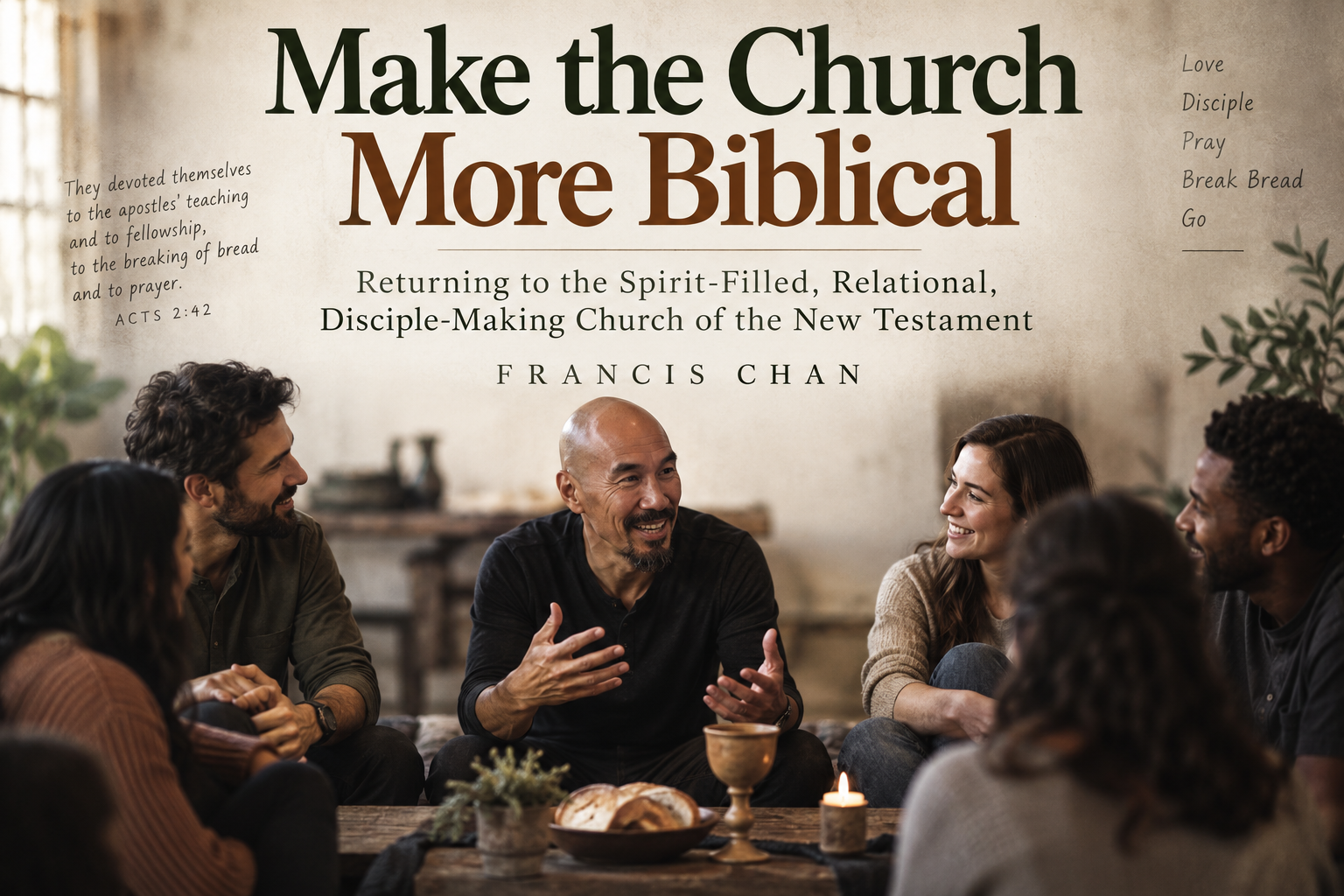
Five Things We Will Learn
- The goal of the church should not be to become as big as possible, but as biblical as possible.
- Christians must learn to start with Scripture rather than inherited traditions, personal preferences, or successful church models.
- A biblical church should be characterized by tangible love, gospel mission, dependence on the Holy Spirit, communion, and prayer.
- The New Testament’s many “one another” commands call believers beyond simply attending services into genuine, relational church life.
- Becoming more biblical may disrupt our comfort and familiar traditions, but obedience requires allowing Scripture to reshape both our lives and our understanding of church.
When Comfortable Christianity Replaces the Biblical Mission
Some Christians have not told anyone about Jesus in years. Francis Chan says, Deep down, they know something is wrong because when they read Scripture, they recognize that proclaiming Christ is something followers of Jesus are supposed to do.
But then they meet other Christians who are not doing it either.
Eventually, the abnormal becomes normal.
We gather. We have Bible studies. We hang out. We care about each other. Maybe several people cry during Bible study, and we walk away thinking, This must be good.
But is that really the emphasis of the New Testament?
When everyone around us becomes comfortable with disobedience, what Scripture calls abnormal can begin to feel normal.
That question reaches beyond evangelism. It forces us to examine what we have come to call “church” and ask whether our assumptions actually came from Scripture.
The Return of Christ and Caring for the Needy
That conviction came into sharp focus during a public hearing.
I opened the Bible—which is not normally what someone does at a hearing—and read from Matthew 25. I had prayed about what I should say, and I felt led to the passage describing the return of Jesus Christ.
Jesus comes with His angels to judge. He separates people to His right and left. To those on His left He says, “Depart from Me, you cursed, into the eternal fire prepared for Satan and his demons.”
Why?
Because He was hungry and they did not feed Him. He was thirsty and they gave Him nothing to drink.
Before speaking, I had asked myself a simple question:
If I really loved everyone in that room, including the people deciding this case, what would I tell them?
The loving thing was to warn them.
This was not about manipulation. If manipulation had been the goal, there were other ways we could have tried to make things happen. This was about standing before God and recognizing that Scripture presents care for the poor and needy as profoundly serious.
We cannot separate our belief in Jesus from caring for people in need. Whatever we do for the least of these, Jesus says we do for Him.
That is why, as a church, we cannot separate CHF and our care for the poor from what happens on Sunday morning. Caring for people is not a side project. It is part of what we do.
But there was another truth those officials needed to hear: there is a God, His Son is returning, and the decisions we make matter before Him.
Do What God Made You to Do
There were plenty of “schmoozy” things I could have done in that setting.
But Scripture says we were created for good works. There are things God made each of us to do while we are on this earth.
God did not put me on earth to schmooze officials.
I believe He made me a preacher. I believe He gave me a gift to teach His Word, whatever setting I am in. If I am at jury duty, I am still supposed to share the gospel. If I am standing in a hearing, I am still supposed to speak truth in love.
The setting does not change what God made me to do.
Was it awkward? Absolutely.
But throughout Scripture, God called people to deliver messages. Frequently, those messages were rejected by the vast majority.
Yet God’s messengers preached them anyway.
Faithfulness is not determined by whether people accept the message. Sometimes faithfulness simply means delivering the message God gave you.
That is part of the responsibility of proclaiming truth.
Some people hear truth, believe it, and are blessed. Others hear it and reject it. Scripture repeatedly shows truth being revealed even when people refuse to receive it.
Think about Noah. He preached, but only a few entered the ark and were saved. The revelation of truth itself became part of the judgment upon those who rejected it.
That is one of the hardest parts of preaching: laying out truth while knowing some people will reject it.
Faithfulness Is Bigger Than Winning or Losing
That changes how we think about winning and losing.
If success simply meant getting the response we wanted, we would have to conclude that many of the prophets lost.
But that is not how Scripture measures faithfulness.
The message still had to be given.
In this situation, two things needed to be emphasized: the return of Christ and care for people in need.
We also gave those making the decision every legal avenue we knew to show that the project could move forward legally, including pointing to federal protections.
Ultimately, they had a choice.
The same was true for landowners who opposed the project. Some essentially said, “I think what you’re doing is great. I just don’t want to have to look at it.”
They did not want to look at a warehouse where food would be brought in and distributed to needy people around the world.
My response was essentially:
I want you to want this.
I wanted them to think beyond themselves and consider the needs of people around the world.
But some simply did not share those convictions.
And that was difficult.
The question is not always, “Did we win?” Sometimes the question is, “Were we faithful to what God called us to say and do?”
While all the details surrounding the project and the land on Tierra Linda were unfolding, however, something much bigger was happening inside the church.
Why Build a Bigger Version of Something That Is Not Working?
When we first began pursuing the land on Tierra Linda, the staff and elders understood something important:
Cornerstone’s biggest problem was not space.
Yes, we had been packed out in every service for years. We had not been able to grow numerically because there simply was not enough room.
But space was not the biggest issue.
When we looked at Scripture and compared it with how people in the church were actually interacting with one another, we saw things Scripture describes that we simply were not living out.
So why would we want a bigger version of a failure?
Why gather even more people together who could care less about one another?
It may look impressive because there are a lot of people in the room, but that does not answer the biblical question.
Why would we want a bigger version of a church that is not living out what Scripture commands?
So while others worked on the land issue, we needed to work on the church.
We needed to focus on caring for one another and doing the things Scripture actually mandates.
That was also what we had been discussing at the gospel conference and what Jeff and Dave were describing through their churches. It was remarkable how our paths had come together around the same concern: caring for one another and making the church as biblical as possible.
That is the goal.
Not making the church as big as possible.
Would I love thousands and thousands of people to come? Sure.
But that is not the goal.
The goal is not to make the church as big as possible.
The goal is to make the church as biblical as possible.
And I believe that as we do that, people will be attracted to the church and it will become a light to the world.
Exegesis or Eisegesis?
One of the first lessons I learned in seminary was the difference between two words: exegesis and eisegesis.
Exegesis attempts to discover the meaning of a text objectively. The word carries the idea of drawing or leading something out.
You begin with Scripture and ask:
What does this actually mean?
Eisegesis works in the opposite direction. Instead of drawing meaning out of Scripture, we import our own subjective meaning into it.
We all have desires, opinions, wants, traditions, and assumptions. Eisegesis begins with those things and then goes looking through the Bible for verses that appear to support what we already wanted to believe.
Exegesis starts with the Bible and asks, “What does this say?” Eisegesis starts with what we want to believe and asks, “How can I use the Bible to support it?”
You can justify almost anything that way.
Want a divorce? Find a verse and make it fit.
Want to build a mansion? Find a verse and justify it.
Want to hate somebody? Find a biblical character who hated somebody and build your argument around that.
If you are determined enough, you can proof-text almost anything.
Exegesis does the opposite. It begins with Scripture and asks what we would believe if we could put our feelings and desires aside and simply allow the text to speak.
Don’t Change Scripture to Fit Your Lifestyle
In seminary, I was taught to teach exegetically.
That is one reason I teach through books such as Philippians verse by verse. I approach the text asking:
What does it say?
Sometimes I am learning right alongside everyone else.
Isn’t this what it says? Am I crazy?
Sometimes I do not like what it says.
Sometimes it does not fit my lifestyle.
But instead of changing Scripture, I have to change my lifestyle.
Teaching exegetically is one thing.
Living exegetically is much harder.
Rather than changing Scripture to fit my lifestyle, I have to change my lifestyle to fit Scripture.
Living exegetically means asking:
How would I live if I read this Bible, put aside my culture, my desires, and what everyone else is doing, and simply allowed Scripture to determine my lifestyle?
That is what we have been trying to do with the church.
Applying the Same Standard to Everyone
I saw this problem in a tangible way when two Mormon missionaries knocked on my door.
They were very nice guys, and we talked for about half an hour.
My basic question was simple:
If you started with this Bible, would you ever arrive at your belief system?
We talked about their belief in a lineage of gods—that God has a father, who has a father, and so on. We discussed their belief that God was not always God but became God, and their expectation that human beings can eventually become gods.
My struggle was that I could not see how someone beginning with the Bible itself would naturally arrive there.
If I simply read Scripture, I would conclude that God is eternal, that there is one God, that He does not change, that He always was God, and that I am His creation.
I would bow down and worship Him.
I would see that everything centers on Jesus.
We also discussed the former Mormon restriction that kept Black people from the priesthood until 1978 and the racial beliefs used to support that restriction.
Again, my question was not merely about one doctrine.
My larger concern was methodology.
Would someone simply read the Bible and arrive at that system?
Or had a system been brought to the Bible and verses then assembled to support it?
I even called my daughter over because I wanted her to hear the conversation and understand the difference.
The issue is not whether you can find verses to support a system. The issue is whether that system would naturally emerge if you started with Scripture.
Given enough determination, people can assemble verses to support all kinds of ideas.
The question is whether those ideas would naturally emerge if we began with Scripture.
The Same Question for Jehovah’s Witnesses
I had a similar conversation with Jehovah’s Witnesses.
They taught that Jesus was Michael the archangel. But Daniel 10:13 describes Michael as “one of the chief princes.”
One of them told me he had never noticed that.
Again, my purpose was not merely to win an argument over one detail of theology.
My point was larger:
If you opened the Bible, read it from cover to cover 20 times, and began only with the text, would you naturally conclude, Jesus is Michael the archangel?
I do not believe you would.
I challenged them, as I had challenged the Mormon missionaries, to get alone before God, read Scripture, study it, and be willing to say:
Whatever it says, I’m going to do it and obey it.
That is incredibly difficult when you have been brought up in a particular system.
It is difficult to question a system you inherited. It is even harder to sit alone with Scripture and tell God, “Whatever this says, I will obey.”
Evangelicals Have to Face the Same Test
It is easy for evangelicals to hear those examples and say, “Right on.”
But we have to be fair.
If we are going to challenge Mormons and Jehovah’s Witnesses to put aside their inherited systems and return to Scripture, then evangelicals must be willing to do exactly the same thing.
So look at what we are doing right now.
If you started only with the Bible, would you come up with a gathering where a thousand people attend one of four services, face forward, sing songs, listen to a message, go home, and then say:
“I’m part of Cornerstone Church”?
Did we actually arrive at that exegetically?
If we ask other religious groups to question their traditions in light of Scripture, evangelicals must be willing to question ours too.
That question has troubled me for the last couple of years.
The Five Things I Thought a Church Had to Have
When I started Cornerstone in 1994, I did not think this way.
I started with my evangelical framework and asked what I needed to start a church.
Five things immediately seemed essential:
- A building.
- Someone to lead music.
- A sermon.
- A sound system.
- Child care.
Those were the five absolutes in my mind.
How could you possibly do church without them?
We needed a building, even though our first “building” was the Sinaloa cafeteria. We bought a little Radio Shack sound system so people could hear. We found a band because a church had to have singing. I prepared a sermon because a church had to have preaching. And one woman cared for all the children in a classroom because, obviously, church had to have child care.
Now I find myself asking:
Says who?
Why did I begin with models of successful churches instead of beginning with Scripture?
Within a few years, Cornerstone became the popular church to attend—the biggest show in town, the “successful” church.
But says who?
Is success based upon what Scripture calls success?
If I had started with Scripture, what kind of gathering would I have created?
That is a difficult question because an honest answer may wreck some of the things I helped build.
What Does Scripture Actually Emphasize?
If I started with Scripture and asked what a gathering of followers of Jesus should emphasize, obviously the holiness and glory of God would be foundational.
But what should actually characterize believers when they gather?
The first thing that seems to jump out is:
Love one another.
For years, I did not make that the priority.
I cared about quality musicians, heartfelt worship, and good teaching. Those are not bad things. Of course we want them.
But are they the priority?
Teaching is certainly important.
But I believe love has to come first.
For years we held services where people could come in, sit down, look forward, hear me preach, and go home without truly loving anybody.
I do not see that pattern in Scripture.
A gathering of followers of Jesus should be unmistakably marked by love for one another.
I do not see believers gathering as the body of Christ without genuinely loving one another.
Church Is Not Merely “My Time With God”
American culture prizes independence.
I don’t need you. You don’t need me. I’ve got my own thing figured out.
I naturally leaned that way myself.
I did not like fellowship. I did not particularly want to hang around people. I liked being alone. I could become irritated and impatient, and I thought I did better by myself.
A couple of years after Lee and I were married, she once asked me:
“What do you love most about me, honey?”
I told her:
“Of all the people on this earth, you bug me the least.”
She actually thought it was romantic.
“Wow, really? The least?”
That gives you some insight into how my mind worked.
When I went to church, I did not necessarily want to talk with anybody. I wanted to sit in the back and have my time with God.
But I do not see the gathering presented that way biblically.
Yes, I need personal time with God.
But when believers gather, we are supposed to love one another.
Church is not simply “my time with God.” The gathering is also where the body of Christ loves, serves, encourages, and cares for one another.
Love Has to Become Tangible
Biblical love is more than saying:
“I really feel love in my heart for you.”
It asks practical questions.
Do you have any needs right now?
Are you okay financially?
Can I help you?
Do you need somewhere to stay?
That is tangible love.
Scripture calls us to stop loving merely with words and begin loving with action and truth.
Biblical love does not stop with feelings. It asks, “What do you need, and how can I help?”
If I started with Scripture, that is what I would expect to see among believers.
But love is only the beginning.
A Church Focused on Getting the Message Out
The second thing I see throughout Scripture is a community focused on getting the gospel message out.
These believers seem to understand that this is why they are on the earth.
Jesus Christ came.
He died for the sins of the world.
He rose from the grave.
He offers us entrance into His kingdom.
Our past sins can be wiped away. We can put to death the sins of the flesh. There is amazing grace and unsearchable riches awaiting us.
This is good news.
We have to get the word out.
I recently read someone describing God’s intention that the church be “fishers of men.” But instead of becoming fishers of men, we have become an aquarium.
That image struck me.
The church was meant to become fishers of men. Instead, we can become an aquarium—gathered together, comfortable together, but no longer going out.
We have lost our outward focus partly because evangelism is difficult.
Who wants to talk to people who might reject them?
So we create environments where we do not have to talk to strangers. We create services where people can disappear into the crowd. We form Bible studies that can exist without reaching the world.
But that is not what I see in Scripture.
Make Disciples Who Obey Jesus
Proclaiming the message also means teaching people to obey what God commanded.
Jesus says in the Great Commission to make disciples and teach them to obey everything He commanded.
Faith in Christ is not merely intellectual assent to the facts that Jesus died on the cross and rose from the grave.
Believing Christ means believing Christ.
You believe what He taught.
You believe that instead of holding tightly to a life of comfort, luxury, self-protection, and self-centeredness, you can die to yourself and receive something better from Him.
Trying to hold onto your old life while simply adding Jesus to it will not work.
He will not allow that.
Jesus is not an addition to the life we already wanted. Following Him means dying to ourselves and trusting that what He gives us is better.
That is the message we need to proclaim.
If I started with Scripture, I would gather people committed to getting that word out.
We would come together and encourage one another to keep going because we know we will be tempted to stop.
We will want to settle down and build our own comfortable little lives.
So brothers and sisters have to encourage each other:
We’re on this mission together.
What’s mine is yours.
That is what I see:
loving one another and proclaiming the message together.
Dependence on the Holy Spirit
The third thing I see is dependence on the Holy Spirit.
When I read the New Testament, I see the Holy Spirit everywhere.
Without Him, we are dead.
We cannot pull this off in our own strength.
The Christian life is supernatural.
Holy Spirit or nothing.
I cannot reach the holiness God wants for me through my own strength. I know myself. I know where I will take myself.
I cannot accomplish the mission God has given me by figuring everything out myself.
Scripture teaches that the Holy Spirit guides us into truth.
So if we were gathering biblically—whether in my house, in a park, or somewhere else—we would genuinely seek Him together:
God, show us what to do.
Holy Spirit, where do we go next?
And then we would surrender ourselves to His leading.
Breaking Bread Together
Fourth, throughout the New Testament I see an emphasis on communion.
That is interesting to me because naturally I would not have put such tremendous emphasis on it.
Yet the New Testament repeatedly shows believers intentionally gathering from house to house, breaking bread and sharing the cup.
Why?
They were reminding one another:
This is what matters.
They shared meals, broke bread, and remembered that Jesus’ body had been broken for them.
They took the cup together.
They could look one another in the eyes and remember:
This is what we’re about.
We’re committed to this.
This is the most important thing.
Communion was not merely an individual ritual. It reminded believers, face-to-face, that they belonged to Christ and to one another.
A Church That Prays
The fifth essential is prayer.
I would gather people to pray.
We would seek the presence of God together and say:
God, we’re about Your kingdom. Help us understand how to further Your kingdom. Show us what to do.
So if I were starting all over again, I would begin there.
I would gather some people and say:
Let’s love one another because we believe in this mission.
Let’s encourage each other to keep reaching the world with this amazing message.
Let’s put lesser things aside.
Let’s pray.
Let’s seek the leading of the Holy Spirit.
Let’s break bread together.
And because God has given me a teaching gift, I would teach in that setting.
If the group became too large, someone else could teach another group. And another person could teach another.
We would not be obsessed with having a superstar speaker.
The question would simply be:
Who can teach me the Word of God?
Because we love God’s Word.
Love one another.
Proclaim the gospel.
Depend on the Holy Spirit.
Break bread together.
Pray.
If I gathered people who loved one another that way, broke bread together that way, prayed together, depended upon the Spirit, and went into the world proclaiming the message, then I believe I could rightfully call that gathering a church.
Do We Have the Right to Call It Church?
I have seriously questioned whether we have the right to call ourselves a church if we are not doing these things.
Otherwise, we are redefining the word.
It would be like saying:
“I went swimming the other day, so I’m a Navy SEAL.”
Navy SEALs swim, but swimming does not make you a Navy SEAL.
In the same way, we call people “followers of Christ” even when they do not follow Him.
That does not make sense to me.
Someone says:
“But they go to church.”
Going to a church service does not automatically make someone a believer or follower.
Likewise, someone says:
“I’m part of the church.”
Why?
“Because I attend one of these services.”
But is that what God calls the church in Scripture?
Or is the church a group of people who belong to one another, encourage one another, love one another, and live on mission together?
Attending a church service is not the same thing as living as the church.
Services Can Be Good Without Being Sacred
I am not saying services like these are bad.
I think they can be good.
I’d rather you be here than at a movie. You can hear the Word of God. You can be around other believers. We can worship God together.
Those are good things.
But are they the best thing?
Are they the commanded thing?
That is what I question.
Our energies should first be prioritized around what Scripture actually commands.
If Scripture commands us to love one another, serve one another, care for one another, and live as Christ’s body together, then we need environments where those commands can actually be obeyed.
A large service may still have a place. People can come and learn. Some may not yet have made a full commitment to follow Jesus.
That is fine.
But we should not confuse a service with the fullness of what Scripture commands believers to practice together.
Something can be good without being sacred. The question is whether we have made our church traditions sacred when Scripture never did.
The “One Another” Church
Look at the commands Scripture gives believers concerning one another:
Love one another.
Be at peace with one another.
Show hospitality to one another.
Honor one another.
Receive one another.
Do not fight with one another.
Serve one another.
Do not envy one another.
Admonish one another.
Greet one another.
Care for one another.
Bear one another’s burdens.
Show deference to one another.
Forgive one another.
Be kind to one another.
Submit to one another.
Do not lie to one another.
Provoke one another to good works.
Comfort one another.
Concern yourselves with one another’s affairs.
Do not hate one another.
Do not speak evil of one another.
Pray for one another.
Be like-minded toward one another.
Do not hold grudges against one another.
Highly esteem one another.
Do not show partiality toward one another.
Have fellowship with one another.
Edify one another.
Teach one another.
Do good to one another.
Exhort one another.
Minister spiritual gifts to one another.
Those are the commands of Scripture.
So we have to ask:
Are we actually doing them?
Or do we have one person teaching from the front, sing some songs together, and call that church?
A gathering this large makes many of these commands extraordinarily difficult to practice. You cannot meaningfully love, serve, care for, bear burdens with, admonish, encourage, and minister to everyone in a crowd of a thousand people facing forward.
Some of you, however, are already living this out.
You are gathering in groups and communities and actually practicing the “one anothers.”
You are being the church.
The New Testament picture of church is intensely relational. Believers do not merely sit beside one another; they live the “one anothers” with one another.
That is why I have become uncomfortable simply calling the large service “church.”
Call it a service. Call it “happy time.” Call it whatever you want.
But if I am going to be fair in challenging other religious systems to return to Scripture, I have to apply the same standard to myself.
I have called the service “church” in the past because I started with what people told me church was supposed to be.
Now I am trying to start with Scripture.
Put Evangelical Tradition Through the Same Test
So I want to ask you to do something extremely difficult.
I asked the Mormon missionaries to do it.
I asked Jehovah’s Witnesses to do it.
Now I am asking evangelicals to do it.
Go back to Scripture and ask:
What is obviously here?
What does Scripture really teach?
What would my life look like if I started with the Word of God?
Rethink it.
That is what I have been doing for the last couple of years.
I keep asking myself:
If I were on an island with nothing but this book, what would I come up with?
How would I live?
What would church look like?
If all you had was the Bible,
what kind of church would you build?
And I will tell you: I do not always enjoy the answers.
Every bone in my body can fight against doing some of these things because I do not always feel like doing them.
But when I do them, there is peace in knowing they are right.
When Biblical Christianity Becomes Personally Costly
This is not theoretical for me.
We took in a family, and suddenly I had eight kids running around my house.
Eight.
There were 13 of us living in the house.
I could wake up in the morning thinking, This stinks.
And I meant it.
My house was in disarray. My life was less convenient. My resources were being affected.
There was a part of me thinking that if there were no resurrection, no heaven, and no eternal reward, this way of living would look foolish.
And yet I was experiencing more peace than ever.
Why?
Because I could look at it and say:
This is right. This is biblical.
Biblical obedience will not always make your life easier. Sometimes the very cost of obedience reveals how deeply you believe eternity is real.
Then there was this little three-year-old who had been homeless.
He would grab my leg, call me daddy, and laugh uncontrollably while I threw him into the air.
And I found myself thinking:
Have I ever painted a better picture of God as Father to the fatherless?
God took me in.
He adopted me.
He allowed me to call Him Father.
And now I had the opportunity to embody something of that love for this child.
Sometimes the clearest picture of the gospel is not something we preach. It is something costly that we live.
That is what I am supposed to be doing.
And this is why I need other believers.
I need brothers and sisters around me saying:
Hold on.
Keep doing it.
I know it’s hard.
It’s worth it.
Paul must have experienced moments like that—being beaten, stoned, shipwrecked, and wondering what in the world he was doing.
Following Jesus is not easy.
It is not easy for me.
And it is not going to be easy for you.
What Will the Church Look Like in Five Years?
People ask:
“Francis, what’s the end result of all this?”
“What is the church going to look like in five years?”
I have no clue.
The elders do not have any clue.
I do not know what my own life will look like at the end of this.
What I want is to be fair to Scripture.
I want to start with Scripture.
For now, all I know is that I cannot simply call a large service “church” anymore while ignoring what Scripture portrays the church actually doing.
We are trying to gather people together to be the church.
I do not know what those gatherings will look like in the future. I do not even know whether we will continue doing everything we are currently doing.
But we have to establish our priorities.
And that means deciding:
What is sacred, and what is not?
We do not have to know what the church will look like five years from now before we obey what Scripture clearly tells us to do today.
Decide What Is Sacred
If loving one another is sacred, then let’s gather and love one another.
Let’s care for one another.
Let’s forgive each other.
Let’s put up with one another.
Let’s care about the needs of the world.
Let’s go out and rescue people.
Let’s be Christ to other people.
Those things are sacred because Scripture tells us to do them.
But a particular format for a large church service?
I do not see that commanded in the same way.
Yet some people will instinctively hold the service itself sacred because that is what they were raised with.
That is why the answer has to be:
Go back to the Book.
Let’s figure this out from Scripture.
What Scripture commands is sacred.
What tradition has merely made familiar is not necessarily sacred.
For the immediate future, services were continuing—including the upcoming Easter service.
But the larger question remained open.
Where is this going?
What will my life look like?
I do not know.
What I do know is that I am finding peace in aligning myself with Scripture.
It is not easy.
But it is right.
Even Communion Should Be Reexamined
As Todd prepared to lead communion, another question emerged:
Is a large service even the best setting for communion?
Much of what I see in Scripture involves believers looking one another in the eye and saying, in effect:
We’re together in this.
There was unity in sharing the cup.
There was community.
There was relationship.
Communion was not simply something received anonymously in a crowd.
It reminded believers of Christ and of their shared commitment to Him.
What if communion was meant not merely to remind me of Christ, but to remind us that we belong to Christ together?
That is another practice we need to be willing to reconsider biblically.
Baptism, Community, and Dying to Self
And if someone says:
“I’ve never been part of the church. I want to be part of the church,”
then there should be people ready to pray with them.
Baptism is part of this too because baptism belongs with community and discipleship.
If I simply started with Scripture, I would not arrive at a model where someone merely raises a hand and prays a prayer.
I would see someone choosing to follow Christ, dying to self through baptism, and rising into a new life.
That is what I would get from the Book.
Following Jesus costs something.
It means:
I want to follow. I will die to myself. I will follow Jesus Christ.
The call is not merely to pray a prayer and add Jesus to your life. It is to die to yourself and follow Him into a new life.
There is a cost to that.
But it is worth it.
One day God will reveal the riches awaiting those who sacrificed for Him on this earth.
It will be worth it.
Start With Scripture and Let It Change Everything
The question, then, is not whether our current way of doing church is familiar, comfortable, popular, large, polished, or successful according to standards we inherited.
The question is much simpler—and much harder:
Is it biblical?
If our traditions are biblical, keep them.
If our methods help us obey what Christ commanded, use them.
But where our assumptions have replaced His commands, we have to be willing to change.
Where attendance has replaced discipleship, change.
Where sitting in a service has replaced loving one another, change.
Where comfort has replaced mission, change.
Where self-sufficiency has replaced dependence on the Holy Spirit, change.
Where Christian community has become anonymous, change.
Where inherited systems have become more authoritative in practice than Scripture, go back to Scripture.
We are not trying to preserve a model.
We are trying to obey the Book.
This is not necessarily comfortable.
It may disrupt things we have spent years building.
It may force us to rethink what we call success.
It may cost us money, privacy, convenience, independence, and comfort.
But the goal was never merely to gather the largest possible crowd.
The goal is to become the people Scripture describes.
A people who love one another.
A people who proclaim Jesus.
A people who make disciples who obey Him.
A people who depend upon the Holy Spirit.
A people who break bread together.
A people who pray.
A people who bear one another’s burdens.
A people who share what they have.
A people who care for the poor.
A people who go into the world together.
A people willing to die to themselves and follow Jesus.
The goal is not to make the church bigger.
The goal is to make the church more biblical.
That is the challenge.
Start with Scripture—and let Scripture determine what the church becomes.

Begin Your Journey Today
Jesus didn’t just call us to believe in Him—He called us to follow Him.
Step into the life He designed for you through Emmaus Road’s The Commands of Jesus . This is more than learning—it’s an invitation to walk with Him, obey Him, and experience Him in a real and powerful way.
You don’t want to miss this exciting adventure Jesus has called you into.
Start now:
https://GregLancaster.org/StartHere