



Five Things We Will Learn
- Why anti-Christendom is not a future threat but a centuries-long counter-movement now reaching maturity.
- How the Enlightenment, the 20th century, and modern moral collapse formed a coherent alternative religion.
- Why technology is not neutral—and how it has become the most effective weapon of anti-Christendom.
- How social media, AI, and digital convenience quietly reshape the human soul, family, and Church.
- Practical ways Christians can resist technological domination without retreating from the world.
From Christendom to Its Opposite
Christendom is now spoken of almost entirely in the past tense. Its geographic, political, and social structures—once unified around an objective moral order—have been steadily dismantled over the last several hundred years.
The fracture began in earnest with the Reformation and the collapse of Catholic unity in Europe. What followed was not merely theological disagreement, but the slow retreat of a civilization shaped by transcendent truth.
Yet history did not stall.
As Christendom receded, its mirror image advanced.
Anti-Christendom did not emerge suddenly. It developed patiently—contesting Christian dominance, refining its philosophy during the Enlightenment, and reaching full expression in what can rightly be called the satanic century: the 20th century.
The results speak for themselves.
Never before had the human mind, freed from all external moral restraint, produced death on such a scale—world wars, genocide, ideological slaughter, and cultural self-destruction. This was not progress. It was regression masked as liberation.
The Creed of “What Is Truth?”
Anti-Christendom is not merely political. It is philosophical and spiritual.
It includes:
- The sexual revolution, which corrodes humanity from the inside.
- Neoliberal capitalism that reduces human beings to data points and profit margins.
- Radical relativism—the resurrection of Pontius Pilate’s creed: “What is truth?”
Truth itself became negotiable.
In this way, anti-Christendom followed the same arc as Christendom once did: it emerged, struggled, and then became dominant. Christians have been fighting a rearguard action ever since.
The statistics confirm what the spirit already knows.
The 20th century witnessed the highest number of Christian martyrs in human history—both numerically and proportionally.
The religion of the Antichrist is no longer hidden.
The War Turned Inward
After decades of kinetic warfare, something changed.
Satan learned that destroying the Church from within was more effective than attacking it from without.
As comfort increased and struggle diminished—especially after the 1960s—the Church fell asleep. Cheap morals replaced costly discipleship. Easy living dulled spiritual vigilance.
Yet the story did not end there.
Despite predictions of Christianity’s extinction—most famously articulated by Francis Fukuyama—conversion rates have begun rising again. People are weary of hollow promises. They are rediscovering meaning, structure, and transcendence.
This renewal is not driven by popes, bishops, or institutions.
It is driven by the Holy Spirit working through the laity.
And that fact alone explains why governments have responded with fear.
The Weapon No One Expected: Technology
If anti-Christendom has a central sacrament, it is not ideology—it is technology.
Not merely phones.
Not merely apps.
But the theology behind them.
Every system operates from a belief structure. Technology is no exception.
Its catechism includes words we instinctively love:
- Convenience
- Efficiency
- Freedom
- Democratization
Each contains partial truth—and therefore enormous danger.
We were never shown the cost.
The price has been staggering:
- Social isolation
- Teen suicide
- Pornography addiction
- Endless work cycles
- Collapse of embodied community
And now, global surveillance powered by non-human intelligence.
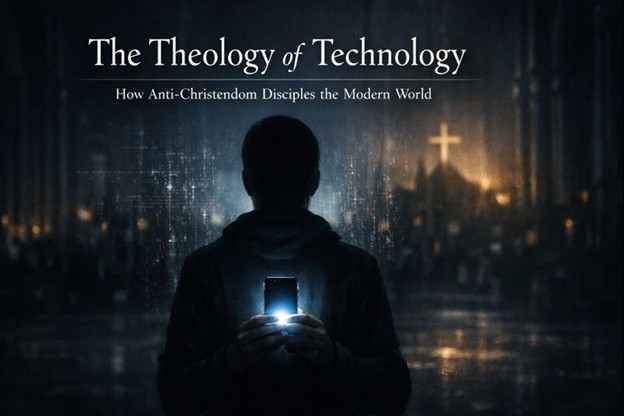
The modern phone—this black mirror we carry everywhere—has likely become the greatest portal to temptation ever invented. It records, listens, tracks, and feeds us endless knowledge of good and evil.
The conquest was voluntary.
Social Media, Dopamine, and the Rewired Soul
The software layer completed what the hardware began.
Social media was designed to addict. Endless scrolls mimic slot machines. Dopamine loops replace meaning. Envy is cultivated. Attention spans collapse.
Karl Marx famously called religion the opium of the masses.
He was wrong.
The true opium is the glowing screen that keeps humanity sedated, distracted, and spiritually numb.
And now comes AI.
We are already living inside a transformation that will redefine work, identity, warfare, and morality. Internal industry warnings describe AI as a species-level threat. Yet alignment and safety have been discarded in a geopolitical race for dominance.
When even Peter Thiel warns that regulation may usher in a false unity—while simultaneously advocating unrestrained AI—the contradiction is unmistakable.
This is not neutrality.
This is theology without God.
How Christians Fight Back
This is not a call to retreat from the world.
It is a call to re-order it.
Key principles emerge clearly:
- Acknowledge the Enemy
Technology is not neutral. It has been weaponized. - God Before Screens
Begin and end the day with the Lord—not the phone. - Redeem, Don’t Abdicate
Use technology that fosters truth, beauty, and prayer. - Know the Founders
Do not expect godly fruit from systems built without God. - Live Local
Build real communities, churches, friendships, and markets. - Look Up, Not Down
The posture of the soul matters. - Defend the Image of God
Only humans bear it. Machines do not. Never blur that line.
The Church has always been unpopular when it tells the truth. That is not a flaw—it is the proof.
The Final Warning
We are at war.
The most dangerous enemy is the one no one recognizes.
The graven image of our age does not sit in a temple—it stares back at us from our own screens. If we gaze into the black mirror long enough, it will reshape us.
Technology must point to the Creator—or it will quietly replace Him.
Deus ex machina belongs in literature, not in how we live.
Begin Your Journey Today
Jesus didn’t just call us to believe in Him—He called us to follow Him.
Step into the life He designed for you through Emmaus Road’s The Commands of Jesus . This is more than learning—it’s an invitation to walk with Him, obey Him, and experience Him in a real and powerful way.
You don’t want to miss this exciting adventure Jesus has called you into.
Start now:
https://GregLancaster.org/StartHere