



Five Things We Will Learn
- Why John the Baptist warned that true repentance must produce visible fruit.
- How Scripture consistently teaches that salvation is more than a verbal profession.
- What the Bible says about people who once appeared fruitful but later drifted away.
- How Jesus’ parable of the four soils reveals the danger of shallow or distracted faith.
- Why abiding in Jesus Christ is the only way to bear lasting spiritual fruit.
John the Baptist’s Warning About Fruitless Repentance
In Matthew 3 (NIV 1984), John the Baptist confronts the Pharisees and Sadducees with striking language, calling them a “brood of vipers.” But his rebuke is not without hope. He immediately opens the door for them, urging them to produce fruit in keeping with their repentance. The implication is clear: at some point they had repented, or at least claimed to, but their lives were not backing it up.
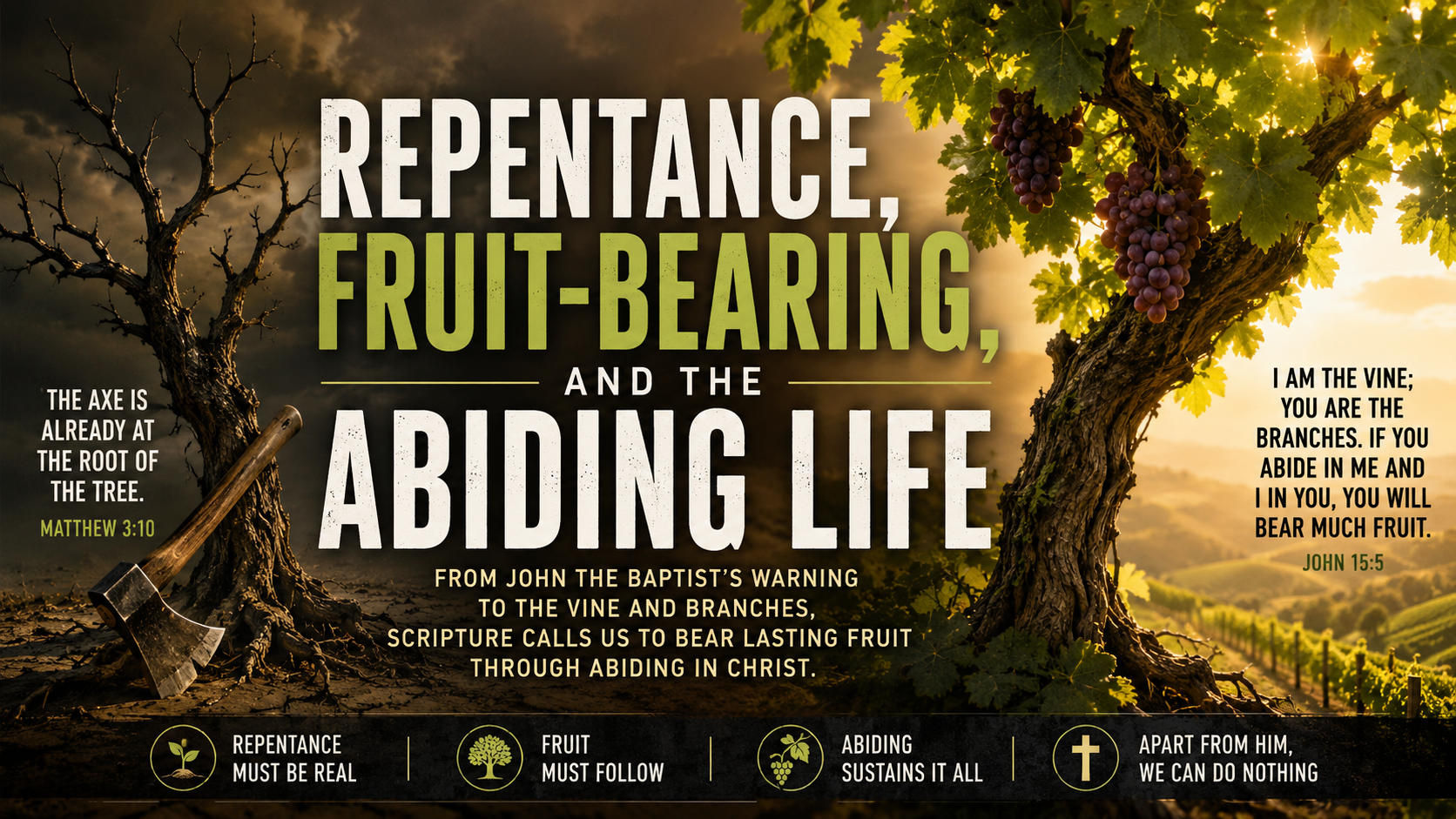
John then intensifies the warning with a vivid image: the axe is already at the root of the tree. Every tree that does not produce fruit will be cut down and thrown into the fire. Each person is being compared to a tree, and the question is whether that tree is bearing fruit. The urgency is unmistakable. The time to change is now.
Matthew 3:8-10 says:
“Produce fruit in keeping with repentance. And do not think you can say to yourselves, ‘We have Abraham as our father.’ I tell you that out of these stones God can raise up children for Abraham. The ax is already at the root of the trees, and every tree that does not produce good fruit will be cut down and thrown into the fire.”
John’s message was not merely about religious identity or outward association. It was about genuine transformation evidenced through a changed life.
A Different Gospel?
This raises an important question for today. When someone tells people that all they need to do is say a prayer, without any life change and without repentance, they are teaching something fundamentally different from what John the Baptist and Jesus taught.
Scripture is consistent on this point: repentance is not merely a one-time verbal commitment. It is a turning around, a change of direction, evidenced by the fruit that follows.
Jesus Himself repeatedly called people to repent and follow Him. The Gospel was never presented as a detached transaction with no expectation of transformed living. Rather, it was an invitation into a living relationship with Christ that changes a person from the inside out.
Once Saved Always Saved, Yet No Fruit?
“I have a friend who says he’s a Christian, but the way he lives doesn’t really reflect what I’d expect from someone following Christ. Someone asked me, ‘Do you think he’s truly a believer? Does he have genuine faith?’ I told them: Ultimately, only God knows his heart—that’s between him and the Lord. But it’s completely fair to look at his life and say, ‘Your salvation is between you and God, but honestly, from the outside, I see very little difference between you and the world around you. I have no real evidence that you’re saved.’ That should concern you. If I look at your life and don’t see much that sets you apart, it either means you’re not living out the calling God has placed on you—or, more seriously, it could mean you don’t truly grasp who Jesus is and what He accomplished for you on the cross.” Wes Huff – This Might Be the Most Important Biblical Discovery of the 20th Century | SRS #279
Wes Huff is saying this based on what Jesus, John the Baptist, and scripture tells us, we only know a person by their fruit.
Jesus explains what Wes Huff said, and I’m writing about to you in this article. “By their fruit you will recognize them. Do people pick grapes from thornbushes, or figs from thistles? Likewise every good tree bears good fruit, but a bad tree bears bad fruit. A good tree cannot bear bad fruit, and a bad tree cannot bear good fruit. Every tree that does not bear good fruit is cut down and thrown into the fire. Thus, by their fruit you will recognize them.” Matthew 7:16-20 (NIV 1984)
What About Those Who Once Bore Fruit but Stopped?
Scripture addresses this sobering reality in several places.
Hebrews Warns About Falling Away
The book of Hebrews warns about those who have tasted God’s goodness but later drift away. The warning is severe because the stakes are eternal. The writer is not discussing casual religious exposure but people who genuinely experienced the work of God.
Revelation Warns About Losing First Love
In Revelation, Jesus warns believers who had lost their first love. These were not people who had never begun. They had started well but had drifted from the passionate devotion they once had for Christ.
Revelation 2:4-5 says:
“Yet I hold this against you: You have forsaken your first love. Remember the height from which you have fallen! Repent and do the things you did at first.”
Jesus calls them to remember, repent, and return.
John 15 and the Vine and Branches
John 15 presents one of the clearest pictures of this reality. Jesus describes Himself as the vine and His followers as branches. Fruitfulness is expected, and branches that do not remain connected are removed.
Jesus says:
“I am the vine; you are the branches. If a man remains in me and I in him, he will bear much fruit; apart from me you can do nothing.”
John 15:5 (NIV 1984)
The consistent biblical message is that ongoing fruitfulness matters, not merely a past experience or decision.
When believer hear this they most all want to abide with Jesus, but they don’t have a plan – a how to abide plan. We have a simple plan for you as a gift at iAbide.org. Get your abiding plan today and begin to separate yourself from the “Fruitless Wonders” who are all talk and no fruit.
The Parable of the Four Soils
Jesus’ parable of the four soils in Matthew 13, Mark 4, and Luke 8 speaks directly to this issue.
Some seed falls on shallow ground. It springs up quickly and initially looks promising, but when pressure comes, it withers because it has no deep root.
Other seed begins to grow but becomes choked by the worries of life, deceitfulness of wealth, and distractions of the world.
In both examples, something genuinely started, but it did not continue to maturity and fruitfulness.
Jesus explains in Luke 8:14:
“The seed that fell among thorns stands for those who hear, but as they go on their way they are choked by life’s worries, riches and pleasures, and they do not mature.”
The parable makes clear that an initial response to the Gospel is not the whole story. Sustained, ongoing fruitfulness is what Jesus is looking for.
The Secret: Abiding in Christ
So how does a person actually bear fruit and continue bearing fruit?
John 15 gives the answer. It is not ultimately about human striving, religious performance, or trying harder through sheer willpower. It is about abiding in Jesus.
He is the vine. We are the branches.
As believers remain connected to Him through relationship, obedience, prayer, dependence, and communion with Him, fruit naturally grows. Apart from Him, nothing lasting can survive.
This is why relationship matters so deeply. Fruit-bearing is not transactional. It is relational. It flows from a living and active connection with Jesus Christ.
And that connection must not be neglected or abandoned.
The Danger of Superficial Christianity
Modern culture often reduces Christianity to a moment, a prayer, a label, or an emotional experience. But Jesus consistently taught something much deeper.
He taught surrender.
He taught abiding.
He taught perseverance.
He taught obedience flowing from love.
This does not mean salvation is earned by works. Rather, true salvation produces evidence. A living tree bears fruit because it is alive.
James 2:17 says:
“Faith by itself, if it is not accompanied by action, is dead.”
The fruit does not save the tree, but it reveals the nature of the tree.
Conclusion
From John the Baptist’s warning in Matthew 3 to the parable of the four soils to Jesus’ teaching on the vine and branches in John 15, and all of Jesus’ twelve disciples, Scripture tells a consistent story: repentance must be real, fruit must follow, and that fruit is sustained only through an ongoing relationship with Jesus Christ.
A gospel that asks for nothing more than a prayer, with no life change and no continued abiding, is fundamentally different from the Gospel preached by John the Baptist and Jesus Himself.
The call of Christ is not merely to begin, but to continue abiding in Him so that lasting fruit may grow.

Begin Your Journey Today
Jesus didn’t just call us to believe in Him—He called us to follow Him.
Step into the life He designed for you through Emmaus Road’s The Commands of Jesus. This is more than learning—it’s an invitation to walk with Him, obey Him, and experience Him in a real and powerful way.
You don’t want to miss this exciting adventure Jesus has called you into.
Start now:
https://GregLancaster.org/StartHere
Related Articles on The Torch
- “I Never Knew You” – Jesus’ Warning on Judgment Day
https://greglancaster.org/torch/i-never-knew-you-jesus-warning-on-judgment-day - The Danger of Lukewarm Christianity
https://greglancaster.org/torch/the-danger-of-lukewarm-christianity - The Urgency of Discipleship
https://greglancaster.org/torch/the-urgency-of-discipleship - Return to Biblical Foundations
https://greglancaster.org/torch/return-to-biblical-foundations - The Commands of Jesus
https://greglancaster.org/torch/the-commands-of-jesus