



Five Things We Will Learn
- Why slavery must be understood as a global human evil rather than the sin of only one nation or people.
- How Western abolitionists helped establish the principle that slavery is morally wrong for everyone.
- Why America’s founding principles exposed the nation’s contradiction and provided the standard for confronting slavery.
- How Dr. Martin Luther King Jr. appealed to America’s founding promises to advance civil rights.
- Why history is often selectively interpreted to unite people around shared principles or divide them through racial resentment.
Slavery Was a Global Human Evil
Slavery was not created by one nation, one race, or one civilization. It existed across the ancient world and appeared in societies throughout Africa, Asia, Europe, the Middle East, and the Americas.
Human beings repeatedly enslaved other human beings whenever they possessed enough power to do so. Tribes enslaved rival tribes. Nations enslaved conquered peoples. Empires built economies upon forced labor. People of nearly every race have participated in slavery, and people of nearly every race have suffered under it.
This broader history does not excuse or minimize the horrors of slavery in America. It helps us understand the deeper truth: slavery reveals what human beings are capable of doing when they possess unchecked power over others.
No people should be entrusted with unbridled power over another people. Human nature does not become righteous merely because the person exercising power belongs to a particular race, nation, religion, or social class.
Unchecked power is dangerous, which is one reason constitutional government places limits upon those entrusted with authority.
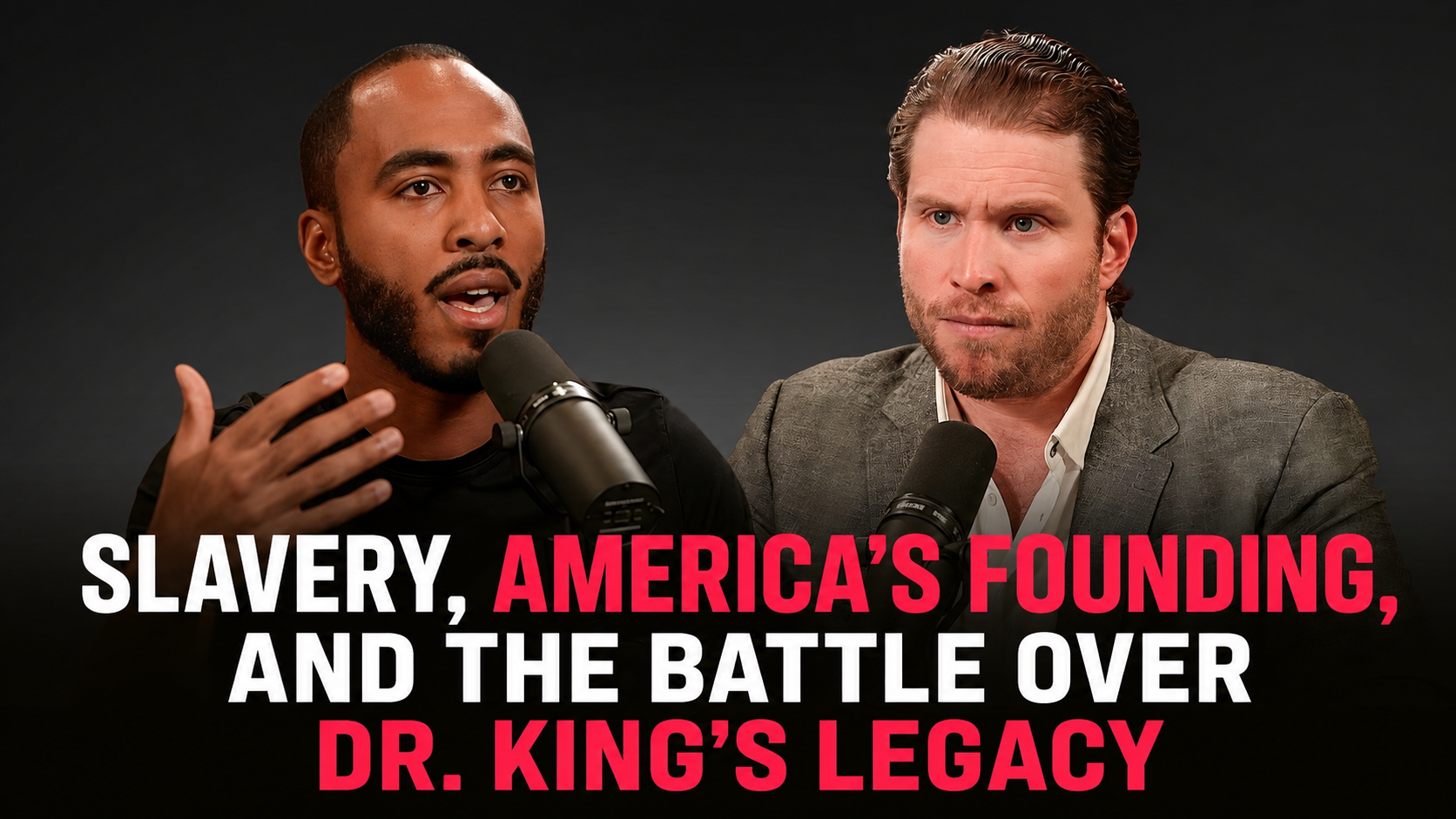
The featured image was not created by Joe Lonsdale. This is an excerpt from full program below.
The Bible and the Ancient Institution of Slavery
The Torah and other ancient religious texts addressed slavery within societies where it was already deeply established. Biblical laws regulated forms of servitude, restrained certain abuses, and commanded humane treatment in ways that differed significantly from many surrounding cultures.
However, these regulations were given within an ancient world where slavery and servitude were accepted facts of life. They should not be confused with an endorsement of the race-based chattel slavery later practiced in the Americas.
The biblical revelation that every human being is created in the image of God ultimately confronts the very foundation of treating people as property. The gospel also declares the spiritual equality of those who belong to Christ:
“There is neither Jew nor Greek, slave nor free, male nor female, for you are all one in Christ Jesus.”
Galatians 3:28, NIV 1984
Although Christians have not always lived consistently with that truth, it became a powerful foundation for Christian abolitionists who opposed slavery.
Where Universal Abolition Took Hold
For much of human history, people objected to their own enslavement while continuing to accept the enslavement of others. The radical moral principle that slavery itself is wrong, regardless of who enslaves whom, developed into a sustained abolitionist movement in the West.
During the eighteenth and nineteenth centuries, Quakers, evangelical Christians, and other religious reformers became powerful voices against slavery in Britain and America. They argued that the institution was fundamentally incompatible with human dignity and the moral law of God.
Britain eventually prohibited the slave trade throughout its empire and used its naval power to suppress slave trafficking across international waters. That effort frequently encountered resistance from rulers, traders, and local authorities who benefited from the trade.
This is an essential part of history. The West participated in terrible acts of slavery, but Western principles, Christian conviction, and abolitionist movements also produced an international campaign to eradicate it.
A truthful account must acknowledge both realities.
America Was Founded Upon a Painful Contradiction
America declared that “all men are created equal” while slavery remained legal in many states. Several founders who affirmed natural rights also owned enslaved people.
That was an undeniable contradiction.
There are two ways to interpret it. One can argue that the hypocrisy made America’s founding principles meaningless. Or one can recognize that those principles created the moral standard by which the nation’s hypocrisy could be exposed and confronted.
Once America declared that human beings possessed rights granted by their Creator, the nation could not permanently defend a system that denied those rights to millions of people.
The Declaration of Independence gave abolitionists a standard they could hold before the country. They could ask how a nation demanding liberty from Britain could keep human beings in chains within its own borders.
The founding principles did not immediately end slavery, but they created a moral tension that demanded resolution. America could either abandon its declaration of equality or begin bringing its conduct into agreement with it.
Good Principles Expose Our Failures
Hypocrisy exists when our conduct contradicts the principles we profess. The answer to hypocrisy is not necessarily to discard the principle. The answer is to repent, correct the conduct, and begin living according to what is right.
A nation without a principle of human equality would experience no such contradiction. It could practice slavery without violating its own declared values.
America’s failure was severe precisely because its stated principles were so high. Yet those same principles gave reformers the language they needed to call the nation to repentance and change.
The existence of hypocrisy does not prove the standard is evil. It proves the people professing the standard have failed to live by it.
Dr. King Called America Back to Its Promise
Dr. Martin Luther King Jr. and other civil rights leaders understood the power of America’s founding promises. They did not merely condemn the nation. They called America to become faithful to what it had already declared.
Dr. King appealed to the Declaration of Independence, the Constitution, biblical truth, and the conscience of the American people. He presented equality as a promise that belonged to every American.
In that sense, his message was not that America’s house must be destroyed. His message was that Black Americans must be welcomed fully into the house and receive the rights that had been promised to them.
He confronted injustice without abandoning the principles that made justice possible.
This distinction matters. One approach says the nation’s foundation is fundamentally corrupt and must be torn down. The other says the nation has failed to live according to its foundation and must return to its highest principles.
Dr. King’s approach called Americans toward justice, reconciliation, and shared citizenship.
Character Must Matter More Than Racial Identity
Dr. King repeatedly emphasized the importance of judging people according to their character rather than the color of their skin. He pursued equality before the law and wanted Black Americans to participate fully in the nation’s civic, economic, and cultural life.
His vision was not built upon permanent racial hostility. It sought a society where people could live together as fellow citizens and human beings.
This does not mean Dr. King lacked strong views on poverty, economics, or war. He challenged many aspects of American life. However, acknowledging those views does not justify turning him into an advocate for every modern race-based ideology.
His support for certain economic programs cannot be used as proof that he embraced racial essentialism. His opposition to the Vietnam War does not mean he wanted Americans permanently separated into competing racial groups.
Distorting Dr. King’s Legacy
Each year, commentators attempt to reinterpret Dr. King by emphasizing that he was a “radical.” That description can be accurate, depending upon what is meant by it. He was radical in his commitment to nonviolent resistance, biblical justice, economic reform, and human dignity.
The problem arises when the word is used to suggest that he supported modern movements whose fundamental assumptions contradict his stated commitment to shared citizenship and individual character.
Dr. King cannot be reduced to a single quotation, but neither should his words be manipulated to promote racial division.
In his final book, Where Do We Go from Here: Chaos or Community?, he offered a serious criticism of the Black Power movement. He recognized that racial slogans and racialized power could deepen separation rather than produce the beloved community he sought.
His ultimate vision was not one racial group triumphing over another. It was justice joined with reconciliation.
The Difference Between Reform and Destruction
There is a fundamental difference between correcting a nation and convincing its people that the nation is beyond redemption.
Reform says, “These principles are right, but we have failed to live by them.”
Destruction says, “The principles, institutions, and nation itself are fundamentally corrupt.”
The civil rights movement succeeded in part because it appealed to truths that Americans already professed to believe. It exposed the contradiction between those truths and the injustice people were experiencing.
An ideology that teaches people to view every relationship primarily through racial power will not produce that same unity. It continually separates people into oppressors and victims based upon their identity.
That approach can weaponize history. Instead of teaching people to recognize the universal danger of unchecked power, it can leave them with the simplistic message that one race is inherently evil and another is inherently virtuous.
History teaches otherwise. Every group contains people capable of justice and injustice, courage and cowardice, mercy and cruelty.
Selective Outrage and Historical Figures
Public figures are often judged according to selective standards. Some historical leaders are condemned for personal failures, while others with equally serious or worse conduct remain honored because their ideas serve the interests of those shaping the culture.
This is why some activists and thinkers are removed from public honor while figures such as Karl Marx or Michel Foucault continue to be celebrated despite deeply troubling elements of their lives and writings.
The standard is often not consistent moral judgment. It is whether the person’s ideas remain useful to the prevailing cultural movement.
Dr. King’s personal failures should not be ignored or concealed. Neither should they be selectively weaponized to erase the truths he courageously proclaimed.
We can acknowledge that a person was flawed while also recognizing that particular principles he defended were right. If moral perfection were required before anyone could contribute something valuable, nearly every historical figure would have to be discarded.
The Real Lesson of History
The history of slavery should humble every people. It reveals humanity’s tendency to dominate others whenever power is left unchecked.
The lesson is not that one race is uniquely evil while another is naturally righteous. The lesson is that every human heart is vulnerable to pride, greed, hatred, and the abuse of power.
At the same time, history shows that moral convictions can awaken people to injustice. Christian abolitionists, reformers, civil rights leaders, and ordinary citizens challenged institutions that had once seemed permanent.
America’s principles exposed America’s failures. Those failures were real, costly, and sometimes horrifying. Yet the answer was not to abandon the truth that all people are created equal. The answer was to apply that truth more faithfully.
Dr. King understood this. He called the nation to live according to its promise, reject racial hatred, and pursue a community built upon justice and human dignity.
We need that understanding again.
History should not be used as a weapon to keep Americans permanently divided. It should teach us what happens when human beings gain unchecked power, when societies excuse injustice, and when people abandon the truth that every person possesses God-given worth.
The path forward is not racial resentment. It is truth, repentance, justice, equal dignity, and unity built upon principles that apply to everyone.

Begin Your Journey Today
Jesus didn’t just call us to believe in Him—He called us to follow Him.
Step into the life He designed for you through Emmaus Road’s The Commands of Jesus . This is more than learning—it’s an invitation to walk with Him, obey Him, and experience Him in a real and powerful way.
You don’t want to miss this exciting adventure Jesus has called you into.
Start now:
https://GregLancaster.org/StartHere