



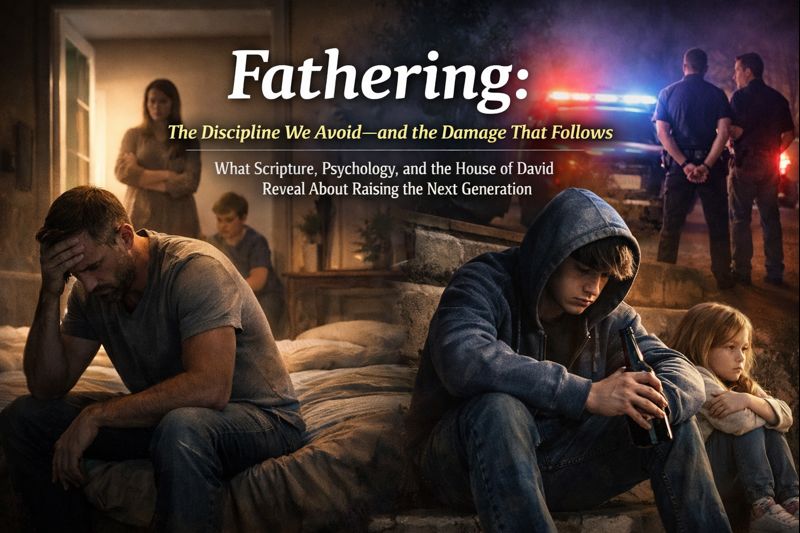
Five Things We Will Learn
• How David’s personal failure became a family fracture that echoed for generations.
• Why mercy without discipline creates confusion rather than restoration.
• How unresolved sin in fathers (and mothers) quietly reappears in the lives of children.
• Why God’s love and justice are never separated—and never unfinished.
• How honest discipline and transparency can turn a parent’s scars into protection for the next generation.
When Love Hesitates, Chaos Multiplies
We live in a culture that celebrates compassion but mistrusts authority.
We speak constantly about grace, understanding, and unconditional love—yet the fruit tells a sobering story. Divorce rates remain high, and family instability continues to reshape society in measurable ways.¹ Prisons are filled disproportionately with men who grew up without an engaged, present father, a pattern documented repeatedly in criminal justice research.² Emotional absence has become so normalized that many homes now function without moral clarity, correction, or guidance.³
This crisis did not originate in modern America. Scripture records the same pattern with unflinching honesty.
The house of King David stands as one of the clearest biblical examples of what happens when love refuses to finish the job discipline was meant to do. David’s family story is not tragic because he sinned. It is tragic because he stopped short—repenting personally while failing to lead decisively within his household.
Father Absence: When Separation Becomes a Generational Wound
One of the most overlooked contributors to this crisis is father absence—not merely emotional distance, but the physical removal of fathers from the daily life of the family. In the United States, approximately 54% of first marriages, 64% of second marriages, and nearly 73% of third marriages end in divorce, and in those cases, mothers most often receive primary custody of children.¹² The result is not only the dissolution of a marriage, but a structural separation that pulls fathers out of the everyday rhythms where fathering actually takes place—daily correction, modeling, protection, and presence.
Dr. James Dobson, founder of Focus on the Family, has long warned that “fathering only comes out of a father when he is in the context of his family.” Outside of that context, the role is inevitably diminished. The father may love deeply and try sincerely, but the relationship is reduced to fragments—weekends, holidays, special events—what Dobson described as the “Disneyland dad” dynamic. He does what he can, with what he has, but the relational infrastructure that forms identity, discipline, and discipleship has already been disrupted.³
Statistically, the consequences are severe and generational. Children raised without an engaged, present father are significantly more likely to experience emotional instability, academic failure, substance abuse, incarceration, and relational breakdown later in life.⁴⁵
When a father is removed from the daily life of his children—whether through divorce, abandonment, emotional absence, or when a mother wants just his seed and not his presence—the consequences are never neutral.¹³¹⁴
It reshapes their emotional world, their understanding of authority, and their capacity to trust—and those patterns often repeat in the next generation.
In other words, when fathers are pulled out of the home, we are not merely changing living arrangements. We are statistically injuring children—and often their children after them.
The Sins of the Father
One of the most sobering biblical realities connected to this crisis of fatherlessness is what Scripture describes as “the sins of the fathers.” This is not just poetry or metaphor—God Himself reveals a spiritual law that explains why cycles of pain, rebellion, addiction, abandonment, and broken identity keep returning generation after generation.
The Lord warned Israel,
“You shall not bow down to them or worship them; for I, the LORD your God, am a jealous God, visiting the iniquity of the fathers on the children to the third and the fourth generation of those who hate Me, but showing steadfast love to thousands of those who love Me and keep My commandments.” (Exodus 20:5–6)
This does not mean that God arbitrarily punishes innocent children for sins they never chose. Rather, Scripture reveals that when fathers rebel against God—especially through idolatry, pride, sexual sin, or abandonment—their choices open a doorway that allows destructive patterns to echo into the lives of their sons and daughters.
Broken men tend to raise broken children.
Wounded fathers often produce wounded homes.
The sins a man refuses to face today will reappear in his children tomorrow.
However, the Bible also gives balance and hope. Ezekiel 18 makes clear that each person is accountable before God for their own life and choices:
“The one who sins is the one who will die. The son will not share the guilt of the father, nor will the father share the guilt of the son.” (Ezekiel 18:20)
In other words:
Children are not damned because of their father’s sin—
but they can repeat the consequences of it if they walk in the same footsteps.
This is why fatherhood matters so deeply. When a father abandons his calling, when he rejects God, or when he refuses discipline, the ripple effects do not remain contained in his own lifetime. They appear in the next generation—in the values, behaviors, wounds, and worldview of his children.
Yet something even more powerful is written into this command:
God promises mercy “to thousands of generations” for those who love Him and keep His ways.
That means:
a single father who returns to God
can break generational curses,
end generational cycles,
heal generational wounds,
and plant blessing instead of destruction.
Your faithfulness today becomes your children’s inheritance tomorrow.
1. The Setup: Sin Starts at Home
David’s sin with Bathsheba is well known. As king, he abused power, violated trust, and arranged the death of Uriah to conceal his wrongdoing. When confronted by the prophet Nathan, David repented deeply. Psalm 51 records one of the most honest confessions in all of Scripture.
God forgave David.
But forgiveness did not erase consequences.
Through Nathan, God warned David that violence and disorder would follow him into his household:
“The sword shall never depart from your house” (2 Samuel 12:10).
This was not vindictive judgment. It was the natural fallout of unresolved leadership failure. David restored his relationship with God, but the moral fracture he introduced into his home created instability that repentance alone did not automatically repair.
Scripture shows this pattern repeatedly. Jacob’s favoritism fractured his sons into rivalry and betrayal. Eli’s refusal to restrain his sons allowed corruption to overtake worship itself. In each case, authority hesitated, and chaos filled the vacuum.
Modern psychology confirms what Scripture already revealed: permissive leadership and the absence of corrective authority increase long-term behavioral and relational instability.⁴
2. The Mirror: What Isn’t Confronted Gets Repeated
David’s sons grew up inside the shadow of his unresolved failure.
Amnon, David’s firstborn, sexually assaulted his half-sister Tamar. David was furious—but he took no decisive action. No discipline. No justice. No public correction. The silence communicated something unmistakable: grave wrongs could occur without consequence.
Absalom watched. He waited. Then he murdered Amnon himself.
What David would not confront as a father, Absalom confronted violently as a brother. Mercy without justice did not heal the family—it multiplied the damage.
When David later allowed Absalom to return from exile without repentance or reconciliation, the unresolved fracture deepened. Absalom’s bitterness turned into ambition, and ambition turned into rebellion. He eventually led a full-scale revolt against his father, attempting to seize the throne.
Long-term studies in psychology and sociology show that unresolved trauma and unchecked behavioral patterns in parents frequently reappear in children unless intentionally confronted and corrected.⁵
The family conflict David hoped would fade instead escalated until it consumed the kingdom.
Delayed discipline did not prevent pain—it guaranteed a greater one.
3. The Tension: God’s Heart Is Not Soft—It Is Complete
Despite everything, Scripture still calls David a man after God’s own heart (Acts 13:22). Not because David excused sin—but because he felt its weight. He grieved. He wept. He took responsibility before God.
That matters.
God Himself carries the same tension David felt: mercy versus judgment, compassion versus justice. But here is the difference—God does not leave that tension unresolved.
Where David hesitated, God acted decisively.
“He was pierced for our transgressions” (Isaiah 53:5).
The violence that tore David’s household apart points forward to a greater resolution. Jesus bears what humanity deserves. The spear that struck Absalom foreshadows the cross—where God finishes the work David could not.
David cried, “Would I had died instead!”
God answers through Christ, “I did.”
Love does not eliminate justice.
Love fulfills it.
4. The Fix: Discipline That Restores, Not Destroys
The apostle Paul, a spiritual father, understood this dynamic well.
He practiced severe self-discipline, knowing unchecked desire disqualifies leadership. When addressing serious sin in the Corinthian church, Paul did not default to sentimentality. He allowed consequences to do their necessary work:
“Deliver such a one to Satan for the destruction of the flesh” (1 Corinthians 5:5).
The goal was never punishment—it was rescue. And when repentance came, Paul urged immediate forgiveness and restoration (2 Corinthians 2:6–8).
This approach aligns with what psychologists describe as authoritative parenting—the combination of firm boundaries and relational warmth that produces the healthiest long-term outcomes.⁴
Grace without boundaries breeds rebellion.
Discipline without restoration breeds resentment.
Biblical love holds both.
To all the fathers out there, your kids won't remember all the gifts they did or didn't get on Christmas. They'll remember the things that made them feel SAFE: the sound of your voice, how you react, that even when you were worried, YOU were the one who stood between them and… pic.twitter.com/aYIVg1gugm
— Glenn Beck (@glennbeck) December 19, 2025
5. The Conclusion: Turning Scars into Shields—Lessons for Today’s Fathers
Fathers, listen up—your past isn’t a secret to bury; it’s a story to share. Psychological studies back this ancient wisdom: sit your child down and say, “Listen, I allowed this stuff in my life. It brought terrible things—pain, regret, brokenness. Because I love you, I’m not going to let you walk that path. I’ll discipline you for it, not out of anger, but to spare you the same scars. You’ll make your own choices one day, but know this: my correction comes from hope—that you won’t repeat my mistakes.”⁴⁵
That’s exactly what the Apostle Paul models in his letters. He doesn’t hide his ugly history as a persecutor, murderer, and rigid Pharisee (Acts 9:1–19; Philippians 3:4–6). Instead, he testifies: “Look at what I was—I got mercy. Now you get a warning. Do you think I want you chained, flogged, or stoned like I was? I love you, so I’m telling you: don’t start down that road” (paraphrased from 1 Corinthians 9:27; 2 Corinthians 11:23–27). It’s not shame; it’s rescue. Too many dads do the opposite—they conceal their failures, hoping the kids never notice. Paul flips it: “Here, look at my scars. They’re ugly. Let them scare you straight.”
And when words aren’t enough? Paul doesn’t hesitate—he hands the unrepentant over to consequences, even “to Satan for the destruction of the flesh” (1 Corinthians 5:5), so the pain hits now, not later. Psychologists call this “modeling consequences,” where vulnerability plus firm boundaries builds resilience.⁴⁵ Paul just calls it love. Either way, it beats the silence of a quiet house, where sons and daughters learn life’s hardest lessons too late—from the world, not from you.
So, dads, embrace the tension. Speak openly of your failures as cautionary tales. Discipline with love, not wrath—swift, fair, and tied to your own story. Follow David’s cry for a clean heart (Psalm 51:10) and Paul’s bold transparency. Your kids don’t need a perfect father; they need an honest one. Finish the job: turn your scars into their shield. In doing so, you’ll reflect the ultimate Father—who didn’t spare His own Son to spare us (Romans 8:32). And your house? It just might stand.
Endnotes
- Pew Research Center, “The Decline of Marriage and Rise of New Families,” November 18, 2010, https://www.pewresearch.org/social-trends/2010/11/18/the-decline-of-marriage-and-rise-of-new-families/; U.S. Census Bureau, “Marriage and Divorce,” https://www.census.gov/topics/families/marriage-divorce.html.
- U.S. Department of Justice, Bureau of Justice Statistics, Family Background Characteristics of Adult Offenders, April 2005, https://bjs.ojp.gov/content/pub/pdf/fcs03.pdf.
- James C. Dobson, Bringing Up Boys (Wheaton, IL: Tyndale House, 2001); Focus on the Family, parenting resources, https://www.focusonthefamily.com/parenting/.
- American Psychological Association, “Parenting Styles,” Monitor on Psychology, February 2013, https://www.apa.org/monitor/2013/02/parenting; Masud H. Rahman et al., “Parenting Styles and Child Outcomes: A Review,” International Journal of Environmental Research and Public Health 15, no. 4 (2018), https://www.ncbi.nlm.nih.gov/pmc/articles/PMC6323136/.
- Rachel Yehuda et al., “Intergenerational Transmission of Trauma Effects,” World Psychiatry 17, no. 3 (2018), https://www.ncbi.nlm.nih.gov/pmc/articles/PMC5573758/; Centers for Disease Control and Prevention, “Adverse Childhood Experiences (ACEs),” https://www.cdc.gov/violenceprevention/aces/index.html.
13. ABC News. “Women choosing to have children on their own.” https://www.abc.net.au/news/2023-01-07/women-choosing-to-have-children-on-their-own-private-donations/101791620
14. Reproductive Health (SpringerLink). “Single motherhood by choice research.” https://reproductive-health-journal.biomedcentral.com/articles/10.1186/s12978-025-02173-0
Begin Your Journey Today
Jesus didn’t just call us to believe in Him—He called us to follow Him.
Step into the life He designed for you through Emmaus Road’s The Commands of Jesus . This is more than learning—it’s an invitation to walk with Him, obey Him, and experience Him in a real and powerful way.
You don’t want to miss this exciting adventure Jesus has called you into.
Start now:
https://GregLancaster.org/StartHere