



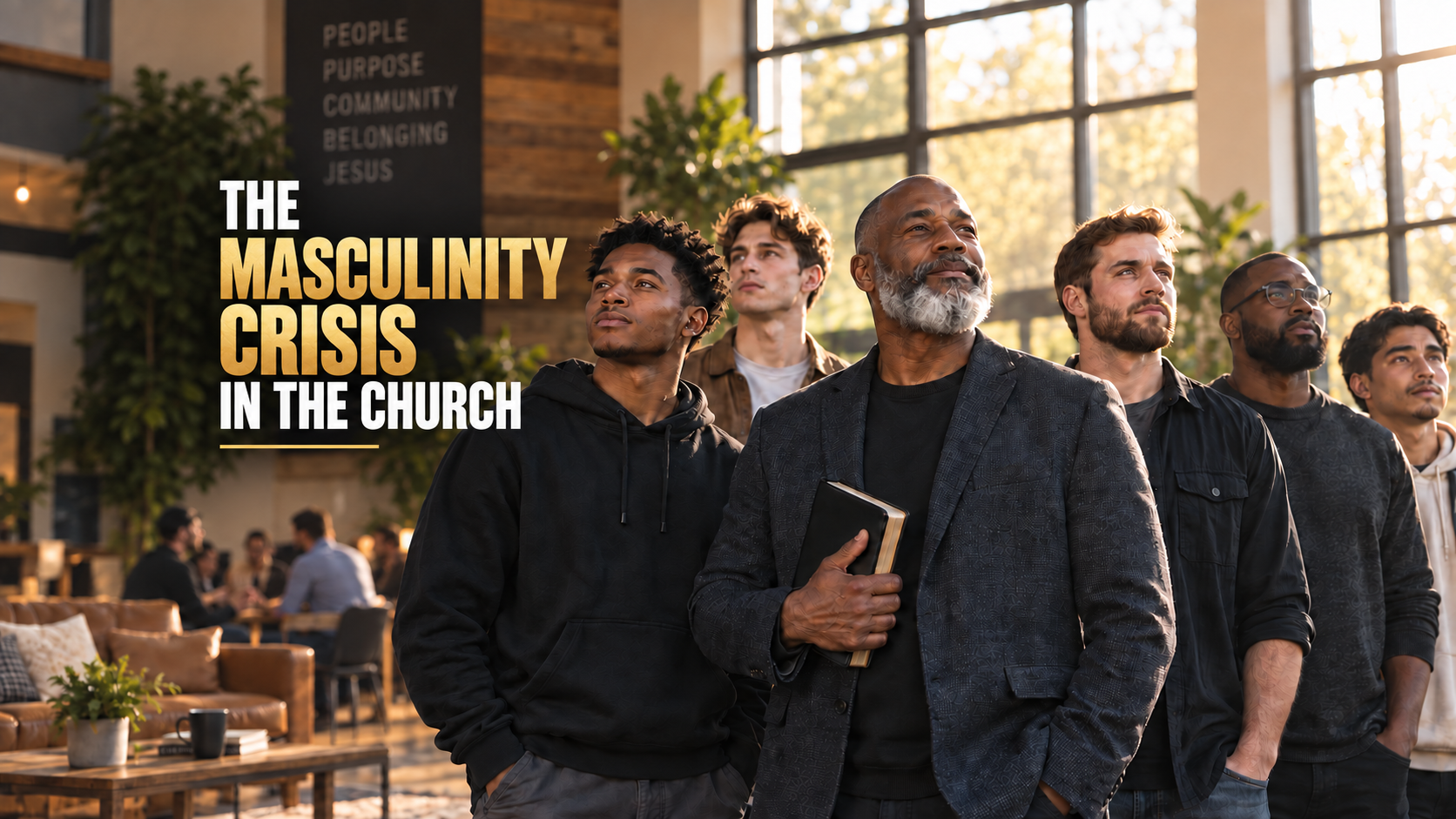
Five Things We Will Learn
- Why many young men feel alienated from the modern evangelical church.
- How the Church can recover spiritual fatherhood without diminishing women.
- Why Jesus commanded His followers to make disciples, not merely converts.
- How biblical masculinity combines the courage of a lion with the tenderness of a lamb.
- Why the gospel of Jesus Christ is the only lasting answer to the crisis facing men, families, and the Church.
A Generation of Men Without Hope or Direction
Many young men are living without a compelling reason to get out of bed, accept responsibility, build a family, or prepare for the future.
Pornography, gambling, video games, isolation, and other addictions offer temporary pleasure without requiring commitment. They provide momentary relief while quietly draining men of initiative, discipline, courage, and hope.
In a wide-ranging conversation with Jeremy Boreing, Pastor Mark Driscoll described this as both a cultural crisis and a crisis within the Church. Young men do not merely need another warning about their failures. They need hope, spiritual fathers, biblical instruction, meaningful responsibility, and a plan for the future.
The Church should be the place where lost, discouraged, and directionless men encounter Jesus Christ and learn how to become faithful sons, husbands, fathers, brothers, and servants.
Instead, many men have concluded that the Church has no meaningful place for them.
That must change.
An Underfathered Church
Driscoll summarized the problem with a provocative phrase: the Church has become “overmothered” and “underfathered.”
This does not mean that women are the problem. Faithful women have carried tremendous spiritual responsibility, often serving, giving, praying, teaching children, and holding families together when men refused to lead.
The deeper problem is the absence of godly fathers.
A healthy family needs the love and strength of both fathers and mothers. Likewise, the Church should not suppress the spiritual contributions of women or redefine masculine strength as inherently sinful. It should honor God’s design and raise up mature men who accept responsibility for others.
Paul repeatedly described younger ministers relationally. Timothy, Titus, and Onesimus were not simply employees, students, or ministry volunteers. Paul referred to them as sons. He instructed them, corrected them, trusted them, and prepared them to carry responsibility.
That kind of spiritual fatherhood cannot be replaced by programs, platforms, or online content.
Young men need more than information. They need mature men who will know them, challenge them, encourage them, correct them, and walk beside them.
When the Church Begins Serving a Market
One of the dangers discussed in the conversation was “audience capture.” This occurs when a leader gradually begins shaping his message around the approval of the people listening to him.
A pastor may begin with a desire to reach people, but attendance, giving, applause, social-media reactions, and the fear of criticism can slowly influence what he is willing to say.
The Church then begins operating like a business attempting to satisfy its most dependable customers.
Jesus Christ must never be treated as a product, and the congregation must never be treated merely as a market.
The Church belongs to Jesus. He must remain at its center.
A biblical gathering welcomes the lost, but it does not reorganize the truth around their preferences. People should be invited into the life, holiness, joy, order, and love of God’s family. God’s family should not be required to abandon those things to prevent anyone from feeling challenged.
The gospel welcomes sinners, but it also calls sinners to repentance.
The Difference Between Controversy and Scandal
Driscoll also distinguished between controversy and scandal.
Controversy can arise when someone says something true that others strongly oppose. Scandal occurs when a leader’s conduct contradicts the message he proclaims.
A Christian leader should never assume that criticism proves his faithfulness. Some criticism is justified. Leaders can be harsh, impatient, proud, unaccountable, or unnecessarily offensive. Every accusation must be examined honestly before God.
At the same time, avoiding controversy cannot become the highest goal of ministry. Jesus was opposed. The apostles were threatened, arrested, and persecuted. Paul wrote some of his most powerful letters while imprisoned.
The real question is not, “Did people become angry?”
The question is, “Was the leader faithful to Jesus in his message, character, and conduct?”
Pastors must be willing to speak the truth, but they must also remain humble enough to receive correction. Boldness without humility becomes arrogance. Humility without courage becomes cowardice.
Biblical leadership requires both.
Great Leaders Are Still Dependent Upon God
The fall of respected Christian leaders can be devastating, particularly for young believers who looked to those leaders as spiritual fathers.
When a pastor preaches faithfulness but lives in secret rebellion, people may begin questioning whether Christianity actually works. It can feel like discovering that a trusted father was living a double life.
Scripture never presents its heroes as flawless.
Moses did not enter the Promised Land. David sinned grievously and was not permitted to build the temple. Peter denied Jesus. Their failures remind us that God alone is perfect and that no leader can replace Him.
This does not excuse sin. Leaders carry greater responsibility because their choices affect entire families, congregations, and generations.
It does remind us, however, that our faith must ultimately rest in Jesus Christ, not in the personality, reputation, gifting, or platform of any human leader.
God may work powerfully through a man, but that man will always need the righteousness, mercy, correction, and sustaining grace of God.
Make Disciples, Not Merely Converts
Jesus did not command His followers merely to collect decisions. He commanded them to make disciples.
“Therefore go and make disciples of all nations, baptizing them in the name of the Father and of the Son and of the Holy Spirit, and teaching them to obey everything I have commanded you” (Matthew 28:19-20).
Salvation is not the finish line of the Christian life. It is the beginning.
A man may respond to the gospel, pray, and be baptized, but he must then learn how to follow Jesus in every area of life.
He must learn how to pray, study Scripture, resist temptation, handle money, work faithfully, honor women, remain sexually pure, love his wife, raise children, forgive enemies, serve the Church, and accept responsibility.
If the Church only tells men how to be saved after death but never teaches them how to follow Jesus today, it leaves much of the Great Commission unfinished.
The gospel is not merely insurance against hell. Eternal life begins when a person comes into a living relationship with Jesus Christ.
Christianity is not simply about where a man will go after he dies. It is about who he is becoming while he lives.
Jesus Saves Us From Ourselves
One of Driscoll’s most personal statements was:
“Jesus didn’t just save me from hell; He saved me from me.”
That captures something essential about salvation.
Apart from Christ, our selfishness, pride, lust, anger, ambition, bitterness, and self-destructive desires damage everyone around us. A man’s sin does not remain contained within him. It affects his wife, children, friends, church, workplace, and future generations.
Through Christ, a man receives more than forgiveness for the past. He receives a new heart, a new identity, the indwelling Holy Spirit, and the power to begin living differently.
Paul explains the battle this way:
“For the sinful nature desires what is contrary to the Spirit, and the Spirit what is contrary to the sinful nature. They are in conflict with each other, so that you do not do what you want” (Galatians 5:17).
The Christian life is not the absence of conflict. It is the presence of the Holy Spirit empowering us to resist the sinful nature and become more like Jesus.
Temptation offers shallow and temporary pleasure. Obedience leads to deeper joy, freedom, peace, and lasting fruit.
Tough and Tender Like Jesus
Biblical masculinity is neither passive weakness nor cruel domination.
Jesus is presented in Scripture as both the Lion and the Lamb. He possessed strength without brutality and tenderness without weakness.
He confronted religious hypocrisy, drove corrupt merchants from the temple, endured suffering, protected the vulnerable, welcomed children, wept with grieving people, washed His disciples’ feet, and willingly laid down His life.
A godly man must know when courage is required and when tenderness is needed.
He should be strong enough to protect his family and gentle enough for his wife and children to feel safe in his presence. He should confront evil without becoming evil. He should exercise authority without using it to satisfy his ego.
The purpose of building strong men is not to elevate men above women and children. It is to prepare men to bless, protect, serve, and sacrifice for them.
Strength is not proved by how many people a man can control. It is demonstrated by how faithfully he carries the responsibilities God has entrusted to him.
The Counterfeit Masculinity of the Internet
When the Church fails to disciple men, other voices will gladly fill the void.
Some young men are turning to online movements that offer confidence, dominance, wealth, physical strength, resentment, and hostility toward women. These voices recognize that men are hurting, but they often prescribe pride, sexual immorality, contempt, and self-glorification as the cure.
That is not biblical masculinity. It is woundedness disguised as strength.
Young men may have been neglected, mocked, or abandoned. Their pain may be real, but victimhood cannot become their permanent identity.
The gospel offers them something far greater.
In Christ, an abandoned man can become a son who knows his Father. Under the Father’s discipline and direction, that son can become a faithful husband, father, servant, and spiritual leader. His life can bless generations he will never live to see.
That is a vision worth pursuing.
Fathers Must Be Willing to Repent
One of the most powerful moments in the conversation concerned repentance within the family.
After leaving Mars Hill Church, Driscoll gathered with his wife and children in their home. During that first family gathering, he taught about forgiveness and asked them to forgive him for the ways his words and actions had contributed to their suffering.
When a father admits that he has sinned, he is not telling his family something they do not already know. He is demonstrating the gospel before them.
He is saying, “I need Jesus too.”
A father does not lose authority by repenting. He establishes moral credibility because he is willing to come under the authority of God.
Paul writes:
“Be kind and compassionate to one another, forgiving each other, just as in Christ God forgave you” (Ephesians 4:32).
Unforgiveness gives the enemy room to work within a family. Repentance and forgiveness close that door and begin the work of healing.
Freedom Requires Faith and Responsibility
The conversation also compared the Israelites’ longing for Egypt with the modern temptation to exchange freedom for control.
Although Egypt enslaved them, it was familiar. The wilderness required daily dependence upon God. Freedom brought uncertainty, responsibility, and the necessity of faith.
That temptation still exists.
People may surrender freedom because responsibility feels difficult. They may prefer a system that promises security, provision, and order, even if that system gradually takes control of their lives.
Biblical freedom is not permission to live irresponsibly. It is the freedom to love God, obey His Word, serve others, build families, work faithfully, and exercise wise stewardship.
Freedom without responsibility produces chaos. Control without freedom produces bondage.
Faith teaches us to trust God while responsibly using what He has placed in our hands.
The Gospel Is the Answer
The crisis facing men will not ultimately be solved by anger, ideology, physical strength, self-improvement, religious performance, or nostalgia for an earlier generation.
Men need Jesus Christ.
Paul summarized the gospel as the message of first importance:
“For what I received I passed on to you as of first importance: that Christ died for our sins according to the Scriptures, that he was buried, that he was raised on the third day according to the Scriptures” (1 Corinthians 15:3-4).
Jesus lived the righteous life we could not live. He willingly took our place upon the cross and bore the consequence of our sin.
“God made him who had no sin to be sin for us, so that in him we might become the righteousness of God” (2 Corinthians 5:21).
Jesus died, was buried, and rose again. Through Him, sinners can be forgiven, reconciled to God, made new, and welcomed into the Father’s family.
Jesus declared:
“I am the way and the truth and the life. No one comes to the Father except through me” (John 14:6).
This is the message the Church must proclaim without alteration or apology.
Young men do not need to be abandoned to addiction, nihilism, resentment, or counterfeit masculinity. They need to encounter Jesus, be fathered in the faith, taught to obey His commands, entrusted with responsibility, and shown how their lives can bless women, children, churches, communities, and generations.
The answer to the masculinity crisis is not merely stronger men.
It is men surrendered to Jesus Christ.
Source: Based on the conversation between Jeremy Boreing and Pastor Mark Driscoll contained in the supplied transcript.
Begin Your Journey Today
Jesus didn’t just call us to believe in Him—He called us to follow Him.
Step into the life He designed for you through Emmaus Road’s The Commands of Jesus . This is more than learning—it’s an invitation to walk with Him, obey Him, and experience Him in a real and powerful way.
You don’t want to miss this exciting adventure Jesus has called you into.
Start now:
https://GregLancaster.org/StartHere