



Five Things We Will Learn
- Why a federal judge ruled that conversations with a consumer AI chatbot were not protected by attorney-client privilege.
- What happened in United States v. Heppner and why those AI conversations became evidence.
- Why the Miranda warning exists and why it offers an important lesson for the AI age.
- How this ruling could affect users of ChatGPT, Claude, Grok, Gemini, Copilot, Meta AI, and other consumer AI platforms.
- How to wisely use AI while protecting sensitive legal information.
We All Know Police Must Read You Your Rights…
One of the most recognized legal protections in America is known as the Miranda warning.
When someone is taken into police custody and questioned, officers generally advise them of certain constitutional rights before asking questions.
Most people recognize some version of these words:
“You have the right to remain silent. Anything you say can and will be used against you in a court of law.”
The warning exists for a simple reason.
Our justice system recognizes that what people say can become evidence.
Words matter.
Once spoken, they may later appear before a judge or jury.
For decades, Americans have understood this principle when speaking with law enforcement.
Today, we may need to begin thinking about artificial intelligence the same way.
Perhaps AI Needs Its Own Miranda Warning
Millions of people now ask AI questions they would never ask a search engine.
They upload contracts.
They discuss business disputes.
They work through employment problems.
Some even explain criminal investigations, lawsuits, divorces, tax matters, or regulatory issues while asking AI for guidance.
Many assume those conversations are private.
A recent federal court ruling suggests they should not make that assumption.
If consumer AI platforms had their own version of the Miranda warning, perhaps it would sound something like this:
AI Warning
Anything you type into this consumer AI service may not be protected by attorney-client privilege. Depending on the circumstances, your conversations may be retained, subpoenaed, or produced during litigation. If you are seeking legal advice or discussing sensitive legal matters, consult a licensed attorney rather than relying on a consumer AI chatbot.
No such warning currently appears.
Perhaps it should.
The Heppner Case
That question became very real in United States v. Heppner.
Bradley Heppner was facing federal securities fraud charges.
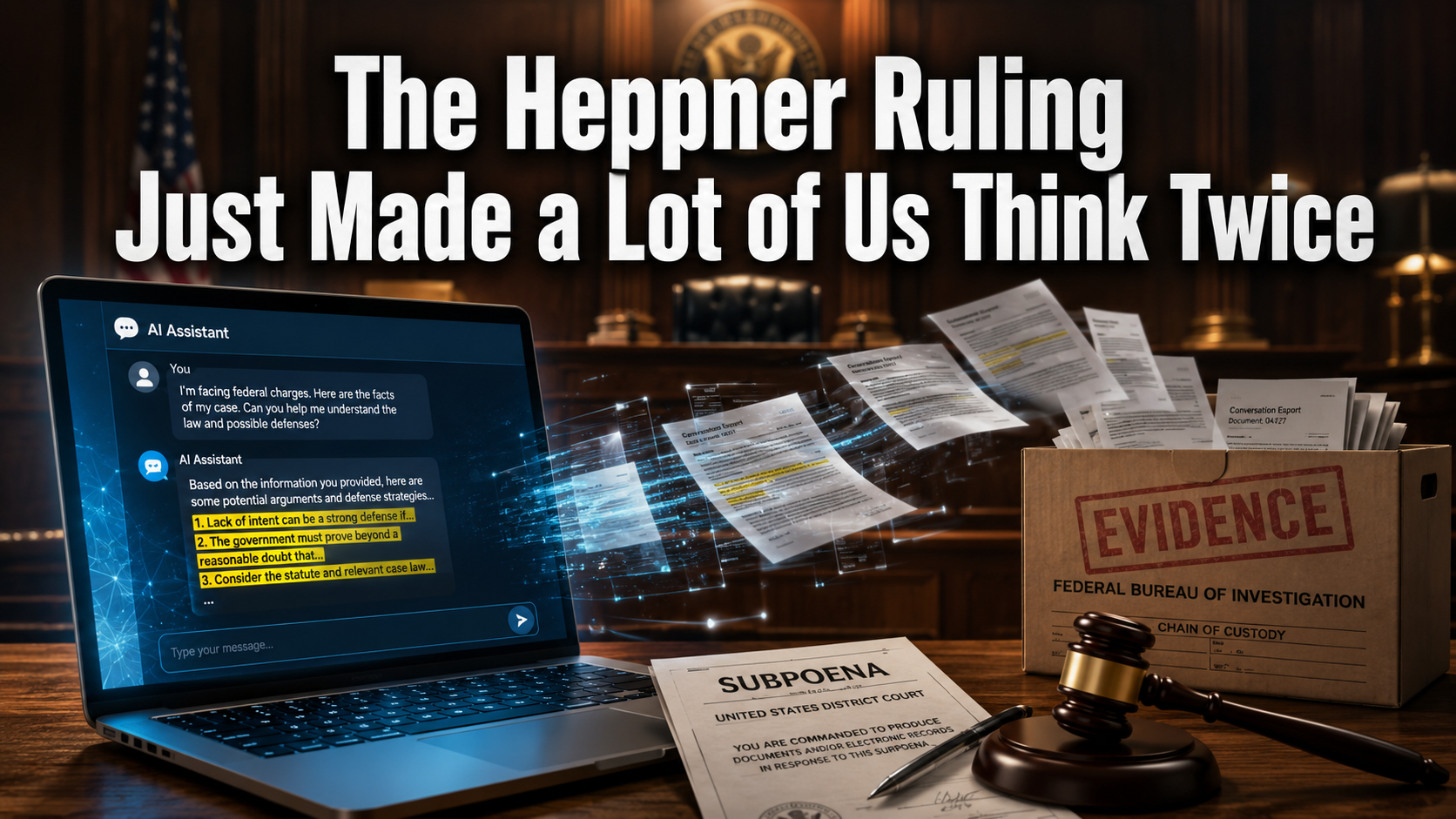
After receiving a grand jury subpoena and learning he was under investigation, Heppner began using Anthropic’s free public version of Claude to help think through his legal defense.
He entered facts about his case.
He asked legal questions.
He explored possible defenses.
He organized legal arguments.
Later, he shared some of Claude’s responses with his attorneys.
When the FBI searched his residence, agents recovered approximately 31 documents generated from those conversations.
Heppner argued those documents should remain protected by attorney-client privilege and the attorney work-product doctrine.
Judge Jed Rakoff ruled otherwise.
Why the Court Said No
The court’s reasoning was straightforward.
Attorney-client privilege protects confidential communications between a client and a licensed attorney.
Claude is not an attorney.
It has no law license.
It owes no fiduciary duty.
It cannot represent clients.
It is software.
The court concluded there simply was no attorney-client relationship.
That alone prevented attorney-client privilege from applying.
Confidentiality Matters
The court also emphasized another important point.
Attorney-client privilege depends on confidentiality.
The consumer version of Claude operated under privacy terms allowing information to be retained and, under certain legal circumstances, disclosed.
Because those conversations were not guaranteed to remain confidential, the court found there was no reasonable expectation they would remain private.
Without confidentiality, attorney-client privilege cannot exist.
The Work-Product Argument Also Failed
Heppner also argued the conversations were protected as attorney work product.
Judge Rakoff rejected that argument as well.
The work-product doctrine generally protects materials prepared by or for attorneys in anticipation of litigation.
Heppner was using Claude independently.
He was not acting under his attorney’s direction.
Because he created those materials himself before involving counsel, they did not qualify for work-product protection.
Why This Matters Beyond Claude
This decision involved one federal district court and Anthropic’s consumer version of Claude.
It is not automatically binding nationwide.
However, it is the first published federal decision addressing attorney-client privilege and consumer AI chatbots.
That makes it significant.
The reasoning could potentially apply to many consumer AI platforms that function similarly.
That includes ChatGPT, Grok, Gemini, Microsoft Copilot, Meta AI, and other consumer AI services, depending on each platform’s privacy policy, contractual terms, data retention practices, and the facts of a future case.
The important issue is not which chatbot someone uses.
The issue is whether the communication is legally confidential.
Enterprise AI Is Not the Same Thing
Many organizations now use enterprise AI platforms offering contractual confidentiality, stronger security, and zero-data-retention options.
Those protections matter.
However, they should not be confused with attorney-client privilege.
Simply paying for an enterprise AI subscription does not create attorney-client privilege.
That privilege generally exists only when confidential communications occur between a client and an attorney acting as legal counsel.
Enterprise protections reduce certain privacy risks.
They do not replace a lawyer.
A Practical Lesson for Every AI User
Artificial intelligence remains one of the most useful technologies available today.
It can summarize documents.
Explain legal concepts.
Organize information.
Brainstorm ideas.
Review contracts.
Help people become better informed.
None of that changed because of the Heppner ruling.
What changed is our understanding of legal risk.
If your issue involves litigation, criminal investigations, government inquiries, employment disputes, tax controversies, regulatory actions, or other matters that could eventually appear in court, think carefully before entering those facts into a consumer AI chatbot.
When the legal stakes are high, your attorney should be your confidential advisor.
Not your chatbot.
The Bottom Line
Judge Rakoff did not rule that artificial intelligence should never be used for legal work.
He ruled that when someone voluntarily uses a public consumer AI service without involving an attorney and without confidentiality protections, those conversations are not protected by attorney-client privilege or the work-product doctrine.
Perhaps the greatest lesson from United States v. Heppner is this:
For nearly sixty years Americans have heard a warning that begins:
“You have the right to remain silent…”
Perhaps the AI age now needs its own reminder:
Think before you type. Anything you enter into a consumer AI service could one day become evidence.
That isn’t meant to discourage the use of artificial intelligence.
It is meant to encourage using it wisely.
Just as the Miranda warning reminds us that our words have legal consequences, the Heppner decision reminds us that what we type into consumer AI platforms can also carry consequences.
Artificial intelligence is an extraordinary tool.
But when legal risks become real, convenience should never replace confidential legal counsel.

Begin Your Journey Today
Jesus didn’t just call us to believe in Him. He called us to follow Him.
Step into the life He designed for you through Emmaus Road’s The Commands of Jesus. This is more than learning. It’s an invitation to walk with Him, obey Him, and experience Him in a real and powerful way.
You don’t want to miss this journey.
Start today: https://GregLancaster.org/StartHere