



Five Things We Will Learn
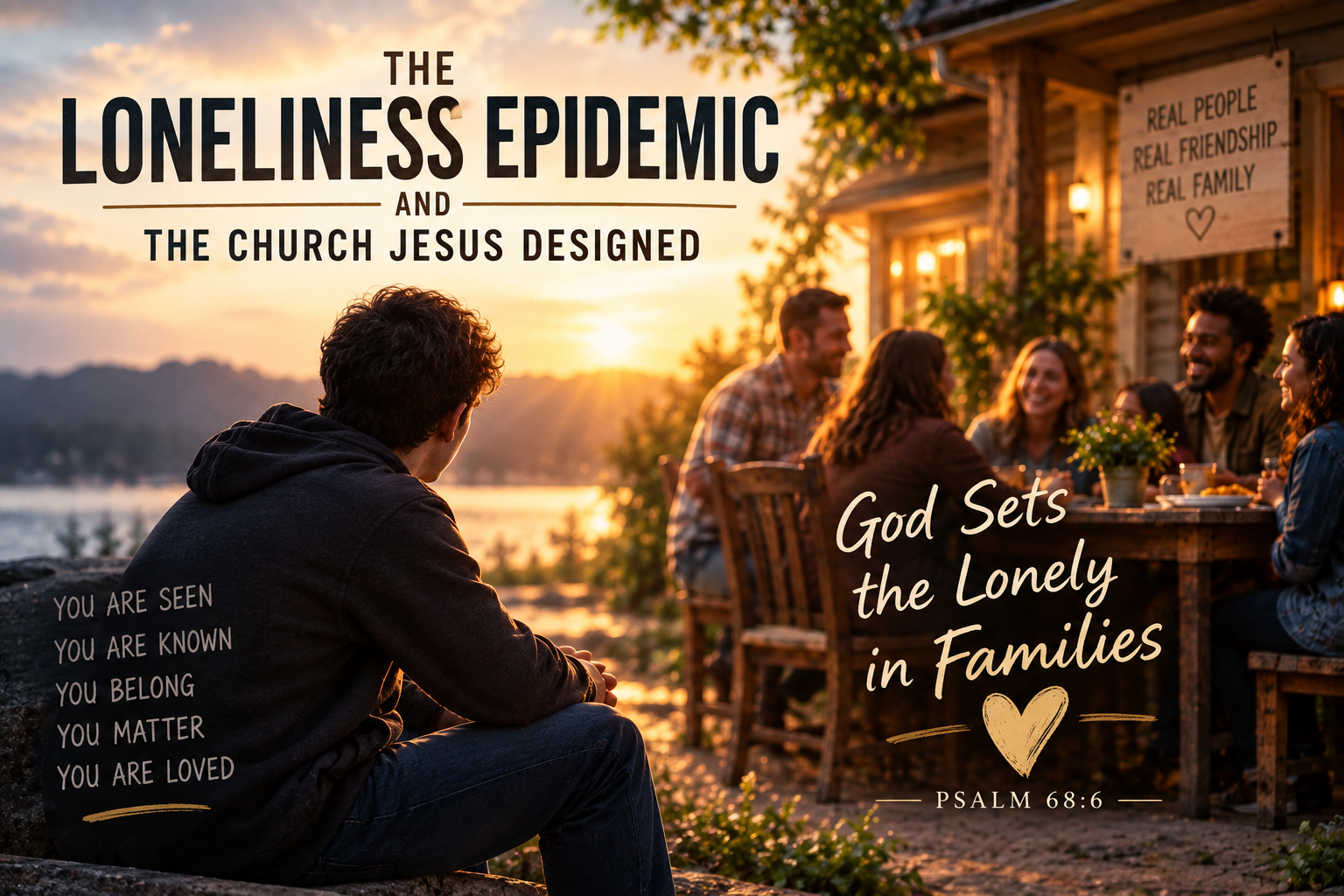
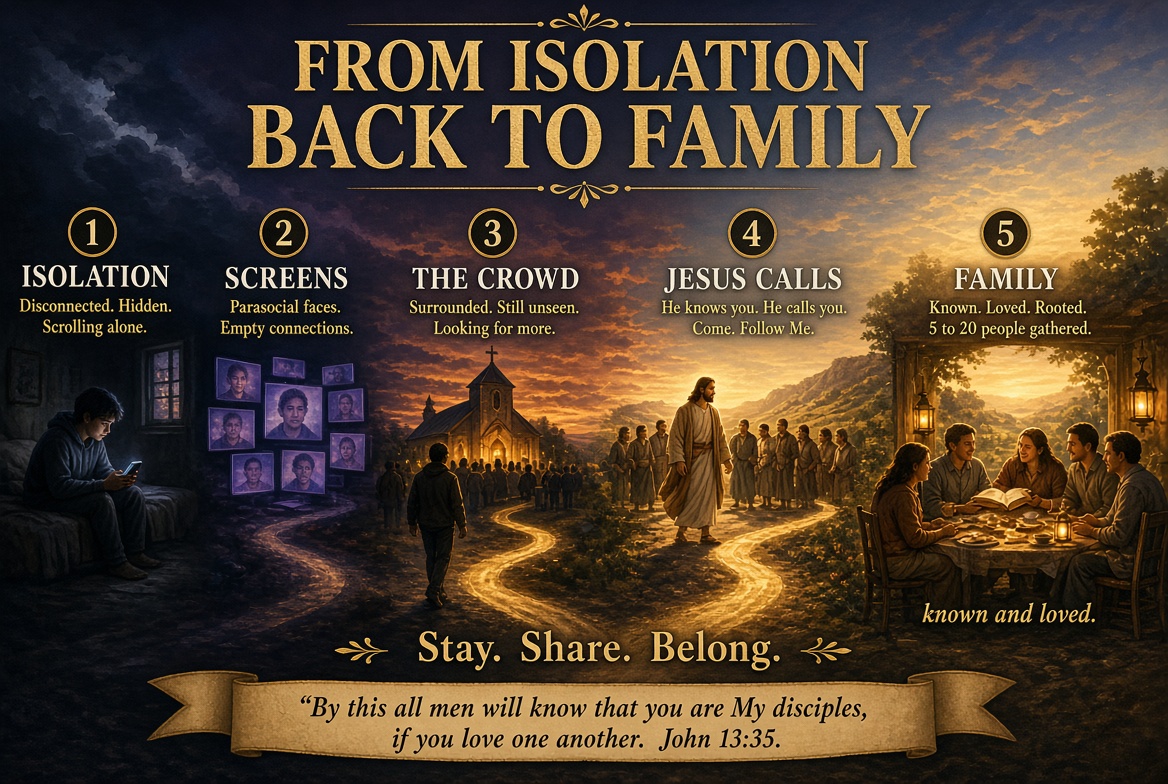
- The loneliness epidemic is about more than being physically alone. People can be surrounded by crowds, connected through screens, and even attend church while remaining deeply unknown and relationally isolated.
- God designed human beings for meaningful connection. Loneliness and prolonged isolation can affect the body, mind, relationships, and spiritual life.
- Jesus modeled a different kind of life. Rather than building His Kingdom around spectators, He shared life with a small company of disciples who walked, ate, learned, served, and grew together.
- The Church is meant to function as spiritual family. Scripture’s picture of fellowship involves belonging, shepherding, shared meals, mutual care, accountability, discipleship, and enduring relationships—not merely attending the same meeting.
- Returning to relational church life offers a way out of isolation. Small, faithful communities where people are known and loved provide the setting for the authentic relationships for which so many people are longing.
We Have Never Been More Connected—and Yet So Many Are Alone
We live in an age of almost unlimited connection.
We can text someone instantly. We can follow hundreds or thousands of people. We can watch teachers, pastors, celebrities, influencers, friends, and strangers from morning until night. We can carry an entire digital world in our pockets.
Yet people are lonely.
In Lorie Johnson’s CBN News report, From Isolation to Community: God’s Answer to America’s Loneliness Epidemic, the crisis becomes especially visible among younger men. The report describes many men under 30 as feeling like failures, experiencing chronic loneliness, and sometimes attempting to fill that emptiness with pornography, gaming, and gambling. The same report points toward a simple but profound problem: the more time people spend behind screens, the less time they may spend engaging face to face.
That apparent contradiction points toward something important:
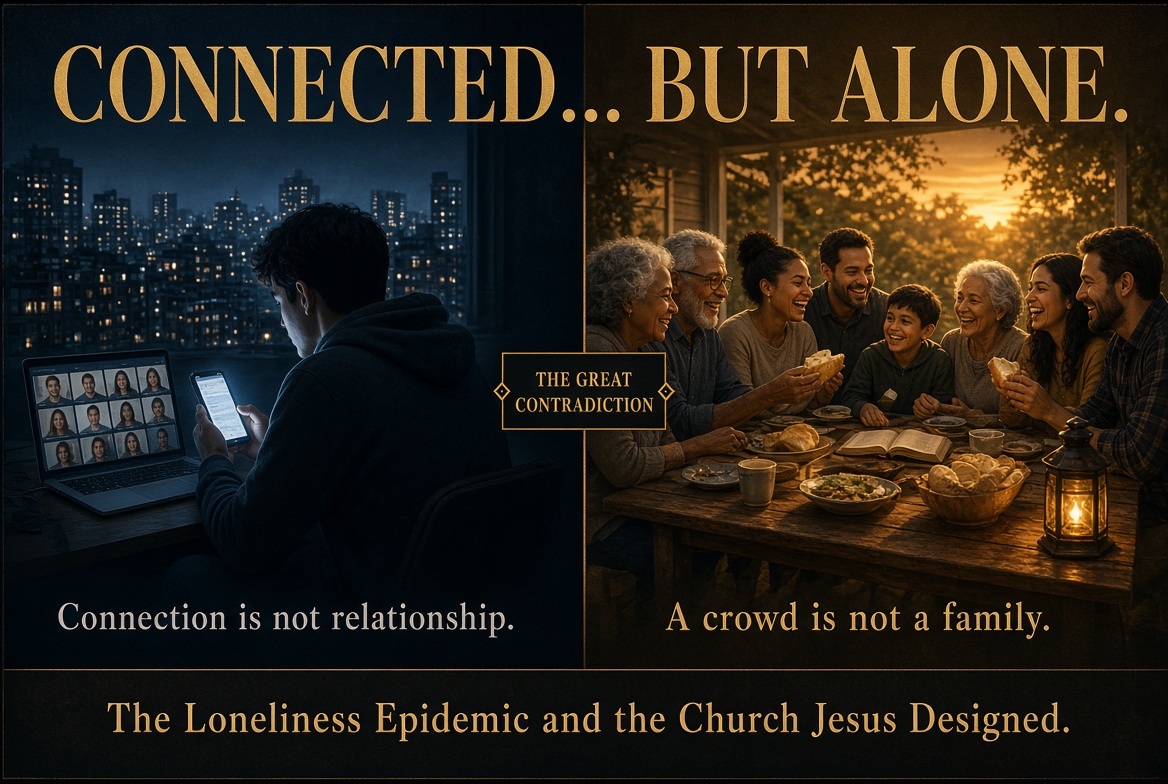
Connection is not the same thing as relationship.
And a crowd is not the same thing as a family.
The loneliness epidemic is therefore more than a problem of people needing additional activities on their calendars. It raises a deeper question about how we are living—and, for Christians, whether the Church has drifted from the relational life Jesus showed us.
God Wired Us for Bonding
God designed human beings for relationship.
When people share life face to face—when a mother holds her child, friends sit together around a table, believers pray together, burdens are carried, tears are shared, and people remain present through difficult seasons—something happens that cannot be duplicated merely by occupying the same digital space.
In The Great Disconnect: Why Digital Isolation Is the New Idolatry, I draw a contrast between oxytocin associated with human bonding and the dopamine-driven rewards increasingly pursued through digital culture. Endless digital stimulation can become a substitute for the relational bonding God designed us to experience.
The problem is not simply the existence of technology.
The problem comes when technology becomes a substitute for presence.
As I have taught in Parasocial Relationships—The Illusion of Connection, a one-sided digital relationship can create the feeling that we know someone who does not actually know us. We can watch someone’s life, listen to that person’s thoughts, laugh with them, and spend hours consuming their content without ever entering a reciprocal relationship in which they know our name, recognize our absence, hear our struggles, challenge us, forgive us, or carry our burdens.
Jesus modeled the opposite.
His relationships with His disciples were reciprocal, accountable, personal, and lived day by day.
That is why He did not merely invite people to listen. He commanded them to love one another—and He said that love is how the world would know they belonged to Him (John 13:34–35).
In The Commands of Jesus Part 2: Love Looks Like Obedience and Part 29, Antioch – Love One Another, I teach that love is not a feeling or a church program. It is obedience. Agapē is the atmosphere in which gifts, unity, and real community actually work.
In The Commands of Jesus Part 10: Rise and Walk, In the name of Jesus, I contrast a sedentary, isolated life with Jesus’ command to get up and walk into the harvest—including the call out of technological isolation into community.
Loneliness Can Reach the Body and Mind
Loneliness is more than an unpleasant emotion.
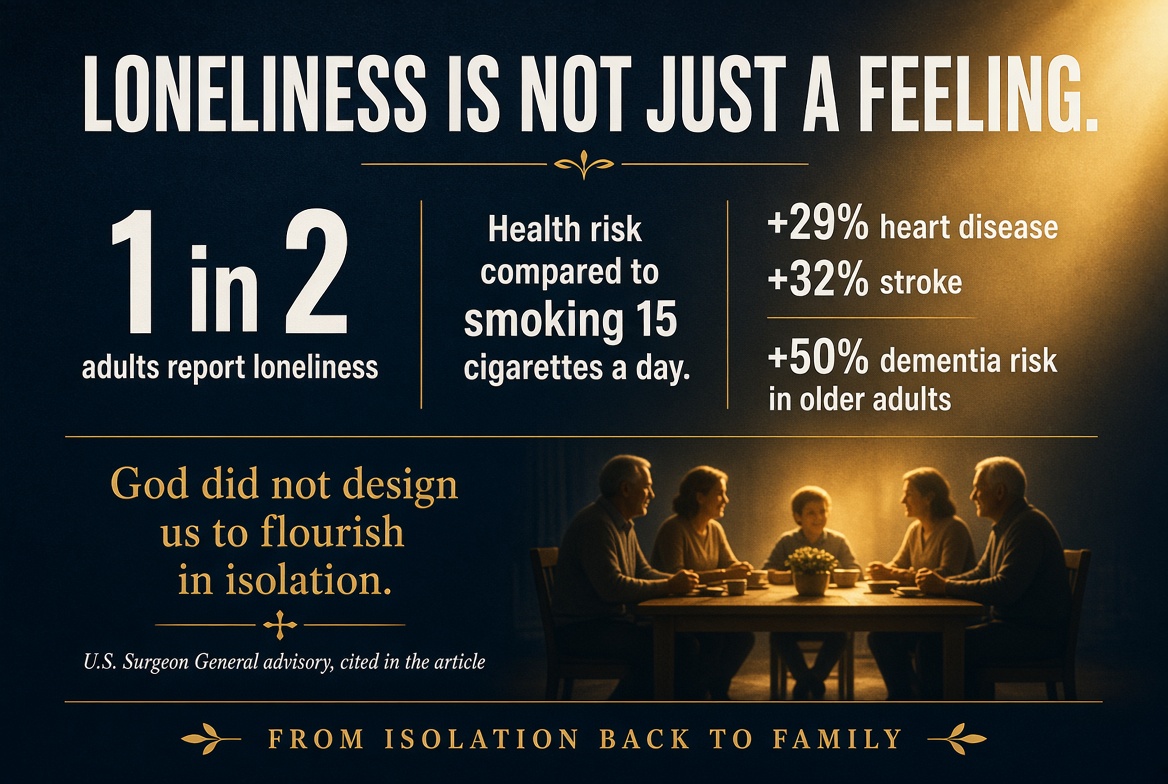
CBN medical reporter Lorie Johnson has reported on research associating loneliness with increased risks of physical problems including heart disease, stroke, and dementia, as well as mental-health struggles such as depression and anxiety. In her reporting with licensed family therapist Dr. Linda Mintle, loneliness was compared in its health effects to smoking as many as 15 cigarettes a day.
Psychiatrist Dr. Daniel Amen also points toward a remarkably practical response. In Johnson’s report Loneliness Now a Major US Health Threat—Top Psychiatrist Says, “Go Back to Church,” Amen argues for reducing screen time, returning to in-person activities, becoming involved with groups, and reconnecting through church.
In Do You Feel Like You Are Losing Your Mind?, I approach the same problem through the connection between isolation, spiritual life, and the brain. Prolonged isolation can damage more than our sense of companionship. Depression and isolation can reinforce one another, while community is part of God’s design for human health.
The conclusion is difficult to escape:
God did not create us to flourish indefinitely in isolation.
Even Church Attendance Can Leave Someone Lonely
This presents an uncomfortable question for the Church.
Getting people back into a building is not necessarily the same thing as bringing people back into relationship.
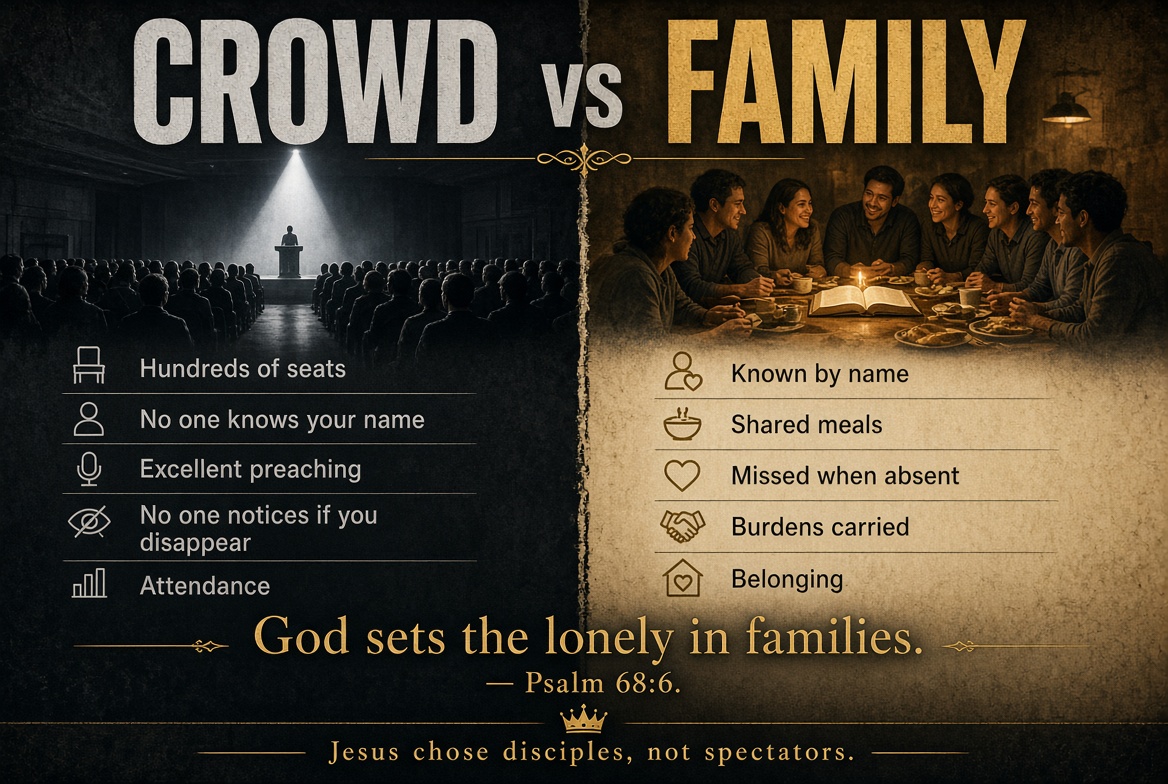
A person can attend a gathering with hundreds or thousands of other people and still leave without anyone knowing his name.
She can worship beside people who do not know she is hurting.
He can listen to excellent preaching without having anyone who will notice when he disappears.
A person can attend church for years without developing relationships in which people walk together through marriages, births, deaths, failures, celebrations, sickness, financial struggles, spiritual victories, and ordinary Tuesdays.
Dr. Linda Mintle addressed this problem directly while discussing loneliness with CBN News. She described how people can attend very large churches, listen to a sermon, and leave without ever truly connecting. Her answer was intentional connection through smaller communities where genuine relationships can form.
In Choosing Family Over the Crowd, I take that principle further. The distinction is not simply between large churches and small churches. It is between a crowd dynamic and a family dynamic.
In The Commands of Jesus Part 31: Antioch: The Order of Worship, I note that the early church gathered smaller and expected every person to bring something when they came. That is the opposite of sitting unknown in a room of thousands.
That distinction matters.
Attendance puts us in the same place. Family joins our lives together.
Jesus Chose Family Over the Crowd
Jesus certainly ministered to crowds.
He taught crowds.
He fed crowds.
He healed people in crowds.
But He did not build His deepest relational life around a crowd.
He called disciples.
He walked with them.
He ate with them.
He taught them.
He corrected them.
They traveled together. They experienced ministry together. They watched Him respond to opposition, suffering, interruption, need, betrayal, and success.
And within His larger company of followers, Jesus intentionally called the Twelve.
This was not merely classroom instruction.
It was shared life.
In Choosing Family Over the Crowd, I point to Jesus’ words in Matthew 12:48–50, where He identified those who do the will of His Father as His brother, sister, and mother.
Jesus was forming spiritual family around Himself.
The implications for the loneliness epidemic are enormous.
Crowds can surround you. Family knows you.
The Church Jesus modeled was never intended to leave believers functioning as anonymous religious consumers.
“God Sets the Lonely in Families”
Psalm 68:6 gives us a remarkably direct picture:
“God sets the lonely in families.”
The answer Scripture gives is not merely that God puts lonely people in meetings.
He puts them in families.
In Healed from the Orphan Spirit: How Family-Sized Churches Restore the Heart of Sonship, I describe family-sized churches—roughly five to twenty people—as places where the lie of not belonging can be confronted by the lived reality of spiritual family.
People are known by name.
Meals are shared.
Burdens are carried.
People are missed when they are absent.
There is a place at the table.
Family means people begin to know your weaknesses as well as your strengths.
Family means someone can celebrate when you succeed without envying you and sit beside you when everything falls apart.
Family means relationships survive inconvenience.
In Freedom to Shepherd, I connect this family-sized environment with shepherding itself. Smaller relational communities can create room for pastors and shepherds not simply to address an audience but to know, serve, provide for, and faithfully love the flock.
This is not smallness for the sake of smallness.
It is relationship for the sake of love and discipleship.
Jesus sent His disciples into houses of peace, not only into public courts. In The Commands of Jesus Part 18: House of Peace, Person of Peace, the contrast is clear: temple courts, streets of chaos, and a surrendered home where Jesus is welcome.
Without a person of peace there is no house of peace—and without a house, lonely people stay in the crowd.
The New Testament Church Shared Life
The New Testament word koinonia points toward fellowship and shared participation.
That is far deeper than conversation in the lobby after a service.
The early believers shared life.
In Forged in Love: The True Design of the New Testament Church, I describe this shared life as central to the Church’s original design. In Original Intent of the Church: Rediscovering Family in a Fragmented World, I contrast that relational beginning with forms of Christianity in which people can participate in religious activity while remaining disconnected from one another.
The Church was spiritual family before it became what many people today think of when they hear the word “institution.”
Christianity was never intended to train believers to live isolated spiritual lives in proximity to one another.
We are a body.
A body cannot flourish by separating all its members.
The Commands of Jesus series follows that same pattern through Antioch: one body, many parts, gifts given for the whole, and love as the lifeline that holds it together. Isolation weakens a body. Shared life strengthens it.
Parts 24–29 develop this picture, especially Part 25, Antioch – One Body, Many Parts, Different Gifts, and Part 29, Love One Another.
Isolation weakens.
Shared life strengthens.
Religion can teach us how to attend something alone.
Family teaches us how to love one another.
Follow the Commands of Jesus: Watch the full Commands of Jesus series and rediscover how Jesus taught His disciples to love, obey, walk together, and make disciples.
The Good Shepherd Knows His Sheep by Name
Jesus’ picture of shepherding also confronts anonymous Christianity.
The Good Shepherd knows His sheep.
He calls them by name.
That is relational language.
In Dynamics of Shepherds and Sheep, Part 1, I emphasize the safety found in the Good Shepherd’s care and the importance of belonging inside the flock. My concern is for sheep who wander from fold to fold without developing the relationships in which someone knows them well enough to recognize when they have wandered.
In Part 2, I emphasize that following Jesus is not meant to become a completely private journey disconnected from the shepherding relationships Christ establishes within His body.
Part 3 continues the warning: isolation makes believers vulnerable. Walking with the body, listening to the Holy Spirit, and remaining within healthy shepherding relationships provide protection that isolated Christianity cannot reproduce.
This is one of the great paradoxes of the digital age.
We have access to more sermons, podcasts, teachers, books, conferences, videos, and Christian content than previous generations could have imagined.
Yet consuming Christian content is not the same thing as being shepherded.
Watching a pastor online does not mean that pastor knows you.
Listening to a thousand teachings does not mean anyone knows whether you are obeying one of them.
The answer to relational starvation is not simply more content.
It is time to settle down and settle in.
FOMO Can Keep Us From Ever Belonging
Fear of missing out can make commitment difficult.
There is always another teacher.
Another gathering.
Another conference.
Another church.
Another livestream.
Another group.
Another opportunity.
Another voice.
In Dynamics of Shepherds and Sheep, Part 8: Dangers of FOMO & TMI—Settle Down, Settle In, I warn that constantly moving from flock to flock and endlessly consuming teaching can prevent believers from developing real relationships with shepherds, spiritual family, and ultimately the kind of settled discipleship Jesus modeled.
But lifelong relationship requires something our culture increasingly resists:
staying.
You cannot develop decades of friendship in six weeks.
You cannot experience being carried through seasons of life if you continually leave before the next season arrives.
You cannot be deeply known while constantly beginning again.
Relationships deepen through repeated faithfulness—week after week, meal after meal, conversation after conversation, prayer after prayer, year after year.
Some of the happiest and most fruitful relational experiences in life are not manufactured through an event.
They are forged through time.
Go Deeper: Watch the full Dynamics of Shepherds and Sheep series and discover what it means to be known, shepherded, protected, and connected within the flock.
Friendship Is Not a Luxury
Lorie Johnson’s reporting on loneliness among American men reinforces the importance of enduring friendship and regular face-to-face relationships.
Christian author Justin Whitmel Earley, author of Made for People, argues that friendship should not be regarded as a luxury but as necessary to living well physically and spiritually. He recommends gathering regularly with the same friends and intentionally moving conversation beyond surface subjects.
That consistency matters.
The goal is not constantly meeting more people.
It is actually knowing people.
Christian author Becky Harling makes a similar point through the biblical examples she explores in Friendwise. Jesus Himself had friends, and Harling encourages Christians to invest intentionally in close friendships. She also emphasizes something easily overlooked: being a good friend requires learning to listen instead of always trying to fix someone’s problem or turning their story back toward ourselves.
Healthy friendship asks:
How are you really doing?
What are you carrying?
How can I pray for you?
What is God doing in your life?
And then it listens.
Love Requires Reciprocity
Parasocial relationships can imitate some of the feelings of friendship without requiring the mutual responsibilities of friendship.
As I have taught in Parasocial Relationships—The Illusion of Connection, digital culture can allow us to feel close to people while remaining outside the reciprocal relationships through which people actually know and care for one another.
Jesus modeled something radically different.
His disciples did not merely watch Him.
They followed Him.
They asked questions.
He answered.
He corrected them.
They served.
They failed.
They learned.
They ate together.
They traveled together.
They encountered opposition together.
Their lives became intertwined.
This is why authentic Christian community cannot ultimately be reduced to content consumption.
Jesus did not say the world would recognize His disciples because they consumed the same teachings.
He said:
“As I have loved you, so you must love one another.”
And then:
“By this all men will know that you are my disciples, if you love one another.”
John 13:34–35
Love eventually becomes visible.
It listens.
It serves.
It gives.
It forgives.
It stays.
And it requires actual people.
Unity Is Part of Our Witness
Jesus prayed for the unity of His followers in John 17.
That makes Christian relationship more than a strategy for making lonely people feel better.
Our life together is part of our witness.
In Dynamics of Shepherds and Sheep, Part 5: Unite! Then the World Will Know, I connect the unity of the flock with Jesus’ prayer that His followers would be one. Love binds people together; pride and division scatter them.
In Part 7, I also make an important distinction between discipleship and possessing private friendships. When someone is born again, that believer becomes part of the larger family of Christ. Christian relationships are therefore meant to help people become connected with Christ’s body rather than turning disciples into people we personally possess.
The Church’s answer to loneliness cannot simply be another program called “community.”
We have to become a community.
We cannot preach family while living independently.
We cannot preach love while refusing the inconvenience of relationship.
We cannot speak about belonging while creating environments where people can disappear unnoticed.
We cannot tell lonely people that God sets them in families and then offer them nothing more relational than a seat in an audience.
What Returning to First Love Looks Like
The way forward does not require inventing a new Church.
It means returning to what Jesus showed us.
Come back to first love.
Come back to Jesus.
Come back to the Word of God and prayer.
Come back to the Holy Spirit.
Come back to the table.
Come back to shepherding.
Come back to discipleship.
Come back to shared meals.
Come back to carrying one another’s burdens.
Come back to knowing people’s names.
Come back to relationships strong enough to endure disagreements.
Come back to brothers and sisters who walk together through decades rather than merely attending the same event for a season.
Come back to family.
Come back to the commands of Jesus—not as a new curriculum, but as the way He formed a family who walked together. Begin with The Commands of Jesus.
Return to First Love: Watch the full First Love series and continue the journey of returning to Jesus, His presence, His Word, prayer, and the life He designed for His people.
Perhaps Your Journey Out of the Wilderness Begins With Family
Some people reading this have spent years in a wilderness of isolation.
You love Jesus, but you are lonely.
You have listened to sermons but have no one to call.
You have attended church but never really felt known.
You may have thousands of digital connections but very few people with whom you can share your heart.
The answer is not to give up on the Church.
It is to rediscover the Church Jesus designed.
The Vine Fellowship Network just might be the place God is calling you to start your journey out of the wilderness of despair and loneliness.
The vision is simple but profound: return to the relational life Jesus modeled—believers gathering as spiritual family, knowing one another, sharing life, being shepherded, making disciples, and walking faithfully together.
You were never designed to walk alone.
You were created to know God, to love Him, to love others, to be known, to belong, to grow, to serve, and to bear fruit together.
Jesus showed us the way.
Maybe it is time to come home to family.
Begin Your Journey Today
Jesus didn’t just call us to believe in Him—He called us to follow Him.
Step into the life He designed for you through Emmaus Road’s The Commands of Jesus . This is more than learning—it’s an invitation to walk with Him, obey Him, and experience Him in a real and powerful way.
You don’t want to miss this exciting adventure Jesus has called you into.
Start now:
https://GregLancaster.org/StartHere
Related Teaching
Greg Lancaster, The Great Disconnect: Why Digital Isolation Is the New Idolatry.
Greg Lancaster, Do You Feel Like You Are Losing Your Mind?
Greg Lancaster, Choosing Family Over the Crowd.
Greg Lancaster, Healed from the Orphan Spirit: How Family-Sized Churches Restore the Heart of Sonship.
Greg Lancaster, Forged in Love: The True Design of the New Testament Church.
Greg Lancaster, Freedom to Shepherd.
Greg Lancaster, Original Intent of the Church: Rediscovering Family in a Fragmented World.
Greg Lancaster, Parasocial Relationships—The Illusion of Connection.
Greg Lancaster’s Dynamics of Shepherds and Sheep series includes Part 1: Finding Safety in Our Good Shepherd’s Care, Part 2: The Lord Is My Shepherd, Part 3: Holy Spirit Shepherd, Part 5: Unite! Then the World Will Know, Part 7: Shepherding You on Your Journey of Transformation, and Part 8: Dangers of FOMO & TMI—Settle Down, Settle In. The Dynamics of Shepherds and Sheep series overview brings the teachings together.
The Commands of Jesus
The Commands of Jesus series overview — Greg Lancaster Ministries.
Greg Lancaster, The Commands of Jesus Part 2: Love Looks Like Obedience.
Greg Lancaster, The Commands of Jesus Part 10: Rise and Walk, In the name of Jesus.
Greg Lancaster, The Commands of Jesus Part 18: House of Peace, Person of Peace — Temple Courts, Houses of Peace, and Houses of Chaos.
Greg Lancaster, The Commands of Jesus Part 25: Antioch – One Body, Many Parts, Different Gifts.
Greg Lancaster, The Commands of Jesus Part 29: Antioch – Love One Another.
Greg Lancaster, The Commands of Jesus Part 31: Antioch: The Order of Worship.
Start Here: A Podcast Introduction to the Commands of Jesus.
CBN News Sources
Lorie Johnson, “From Isolation to Community: God’s Answer to America’s Loneliness Epidemic,” CBN News, September 18, 2026. Watch the CBN News report. Read the CBN News article.
Dan Andros, Tré Goins-Phillips, and Billy Hallowell, “An Epidemic of Loneliness | Faith vs. Culture,” CBN News, May 6, 2023. Watch the CBN News discussion.
Lorie Johnson and Linda Mintle, “Loneliness Equal to Smoking Almost a Pack a Day, Plagues Nearly Half of Americans, Especially Gen Z,” CBN News, May 3, 2018. Watch the CBN News interview.
Lorie Johnson, “Loneliness Now a Major US Health Threat—Top Psychiatrist Says, ‘Go Back to Church,’” CBN News, July 13, 2023. Watch the CBN News report. Read the CBN News article.