



Five Things We Will Learn
- Why unforgiveness is one of the most destructive spiritual conditions a believer can carry.
- How forgiveness and justice work together instead of opposing one another.
- The biblical difference between forgiveness and reconciliation, and why they are not the same.
- A practical, biblical process for releasing deep wounds and canceling the “debt ledger” of offenses.
- Why Jesus had to die on the cross in order for God to remain both perfectly just and perfectly loving.
Forgiveness Is Not Optional
Everyone will experience betrayal. Every person will eventually be wounded by someone they trusted. Some wounds are small, while others leave scars that seem impossible to heal. The question is not whether we will be hurt. The question is what we will do with the hurt.
Pastor Josh Howerton has spent years walking with people through broken marriages, abuse, betrayal, family conflict, church hurt, and unimaginable pain. After watching countless lives unfold, he arrived at one unmistakable conclusion:
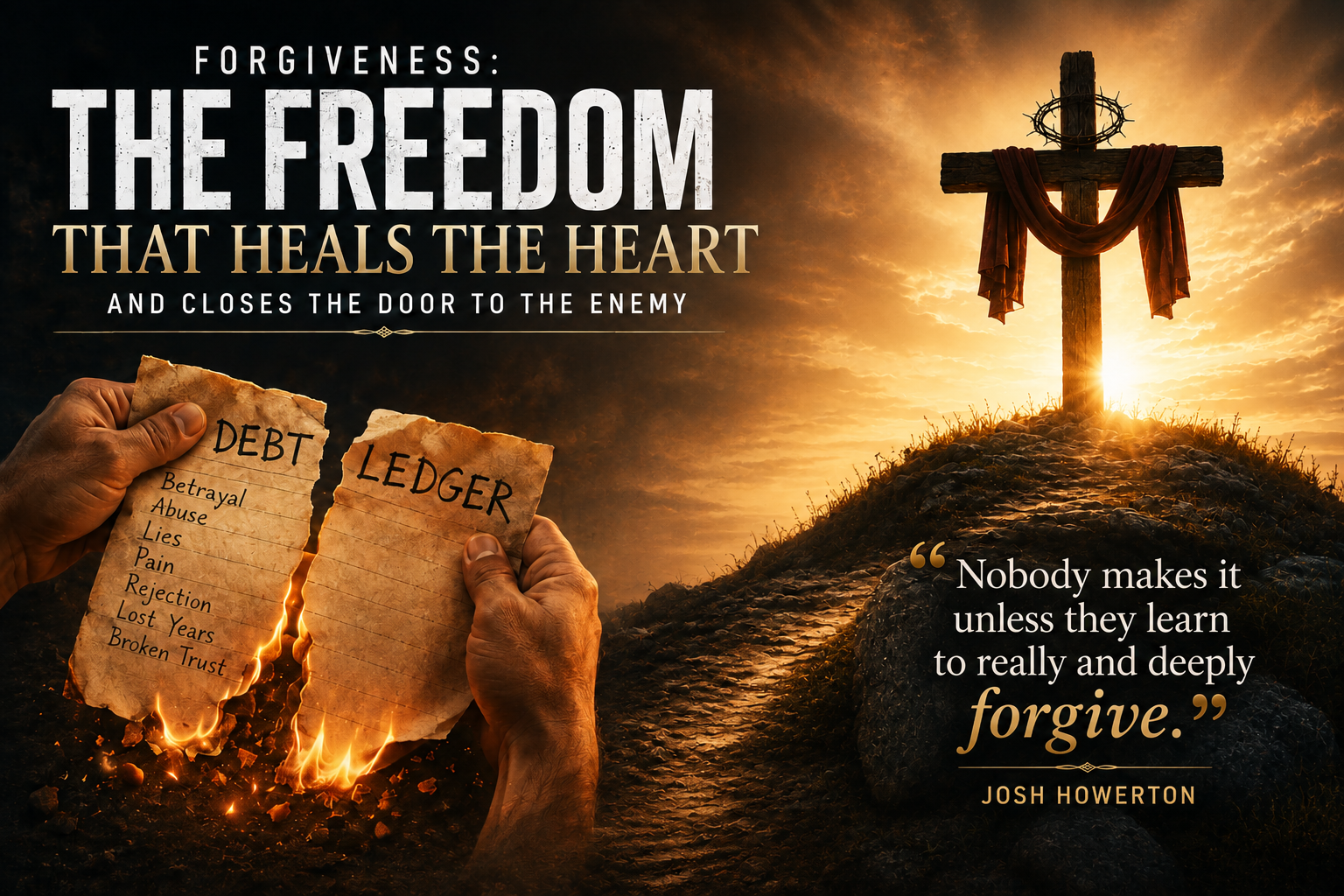
“Nobody makes it unless they learn to really and deeply forgive. Dude, they just don’t make it, man. I’ve seen a lot of things as a pastor. One thing I can make you promise: nobody makes it that doesn’t learn to forgive.”
That statement is not based merely on experience. It echoes the teaching of Scripture.
Jesus repeatedly commanded His followers to forgive others. He taught His disciples to pray:
“Forgive us our debts, as we also have forgiven our debtors.” (Matthew 6:12, NIV 1984)
Immediately after teaching the Lord’s Prayer, Jesus emphasized forgiveness again:
“For if you forgive men when they sin against you, your heavenly Father will also forgive you. But if you do not forgive men their sins, your Father will not forgive your sins.” (Matthew 6:14-15)
Forgiveness is not a suggestion for spiritually mature believers. It is part of following Christ.
The Root That Eventually Produces Fruit
Hebrews warns believers:
“See to it that… no bitter root grows up to cause trouble and defile many.” (Hebrews 12:15)
Howerton points out that Scripture calls bitterness a root because roots never remain hidden. Eventually they produce fruit.
Bitterness begins beneath the surface.
It quietly feeds resentment.
It nurtures anger.
It fuels cynicism.
Over time it changes how a person sees everyone around them.
People often wonder why two individuals who loved Jesus in their twenties can look so different decades later. One grows increasingly joyful, compassionate, and peaceful. The other becomes suspicious, angry, and emotionally hard.
Howerton explains the difference this way:
“I’ve watched people: some get older and more cynical and angry and crusty. Others get older and more joyful and soft in the right ways. The difference is one cleaned out the junk in their heart throughout their life with forgiveness, and the other didn’t.”
The heart never stays neutral.
It is either continually cleansed by forgiveness or gradually hardened by bitterness.
Heaven or Hell Begins in the Heart
Perhaps one of the most profound observations from the discussion was this:
“If heaven is the place where everybody’s forgiven and hell is the place where nobody’s forgiven, when we forgive, we pull heaven down into our lives. And when we choose not to forgive, we pull hell up into our lives.”
That statement captures something Scripture repeatedly reveals.
The Kingdom of God is not merely a future destination. Jesus taught that God’s Kingdom begins transforming our hearts today.
Forgiveness allows God’s peace, mercy, and grace to govern our lives.
Unforgiveness allows resentment, hatred, revenge, and darkness to take root.
One leads toward life.
The other slowly resembles hell itself.
Unforgiveness Opens the Door to Spiritual Attack
Modern culture often treats unforgiveness as merely an emotional issue.
The Bible treats it as a spiritual issue.
Howerton connects several biblical passages that reveal an unsettling reality.
Jesus referred to Satan as Beelzebub, a name meaning “Lord of the Flies.”
The imagery is striking.
Flies are attracted to open wounds.
If a wound remains untreated, flies lay eggs, infection spreads, and something painful becomes deadly.
Howerton explains the implication:
“Every wound you’ve got, if you don’t, by the power of Jesus Christ, His blood and forgiveness, close that wound, that is a wide-open pathway for Satan’s work in your life.”
The Apostle Paul gives a similar warning:
“In your anger do not sin… Do not let the sun go down while you are still angry, and do not give the devil a foothold.” (Ephesians 4:26-27)
James describes bitter jealousy and selfish ambition this way:
“Such ‘wisdom’ does not come down from heaven but is earthly, unspiritual, of the devil.” (James 3:15)
Scripture consistently connects unresolved bitterness with spiritual vulnerability.
That does not mean every struggle is demonic.
It does mean that refusing to forgive creates fertile ground for the enemy to exploit.
Howerton describes the process as almost invisible.
Like fossilization, it happens slowly.
Year after year, unresolved pain gradually changes a person’s character until bitterness begins defining who they have become.
Justice and Forgiveness Are Friends
One of Shawn Ryan’s most honest questions addressed something many believers wrestle with:
How can someone forgive while still wanting justice?
The answer surprised many listeners.
Howerton replied:
“Justice and forgiveness are not at odds. I don’t have to reconcile them because I don’t reconcile friends. They’re already friends.”
Many people mistakenly believe forgiveness means pretending evil never happened.
It does not.
Forgiveness is not denial.
Forgiveness is not excusing abuse.
Forgiveness is not abandoning justice.
If someone commits assault, abuse, fraud, or another crime, Scripture never commands victims to ignore the law.
God established different spheres of authority.
Romans 13 teaches that government bears “the sword” to punish wrongdoing.
Families have responsibilities.
Churches have responsibilities.
Civil government has responsibilities.
An individual Christian has a different responsibility.
We forgive.
The government administers justice.
Those responsibilities complement one another rather than compete.
Howerton explains:
“If somebody abused you or committed a crime against you, forgiving them does not mean you don’t call the authorities… As an individual, my job is to love you, to forgive you, to release you from the debt.”
Justice belongs to the proper authorities.
Personal vengeance belongs to no believer.
As Paul writes:
“Do not take revenge, my friends, but leave room for God’s wrath… ‘It is mine to avenge; I will repay,’ says the Lord.” (Romans 12:19)
Forgiveness releases our claim to revenge while trusting God to administer perfect justice, whether through earthly authorities or His final judgment.
Forgiveness Is Not Reconciliation
One of the greatest misunderstandings within Christianity is treating forgiveness and reconciliation as identical.
They are not.
Howerton explains it clearly:
“Forgiveness takes one person and it’s always possible. Reconciliation takes two people and it’s not always possible.”
Forgiveness is something you choose before God.
Reconciliation requires repentance, honesty, humility, trust, and willingness from both parties.
You can forgive someone who never apologizes.
You can forgive someone who has died.
You can forgive someone who continues rejecting responsibility.
But reconciliation cannot occur without mutual participation.
Recognizing that distinction frees many believers from unnecessary guilt.
God commands forgiveness.
He does not require impossible reconciliation when another person refuses to acknowledge wrongdoing.
Jesus Gives a Practical Roadmap for Forgiveness
Forgiveness is one of the most difficult commands Jesus ever gave, yet He did not leave His followers without instruction. In Matthew 18, Jesus provides a practical roadmap for handling conflict and sin within the family of God.
Josh Howerton encourages believers who are wrestling with forgiveness to carefully study this chapter because Jesus doesn’t merely tell us to forgive, He shows us how to navigate offenses biblically.
The first question is surprisingly simple.
Did someone actually sin against me, or was I merely offended?
Our culture often treats being offended as though it automatically means someone has sinned. Scripture does not. Sometimes someone has genuinely violated God’s commands. Other times personalities clash, expectations differ, or misunderstandings occur. Wisdom begins by honestly determining whether a biblical sin has actually taken place.
If a genuine sin has occurred, Jesus then asks another important question:
Is this person a brother or sister in Christ?
That matters because Jesus is specifically addressing relationships within His church.
If the answer is yes, Jesus instructs believers to begin privately.
“If your brother sins against you, go and show him his fault, just between the two of you.” (Matthew 18:15, NIV 1984)
Notice what Jesus does not say.
He does not tell us to vent on social media.
He does not tell us to gather allies first.
He does not tell us to quietly resent the other person for years.
He says to go directly to them.
The goal is restoration, not winning an argument.
If that conversation fails, Jesus continues:
“But if he will not listen, take one or two others along.” (Matthew 18:16)
The purpose is not intimidation. It is clarity, accountability, and reconciliation. Mature believers can often help both parties hear one another more clearly while keeping everyone submitted to God’s Word.
Howerton summarizes this process simply:
“Go and show him his fault privately. If that doesn’t work, take two or three others with you. Let’s talk about this with an open Bible and open hearts.”
Jesus always aims toward restoration.
Forgiveness and Reconciliation Are Different
One of the most freeing truths for many hurting people is understanding that forgiveness and reconciliation are not the same thing.
They are related.
They are not identical.
Howerton explains:
“Forgiveness takes one person and it’s always possible. Reconciliation takes two people and it’s not always possible.”
This distinction matters because many people believe they have failed spiritually if a broken relationship is never restored.
That simply is not true.
Forgiveness is your decision before God.
Reconciliation requires repentance, humility, confession, and rebuilding trust from both people.
You may completely forgive someone who never apologizes.
You may forgive someone who has died.
You may forgive someone who continues denying they ever did anything wrong.
None of those situations makes reconciliation possible.
Scripture commands forgiveness.
It does not require pretending trust has automatically been restored.
Trust is earned.
Forgiveness is given.
The two should never be confused.
Forgiveness Is Often a Repeated Decision
Many Christians become discouraged because painful memories return after they believe they have forgiven someone.
They wonder whether they failed.
According to Howerton, that is simply part of being human.
Jesus told Peter:
“I tell you, not seven times, but seventy-seven times.” (Matthew 18:22, NIV 1984)
Jesus was not establishing the number 490 as the maximum limit.
He was teaching that forgiveness has no ceiling.
Howerton explains that often believers are forgiving the same offense from the same person over and over again because painful emotions resurface.
That does not mean forgiveness never happened.
It means healing is often a process.
Every time the memory returns, the believer again chooses to surrender the offense to Christ rather than reopen the wound.
Forgiveness is not measured by whether painful memories disappear.
It is measured by repeatedly choosing obedience over resentment.
Taking Inventory Before Canceling the Debt
One of the most practical ideas Howerton shared is something he and his wife, Jana, used during a particularly painful season of life.
He calls it creating a debt ledger.
The idea comes from recognizing that you cannot release something you have never honestly acknowledged.
Too often people say, “I’ve forgiven them,” while still carrying years of buried hurt because they never faced what was actually lost.
Howerton recommends beginning with one question:
Who specifically sinned against me?
Write their name down.
Then carefully inventory everything that was taken.
Not just the obvious things.
Everything.
Perhaps they stole years of peace.
Perhaps they damaged your reputation.
Maybe they shattered trust.
Maybe they robbed you of childhood innocence.
Maybe they destroyed financial security.
Maybe they fractured family relationships.
Maybe they stole joy.
Maybe they created anxiety that lasted for decades.
Write it down.
Be honest.
Be specific.
As Howerton explains:
“You can’t cancel a debt you never inventoried.”
This exercise is not about dwelling on the offense.
It is about finally bringing hidden pain into the light so it can be surrendered to Christ.
Then Make the Greatest Financial Decision of Your Life
Once the debt ledger is complete, there are only two options.
You can continue collecting on the debt.
Or you can cancel it.
If you keep the ledger, you become its prisoner.
Every new reminder adds another line to the account.
Every memory demands another payment.
Every encounter revives another wound.
The debt grows larger, while your joy grows smaller.
Scripture presents another option.
Paul writes:
“…having canceled the written code, with its regulations, that was against us and that stood opposed to us; he took it away, nailing it to the cross.” (Colossians 2:14, NIV 1984)
That is exactly what God did with our debt.
He canceled it.
He did not ignore it.
He paid it.
Howerton encourages believers to make their surrender tangible.
Some have burned their debt ledger in a fire pit.
Others have nailed it to a wooden cross.
The physical act is not what forgives.
Faith in Christ forgives.
The physical act simply becomes a visible declaration that the debt no longer belongs to you.
You are placing it into the hands of the only Judge qualified to deal with it.
As you release the debt, you are saying something like this:
“Jesus, I trust that You have already paid for this sin at the cross, or that perfect justice will one day be carried out by You. Vengeance belongs to You, not me. Today I release this debt into Your hands.”
Howerton later clarified that this is not a list you keep forever.
The goal is not maintaining a record of wrongs.
The goal is to identify the debt so that it can be permanently canceled and destroyed, just as Christ canceled our debt before God.
The ledger is not meant to become another source of bitterness.
It is meant to become a testimony of freedom.
Why Jesus Had to Die
One of the most profound questions Shawn Ryan asked during the conversation was one that many believers and skeptics alike have wrestled with:
If God is all-powerful, why couldn’t He simply forgive our sins? Why did Jesus have to die on the cross?
Rather than launching into theological terms or complex doctrines, Josh Howerton answered with an unforgettable story that illustrates the heart of the gospel.
The Story of the Just and Loving King
Imagine a kingdom ruled by a king who was known throughout the land as both the most loving and the most just king anyone had ever known.
His people loved him because he was compassionate.
They respected him because he was righteous.
Everyone knew that justice mattered in his kingdom.
One day it was discovered that someone had been stealing from the king’s treasury.
Because justice demanded consequences, the king issued a decree.
When the thief was found, the punishment would be ten lashes.
But the thefts continued.
So the king increased the sentence to twenty lashes.
Still the stealing continued.
The punishment became thirty lashes.
Finally, after the crimes continued without stopping, the king issued one final decree.
The punishment would now be forty lashes.
Everyone understood what that meant.
Forty lashes was effectively a death sentence.
Justice had spoken.
Time passed until one day the thief was finally identified.
To everyone’s shock, the guilty person was not a stranger.
It was the king’s own daughter.
Immediately a question spread throughout the kingdom.
What will the king do?
Some believed he would simply forgive her.
But if he ignored his own law, how could he still be called just?
Others believed he would carry out the sentence.
But if he executed his own daughter, where was his love?
The entire kingdom waited.
The king considered the matter carefully.
Then he made his decision.
The law would stand.
Justice demanded it.
The sentence would not be changed.
The day of judgment arrived.
Citizens from throughout the kingdom gathered to witness what would happen.
The king’s daughter was brought forward.
She was tied to the whipping post.
The executioner stood behind her and slowly raised the whip.
Just before the first lash fell, the king cried out,
“Stop!”
Silence covered the crowd.
The king walked forward.
Without saying another word, he removed his royal robe and shirt.
He wrapped his own body around his daughter, shielding her completely.
Then he looked over his shoulder at the executioner and gave one final command.
“Now hit her.”
The executioner hesitated.
“Your Majesty… if I strike her… the lashes will fall on you.”
The king answered,
“The sentence is just. It must stand. Hit her.”
The executioner obeyed.
One after another, forty lashes landed across the back of the king instead of his daughter.
Every blow intended for her fell upon him.
When it was over, the daughter walked away alive.
The king died in her place.
Justice and Love Meet at the Cross
Howerton then explained why this story matters.
At that moment the king was both just and the justifier.
Justice was satisfied because the penalty for the crime was fully paid.
Love was demonstrated because the guilty person was spared.
That is exactly what happened at Calvary.
God could not simply pretend sin never happened.
If He ignored justice, He would cease to be perfectly holy.
Sin carries a real penalty.
Scripture declares:
“For the wages of sin is death…” (Romans 6:23, NIV 1984)
Every lie.
Every act of hatred.
Every theft.
Every murder.
Every act of adultery.
Every moment of pride.
Every sin carries a debt before a holy God.
Justice requires payment.
But God is not only perfectly just.
He is also perfect love.
Rather than demanding that we pay the penalty ourselves, He took the punishment upon Himself.
Jesus Christ willingly went to the cross.
Isaiah prophesied it hundreds of years beforehand:
“But he was pierced for our transgressions, he was crushed for our iniquities; the punishment that brought us peace was upon him, and by his wounds we are healed.” (Isaiah 53:5)
The Apostle Paul explains this incredible mystery in Romans:
“God presented him as a sacrifice of atonement… He did it to demonstrate his justice… so as to be just and the one who justifies those who have faith in Jesus.” (Romans 3:25-26)
At the cross, God’s justice was fully satisfied.
At the cross, God’s love was fully displayed.
Neither attribute was compromised.
Jesus received the punishment we deserved so that we could receive the forgiveness we could never earn.
Forgiveness Cost God Everything
Understanding the cross changes how we view forgiveness.
Forgiveness is never free.
Someone always pays.
When someone sins against you, a debt is created.
If you insist on collecting that debt yourself, bitterness will become your lifelong companion.
If you forgive, you choose to absorb the loss rather than demanding repayment.
That is precisely what God did for us.
The cross reminds us that forgiveness is costly.
Jesus did not dismiss sin.
He paid for it.
As Paul wrote:
“Be kind and compassionate to one another, forgiving each other, just as in Christ God forgave you.” (Ephesians 4:32)
Our willingness to forgive others is rooted in the immeasurable forgiveness we ourselves have received.
Freedom Begins When the Debt Is Released
Perhaps there is someone whose name immediately comes to mind as you read this.
Maybe they betrayed your trust.
Maybe they abused you.
Maybe they abandoned you.
Maybe they lied about you.
Maybe they shattered your family.
Perhaps years have passed, yet the wound still feels fresh.
Forgiveness does not mean what they did was acceptable.
It does not mean justice should be ignored.
It does not mean trust is instantly restored.
It means you refuse to carry a debt that Jesus never intended you to carry.
You place that debt into His hands.
You allow the righteous Judge of all the earth to do what only He can do.
The person who benefits most from forgiveness is often not the offender.
It is the one who finally lays down the burden they were never created to carry.
As Josh Howerton observed, people become one of two kinds of people as they age.
Some become increasingly bitter.
Others become increasingly joyful.
The difference is not that one experienced less pain.
The difference is that one continually brought every wound to the cross and allowed Christ to heal it through forgiveness.
Forgiveness is not forgetting.
It is not pretending.
It is not weakness.
It is the supernatural freedom purchased by Jesus Christ.
When we forgive, we are not declaring that evil does not matter.
We are declaring that Christ’s cross is greater than the evil done against us.
And in doing so, we close the door to bitterness, remove the enemy’s foothold, and walk in the freedom that only Jesus can give.
Jesus didn’t just call us to believe in Him—He called us to follow Him.
Step into the life He designed for you through Emmaus Road’s The Commands of Jesus. This is more than learning—it’s an invitation to walk with Him, obey Him, and experience Him in a real and powerful way.
You don’t want to miss this exciting adventure Jesus has called you into.
Start now:
https://GregLancaster.org/StartHere