



Five Things We Will Learn
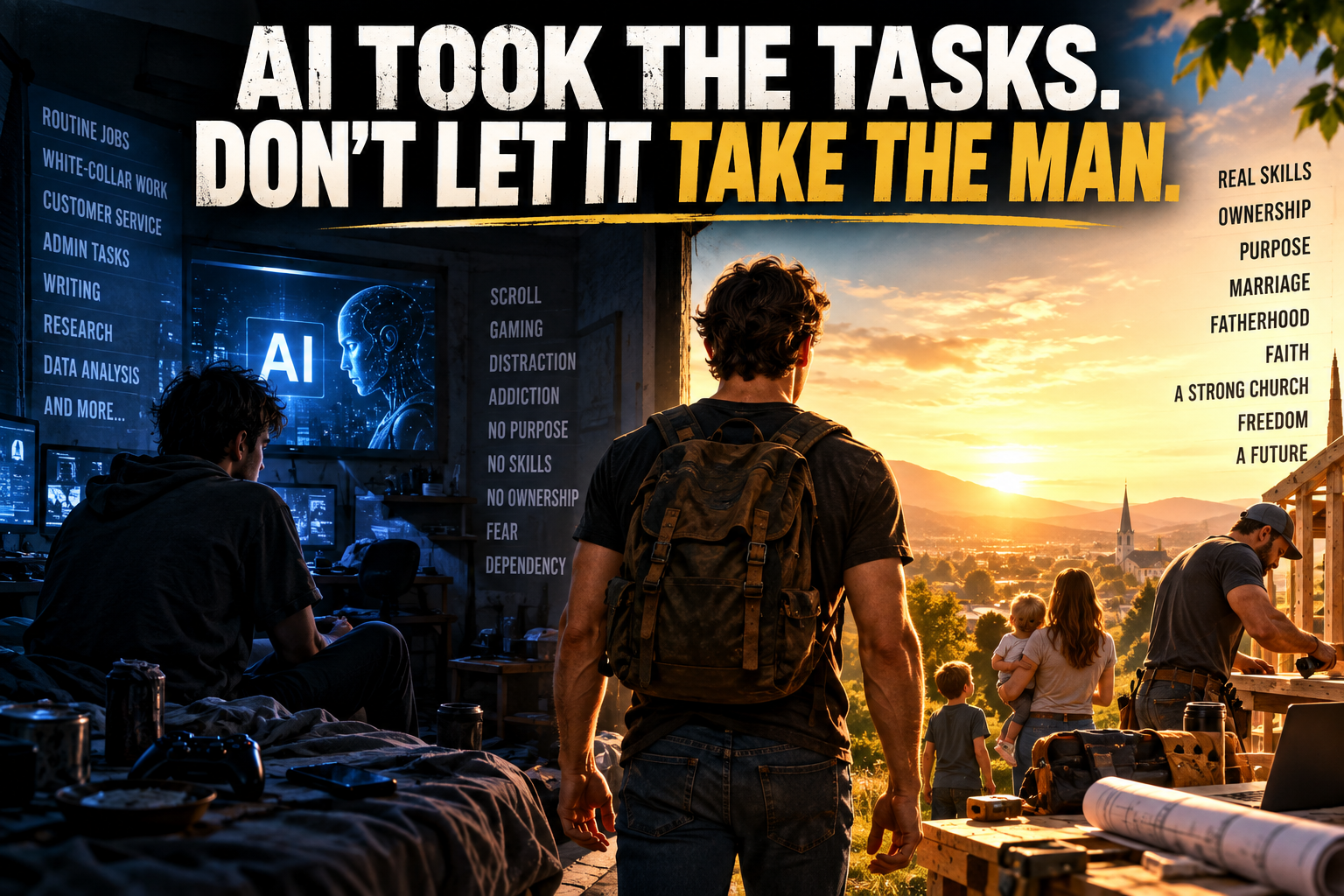
- Why conflating AI job disruption with male addiction and socialist escapism produces the worst possible answer.
- What Scripture says about work, idleness, and dominion when tools change.
- How young men can kill the dopamine traps that make them less prepared for a changing economy.
- Which skills, trades, and ownership paths remain valuable—and what “own equity” actually means.
- How marriage, fatherhood, and the local church give a man a reason to thrive when the job market shifts.
The Conflation That Will Ruin a Generation
Two crises are colliding, and if we mash them into one slogan, we will spiritually castrate a generation of young men.
Crisis one is technological: AI and manhood are now colliding with a rapidly changing workplace. Artificial intelligence is poised to swallow a significant share of mediocre, routine, replaceable work. Tasks that once paid a rent check are increasingly vulnerable to automation. This is a tool shift on the scale of the assembly line and the spreadsheet.
Crisis two is older: millions of young men are already checked out. Porn. Gaming. Weed. Endless scroll. “Late-stage capitalism” as a personality. Socialism as a substitute for a spine. They are not primarily victims of ChatGPT. They are victims of a culture that told them pleasure is the point and work is oppression.
If you conflate those two crises, you get the softest, deadliest lie of our age: “The machines took my future, so give me UBI and let me rot.”
That does not produce men. It produces dependents. And Scripture has never been confused about the importance of work, stewardship, responsibility, and self-government.
Character First, Then Skill, Then Ownership
When tools change, men of God do not panic into the arms of the state. They do what they have always done: put character before credentials, skill before slogans, and ownership before entitlement.
Genesis 1–2 is not a TED Talk. God puts Adam in the garden to work it and keep it. Work is not a curse that arrived after the Fall; frustration in work is. The mandate to exercise dominion—to take raw creation and make it fruitful—is still on the books.
AI does not repeal Genesis. It raises the bar on what kind of man can still exercise dominion.
Paul is blunt: “If anyone is not willing to work, let him not eat” (2 Thessalonians 3:10). Proverbs calls the sluggard to the ant. Idleness is not a mental health aesthetic. It is sin with a Wi-Fi signal.
So the order is not, “Wait for policy, then maybe try.” The order is: become a man under God, then become useful, then own something.
Victimhood is not a career path. A government check is not a calling.
Kill the Addictions Before You Compete With the Machines
You cannot outwork AI if your dopamine is owned by a phone.
Porn trains a man to consume without covenant. Gaming and scroll culture train him to chase novelty without responsibility. Soft drugs and soft excuses train him to numb the very ambition he needs to build a future. Then he looks at a disrupted job market and concludes the system failed him—when he has neglected the basic stewardship of his own mind.
Repentance is not a vibe. It is a decision.
Flee sexual immorality (1 Corinthians 6). Put away childish things (1 Corinthians 13:11). Present your body as a living sacrifice (Romans 12:1).
A young man who will not govern his appetites will struggle to govern a career, a household, or a future. That is part of why the conversation about AI and manhood must begin deeper than economics.
Work is not optional therapy. Work is obedience. A man who treats labor like an optional lifestyle accessory leaves himself especially vulnerable when technology begins replacing routine tasks.
Become Hard to Replace—Use the Machine
AI eats routine. It does not eliminate the need for judgment, courage, salesmanship, skilled trades, leadership under pressure, excellent physical work, or people who can deliver when it counts.
So learn a trade. Learn to build, fix, farm, sell, and code with the tools instead of shaking your fist at them. Start something small. Become an operator of the machine rather than merely fearing what the machine might do.
And own equity where you can.
That does not mean using Wall Street jargon for its own sake. It means owning a slice of the thing that makes money—not only trading your hours for a paycheck.
A wage says: show up, get paid, leave.
Equity says: you own part of something that can produce value. That might be a business, a trade company, stock in a firm, a side business you built, a partnership, or another productive asset.
If a job disappears, the man who depends exclusively upon wages can find himself exposed. Ownership can provide another connection to the value being created.
Practically, that can mean starting a small business, earning sweat equity in a venture, buying into the truck and customer list behind a trade business, holding shares over time, or building a product and brand you own.
Scripture repeatedly deals with stewardship, property, inheritance, work, and responsibility. The command “You shall not steal” itself assumes that people can possess things for which they bear responsibility.
The principle is simple: do not spend your entire working life renting out your labor if you have a wise opportunity to build ownership too.
That is dominion language. God did not tell Israel to pretend the plow never happened. He told His people to be fruitful. The Christian response to powerful tools is mastery joined to morality—not nostalgia for a world before the tools existed.
Economic Policy Cannot Replace Character
Technological disruption inevitably raises political questions about socialism, redistribution, regulation, energy, immigration, markets, and the proper role of government.
The argument presented here rejects socialism as the answer to AI-driven disruption and instead favors private ownership, entrepreneurship, greater freedom to create, energy abundance, fewer regulatory obstacles for producers, and secure borders. Supporters and critics of these approaches disagree over their economic effects and the appropriate role of government.
But no political system can do the work of character for a man.
Government cannot repent for him. It cannot govern his appetites for him. It cannot make him disciplined, faithful, courageous, skilled, or responsible.
That is why the first response to economic disruption cannot simply be political.
A man still has to become useful. He still has to steward what is in his hands. He still has to work. He still has to build.
Build a Household—Purpose Beats Panic
A loner with no purpose will always be tempted by fantasies and the refrain that “the system failed me.” A husband and father has people depending on him to show up.
Marriage, children, church, and community are not distractions from economic survival. They are the why that can make a man endure a shifting job market.
When your identity is “content consumer,” every layoff can feel like annihilation. When your life is rooted in covenant—one man, one woman, for life, raising children in the fear of the Lord—you have powerful reasons to adapt, retrain, work, and keep your vows.
This is why the call remains: repent, become the kind of man who can lead a home, marry a woman of faith, have children, and build.
Civilization does not run on atomized males optimizing their dopamine until the robots arrive. It runs on households.
The local church has a role here too. Pastors can preach work, purity, marriage, fatherhood, stewardship, responsibility, and liberty. Families and congregations can become places where men are discipled rather than merely entertained.
The answer to isolation is not simply employment. A man needs people for whom his work matters.
The Takeover of Tasks Is Coming. The Takeover of Your Will Is Optional.
How do young men survive and thrive?
Stop waiting for the culture to make it easy. Kill the addictions. Master useful skills. Use AI as leverage, not as an alibi.
Own equity where you can—build or buy a real stake rather than renting your hours forever.
Build a household worth defending. Stay planted in Scripture and a serious church.
The machines may take tasks. They do not have to take your agency, your faith, your character, or your future.
Character first. Skill next. Ownership after that.
Tools will change. The calling to faithful stewardship will not.
Begin Your Journey Today
Jesus didn’t just call us to believe in Him—He called us to follow Him.
Step into the life He designed for you through Emmaus Road’s The Commands of Jesus . This is more than learning—it’s an invitation to walk with Him, obey Him, and experience Him in a real and powerful way.
You don’t want to miss this exciting adventure Jesus has called you into.
Start now:
https://GregLancaster.org/StartHere