



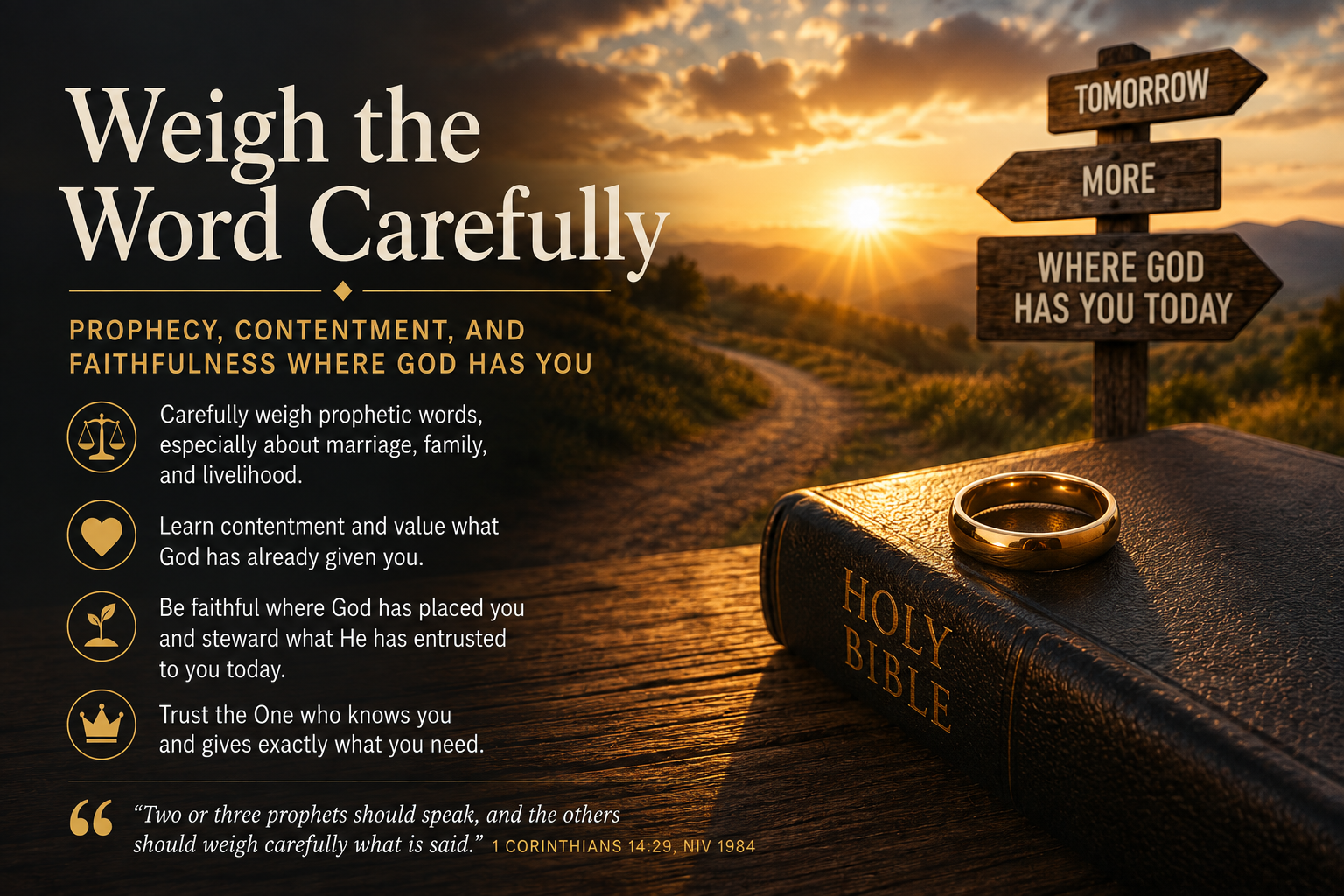
Five Things We Will Learn
- Why prophetic words concerning marriage, family, relationships, and employment require extraordinary care. The consequences of a mistaken word in these areas can affect spouses, children, livelihoods, and even generations.
- Why every prophetic word must be weighed carefully. Scripture does not teach us to automatically accept a word simply because someone sincerely believes it came from God.
- How dissatisfaction can disguise itself as divine direction. There is a tremendous difference between God leading us somewhere else and dissatisfaction making us want to be somewhere else.
- Why contentment and faithfulness are essential parts of following Christ. Sometimes God’s work is not moving us to something new, but changing us and teaching us to faithfully steward what He has already given us.
- Why more is not always better. God knows exactly what we need, what we can carry, and what we can faithfully steward without allowing His blessings to pull our hearts away from Him.
Wisdom Nugget: The Cost of Getting a Prophetic Word Wrong
There are two areas where I believe we need to exercise particular care when giving prophetic words:
- Concerning someone’s relationship, marriage, or family.
- Concerning someone’s work, employment, or livelihood.
We need to be extremely careful when giving words in these areas because the cost of being wrong is simply too high. If those words are not truly from God, they could negatively affect not only that person’s life, but the lives of their spouse, children, and family as well.
If God has given someone a job or employment to provide for themselves and their family, that very provision could be put at risk if someone gives them a word that wasn’t from God.
The same is true concerning marriage and family. A word spoken into someone’s marriage can have consequences that reach far beyond that individual. It can affect a spouse, children, families, and even generations.
That is why, when giving prophetic words concerning someone’s marriage, family, or employment, we need to be extremely careful that we have truly heard from God. If we are going to tell someone that God is directing them concerning their marriage, family, or livelihood, we need to be certain it is God speaking and not our own experiences, desires, assumptions, or interpretations.
Scripture specifically tells us that prophetic words are to be weighed carefully.
1 Corinthians 14:29, NIV 1984
“Two or three prophets should speak, and the others should weigh carefully what is said.”
Even when someone sincerely believes God has spoken, Scripture says the word should be weighed carefully. The greater the potential consequences of a word, the more important it is that we do exactly that.
When a Word Can Create Dissatisfaction
There are times when someone has received employment that appears to be a clear answer to prayer. It provides for the family, utilizes the person’s abilities, and has been accompanied by significant confirmation of God’s provision.
We should be extremely cautious about subsequently giving that person a prophetic word suggesting that God intends to move them somewhere else. A sincere but mistaken word can plant dissatisfaction with something God may actually be asking that person to faithfully steward.
There was already a strong sense concerning one such situation that “Satan can be trying to pry you out of where God has you,” like using a crowbar.
This reminds me of Brother Kilpatrick and Brownsville. The adversary attempted to pry him out of Brownsville. Had he left, he would have missed the Brownsville Revival and so much of what God was preparing to do there.
Sometimes we don’t yet know why God has placed us where He has placed us. We don’t know what He has planned for tomorrow. Our responsibility is to remain faithful to what He has clearly entrusted to us today.
There is an important principle here:
Never allow a word about what God might give you tomorrow to cause you to despise, devalue, or become unfaithful with what God has clearly entrusted to you today.
The Ring: When God’s Gifts Stop Looking Like Enough
My song, “The Ring,” speaks directly to this.
In the song, a man gives to someone he loves, but instead of what he gives being received with gratitude and appreciation, she keeps wanting more. Her dissatisfaction causes what he gave her to lose its value in her eyes, and it begins to hurt their relationship.
Later, when he looks in the mirror, he realizes that he has been doing the very same thing to God.
God has loved him, provided for him, blessed him, and given him good things, yet instead of valuing what God has already placed in his life, he is continually looking for what is next and wanting more.
For the first time, he understands what it feels like from the other side.
How must God feel when He gives us something good, yet our eyes are already looking beyond His gift for something else?
That is really the heart of “The Ring.”
We can become so focused on what we don’t have, what might be next, or what someone else has that we fail to treasure what God has already given us. And when we do that, it can affect our relationship with Him.
Sometimes faithfulness isn’t about finding the next thing God has for us. Sometimes faithfulness is recognizing, valuing, and being content with what God has already given us and where He has already placed us.
Listen to “The Ring”:
https://youtu.be/lpgs7KZtrOg
We’ve Already Arrived
We can miss what God is doing when we are always looking beyond where He has us “for more.”
We need to continually remind ourselves: we are not trying to get somewhere, do something, or be something. We’ve already arrived.
We have been reconciled to God through Jesus Christ. Now we are sharing something with others: the Gospel, and giving them the opportunity to have the same relationship with God and His people, the Church.
I believe we need to continually reaffirm this because of the philosophies of this world that depend on human reasoning rather than Christ.
The tendency among American Christians, for sure, is to not be content. Nothing seems to be enough. There is always supposedly something more. We can begin to believe we have less than others and develop a concern that we are missing out, what the world calls FOMO.
These are lies from the second heaven designed to make us feel unloved, uncared for, and as though God is withholding something good from us.
It is the same lie the enemy used with Eve:
God is keeping something from you.
God had already surrounded Adam and Eve with His goodness and provision, yet the enemy directed Eve’s attention toward what she did not have. Believing that lie ultimately led to the fall of man.
That same lie can still tempt us today. Instead of recognizing everything God has given us, our attention becomes fixed on the thing we don’t have, the position we haven’t received, the money we haven’t made, or the opportunity we think we are missing.
We Have to Learn Contentment
We all have to learn to be content with how God is choosing to move in our lives.
Paul said, “I have learned to be content.”
Contentment is a learned characteristic. It requires us to put forth effort, focus, and abide in God’s Word concerning this part of our lives.
Philippians 4:11-13
“I am not saying this because I am in need, for I have learned to be content whatever the circumstances. I know what it is to be in need, and I know what it is to have plenty. I have learned the secret of being content in any and every situation, whether well fed or hungry, whether living in plenty or in want. I can do everything through him who gives me strength.”
Notice that Paul didn’t say he finally received circumstances that made him content. He said he had learned to be content whatever the circumstances.
Sometimes God changes our circumstances.
Sometimes God changes us while we are in those circumstances.
If we believe every feeling of dissatisfaction means God must be preparing something bigger or calling us somewhere else, we may never learn what Paul learned.
There is a tremendous difference between God leading us somewhere else and our dissatisfaction making us want to be somewhere else.
We need to know the difference.
Be Faithful Where God Has You
When God blesses us with the opportunity to work for someone, with someone, or to have our own business, we are to work there as unto the Lord, showing ourselves faithful.
We learn a lot about ourselves when we place ourselves under authority.
Before we look for a prophetic word about where God may take us next, we need to obey His written Word concerning how we are to live faithfully where He has us now.
Psalm 37:23
“If the LORD delights in a man’s way, he makes his steps firm.”
There are specific instructions from God’s Word about the attitude we’re to have in relationship to our employers, bosses, supervisors, and those God has placed in authority over us.
Ephesians 6:5-8
“Slaves [employees], obey your earthly masters [employers/bosses/supervisors] with respect and fear, and with sincerity of heart, just as you would obey Christ. Obey them not only to win their favor when their eye is on you, but as slaves [employees] of Christ, doing the will of God from your heart. Serve wholeheartedly, as if you were serving the Lord, not people, because you know that the Lord will reward each one for whatever good they do, whether they are slave or free.”
Colossians 3:22-25
“Slaves [employees], obey your earthly masters [bosses/supervisors] in everything; and do it, not only when their eye is on you and to curry their favor, but with sincerity of heart and reverence for the Lord. Whatever you do, work at it with all your heart, as working for the Lord, not for human masters [employers], since you know that you will receive an inheritance from the Lord as a reward. It is the Lord Christ you are serving. Anyone who does wrong will be repaid for their wrongs, and there is no favoritism.”
The emphasis of these Scriptures isn’t continually looking for an exit, a promotion, greater recognition, or something “more.”
God tells us how to serve Him right where we are.
That doesn’t mean God will never move us or change our employment. Of course He can. But until He does, our responsibility is to be faithful with what He has entrusted to us.
Marriage, Family, and the Cost of a Wrong Word
As we are learning concerning marriage, family, and God’s desire for godly children, words that are not from God can have devastating consequences. Marriage: For God’s Sake & the Children’s Sake shows the evidence of all the damage that has been done to marriage, family, and children because of words given to God’s people that were not from God.
People have received words concerning their marriages and families that were not from God, and lives have been shattered into many pieces, leaving spouses, children, and families broken and hurting.
That is another reason I take prophetic words concerning marriage, relationships, family, and employment so seriously.
The consequences don’t necessarily stop with the person receiving the word.
The cost can be generational.
I love for God’s people to allow the Holy Spirit to use them through His gifts. Yet we have to be careful that we don’t put ourselves or our experiences into His gift or His word.
In other words, we cannot assume that because something happened to us, it therefore applies to someone else.
Our experience isn’t automatically someone else’s prophetic word.
If we realize we have done that, we need to speak to the person and let them know so they are not misled by our word.
Again, this is why Scripture tells us:
1 Corinthians 14:29, NIV 1984
“Two or three prophets should speak, and the others should weigh carefully what is said.”
Even sincere prophetic words are to be weighed.
Related:
- The Commands of Jesus (Part 24) Antioch: The Spirit-Filled, Spirit-Led Church
- The Commands of Jesus (Part 25) Antioch – One Body, Many Parts, Different Gifts
- The Commands of Jesus (Part 26) Antioch – One Body, Many Parts, Different Gifts, Apostles (pt 2)
- The Commands of Jesus (Part 27) Antioch – One Body, Many Parts, Different Gifts (pt 3) Eight Gifts Placed by God
- The Commands of Jesus (Part 28) Antioch – One Body, Many Parts, Different Gifts (Pt 4) 7 Grace Gifts to the Body
- The Commands of Jesus (Part 31) Antioch: The Order of Worship
God and Money
The world and its ways, including many in America, are always running after more money, when God may have already given us enough to provide for our needs, but not so much that we leave Him.
Jesus clearly tells us that we cannot serve both God and money.
Matthew 6:24
“No one can serve two masters. Either he will hate the one and love the other, or he will be devoted to the one and despise the other. You cannot serve both God and Money.”
A higher-paying job isn’t automatically God’s will.
A promotion isn’t automatically God’s favor.
Remaining somewhere isn’t automatically stagnation.
Having less than someone else doesn’t mean God loves us less.
And having more than someone else doesn’t necessarily mean God loves us more.
The real question is:
Where has God placed me, what has God entrusted to me, and am I being faithful to Him there?
God Knows Just How Much!
This is something we need to understand about the Father’s love for us:
God knows us.
He knows exactly what we need, and He knows what we can faithfully carry.
Proverbs 30:7-9
“Two things I ask of you, O LORD;
do not refuse me before I die:
Keep falsehood and lies far from me;
give me neither poverty nor riches,
but give me only my daily bread.
Otherwise, I may have too much and disown you
and say, ‘Who is the LORD?’
Or I may become poor and steal,
and so dishonor the name of my God.”
What an incredible prayer.
He understood that more isn’t automatically better.
He recognized that too little could tempt him, but he also understood that too much could tempt him.
Essentially, he was saying:
“God, You know me. Give me what You know is right for me.”
God knows a man. He knows a woman. He knows you.
He knows your strengths.
He knows your weaknesses.
He knows what will draw you closer to Him and what could begin pulling your heart away from Him.
He knows how much money you can steward.
He knows how much responsibility you can carry.
He knows how much influence you can handle.
He knows what position you can occupy.
He knows what opportunities you can faithfully steward.
And He knows how much you can be entrusted with without losing you to it.
Sometimes God’s protection may actually be found in not giving us more.
He loves us enough to give us exactly what we need to remain in a close, loving relationship with Him and with those we are called to love and lead.
Trust the One Who Knows You
We don’t have to continually chase the next thing.
We don’t have to measure God’s goodness by someone else’s blessings.
We don’t have to interpret every difficult season as evidence that we’re in the wrong place.
And we shouldn’t allow a prophetic word, particularly one concerning something as consequential as marriage, family, or livelihood, to move us away from something God has clearly given us without carefully weighing that word.
God gives.
We receive with gratitude.
We remain faithful.
We learn contentment.
We steward what He has entrusted to us.
And we trust God to determine when, how, and whether something changes.
God knows exactly how much He can entrust to each of us while keeping our hearts close to Him.
So treasure what He has given you.
Serve Him wholeheartedly where He has placed you.
Be grateful.
Learn contentment.
Carefully weigh what is spoken in His name.
And trust Him with what comes next.
Never allow a word about what God might give you tomorrow to cause you to despise, devalue, or become unfaithful with what God has clearly entrusted to you today.
The Ring
Begin Your Journey Today
Jesus didn’t just call us to believe in Him—He called us to follow Him.
Step into the life He designed for you through Emmaus Road’s The Commands of Jesus. This is more than learning—it’s an invitation to walk with Him, obey Him, and experience Him in a real and powerful way.
You don’t want to miss this exciting adventure Jesus has called you into.
Start now:
https://GregLancaster.org/StartHere