



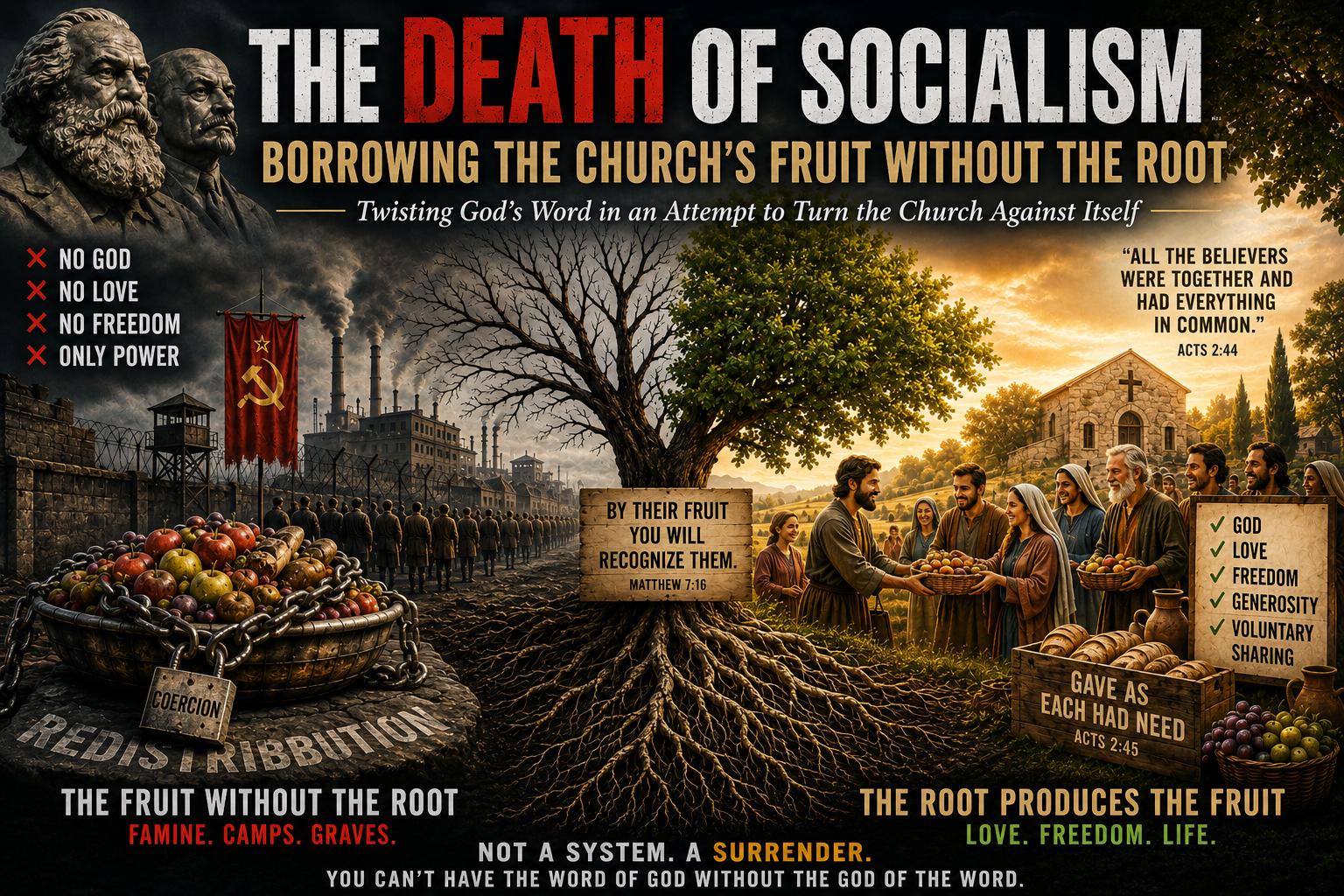
Five Things We Will Learn
- Why the generosity of the early church in Acts was fundamentally different from socialism or communism.
- Why voluntary love, not government coercion, was the driving force behind the believers sharing their possessions.
- How socialism attempts to reproduce the fruit of Christian community while rejecting the spiritual root that produces it.
- What Jamestown and Plymouth demonstrate about communal economic systems when personal responsibility and voluntary generosity are removed.
- Why Scripture calls believers to something more demanding than economic redistribution: surrendering their lives to Jesus and loving others from transformed hearts.
The Promise of Socialism and Its Terrible Record
For more than a century, socialist and communist regimes have promised equality, economic security, and a society in which everyone’s needs would be met.
The historical results have been devastating.
Across roughly twenty countries, socialist and communist regimes have been associated with famine, mass death, political repression, imprisonment, and economic collapse, with some historical tallies placing the death toll at approximately one hundred million people.
The verdict of history is difficult to ignore. Again and again, systems promising equality have concentrated enormous power in the hands of governments and ruling parties.
Yet there is an argument Christians sometimes hear in response.
Socialists point to the Bible.
More specifically, they point to the book of Acts.
They say, in effect, “See? Socialism is in the Bible.”
At first glance, Acts 2 and Acts 4 can appear to describe something remarkably similar to the socialist ideal.
Acts tells us:
“All the believers were together and had everything in common. Selling their possessions and goods, they gave to anyone as he had need.”
Acts 2:44-45
Later we read:
“All the believers were one in heart and mind. No one claimed that any of his possessions was his own, but they shared everything they had.”
Acts 4:32
There were even believers who sold property and brought the proceeds to the apostles so that the needs of others could be met.
It sounds like the socialist dream.
But it wasn’t.
There is a fundamental difference between what happened in the early church and socialism.
That difference can be summarized in one word:
Love.
The Early Church Was Not Being Forced to Share
The believers in Acts were not surrendering their possessions because a government ordered them to do so.
There was no commissar.
There was no government quota.
There was no economic police force.
There was no threat of imprisonment for refusing to participate.
There was no gun compelling them to surrender what belonged to them.
Their hearts had been changed by Jesus Christ.
The Holy Spirit was moving among them.
They loved God.
They loved one another.
And because they loved one another, they willingly responded when they saw their brothers and sisters in need.
That distinction becomes unmistakable in the account of Ananias and Sapphira in Acts 5.
After Ananias sold property and deceptively presented only part of the proceeds while pretending he had given everything, Peter confronted him.
But notice what Peter said about the property:
“Didn’t it belong to you before it was sold? And after it was sold, wasn’t the money at your disposal?”
Acts 5:4
That one statement destroys the idea that the early church abolished private property.
The land belonged to Ananias.
He could keep it.
He could sell it.
And after selling it, the money remained at his disposal.
His sin was not refusing to participate in compulsory redistribution. His sin was lying to God.
The generosity of Acts was voluntary.
The believers were not being compelled by the state.
They were being moved by the Spirit.
Hearts Changed First, Generosity Followed
This is where the comparison between socialism and the early church collapses.
The order matters.
First, hearts were transformed.
Then, generosity flowed from those transformed hearts.
Acts does not describe a government taking property from one citizen and redistributing it to another.
It describes believers looking at their brothers and sisters and refusing to allow them to suffer while they possessed the means to help.
Acts 4:34 says:
“There were no needy persons among them.”
Why?
Because believers voluntarily sold property and possessions and gave to meet the needs of others.
They gave “as he had need” (Acts 2:45).
The government did not force them.
Love moved them.
Socialism Wants the Fruit Without the Root
This exposes one of socialism’s fundamental problems.
Socialism takes the fruit and discards the root.
It sees the beauty of a community in which people care for one another.
It sees resources being shared.
It sees the hungry being fed.
It sees the poor being helped.
It sees people refusing to allow their neighbors to suffer.
Those are beautiful things.
But socialism attempts to reproduce those outcomes without the God who transformed the people producing them.
It wants the pooling of resources without the spiritual transformation that causes people willingly to share their resources.
It wants the benefits produced by God’s people without God.
It wants the fruit while cutting away the root.
But once the root is removed, something else must provide the motivation.
If love will not compel people to give voluntarily, power must compel them to give involuntarily.
And that changes everything.
What was generosity becomes redistribution.
What was voluntary becomes mandatory.
What was love becomes law.
What was surrender to God becomes submission to the state.
And when enormous economic power becomes concentrated in governments without the restraint produced by love, righteousness, accountability, and recognition of God, history shows how quickly promises of equality can descend into repression, famine, camps, and graves.
Scripture Never Commands a Socialist Economy
The Bible never commands the establishment of a socialist economic system.
Instead, Scripture commands something far more personal and far more demanding.
Jesus commands us:
“Love your neighbor as yourself.”
Matthew 22:39
Jesus told His disciples:
“As I have loved you, so you must love one another.”
John 13:34
Scripture commands us to care for the needy.
To feed the hungry.
To help the poor.
To visit prisoners.
To care for the sick.
To open our homes.
To practice hospitality.
To bear one another’s burdens.
To give generously.
To lend without expecting repayment.
And Jesus made our treatment of those in need intensely personal:
“I tell you the truth, whatever you did for one of the least of these brothers of mine, you did for me.”
Matthew 25:40
That is not merely an economic system.
That is surrender.
Christianity Begins With Surrender, Not Redistribution
The Gospel does not begin by demanding your neighbor’s possessions.
It begins by demanding you.
Jesus calls us to surrender our lives to Him.
We give ourselves to the Lord.
We follow Him.
We obey His commands.
We allow His Word to expose what is happening inside our hearts.
Hebrews says:
“For the word of God is living and active. Sharper than any double-edged sword, it penetrates even to dividing soul and spirit, joints and marrow; it judges the thoughts and attitudes of the heart.”
Hebrews 4:12
God deals with greed.
God deals with selfishness.
God deals with envy.
God deals with materialism.
God deals with our unwillingness to share.
God deals with our indifference toward suffering.
Then, from a transformed heart, we begin loving others differently.
We give because we love.
We serve because we love.
We sacrifice because we love.
We help because we love.
We do not need a government official standing over us demanding generosity because the Holy Spirit is working within us producing generosity.
That is what happened in Acts.
Jamestown and Plymouth: When the Common Store Had No Moral Engine
The early American settlements of Jamestown and Plymouth provide another historical warning about attempting communal economic arrangements without the internal motivation necessary to sustain them.
Early settlers experimented with systems in which production went into a common store and provisions were distributed from it.
The results included severe shortages and starvation.
Plymouth Governor William Bradford eventually moved away from the common system and assigned individual families their own plots of land.
Production increased.
The lesson is not that private property itself is holy.
The deeper issue is human nature.
A system that assumes people will continually labor sacrificially for others requires a powerful moral engine.
The early church had one.
Love.
More specifically, it had Spirit-produced love flowing from people whose lives had been surrendered to Jesus Christ.
Remove that transformation and the external appearance of Acts can remain while its internal power disappears.
The structure can be copied.
The heart cannot.
You Cannot Legislate the Fruit of the Spirit
This is ultimately why government cannot reproduce the church.
Paul describes the fruit produced by the Holy Spirit:
“But the fruit of the Spirit is love, joy, peace, patience, kindness, goodness, faithfulness, gentleness and self-control.”
Galatians 5:22-23
Notice where it comes from.
It is the fruit of the Spirit.
Government cannot manufacture that fruit.
Government cannot pass a law producing love.
Government cannot create generosity by taxation.
Government cannot produce compassion through regulation.
Government cannot create selflessness through bureaucracy.
Government can compel behavior.
It cannot transform the human heart.
Only God can do that.
Love Is More Demanding Than Socialism
This does not excuse Christians from caring for the poor.
It does exactly the opposite.
The failure of socialism is not permission for Christians to become selfish.
We cannot condemn forced redistribution while ignoring Jesus’ commands concerning generosity.
We cannot defend private property while closing our hearts to people in need.
The question is not merely:
“What belongs to me?”
The greater question is:
“Lord, what do You want me to do with what You have entrusted to me?”
That is stewardship.
The Christian recognizes that everything ultimately belongs to God.
Our possessions.
Our homes.
Our money.
Our abilities.
Our time.
Our lives.
We are stewards of what God has placed into our hands.
And when the Holy Spirit says, “Give,” we give.
When Jesus says, “Serve,” we serve.
When our brother is hungry, we feed him.
When our sister is suffering, we help her.
When someone is sick, we visit.
When someone is imprisoned, we remember them.
When someone is without clothing, we provide it.
Not because Caesar demanded it.
Because Jesus commanded us to love.
The Church Has Something Socialism Can Never Produce
This is what makes the church fundamentally different.
The church is not simply a collection of people sharing resources.
It is a family created by God.
These believers have one Father.
They have been redeemed by one Savior.
They are inhabited by one Spirit.
They are brothers and sisters.
That is why Acts says:
“All the believers were one in heart and mind.”
Acts 4:32
Their economic behavior flowed from their spiritual relationship.
They did not become family because they shared their possessions.
They shared their possessions because they had become family.
That order cannot be reversed.
Government cannot decree brotherhood.
Government cannot legislate family.
Government cannot manufacture love.
Government cannot reproduce Pentecost.
The Root Determines the Fruit
Jesus taught us that fruit reveals the nature of the tree.
The same principle applies here.
Socialism can attempt to imitate the outward appearance of Christian generosity.
It can use words such as equality, community, sharing, compassion, justice, and care for the poor.
But those words alone cannot produce what happened in Acts.
The early church had a root.
Jesus Christ.
The believers had received the Holy Spirit.
Their hearts had been transformed.
Their possessions no longer possessed them.
Their brothers and sisters were no longer strangers.
And generosity became the natural fruit of lives surrendered to God.
Remove the root and eventually the fruit dies.
You Cannot Have the Word of God Without the God of the Word
This brings us to the central problem.
You cannot have the Word of God without the God of the Word.
You cannot take the Christian vision of generosity while rejecting Christ.
You cannot reproduce the fellowship of Acts while removing the Holy Spirit.
You cannot demand the fruit while destroying the root.
Socialism borrows the church’s vocabulary while burying the church’s God.
It attempts to reproduce through governmental power what God produces through transformed hearts.
But coercion can never become love.
Redistribution can never become generosity simply because the outcomes appear similar.
One takes because authority demands it.
The other gives because love compels it.
The difference is not small.
It is the difference between law and love, coercion and surrender, the power of the state and the transforming power of God.
The early church did not prove socialism works.
The early church proved what happens when people truly surrender their lives, possessions, relationships, and resources to Jesus Christ and then begin loving one another as He commanded.
That is something no government can manufacture.
And it is something the church should never surrender.
The fruit only lives because of the Root.
Look at what love does when we follow Jesus! See all the missions we get to help support because of our love for God and others.

Begin Your Journey Today
Jesus didn’t just call us to believe in Him—He called us to follow Him.
Step into the life He designed for you through Emmaus Road’s The Commands of Jesus . This is more than learning—it’s an invitation to walk with Him, obey Him, and experience Him in a real and powerful way.
You don’t want to miss this exciting adventure Jesus has called you into.
Start now:
https://GregLancaster.org/StartHere