



Five Things We Will Learn
- Why Samaria is conspicuously absent from the regions Luke names in Luke 6:17, and how that absence reflects centuries of spiritual and relational division.
- How the northern kingdom drifted from covenant faithfulness, beginning with Jeroboam’s decision to replace obedience with a more convenient form of worship.
- Why the existence of a faithful remnant did not prevent Israel’s national collapse when its kings, priests, and institutions continued in generations of rebellion.
- How the pattern of convenience, compromise, and institutional drift offers a sobering warning for America, even though America is not Israel.
- Why America’s deepest need cannot be solved by an election, president, court, or government program, but requires repentance, revival, and another Great Awakening.
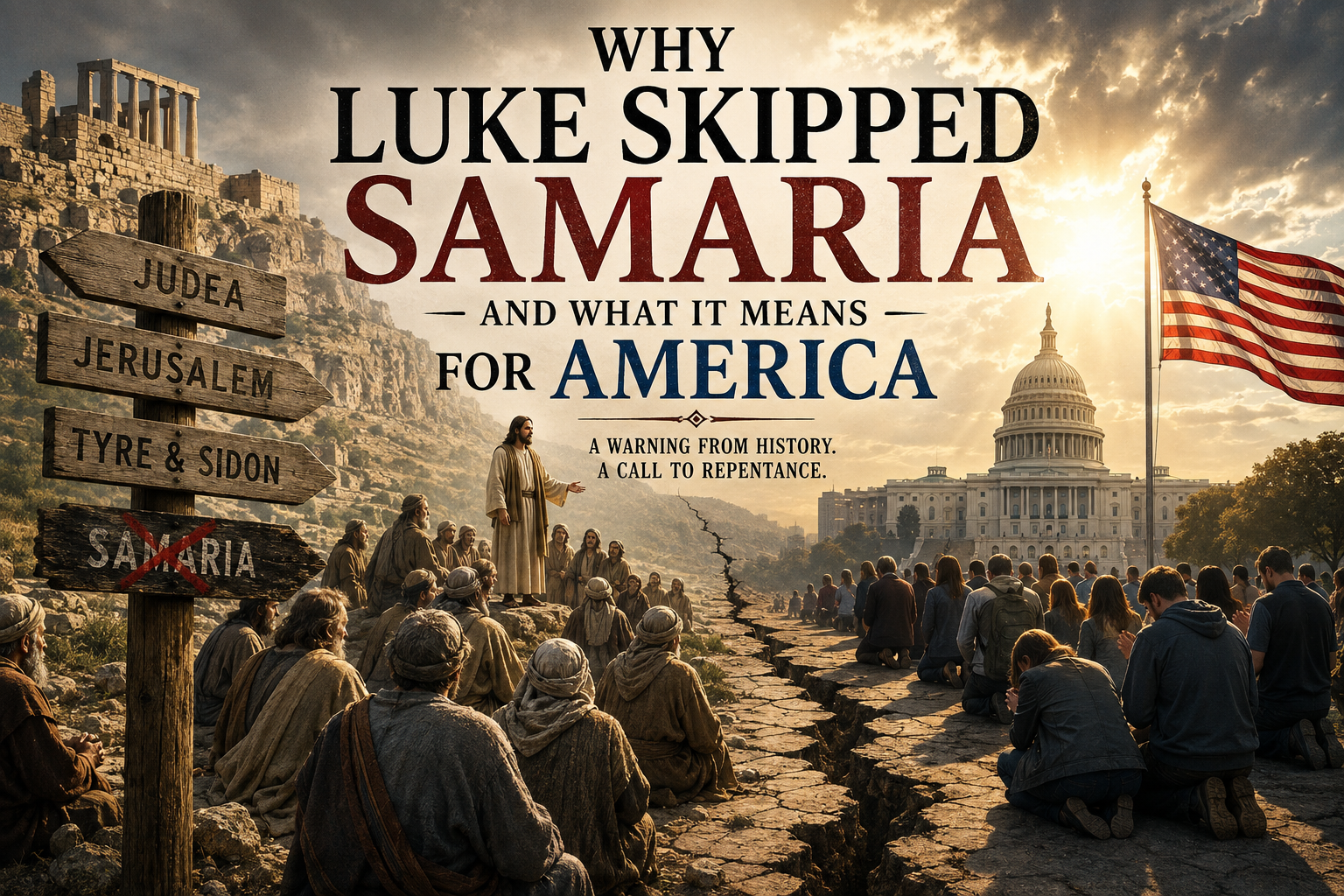
In Luke 6:17, Jesus comes down from the mountain and stands on a level place. A great crowd gathers around Him:
“A large crowd of his disciples was there and a great number of people from all over Judea, from Jerusalem, and from the coast of Tyre and Sidon.”
Luke 6:17
Luke gives us geography.
Judea.
Jerusalem.
Even the distant Gentile coastal regions of Tyre and Sidon.
But one region is conspicuously absent: Samaria.
The territory sitting directly between Galilee and Judea, associated with the former northern kingdom and its long history of separation from Judah, is simply not named among those who came.
That omission paints a picture of a broken relationship whose roots stretched back for centuries.
The Northern Kingdom’s Long Drift
The story begins after the death of Solomon.
The kingdom divided. Ten tribes formed the northern kingdom under Jeroboam, while Judah and Benjamin remained associated with the southern kingdom under Rehoboam.
Jeroboam immediately faced what he considered a political problem.
Related:
If his people continued traveling to Jerusalem to worship the Lord, he feared their hearts might eventually return to the house of David.
So he changed worship.
He established golden calves at Bethel and Dan. He appointed priests who were not Levites. He created his own religious festival.
Then he told the people:
“It is too much for you to go up to Jerusalem.”
1 Kings 12:28
Those words reveal something profound.
Jeroboam did not initially tell Israel to abandon religion altogether.
He made obedience more convenient.
What God had commanded was presented as “too much.”
Jeroboam essentially reframed disobedience as common sense.
That decision became a pattern that haunted the northern kingdom for generations.
Again and again, Scripture describes later kings as walking in “the sins of Jeroboam.”
Then came Ahab and Jezebel.
Under their leadership, Baal worship became deeply established in the kingdom. Ahab erected an altar to Baal and made an Asherah pole, provoking the Lord to anger (1 Kings 16:30-33).
Yet God did not leave Israel without warning.
He sent prophets.
Elijah confronted Ahab and the prophets of Baal.
Elisha ministered throughout the northern kingdom.
Amos warned of coming judgment.
Hosea pleaded with a spiritually adulterous nation to return to God.
Again and again, God called His people back.
Second Kings summarizes the tragedy:
“The LORD warned Israel and Judah through all his prophets and seers: ‘Turn from your evil ways. Observe my commands and decrees.’”
2 Kings 17:13
But they would not listen.
“They rejected his decrees and the covenant he had made with their fathers and the warnings he had given them.”
2 Kings 17:15
This was not one bad king, one bad election, one bad generation, or one moment of national confusion.
It became generations of institutionalized rebellion without national repentance.
When Assyria Finally Came
Eventually, the warnings became consequences.
In the eighth century BC, Assyria invaded the northern kingdom. Samaria endured a prolonged siege, and in 722 BC the northern kingdom fell.
Second Kings records:
“The king of Assyria captured Samaria and deported the Israelites to Assyria.”
2 Kings 17:6
The Assyrians subsequently brought other peoples into the region:
“The king of Assyria brought people from Babylon, Cuthah, Avva, Hamath and Sepharvaim and settled them in the towns of Samaria to replace the Israelites.”
2 Kings 17:24
The northern kingdom ceased to exist as the kingdom it had been.
The ten tribes were scattered, and unlike Judah’s later return from Babylonian exile, the northern kingdom never returned and reconstituted itself as an independent kingdom.
What had begun with a seemingly practical religious compromise under Jeroboam ended generations later in national destruction.
The Remnant That Couldn’t Save the Kingdom
Yet not everyone in Israel had abandoned God.
This matters.
During Elijah’s ministry, Elijah became convinced that he was essentially alone.
God corrected him:
“Yet I reserve seven thousand in Israel, all whose knees have not bowed down to Baal and all whose mouths have not kissed him.”
1 Kings 19:18
There was a remnant.
There were faithful people living inside an unfaithful nation.
There were people who had not bowed.
There were prophets speaking truth.
There were households that still feared God.
But the remnant did not control the institutions.
The kings continued in rebellion.
The religious establishment continued its compromise.
The culture continued drifting.
The prophets preached from the margins while the machinery of the kingdom continued moving in the opposite direction.
And eventually Assyria came.
That is one of the most sobering lessons in Israel’s history:
The existence of faithful people within a nation does not guarantee that the nation itself will escape the consequences of generations of rebellion.
Why Luke Leaves Samaria Off the Map
By the time of Jesus, Samaria carried the scar tissue of this long history.
Samaritans had developed their own religious identity. Mount Gerizim stood at the center of their worship rather than Jerusalem.
The Samaritan woman said to Jesus:
“Our fathers worshiped on this mountain, but you Jews claim that the place where we must worship is in Jerusalem.”
John 4:20
The division was so deep that John simply states:
“Jews do not associate with Samaritans.”
John 4:9
That background helps us understand just how radical Jesus’ ministry was.
When Jesus told the story we now call the Good Samaritan in Luke 10:25-37, He deliberately made a Samaritan the compassionate neighbor.
The hated outsider became the example of mercy.
Jesus was confronting centuries of hostility.
Against that background, Luke 6:17 becomes striking.
People came from Judea.
They came from Jerusalem.
They came from the distant coastal territory of Tyre and Sidon.
Samaria is not named.
The geography itself reflects the brokenness of the world into which Jesus came.
The American Parallel
America is not Israel.
The United States is not the northern kingdom, and biblical promises or judgments specifically given to covenant Israel should not simply be transferred wholesale to America.
But biblical history still gives us patterns from which we are supposed to learn.
Paul wrote:
“These things happened to them as examples and were written down as warnings for us.”
1 Corinthians 10:11
And the pattern surrounding Jeroboam deserves our attention.
Jeroboam restructured worship so the people would not have to go to Jerusalem.
He did not begin by telling Israel that God did not exist.
He gave them a more convenient version.
The true thing was declared “too much.”
That sounds remarkably familiar.
Biblical truth is increasingly described as too exclusive.
Biblical morality is considered too demanding.
Biblical marriage is considered too restrictive.
Biblical authority is considered too old-fashioned.
Repentance is considered too negative.
Holiness is considered too extreme.
So instead of openly announcing, “We are abandoning God,” a culture can gradually construct a more convenient version of faith.
God remains in the vocabulary while His authority disappears from everyday life.
That is how drift works.
It is often gradual enough that the people drifting do not realize how far they have traveled.
When Institutions Begin to Drift
The northern kingdom’s problem eventually became larger than individual sin.
Its rebellion became institutional.
Kings supported it.
Priests administered it.
Places of worship normalized it.
Generations inherited it.
Eventually, children were born into a system their grandparents had created, and what once represented rebellion simply became normal life.
That is where the comparison with America becomes especially sobering.
Institutions that once broadly operated within a Christian moral framework increasingly reject that framework.
Marriage and family have been redefined.
God and Scripture have been progressively pushed from much of public education.
Churches and denominations that once affirmed the authority of Scripture now openly dispute teachings previous generations considered foundational.
The shift did not happen overnight.
It has been generational.
And generational problems require more than temporary solutions.
Related:
Government Cannot Produce a Great Awakening
America possesses mechanisms the northern kingdom did not have.
We have free speech.
We have elections.
We have representative government.
We have civil society.
We have a free press.
Citizens can organize, speak, vote, teach, build institutions, establish ministries, educate their children, plant churches, and call their communities back toward truth.
Those things matter.
But they cannot substitute for repentance.
A president can change government policy.
A legislature can pass a law.
A court can issue a ruling.
An administration can change enforcement priorities.
But no president can issue an executive order restoring a biblical worldview to a people who have spent generations unlearning it.
Government can restrain certain forms of evil.
It cannot regenerate the human heart.
That takes something government cannot manufacture.
Revival.
The Methodist Split Was a Warning
The recent Methodist division provides a striking example of what happens when Christians eventually conclude that institutional drift has crossed a line they can no longer follow.
For years, faithful Methodists wrestled with theological and moral disagreements inside their denomination.
Eventually many said, in effect:
We will not continue going in this direction.
Whatever one thinks about every detail surrounding denominational separation, the larger lesson remains important.
Institutions can drift so far that remaining faithful eventually requires people to stop pretending nothing has changed.
The same question confronts Christians throughout American culture:
At what point does faithfulness require us to say, “We will not go along with this anymore”?
The Remnant Cannot Be Content With Remaining a Remnant
The northern kingdom had faithful people.
But the faithful remained a remnant while the nation continued moving away from God.
America has a remnant too.
There are faithful pastors.
Faithful churches.
Faithful parents.
Faithful teachers.
Faithful young people.
Faithful business leaders.
Faithful citizens.
People who have not bowed.
But biblical history forces us to confront an uncomfortable reality:
Having a remnant is not the same thing as having a revived nation.
The seven thousand who had not bowed to Baal did not prevent Assyria from eventually coming.
Faithfulness matters eternally and personally, but if we care about our children, our communities, and the generations that follow us, we cannot be satisfied merely knowing that we personally have not bowed.
The nation needs to hear the call to return.
What Turning Back Requires
The northern kingdom did not collapse simply because sin existed.
Sin exists in every generation.
Its destruction came after generations of rebellion, warning, refusal, and hardened institutional idolatry.
God repeatedly called the people to repentance.
They repeatedly refused.
America still has an opportunity to turn.
But turning requires more than winning arguments.
More than changing laws.
More than electing leaders.
More than changing school boards.
More than creating alternative media.
More than winning court cases.
Those things may matter tremendously within their proper spheres, but none of them can replace the transformation of the human heart.
America needs another Great Awakening.
What a Great Awakening Actually Looks Like
A Great Awakening does not begin as a partisan campaign.
It begins with conviction.
Ordinary people suddenly recognize their own spiritual condition.
Church members who assumed they were fine realize they have drifted.
Pastors begin preaching repentance again.
Families begin ordering their homes around Scripture.
People stop asking how closely they can resemble the culture while still calling themselves Christian.
They begin asking how completely they can belong to Jesus.
God said through Ezekiel:
“As surely as I live, declares the Sovereign LORD, I take no pleasure in the death of the wicked, but rather that they turn from their ways and live.”
Ezekiel 33:11
That is the heart of awakening.
Turn and live.
America Needs Pulpits That Speak Clearly Again
A modern awakening would require pulpits willing to recover the courage to say what Scripture says about sin, repentance, righteousness, holiness, judgment, mercy, forgiveness, salvation, and obedience.
Not cruelty.
Not condemnation for condemnation’s sake.
Truth spoken in love.
But truth nonetheless.
Scripture cannot be softened into therapy until repentance disappears.
Churches cannot simply compete with the culture for attention.
They must proclaim another Kingdom.
They must make disciples.
They must teach believers to obey Jesus.
They must again believe that the Word of God is actually alive and capable of transforming people.
“For the word of God is living and active. Sharper than any double-edged sword.”
Hebrews 4:12
America does not merely need people who possess Bibles.
America needs people whose lives are being reordered by them.
Families Must Rebuild Around Scripture
Awakening must also enter the home.
Families cannot be built primarily around convenience, entertainment, activities, careers, technology, and cultural expectations, with Jesus added somewhere around the edges.
Parents must disciple their children.
Husbands and wives must recover covenant faithfulness.
Children must see parents who actually believe what they profess.
Homes must again become places of prayer, Scripture, worship, hospitality, repentance, forgiveness, and discipleship.
If cultural drift is generational, restoration must become generational too.
The Remnant Must Find Each Other
Many faithful believers today feel scattered.
Some feel isolated.
Some know something is wrong but cannot put words to it.
Others recognize the drift but remain silent because they believe they are alone.
Elijah thought he was alone too.
He was not.
There were seven thousand.
Imagine what happens when the seven thousand discover one another.
Imagine when faithful believers stop assuming they are isolated exceptions and begin strengthening one another.
Imagine pastors encouraging pastors.
Families strengthening families.
Believers gathering around Scripture.
Christians speaking plainly again.
Disciples making disciples.
Churches choosing obedience over cultural acceptance.
The remnant does not have to remain isolated.
Awakening Eventually Changes a Culture
Historically, major spiritual awakenings have produced consequences far beyond Sunday worship.
The First Great Awakening helped reshape the spiritual and moral imagination of colonial America.
The Second Great Awakening fueled missionary activity, reform movements, educational institutions, and powerful opposition to slavery.
Those movements did not begin primarily as government programs.
They began with people encountering God, confronting sin, repenting, believing the Gospel, and living differently.
When enough people change, communities change.
When communities change, institutions eventually change.
When institutions change, nations can change.
The order matters.
Repentance first.
Then transformation.
Then cultural fruit.
That is why Scripture says:
“If my people, who are called by my name, will humble themselves and pray and seek my face and turn from their wicked ways, then will I hear from heaven and will forgive their sin and will heal their land.”
2 Chronicles 7:14
This promise was spoken specifically to Israel in its covenant setting, but the spiritual pattern of humility, prayer, seeking God, and turning from wickedness remains unmistakable throughout Scripture.
Revival begins when God’s people turn.
America Still Has a Chance
The northern kingdom eventually reached the end of centuries of warnings.
Its prophets preached.
Its remnant remained.
Its kings continued rebelling.
Its institutions continued drifting.
And eventually Assyria came.
America is not ancient Israel, and we should not pretend that our national story is identical to theirs.
But we would be foolish not to learn from what happened.
America still has churches.
We still have Bibles.
We still have pulpits.
We still have parents.
We still have pastors.
We still have freedom to speak.
We still have freedom to gather.
We still have freedom to proclaim Jesus.
We still have the opportunity to repent.
We still have the opportunity to awaken.
And we still have the opportunity to call another generation back to God.
The question is whether the remnant will be satisfied merely to survive the drift, or whether it will call a nation to turn before consequences arrive.
Luke names Judea.
He names Jerusalem.
He names Tyre and Sidon.
But in Luke 6:17, Samaria is absent from the list.
A land sitting between Galilee and Judea had become separated by centuries of broken worship, broken relationships, and competing claims about where and how God should be worshiped.
And that leaves America with a sobering question.
Will we continue choosing convenience over covenant, cultural acceptance over Scripture, and institutional drift over repentance?
Or will another generation hear the ancient call:
Turn and live.
Luke skipped Samaria.
He didn’t have to.
The question is whether America will give him a reason to write us back in.
Begin Your Journey Today
Jesus didn’t just call us to believe in Him—He called us to follow Him.
Step into the life He designed for you through Emmaus Road’s The Commands of Jesus . This is more than learning—it’s an invitation to walk with Him, obey Him, and experience Him in a real and powerful way.
You don’t want to miss this exciting adventure Jesus has called you into.
Start now:
https://GregLancaster.org/StartHere